🌿 Common sow thistle (smooth sow thistle)
Sonchus oleraceus · Asteraceae
🔍 Identify it without mistakes
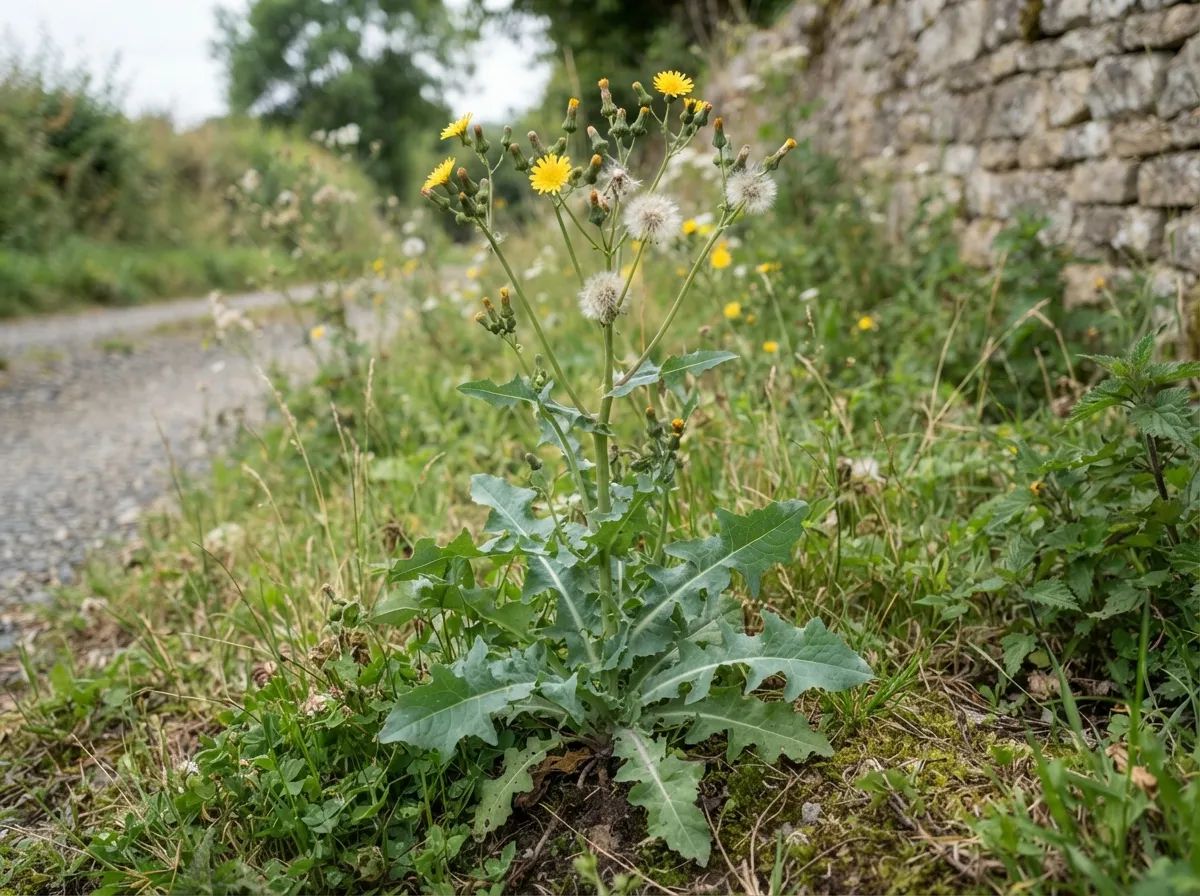
Large annual member of the Asteraceae family found in gardens and wasteland, recognizable by the white latex that beads as soon as you break a leaf or stem — hence its name, shared with lettuce to which it is related. Leaves are lobed, clasping the stem with two pointed auricles; yellow flower heads resemble small dandelions grouped in clusters at the top of hollow stems.
- abundant milky white latex when broken (stem and leaves)
- leaves with slightly spiky but soft edges, clasping the stem with arrowhead-shaped auricles
- hollow stem, glaucous (bluish), grooved
- yellow flower heads 2 cm wide grouped in a loose corymb at the top
- achenes topped with a silky white pappus, like a dandelion
⚠️ Not to be confused with
To tell them apart: prickly sow thistle has glossier, more spiny leaves and rounded (not pointed) auricles at the base; in practice no need to tell them apart, harvest them the same way
To tell them apart: great lettuce often has a purple-spotted stem and a stronger, unpleasant smell when bruised; if in doubt about a young rosette, do not eat it
🍽️ Eating it
Preparation : young leaves raw in salads (taste close to lettuce), older leaves cooked 5-10 min to reduce bitterness; peeled stems can also be eaten raw
🪓 Other bushcraft uses
- latex traditionally applied to warts in several European folk pharmacopeias (anecdotal use, not clinically validated)
No entry replaces a certain identification in the field, or medical advice. When in doubt: don't eat it. If ingestion is suspected: poison control or 112/911.