🌿 White and Purple Dead-Nettle
Lamium album / Lamium purpureum · Lamiaceae
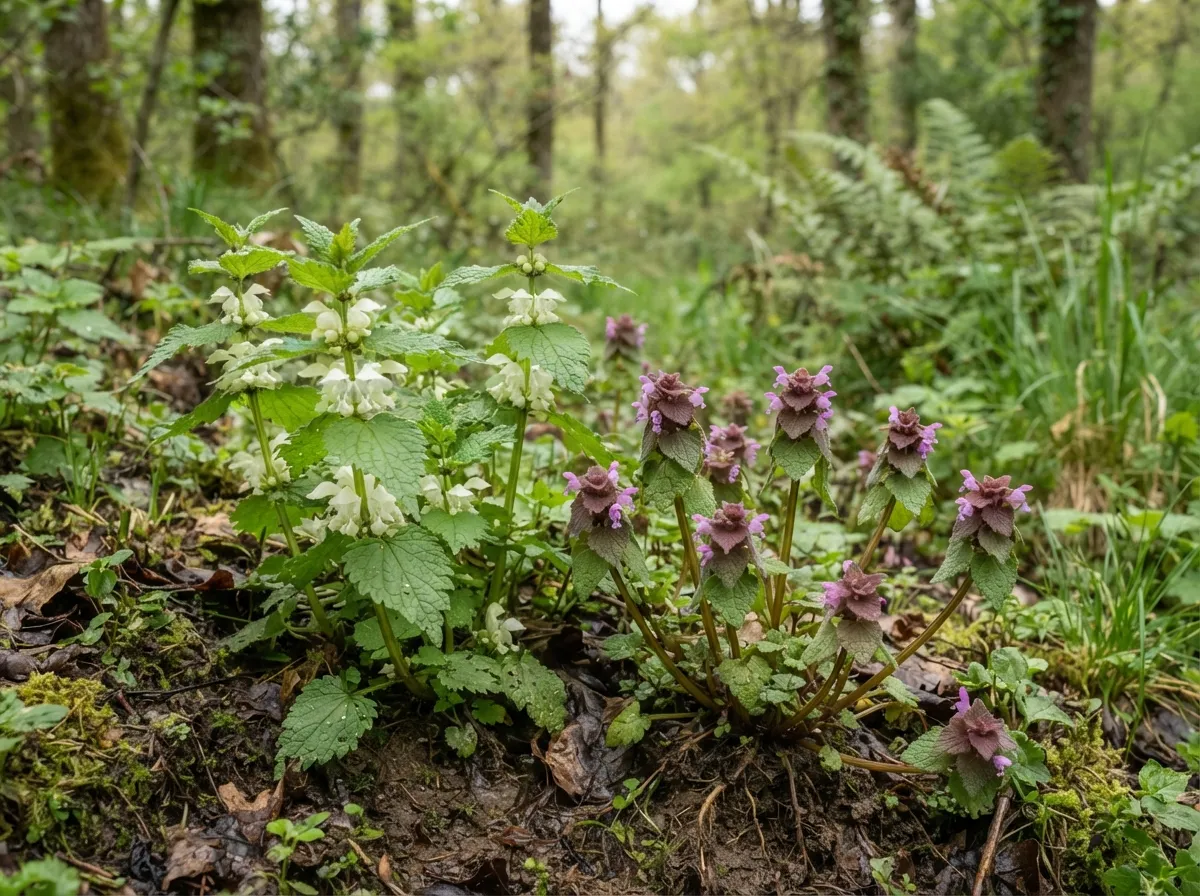
🔍 Identify it without mistakes
Two small plants with square stems typical of Lamiaceae, often called "dead-nettles" because their leaves mimic the stinging nettle's toothed shape, but WITHOUT any stinging hairs. White dead-nettle has large, opposite, toothed leaves and prominent white flowers in whorls at the upper leaf axils. Red dead-nettle is smaller, with reddish-purple tinged upper leaves and more subtle pink-purple flowers.
- square stem, soft to the touch, NEVER with stinging hairs (unlike stinging nettle)
- opposite toothed leaves mimicking the shape of stinging nettle
- white (white dead-nettle) or pink-purple (red dead-nettle) flowers in whorls at the leaf axils
- red dead-nettle: upper leaves often tinged with red-purple
- subtle, pleasant smell when crushed
⚠️ Not to be confused with
To tell them apart: gently touch a leaf: dead-nettle is completely soft, without a single stinging hair, unlike stinging nettle which stings immediately on contact
🍽️ Eating it
Preparation : raw leaves in salads (mild, without the cooking required for nettles) or cooked like mild spinach; raw flowers as garnish, slightly sweet from nectar
💊 Healing with it
white dead-nettle is traditionally used for mild gynecological issues (leukorrhea) and as a mild astringent; properties are less documented than those of stinging nettle
Level of evidence : traditional use — ethnobotanical compilations (Fournier, PFAF)
⚠️ no major known contraindications at food-level doses
🪓 Other bushcraft uses
- dead-nettle flowers are rich in nectar, loved by short-tongued bumblebees that pierce the base of the corolla to reach it without going through the main opening
No entry replaces a certain identification in the field, or medical advice. When in doubt: don't eat it. If ingestion is suspected: poison control or 112/911.