🌼 Common Nipplewort
Lapsana communis · Asteraceae
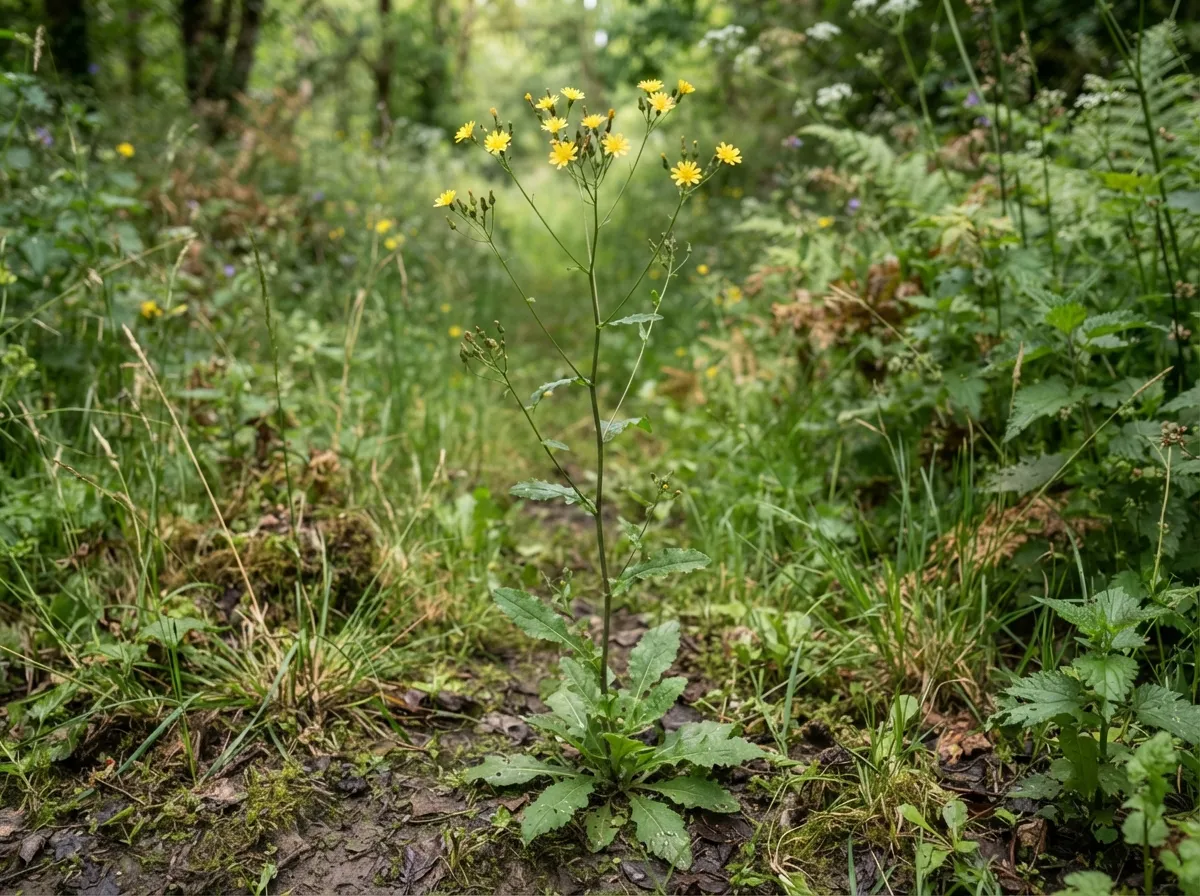
🔍 Identify it without mistakes
A small, unassuming composite plant found in undergrowth and wasteland, often overlooked because it looks quite ordinary: a thin branched stem, soft leaves that are barely divided, and tiny pale yellow flower heads barely wider than a pea, open only in the morning. The entire plant is tender and free of sticky latex, unlike many of its Asteraceae cousins.
- small pale yellow flower heads of 1-2 cm, few ray florets (often 8-15)
- flower heads close in the afternoon and during overcast weather
- soft leaves, the basal leaf often lyrate (one large terminal lobe, a few small lateral ones)
- thin stem, hairy at the base, branched, without spines
- scarce milky sap unlike dandelion or sow thistle
⚠️ Not to be confused with
To tell them apart: nipplewort lacks the clasping, spiny leaves of sow thistle and the small tubular yellow heads without visible petals of groundsel; its flower heads have clearly visible, pale yellow ray florets
🍽️ Eating it
Preparation : raw leaves in salads when young (slightly milder than lamb's lettuce), or cooked for 5-10 min like spinach; softens quickly when cooked
🪓 Other bushcraft uses
- traditional French countryside "famine plant", referred to as "salade de curé" (priest's salad) or "herbe aux mamelles" in several 19th-century popular flora records
No entry replaces a certain identification in the field, or medical advice. When in doubt: don't eat it. If ingestion is suspected: poison control or 112/911.