🌺 Oleander
Nerium oleander · Apocynaceae
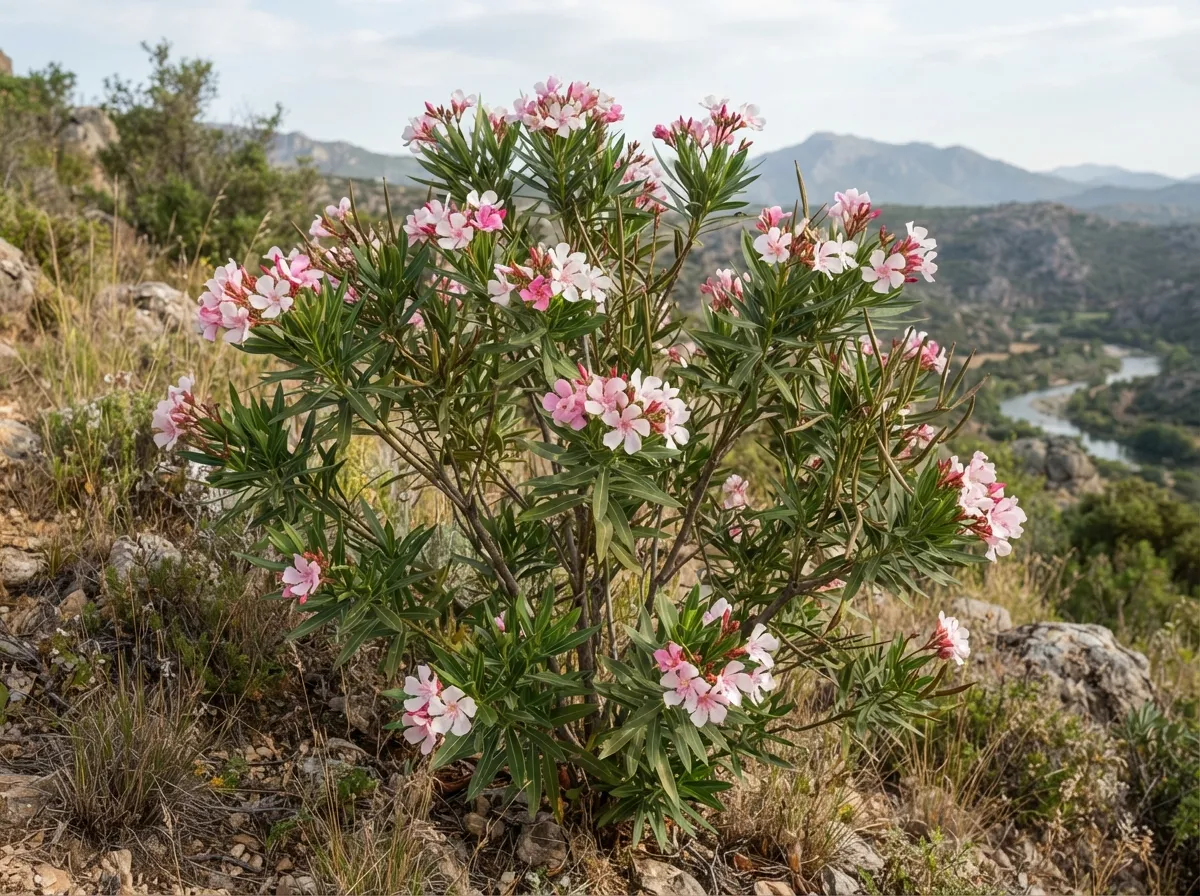
🔍 Identify it without mistakes
A Mediterranean shrub very widely planted in hedges and ornamental containers, featuring narrow, leathery evergreen leaves and large, fragrant pink, white, or red flowers. The entire plant is cardiotoxic, including its wood and the smoke from its burning—a known hazard during barbecues where an oleander branch was used as a skewer.
- lanceolate, leathery leaves, arranged in whorls of 3, shiny dark green above
- large flowers with 5 petals, pink, white, or red, clustered in terminal cymes
- slightly sticky milky sap appearing at stem wounds
- fruit in a long, tapered pod containing tufted seeds
⚠️ Not to be confused with
To tell them apart: bay laurel has alternate leaves (not in whorls of 3) that smell strongly aromatic when crushed; oleander has no culinary scent and its leaves are grouped in 3s
☠️ What kills
First steps : Call poison control immediately, even if a child has simply chewed on a leaf. Do not induce vomiting. Never use oleander wood for a campfire or skewers; keep a fragment of the plant involved.
Sources (3)
No entry replaces a certain identification in the field, or medical advice. When in doubt: don't eat it. If ingestion is suspected: poison control or 112/911.