🌱 Alfalfa
Medicago sativa · Fabaceae
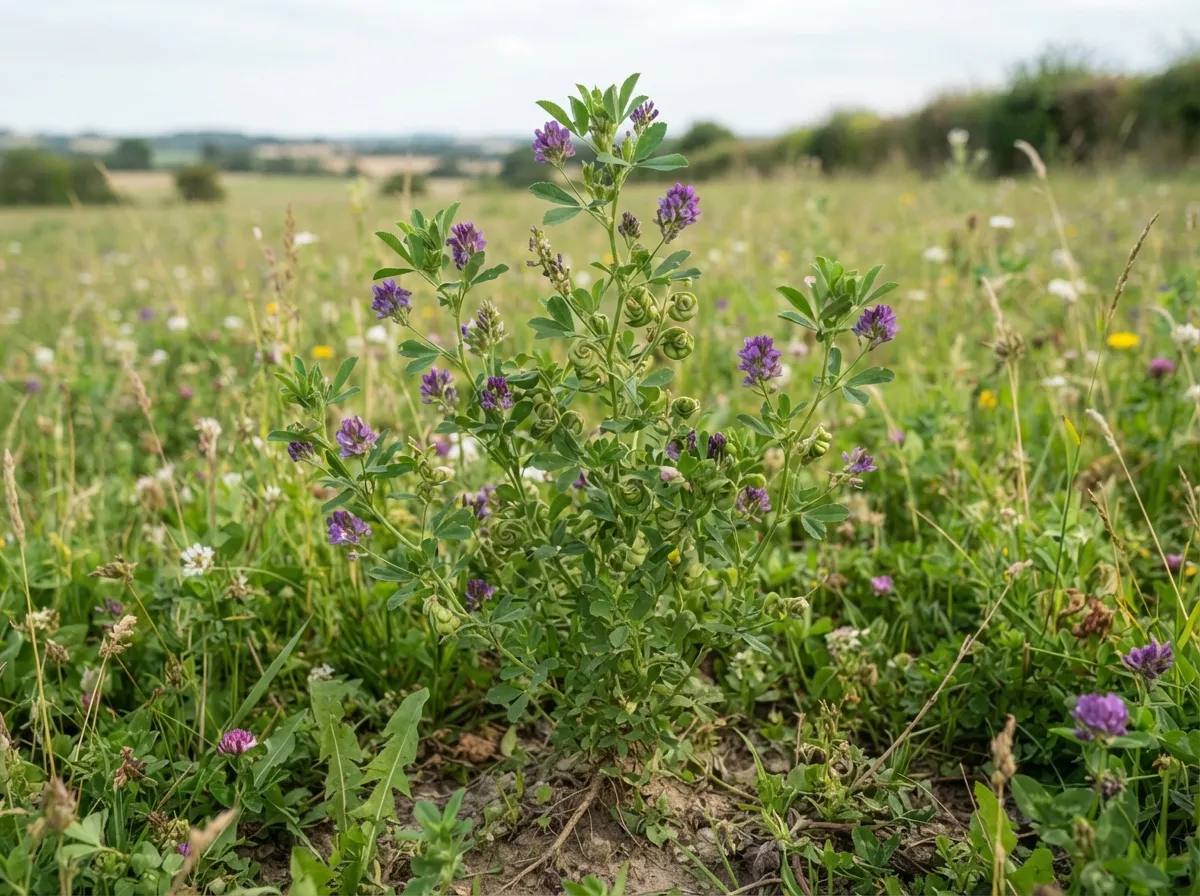
🔍 Identify it without mistakes
A forage legume escaped from cultivation and naturalized along field margins, recognizable by its purple flowers in small erect clusters (unlike clover which has flowers grouped in a ball) and its seed pods coiled in a characteristic spiral when dry.
- purple to blue-mauve flowers in elongated erect clusters (not in a ball like clover)
- trifoliate leaves, leaflets toothed only on the upper third
- seed pods coiled in a 2-3 turn spiral when mature (a very distinct feature of the genus Medicago)
- erect, branched stem, often woody at the base in older plants
- deep taproot that can reach several meters down
⚠️ Not to be confused with
To tell them apart: clover has its flowers grouped in a dense ball (head), while alfalfa bears them in an elongated erect cluster; alfalfa pods coil into a spiral, while clover pods remain straight
🍽️ Eating it
Preparation : young shoots and leaves in salads or cooked like a green vegetable; sprouted seeds ("alfalfa sprouts") are eaten raw
USDA FoodData Central, raw alfalfa sprouts, per 100 g
💊 Healing with it
traditionally used as a remineralizer (rich in calcium, magnesium, vitamin K) and to stimulate appetite
Level of evidence : traditional use — ethnobotanical compilations (PFAF)
⚠️ consume raw sprouted seeds with caution if pregnant or immunocompromised (bacterial risk, as with any raw sprout); high vitamin K content, monitor if taking blood thinners
🪓 Other bushcraft uses
- cultivated since antiquity (introduced to Greece by the Persians around the 5th century BC) as one of the oldest domesticated forage plants in the world, known as the "queen of forages" for its high protein content
Sources (3)
No entry replaces a certain identification in the field, or medical advice. When in doubt: don't eat it. If ingestion is suspected: poison control or 112/911.