🌰 Macadamia Nut
Macadamia integrifolia · Proteaceae
🔍 Identify it without mistakes
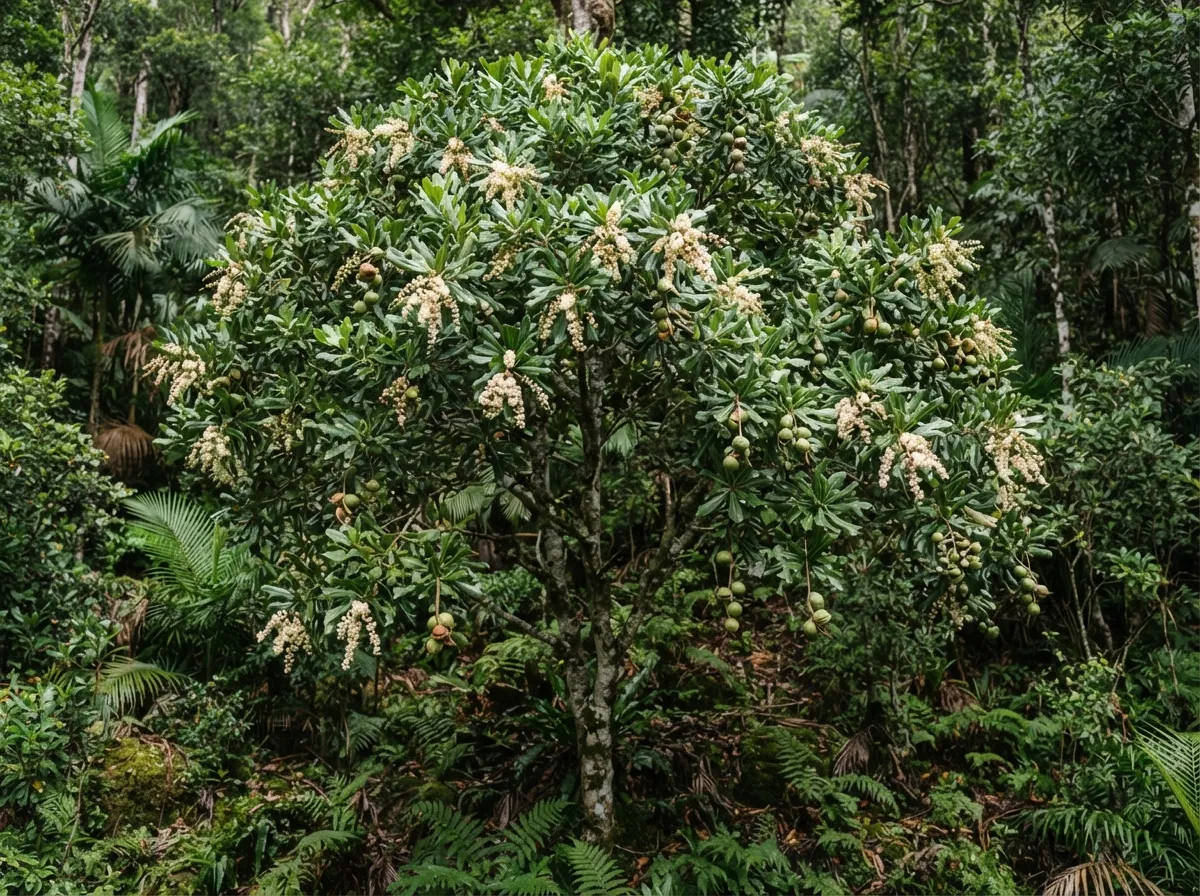
Tree with dense, evergreen foliage, leathery leaves arranged in whorls, often finely serrated, bearing long hanging racemes of small cream-white flowers followed by round fruits with a very hard shell enclosing a single round, smooth seed (nut).
- leathery leaves in whorls of 3-4, margins sometimes spiny on young plants
- hanging racemes of small fragrant white flowers
- fruit with an extremely hard, almost spherical woody shell
⚠️ Not to be confused with
To tell them apart: only cultivated M. integrifolia and M. tetraphylla are commonly consumed without special processing; if in doubt about a bitter wild nut, do not eat it
🍽️ Eating it
Preparation : crack the very hard shell (requires a solid tool, a simple pebble usually won't cut it) then eat raw, roasted, or salted
USDA FoodData Central, raw macadamia nuts, per 100 g
💊 Healing with it
no major traditional medicinal uses documented; valued nutritionally for its extremely high energy density and monounsaturated fatty acids
Level of evidence : traditional use — USDA FoodData Central
⚠️ toxic to dogs (not to humans) - worth keeping in mind if a pet comes along on your expedition
🪓 Other bushcraft uses
- very hard shell is sometimes used as slow-burning fuel
- wood used locally in woodworking
No entry replaces a certain identification in the field, or medical advice. When in doubt: don't eat it. If ingestion is suspected: poison control or 112/911.