🍂 Manzanita
Arctostaphylos manzanita · Éricacées
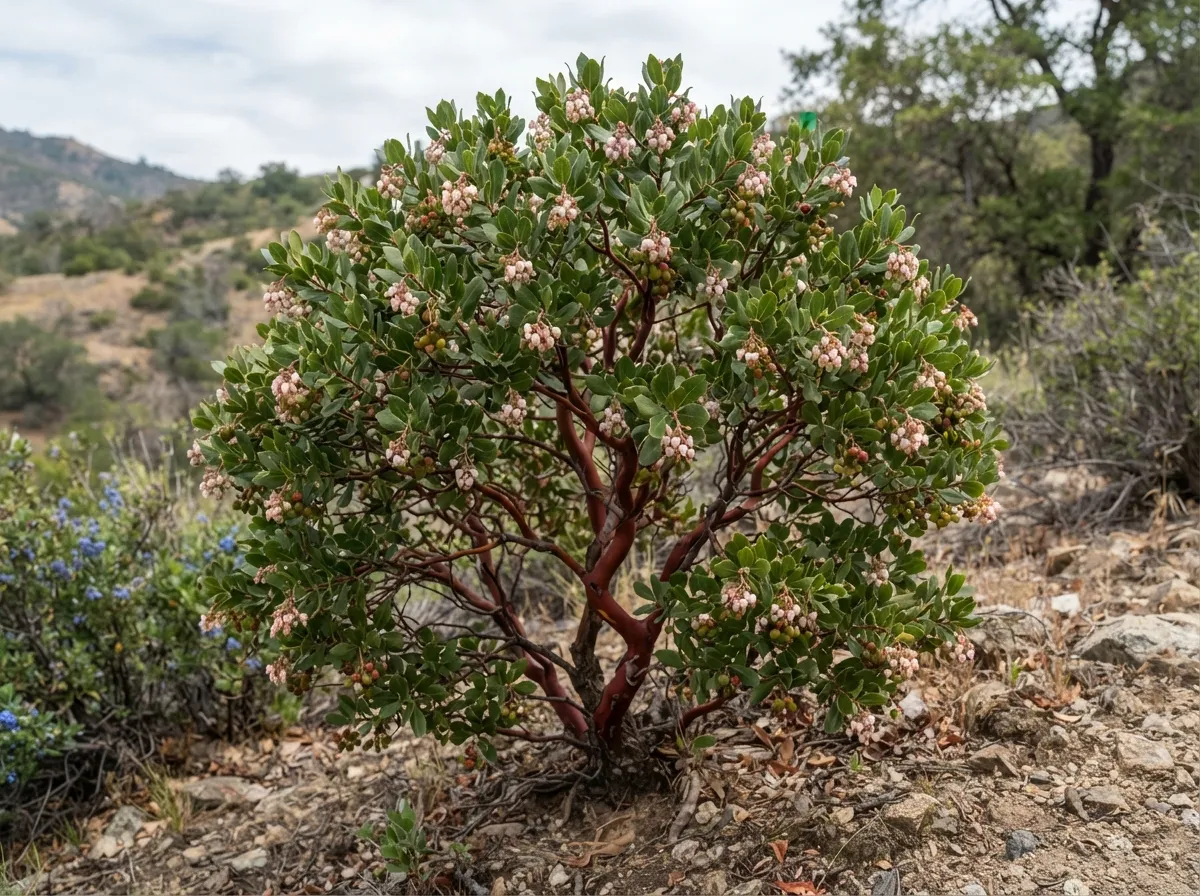
🔍 Identify it without mistakes
An iconic shrub or small tree of the California chaparral and southern Rockies, instantly recognizable by its smooth, glossy red-brown bark that peels in thin paper-like layers, its twisted branches, and its leathery, evergreen grey-green foliage. Small, pinkish-white bell-shaped flowers appear in spring, followed by small red-brown berries resembling tiny apples (hence the Spanish name "manzanita", meaning little apple).
- smooth, glossy red-brown bark, peeling in thin layers
- leathery evergreen leaves, often oriented vertically to reduce evaporation
- drooping, bell-shaped pinkish-white flowers
- clusters of small, mealy red-brown berries
⚠️ Not to be confused with
To tell them apart: the smooth, glossy red-brown bark that peels in thin layers is almost unique in the California chaparral and is enough on its own to confirm identification
🍽️ Eating it
Preparation : the berries, mealy and not very juicy, can be chewed fresh (the pulp separates easily from the large seed) or cold-steeped in water to make a refreshing, slightly tart drink traditionally called "manzanita cider"; they can also be dried and ground into a coarse flour
💊 Healing with it
dried leaves are traditionally infused for their diuretic and urinary antiseptic properties — same family and related compounds (arbutin) as bearberry (Arctostaphylos uva-ursi), a related plant in the same genus used in Europe for urinary tract infections
Level of evidence : limited studies — ethnobotanical literature of Western North America; European monographs on the related species Arctostaphylos uva-ursi (EMA/HMPC)
⚠️ arbutin, found in the leaves, metabolizes into hydroquinone, a compound potentially irritating to the liver and kidneys with prolonged use or in high doses; leaf infusions are not recommended for prolonged use, during pregnancy or breastfeeding, or for people with kidney failure
🪓 Other bushcraft uses
- hard and dense wood highly sought after for carving, furniture, and decorative bird perches
- leaves were traditionally mixed with tobacco in ceremonial smoking blends by several Western Native nations
Sources (2)
No entry replaces a certain identification in the field, or medical advice. When in doubt: don't eat it. If ingestion is suspected: poison control or 112/911.