🌾 Cattail and Common Reed
Typha latifolia / Phragmites australis · Typhaceae (cattail) — Poaceae (reed)
🔍 Identify it without mistakes
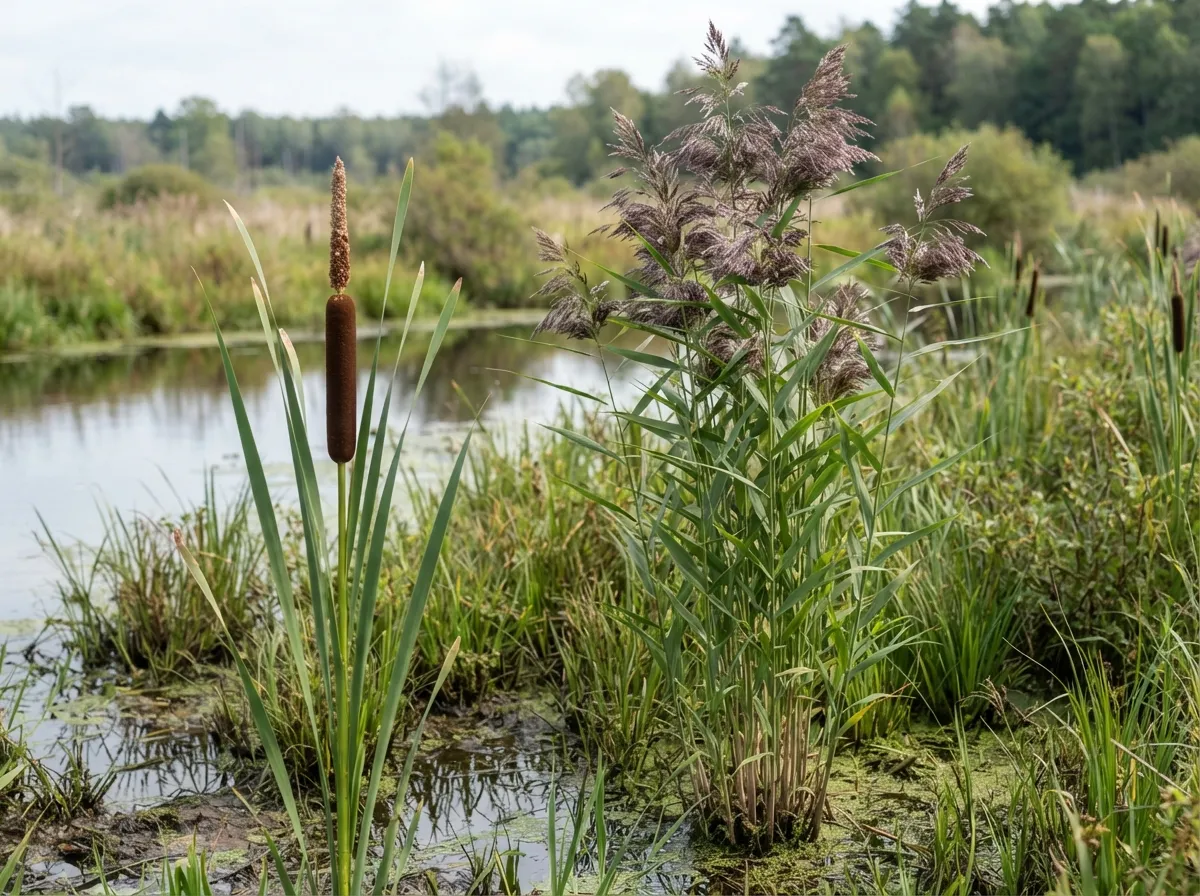
Two iconic wetland plants, often growing side by side. Cattail forms tall clumps with long, strap-like, upright leaves and its famous brown-black, sausage-shaped cylindrical spike (the compact female inflorescence, topped by a thinner male spike that disappears after pollination). Common reed forms vast reed beds with hard, hollow stems, strap-like leaves, and a large, silvery-brown feathery panicle in late summer.
- cattail: characteristic compact brown-black cylindrical spike, upright strap-like leaves
- reed: feathery, silvery-plumed panicle, rigid upright hollow stem
- both: spreading rhizomes forming dense colonies in wetlands
- cattail: no visible nodes on the flowering stalk
- reed: stem with distinct nodes like a cane
⚠️ Not to be confused with
To tell them apart: iris rhizome is flattened and gnarled with distinct ring-like scars, its leaves are sword-shaped and flat, not strap-like or cylindrical; if in doubt about a wetland rhizome without the whole plant clearly identifiable (flower or spike), do not harvest
🍽️ Eating it
Preparation : rhizome washed, peeled, rich in starch, cooked or pounded and rinsed several times in water to extract starch ('cattail flour'); young white central cattail shoot eaten raw, crunchy, nicknamed 'Cossack asparagus'; cattail pollen harvested by shaking the male spike into a bag, used to supplement flour
💊 Healing with it
rarely used in modern European herbal medicine; traditional use of cattail rhizome as a poultice for burns and wounds across several ethnobotanical traditions
Level of evidence : traditional use — ethnobotanical compilations (Thayer, PFAF)
⚠️ always identify the plant with certainty before harvesting a wetland rhizome, due to the risk of confusion with toxic yellow iris
🪓 Other bushcraft uses
- cattail and reed leaves woven to make mats, baskets, and thatched roofs
- fuzz from cattail spikes used as insulation, tinder, and padding
- reed stems used to make flutes, reeds, and arrows since antiquity
Sources (3)
No entry replaces a certain identification in the field, or medical advice. When in doubt: don't eat it. If ingestion is suspected: poison control or 112/911.