🌸 Common mallow
Malva sylvestris · Malvaceae
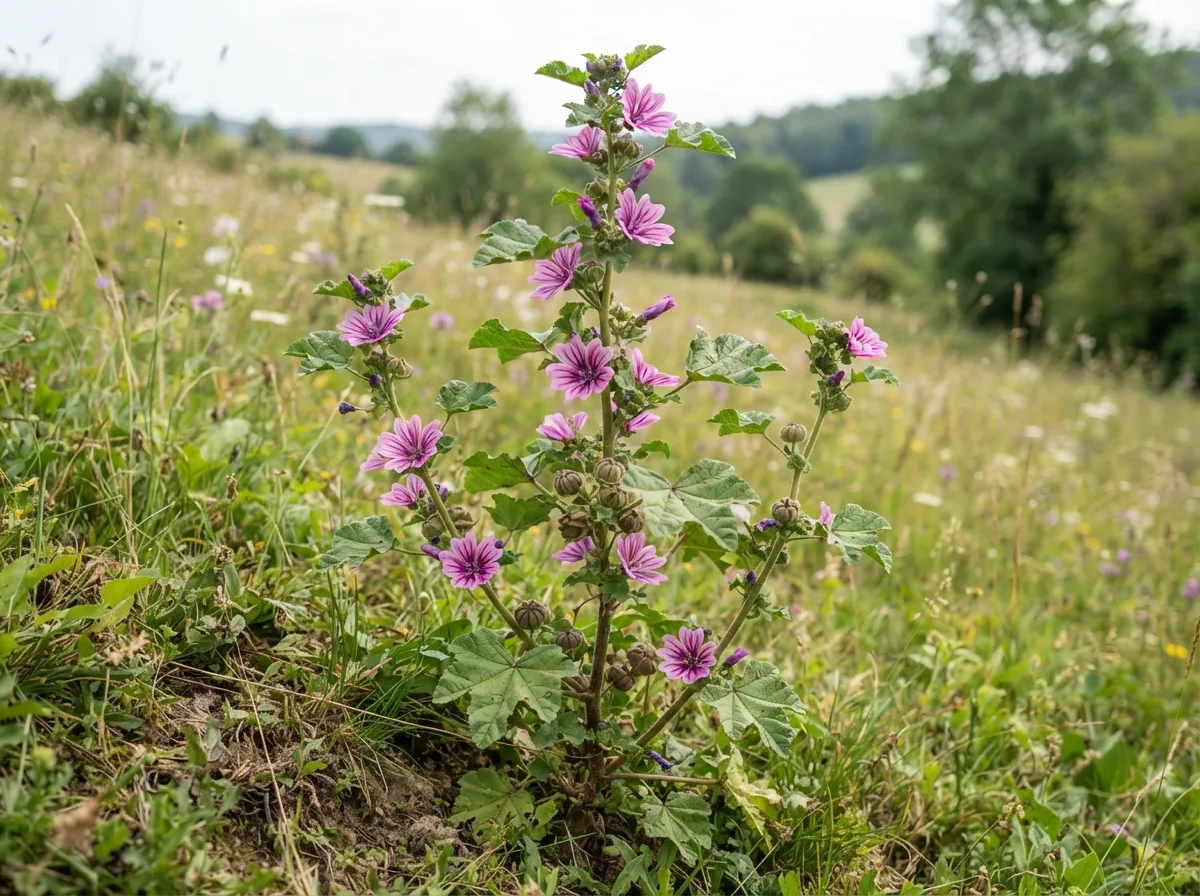
🔍 Identify it without mistakes
Plant with rounded, palmate leaves, having 5-7 shallow lobes and a scalloped margin, borne on long petioles. Pink to purple flowers with darker stripes and 5 heart-shaped notched petals. Distinctive fruit shaped like a small flat disc composed of several tight carpels, popularly nicknamed 'little cheese' in the countryside.
- rounded, palmate leaves with 5-7 shallow lobes
- pinkish-purple flowers striped with darker veins
- flat, segmented disc-shaped fruit ('little cheese')
- entire plant mucilaginous (slimy texture) when chewed or infused
- upright to spreading habit depending on density, 30-120 cm
⚠️ Not to be confused with
To tell them apart: palmate leaves and segmented disc fruit are distinctive among common wasteland plants
🍽️ Eating it
Preparation : young leaves eaten raw in salads or cooked in soups (they thicken broth slightly thanks to the mucilage, much like okra); raw flowers as a garnish; young green fruits snacked on as is, soft and slightly mucilaginous texture
approx, raw leaves, ethnobotanical compilations (mallow closely related to the widely documented genus Malva in the Mediterranean)
💊 Healing with it
traditionally used as an emollient and demulcent for throat irritation, dry coughs, and mild digestive inflammation, thanks to its mucilage
Level of evidence : tradition (recognized by the EMA/HMPC for traditional use) — EMA/HMPC, community monograph on Malvae sylvestris folium/flos
⚠️ no major known contraindications; mucilage can slow down the absorption of other medications taken at the same time, space out doses as a precaution
🪓 Other bushcraft uses
- flowers used for gentle textile dyeing
- considered an indicator of rich, disturbed soil in urban wastelands
Sources (3)
No entry replaces a certain identification in the field, or medical advice. When in doubt: don't eat it. If ingestion is suspected: poison control or 112/911.