🍇 Canada Moonseed
Menispermum canadense · Menispermaceae
🔍 Identify it without mistakes
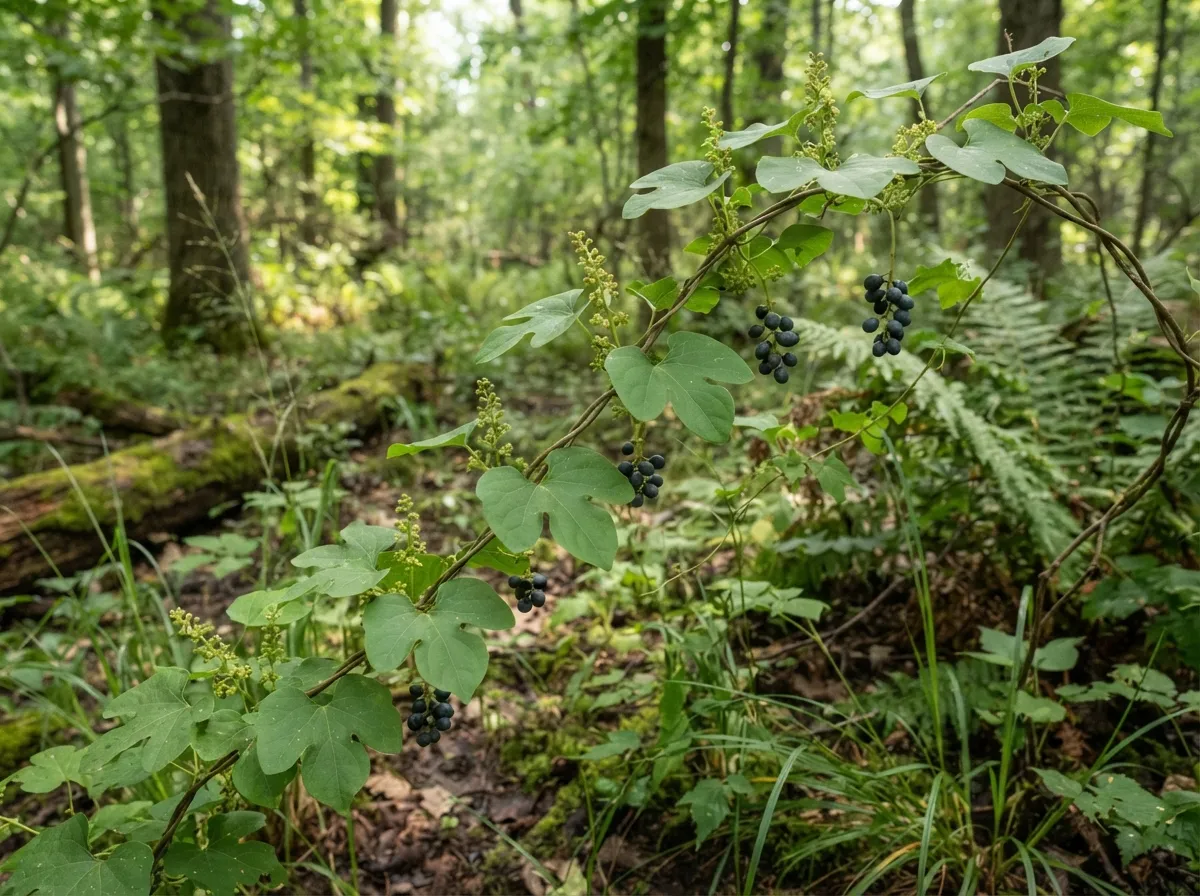
North American climbing vine whose clusters of small blue-black fruits look deceptively like wild grapes, a documented and potentially dangerous confusion for inexperienced foragers. The detail that gives the plant away every time is the seed: a grape contains several oval seeds, while moonseed has a single, flattened, crescent-moon-shaped seed—hence its name.
- simple, broad, shield-shaped leaves with 3-7 shallow lobes, resembling grape leaves but lacking the typical fork-like tendrils
- small, round, blue-black fruits with a waxy bloom in loose clusters, closely mimicking wild grapes
- CUT THE FRUIT OPEN: a single, flat crescent seed in moonseed, compared to several oval seeds in grapes
- climbing vine without tendrils (twines directly around support, unlike grapevines which use tendrils)
⚠️ Not to be confused with
To tell them apart: ABSOLUTE RULE before picking any "wild grape": cut a fruit in half—several oval seeds confirm an edible grape, a single flat crescent moon seed marks toxic moonseed; grapevines also have forked tendrils that moonseed lacks
To tell them apart: forked tendrils present on the grapevine, ABSENT on moonseed (which climbs by twining without tendrils); multiple round seed(s) in grapes versus A SINGLE crescent moon seed in moonseed—a decisive criterion if a fruit is already picked; grapevine leaves have coarse teeth and distinct palmate veins versus moonseed leaves with often smoother edges and petioles attached slightly inside the margin (peltate)
☠️ What kills
First steps : Call Poison Control or your local poison center in case of moonseed fruit ingestion. Do not induce vomiting. Before harvesting any "wild grape", systematically cut open a fruit to check the number of seeds.
No entry replaces a certain identification in the field, or medical advice. When in doubt: don't eat it. If ingestion is suspected: poison control or 112/911.