🌵 Honey Mesquite
Prosopis glandulosa · Fabacées
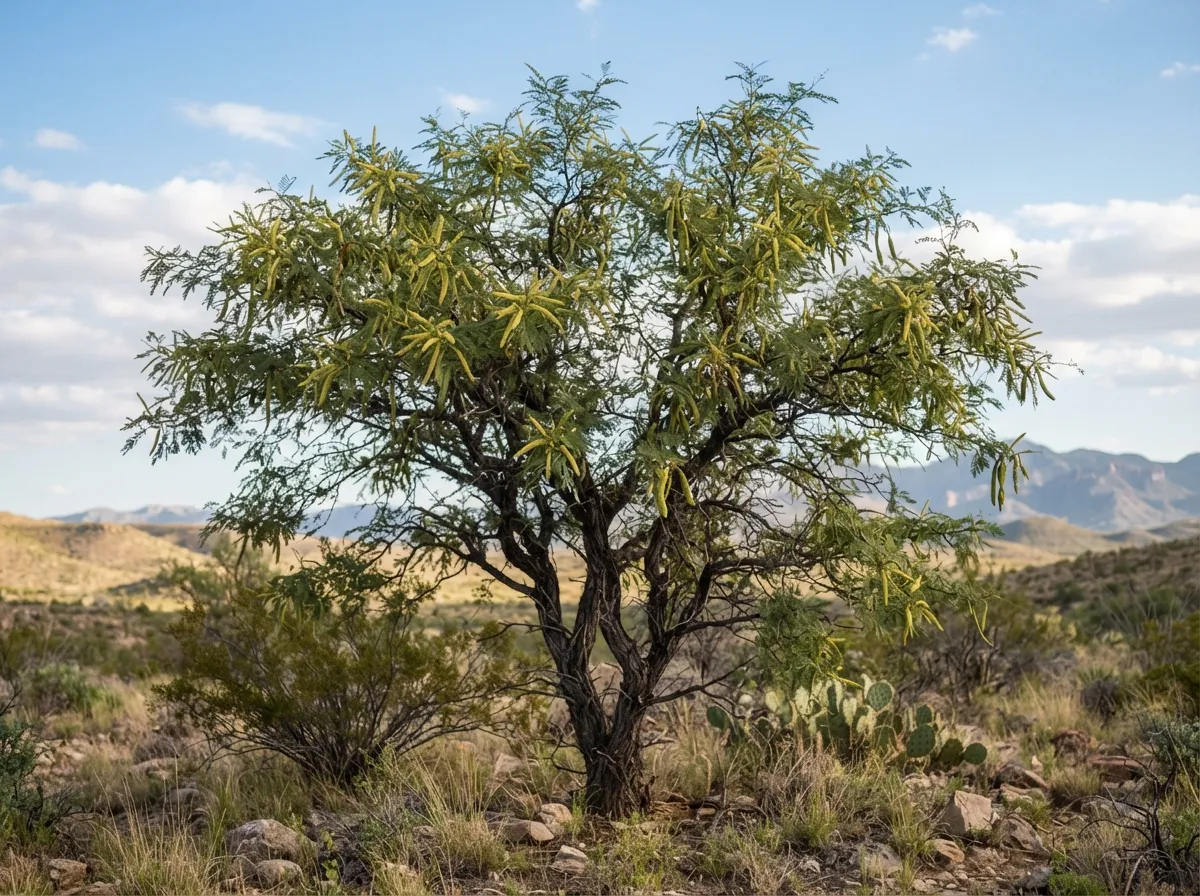
🔍 Identify it without mistakes
Shrub or small tree of the arid Southwest, with a rounded and drooping silhouette, fine and feathery foliage composed of numerous small leaflets, and straight paired thorns along the twigs. Long, drooping spikes of pale yellow, highly fragrant flowers appear in spring, followed by straight, yellow to brown pods at maturity.
- fine and feathery bipinnate foliage
- straight paired thorns on young twigs
- elongated and drooping pale yellow floral spikes
- straight pods (not coiled, unlike screwbean mesquite)
⚠️ Not to be confused with
To tell them apart: the fine, feathery bipinnate foliage combined with straight paired thorns and long, straight pale yellow pods with a sweet smell marks the mesquite among Southwest desert thorny shrubs
To tell them apart: palo verde is immediately recognizable by its green bark and trunk that perform photosynthesis, absent in mesquite whose bark remains brown and foliage fine, feathery, and bipinnate; palo verde pods are flattened with a hard shell, while mesquite pods are long, straight, and sweet with a characteristic smell
🍽️ Eating it
Preparation : dry, mature pods are pounded whole (with the sweet casing and seeds) then sifted to remove hard fibers, yielding a sweet flour used alone or mixed with other flours for breads, porridges, and cakes; fresh green pods are chewed for their sweet pulp; flowers are eaten raw or ground into cake flour by the Cahuilla
💊 Healing with it
bark gum traditionally used as eye drops for eye inflammation; leaves in infusion for headaches and digestive issues; bark as a poultice on wounds
Level of evidence : traditional use — Native American Ethnobotany Database (Moerman, University of Michigan)
⚠️ no notable toxicity documented for traditional food uses of pods and flowers
🪓 Other bushcraft uses
- dense and fragrant wood highly sought after for smoking and barbecue cooking (a Texas specialty)
- thorns used as tattooing needles by the Cahuilla and Serrano, with ash used as pigment
- wood used for tools, arrowheads, and small furniture
Sources (3)
No entry replaces a certain identification in the field, or medical advice. When in doubt: don't eat it. If ingestion is suspected: poison control or 112/911.