🫐 Black Nightshade
Solanum nigrum · Solanaceae
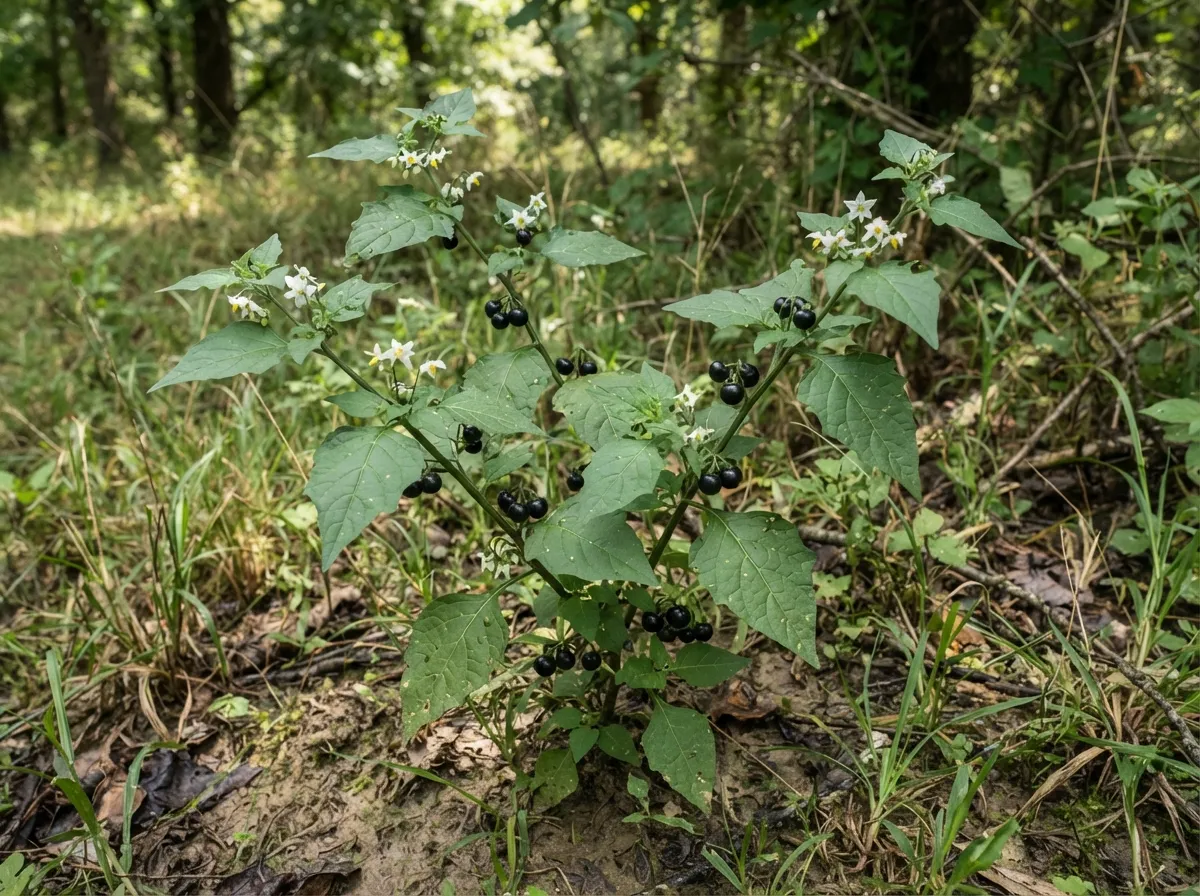
🔍 Identify it without mistakes
A small, very common annual plant of gardens and wasteland, with green berries that turn black when mature. Although traditionally consumed fully ripe and cooked in certain regions, doing so remains inadvisable without absolute certainty of maturity and species, as solanine levels vary greatly and the green berries are clearly toxic.
- oval leaves with wavy or weakly toothed margins, arranged alternately
- small white flowers with 5 backward-curving petals, yellow stamens fused in a central cone (typical of Solanaceae)
- spherical berries in small hanging clusters, green then black when fully ripe
- low bushy habit, angular stem
⚠️ Not to be confused with
To tell them apart: bilberries grow on a low, woody subshrub in acidic undergrowth with leathery toothed leaves, never in a garden or annual wasteland like nightshade
To tell them apart: blackcurrant has aromatic lobed leaves (characteristic smell when crushed) and never produces white flowers with yellow cone-shaped stamens
To tell them apart: belladonna berries are much larger (10-20 mm) and solitary, sitting on a clear 5-pointed green calyx, unlike the small clustered berries of black nightshade
To tell them apart: the Australian bush tomato is only harvested fully ripe and naturally dried on the stem (resembling a yellow raisin), never green or fresh like black nightshade berries; both species share the same genus Solanum and the same risk with green fruit (solanine)
To tell them apart: the papery lantern-like calyx that completely wraps the fruit is unique to physalis and absent in black nightshade, whose small black berries grow naked in clusters with no husk; when in doubt, the absence of a cage signals extra caution
☠️ What kills
First steps : Call poison control immediately if green berries are ingested, especially by a young child. Do not induce vomiting. Never eat the berries without complete certainty of maturity and species identification; keep a sample for identification.
Sources (3)
No entry replaces a certain identification in the field, or medical advice. When in doubt: don't eat it. If ingestion is suspected: poison control or 112/911.