🔔 Lily of the Valley
Convallaria majalis · Asparagaceae
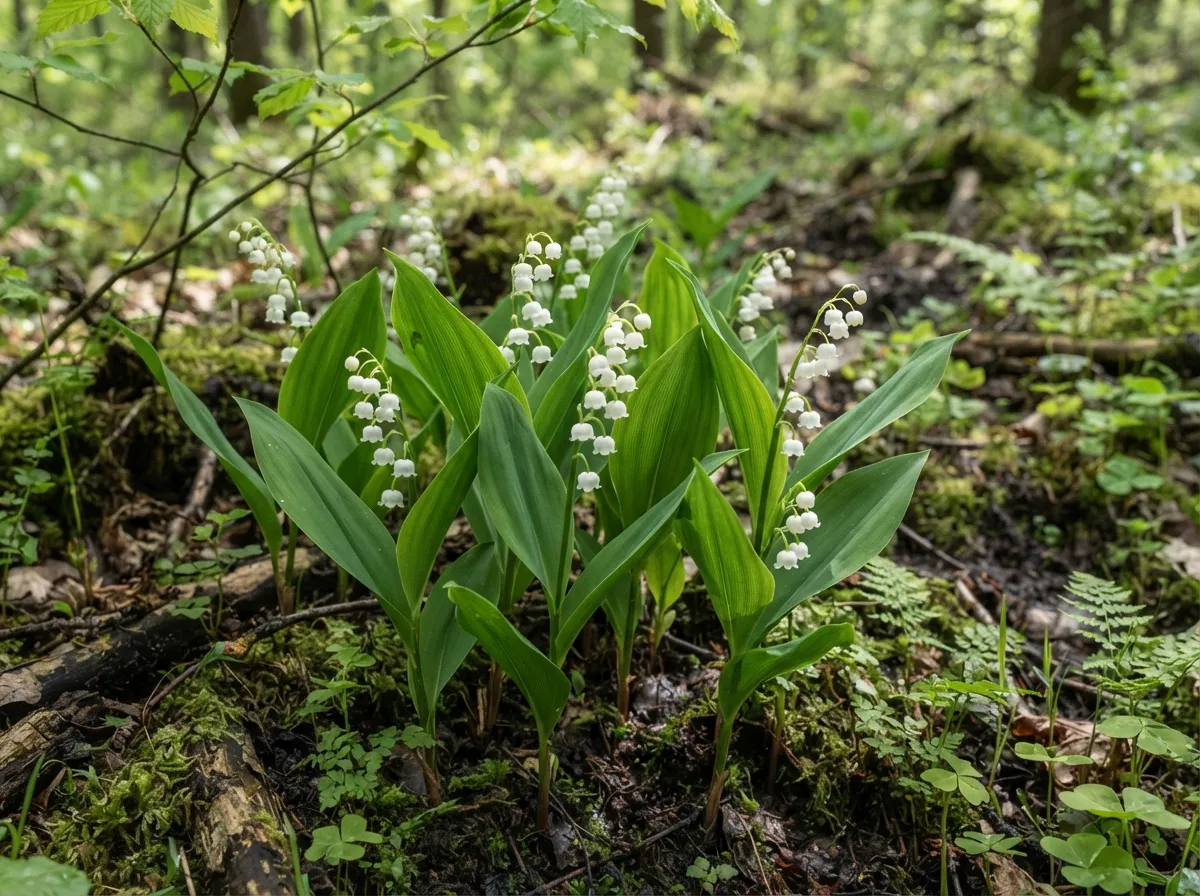
🔍 Identify it without mistakes
Small understory perennial well known for its fragrant white bell-shaped flowers borne in a cluster on a leafless stalk, nestled between two large lance-shaped leaves emerging directly from the ground. The entire plant is toxic, including the vase water in which it is placed—a classic trap for young children.
- two sheathing, lance-shaped leaves arising directly from the rhizome, with no apparent stem
- a leafless flowering stalk carrying 5 to 13 small, drooping, highly fragrant white bells
- spherical orange-red berries in late summer, which are also toxic
- characteristic sweet scent of the flowers
⚠️ Not to be confused with
To tell them apart: wild garlic gives off a strong garlic smell when crushed, while lily of the valley has none; lily of the valley leaves are sheathed at the base without a distinct stalk, whereas wild garlic leaves have a clear petiole
To tell them apart: lily of the valley has NO garlic or onion odor when crushed—this is the decisive field test to perform systematically before any harvest
☠️ What kills
First steps : Call poison control if a child has chewed a leaf, a flower, a berry, or drunk the vase water. Do not induce vomiting. Discard vase water out of reach and keep a sprig for identification.
Sources (3)
No entry replaces a certain identification in the field, or medical advice. When in doubt: don't eat it. If ingestion is suspected: poison control or 112/911.