🍒 Native Cherry (Cherry Ballart)
Exocarpos cupressiformis · Santalacées
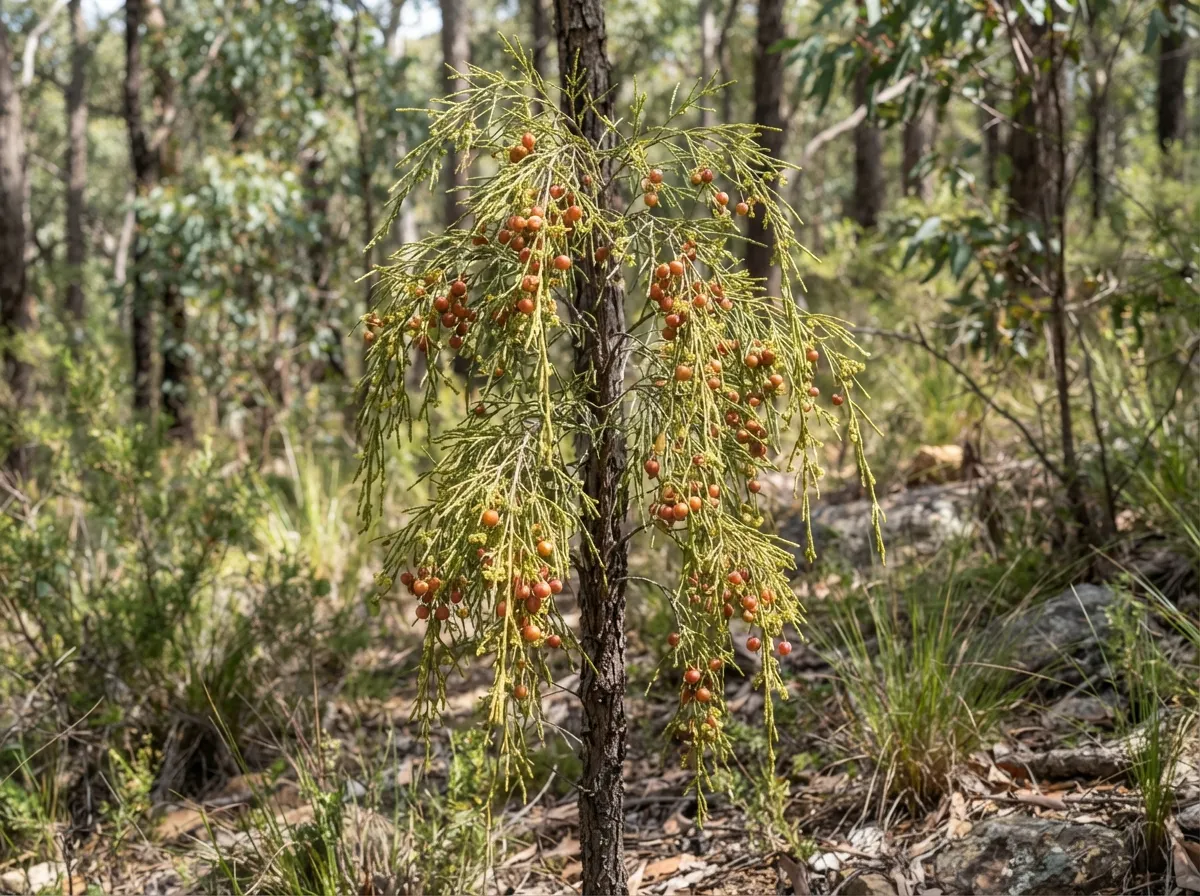
🔍 Identify it without mistakes
Large shrub or small tree growing 3 to 8 m high, often with a pyramidal silhouette that looks like a cypress from a distance. Its leaves are reduced to tiny scales: green, drooping branchlets carry out photosynthesis. When young, it lives as a partial root parasite on other trees, especially eucalypts—a dependence that decreases as it matures. Its fruit is unique: the true seed (hard, looking like a small nut) sits on the outside of a fleshy, colored stalk that swells to become the edible part—the exact opposite of a classic cherry.
- pyramidal silhouette resembling a cypress from afar
- leaves reduced to tiny scales, photosynthesis performed by green, cascading branchlets
- partial root parasite on other trees (often eucalypts), especially when young
- inverted fruit: the hard seed is on the outside, borne on an edible fleshy stalk that swells and turns red when ripe
⚠️ Not to be confused with
To tell them apart: the unique inverted structure of the fruit—the true hard seed sitting outside an edible fleshy stalk—combined with foliage reduced to scales on cascading green twigs, is not found in any other Australian bush plant, making identification virtually unmistakable
🍽️ Eating it
Preparation : pick when fully ripe and eat raw directly, or cook it; do not eat the hard seed on the outside, which is not the part you're after
💊 Healing with it
no major traditional medicinal uses documented in the consulted sources
Level of evidence : traditional use — Wikipedia — Exocarpos cupressiformis
⚠️ no specific precautions known for the ripe fleshy stalk
🪓 Other bushcraft uses
- wood traditionally used by Aboriginal people to make spearthrowers and other tools
Sources (1)
No entry replaces a certain identification in the field, or medical advice. When in doubt: don't eat it. If ingestion is suspected: poison control or 112/911.