🫐 Purging Buckthorn
Rhamnus cathartica · Rhamnacées
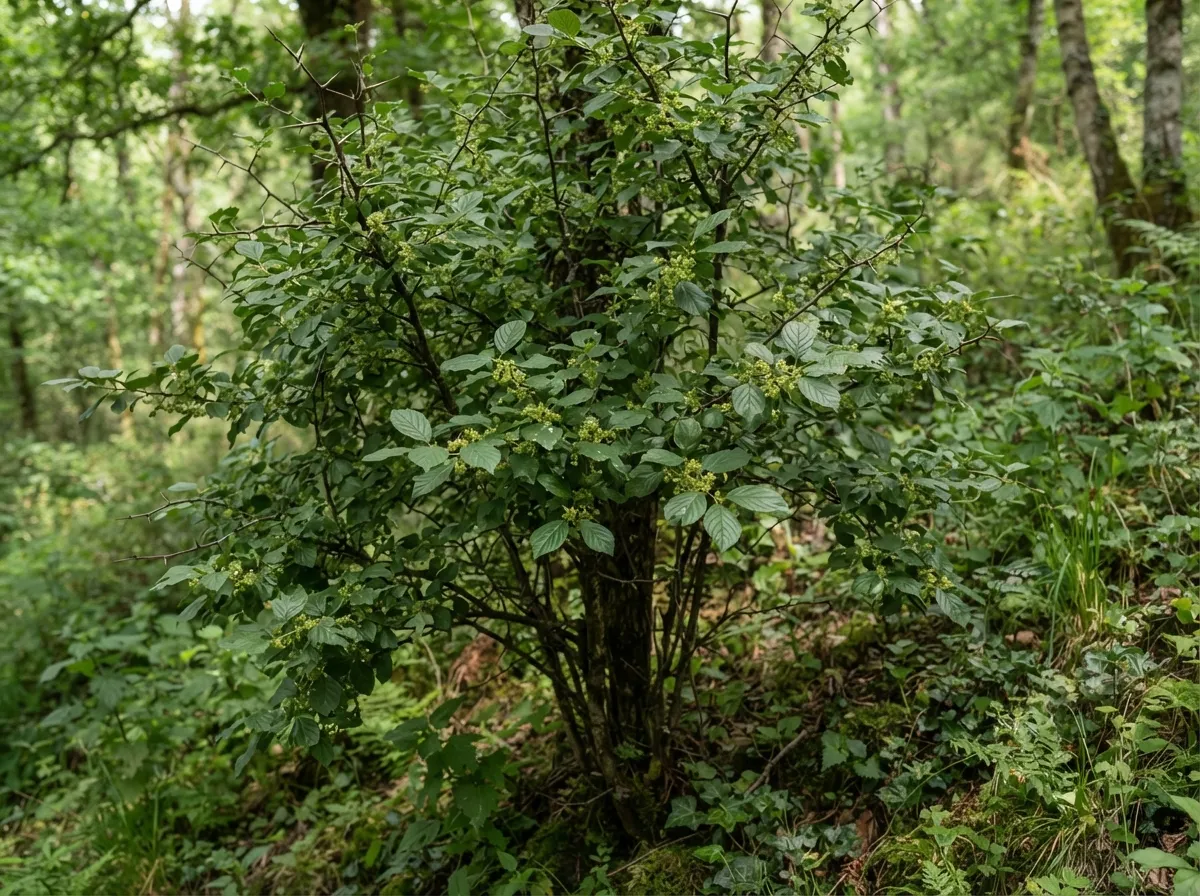
🔍 Identify it without mistakes
Spiny shrub of hedges and forest edges, recognizable by its twigs often ending in a spine and its small, highly toxic black berries clustered in small groups in the leaf axils. Its very name ("cathartica", purging) is a warning: historically used as a drastic purgative, it was abandoned in medicine due to its violent nature, and must never be consumed today.
- twigs often ending in a short, rigid spine
- leaves opposite or sub-opposite, oval, finely serrated, with clearly visible arched veins
- small, glossy black berries, clustered in groups of 2-4 in the leaf axils, highly toxic
- yellow-orange wood under the gray bark, visible when cut
- dioecious shrub (separate male and female plants), only female plants bear berries
⚠️ Not to be confused with
To tell them apart: buckthorn is a woody shrub with spiny twigs and berries clustered in the leaf axils, never a low-growing plant like the bilberry; if you have any doubt about an unknown black berry in a hedge, refrain from eating it
To tell them apart: the blueberry is a low, carpet-forming subshrub (under 40 cm) with each berry bearing a small five-pointed starry crown; buckthorn is a tall shrub with crownless berries, often featuring a twig ending in a spine
💊 Healing with it
historically used as a powerful purgative (bark and berries contain laxative anthraquinone glycosides), a use now abandoned in favor of better-dosed and safer laxatives
Level of evidence : traditional use — Toxiplante — Rhamnus cathartica
⚠️ TOXIC: never consume the berries or bark without strict medical supervision — overdose easily causes violent abdominal cramps, severe vomiting, and severe diarrhea that can lead to dangerous dehydration, especially in children
🪓 Other bushcraft uses
- bark and berries traditionally used in dyeing to obtain yellow (unripe berries) or green (ripe berries with alum), dyes known as "bladder green" or "Avignon berry yellow"
No entry replaces a certain identification in the field, or medical advice. When in doubt: don't eat it. If ingestion is suspected: poison control or 112/911.