☠️ Strychnine tree (nux vomica)
Strychnos nux-vomica · Loganiacées
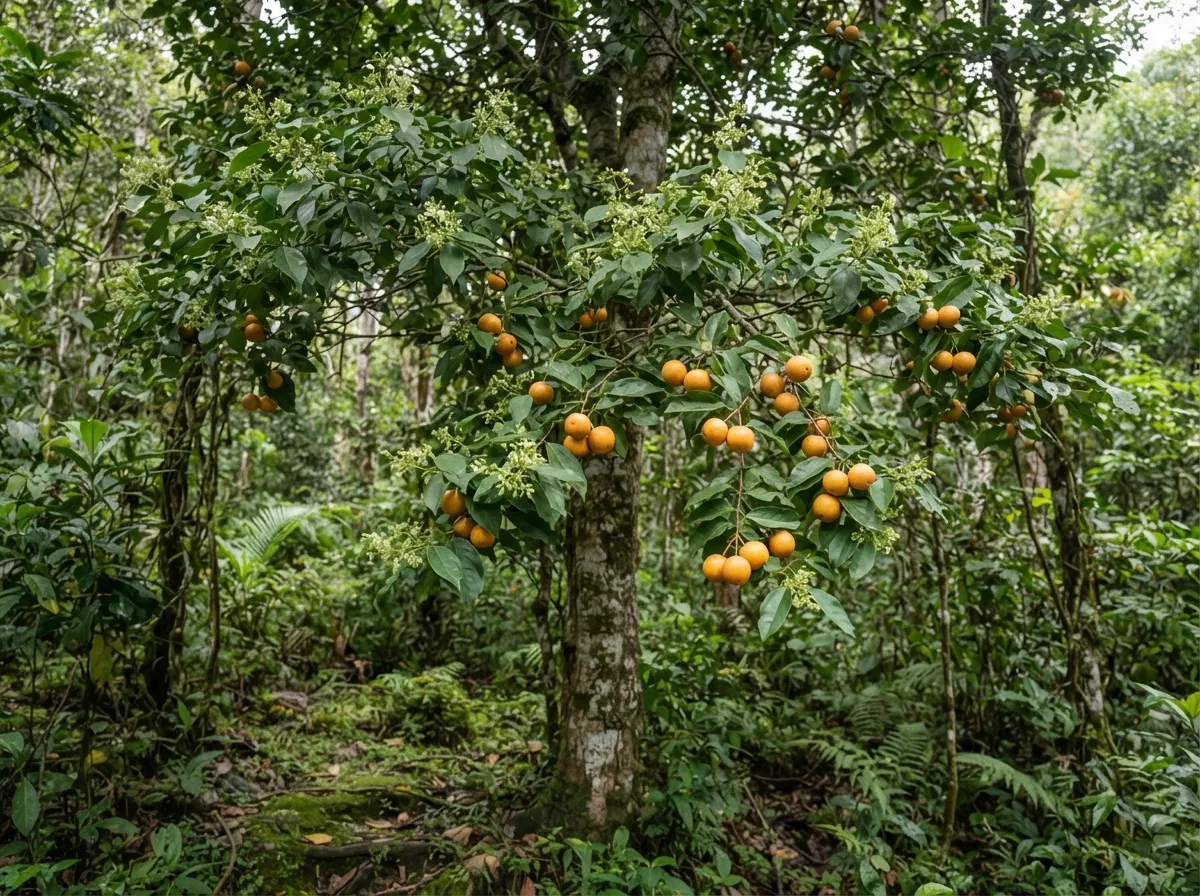
🔍 Identify it without mistakes
A small hardwood tree of the dry and humid forests of South and Southeast Asia. Its round, smooth fruit, bright orange when ripe, strongly resembles a small orange—a formidable visual trap since its seeds contain strychnine, one of the most potent plant poisons known.
- opposite, oval leaves with 3-5 prominent main veins starting from the base (characteristic fan-like venation)
- round, smooth fruit with a hard rind, bright orange when ripe, the size of a small orange or apple
- 5 flat, button-shaped seeds covered in a fine, silky grey down, arranged around the central pulp
- smooth, grayish bark, hard and dense wood
⚠️ Not to be confused with
To tell them apart: cut the fruit open: the pulp of the strychnine tree is gelatinous and bitter, with 5 large flat seeds covered in silky down clearly visible, whereas an orange has juicy segmented pulp with nothing comparable; the rind of the strychnine tree is smooth and hard, not pebbled like that of a citrus
☠️ What kills
First steps : Call emergency services or a poison control center immediately upon the slightest ingestion, even without apparent symptoms. Minimize all stimulation (noise, light, handling) that could trigger convulsions. Do not induce vomiting. Emergency medical transport is imperative.
No entry replaces a certain identification in the field, or medical advice. When in doubt: don't eat it. If ingestion is suspected: poison control or 112/911.