🌲 Eastern white pine
Pinus strobus · Pinacées
🔍 Identify it without mistakes
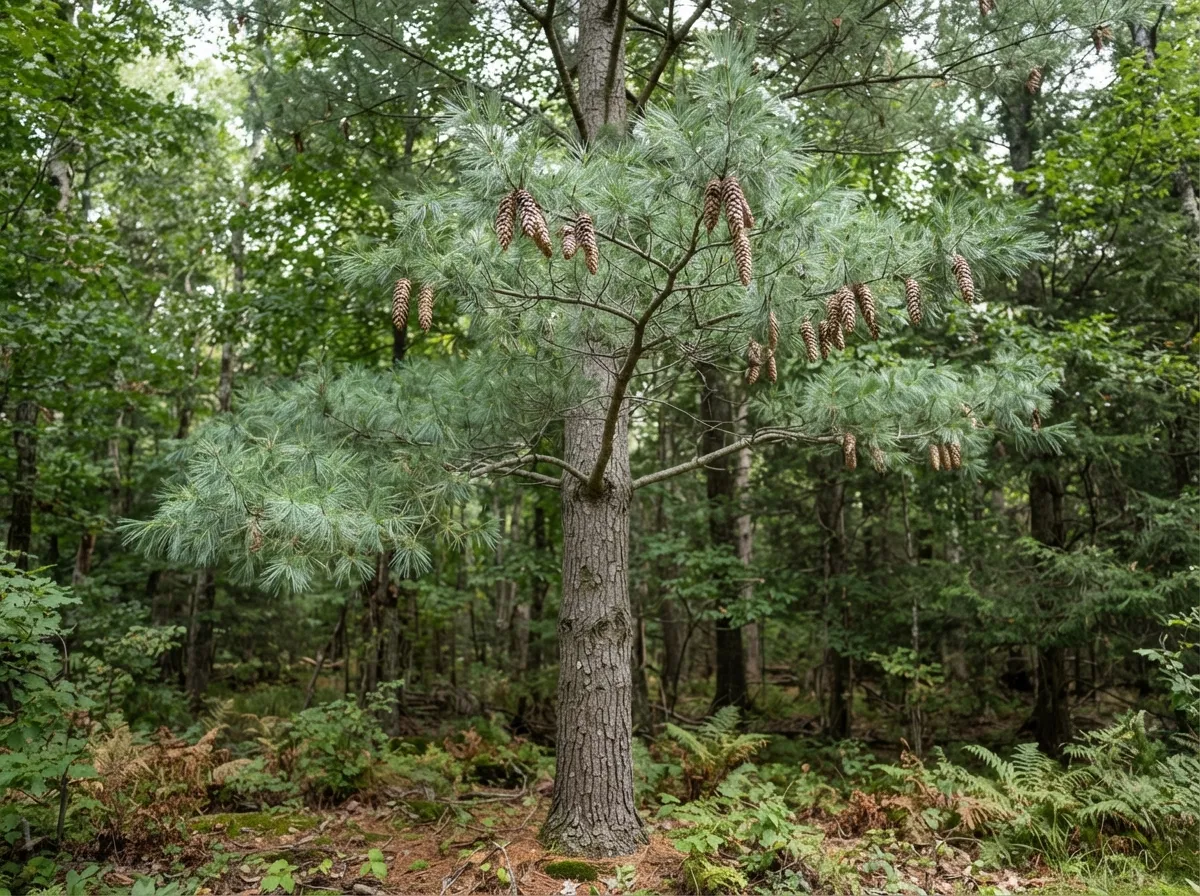
Tall, slender conifer, the tallest tree in eastern North America, instantly recognizable among all local pines by its soft needles grouped in bundles of five (an foolproof counting check). Long, slender, slightly curved cones covered in resin. Smooth gray bark on young trees, becoming deeply furrowed with age.
- soft needles grouped in BUNDLES OF FIVE (unique among eastern pines)
- long (10-20 cm), slender, curved, resinous cones
- characteristic horizontal layered silhouette
- smooth gray-green bark on young trees, furrowed on adults
⚠️ Not to be confused with
To tell them apart: eastern white pine has soft needles grouped in bundles of five and long resinous cones; Canada yew is a low shrub (rarely over 1-2 m) with flat needles not grouped in bundles, arranged in two rows along the twig, and never bears cones — only red arils. Simply counting the needles per bundle (five on the pine, no bundles on the yew) is enough to avoid any risk
🍽️ Eating it
Preparation : steep a handful of freshly chopped needles in hot water (never prolonged boiling, which destroys vitamin C) for a tea; scrape the cambium (living layer under the bark) and eat it raw, dried into powder to thicken soups, or cooked as a vegetable in times of famine; nibble the seeds from old open cones
💊 Healing with it
needle tea traditionally used against scurvy and respiratory ailments; resin applied as a poultice on wounds, cuts, and skin infections (empirically recognized antiseptic properties)
Level of evidence : traditional use — Native American Ethnobotany Database (Moerman, University of Michigan)
⚠️ no major contraindications documented for occasional needle tea use; as a precaution, avoid in large quantities during pregnancy, like most conifer infusions
🪓 Other bushcraft uses
- resin used as glue, waterproof sealant for bark canoes, and tinder for fire-starting
- lightweight, easy-to-work wood for ship masts (one of the most sought-after woods by the British Royal Navy in the 18th century, which reserved the finest specimens under the 'Broad Arrow')
- split bark and roots used as sewing fiber for birch bark canoes
Sources (3)
No entry replaces a certain identification in the field, or medical advice. When in doubt: don't eat it. If ingestion is suspected: poison control or 112/911.