🌲 Swiss pine (Arolla pine)
Pinus cembra · Pinaceae
🔍 Identify it without mistakes
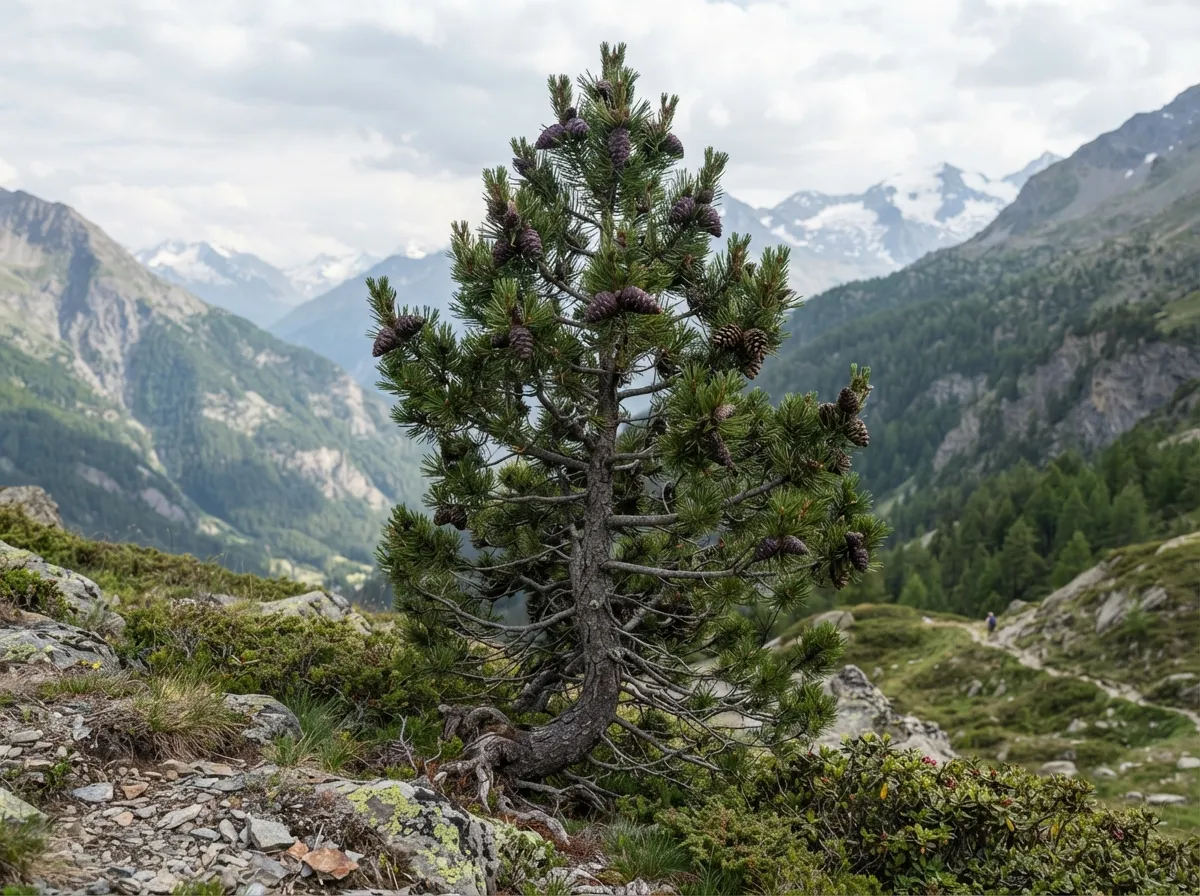
Massive conifer with a pyramidal shape becoming spreading with age, reaching up to 25 m. Needles grouped in clusters of 5 (fascicles), long, thin, slightly twisted, remaining on the tree for 3 to 4 years. Upright, ovoid cones that do not open on their own at maturity — they are broken open by the spotted nutcracker, a bird with which the Swiss pine shares a mutually dependent relationship for seed dispersal.
- needles grouped in 5s (unlike Scots pine, which has 2)
- upright cone that does not open on its own, broken open by the nutcracker
- smooth grey bark on young trees, becoming fissured with age
- found exclusively at very high alpine altitudes
⚠️ Not to be confused with
To tell them apart: Swiss pine has needles grouped in bundles of five and bears upright cones broken open by the nutcracker; yew has flat, ungrouped needles arranged in two flat rows along the twig, never bears cones (red arils instead), and often has a spreading shrubby habit rather than a tall pyramidal conifer shape
🍽️ Eating it
Preparation : extract the seeds from the cone, shell them, then eat them raw or lightly toasted
🪓 Other bushcraft uses
- soft, aromatic wood highly sought after in traditional alpine woodworking (chalets, furniture) for its scent, which is said to repel moths
No entry replaces a certain identification in the field, or medical advice. When in doubt: don't eat it. If ingestion is suspected: poison control or 112/911.