🌿 Sea Sandwort
Honckenya peploides · Caryophyllaceae
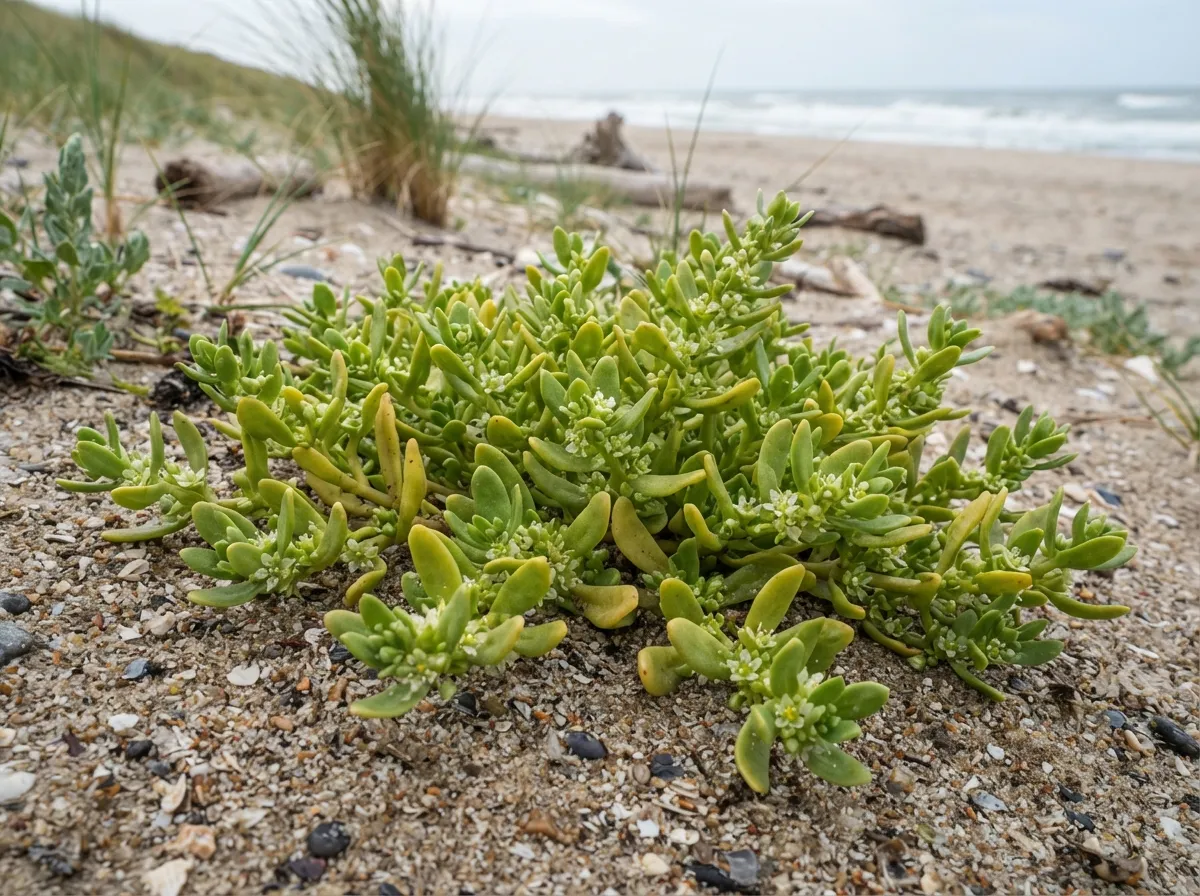
🔍 Identify it without mistakes
Small, succulent, creeping perennial plant, entirely hairless, with prostrate stems that root at the nodes. It bears fleshy, sessile leaves arranged in four regular, overlapping rows like scales—an almost perfect geometry that makes it instantly recognizable.
- fleshy, sessile, oval-pointed leaves arranged in 4 overlapping, regular rows along the stem
- entirely hairless plant (glabrous), prostrate stems rooting at the nodes
- greenish-white flowers with 5 short petals, no longer than the sepals, followed by globose 3-valved capsules
⚠️ Not to be confused with
To tell them apart: sea sandwort never exudes white latex when broken and its leaves are arranged in 4 very regular overlapping rows; sea spurge instantly releases a sticky milky latex as soon as you snap a leaf or stem — this latex test is decisive and must be done systematically before harvesting
To tell them apart: sea sandwort has no particular smell and its leaves are arranged in 4 neatly overlapping rows; oysterplant has broader, frosted blue-green leaves, with a very distinct fresh oyster smell and taste when crushed
🍽️ Eating it
Preparation : eat raw in salads for its crunch, or briefly cooked/pickled in vinegar like glasswort; always check for the absence of latex when snapping a leaf before eating an unfamiliar plant from the same habitat
💊 Healing with it
no major documented medicinal use beyond its value as a wild leaf vegetable
Level of evidence : traditional use — Préservons la Nature / FloreAlpes — Honckenya peploides
⚠️ always check for the absence of white latex before picking, due to the frequent presence of toxic sea spurge in the same sandy habitat
🪓 Other bushcraft uses
- creeping roots traditionally used in Iceland and the Arctic as a emergency vegetable during famines
Sources (3)
No entry replaces a certain identification in the field, or medical advice. When in doubt: don't eat it. If ingestion is suspected: poison control or 112/911.