🌿 Field Horsetail
Equisetum arvense · Equisetaceae
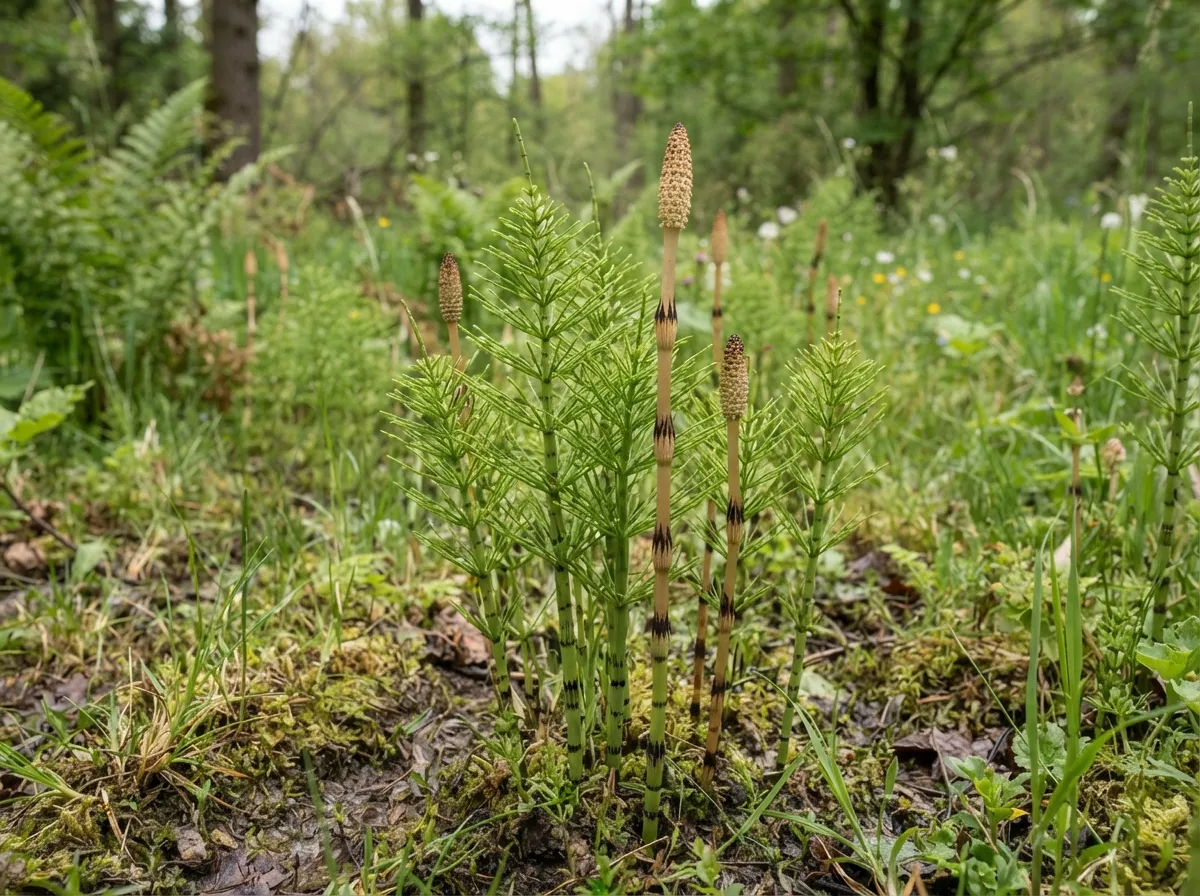
🔍 Identify it without mistakes
Primitive perennial plant with no flowers or seeds (reproduces via spores), featuring hollow ribbed stems articulated into segments clearly defined by nodes. At each node, a sheath of tiny leaves reduced to fused scales is present. Two distinct types of stems: a brownish fertile stem in spring bearing a spore cone, followed by a green sterile stem, branched in regular whorls like a miniature Christmas tree.
- hollow ribbed stem articulated in distinct segments, easily pulled apart by hand at the nodes
- sterile stem branched in regular whorls of slender branches
- distinct brown fertile stem appearing before the sterile one in spring
- rough texture to the touch (silica)
⚠️ Not to be confused with
To tell them apart: more irregular branching and a central stem that is proportionally thinner than in field horsetail
To tell them apart: ephedra is a woody desert shrub with stems that don't snap cleanly at each node, whereas horsetail is a non-woody plant of wet soils whose stems pull apart cleanly at each joint; their habitats (dry desert vs. damp soils) almost never overlap
💊 Healing with it
traditional diuretic, remineralizing (silica), supports healing and strength of nails and hair
Level of evidence : limited studies — EMA/HMPC Monograph Equiseti herba (well-established traditional use)
⚠️ not recommended for prolonged use without guidance (interferes with thiamine/vitamin B1 absorption), contraindicated in cases of edema caused by heart or kidney failure without medical advice
🪓 Other bushcraft uses
- silica-rich stem traditionally used as a natural abrasive to polish wood, metal, and even fingernails (hence its nickname 'scouring rush')
No entry replaces a certain identification in the field, or medical advice. When in doubt: don't eat it. If ingestion is suspected: poison control or 112/911.