🌾 Cattail (quenouille)
Typha latifolia · Typhacées
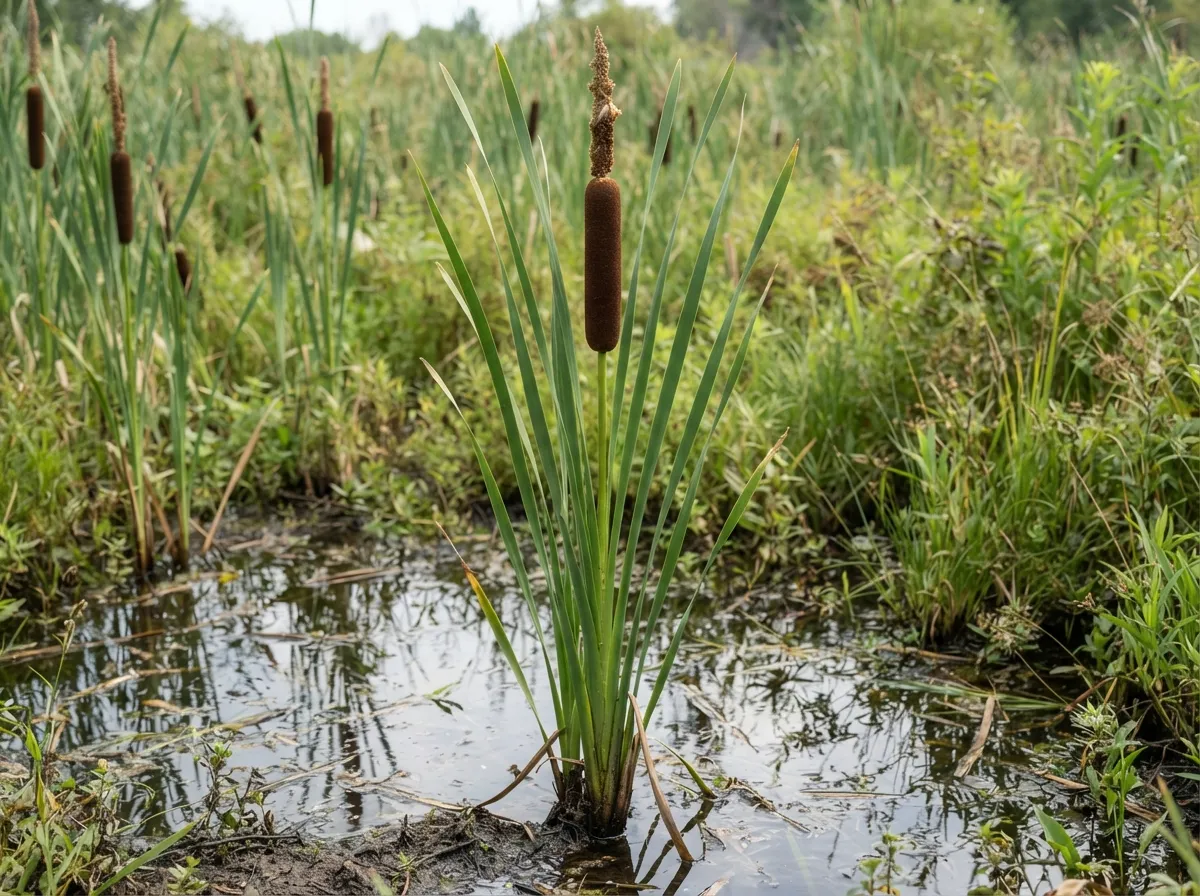
🔍 Identify it without mistakes
Large wetland plant growing in dense stands, instantly recognizable by its brown sausage-like flower spike at the top of a smooth, erect stem. Strap-like leaves, taller than the spike, fan out from the base. Two common species in North America: T. latifolia (male and female spikes contiguous) and T. angustifolia (a gap of bare stem separates the two parts of the spike).
- velvety brown cylindrical flower spike
- flat, strap-like, glaucous leaves
- round stem without nodes
- grows in colonies in shallow water
⚠️ Not to be confused with
To tell them apart: young iris shoots also grow in fans in wetlands, but their leaves are stiffer, sword-shaped with a distinct central midrib, and the base of the iris rhizome has a sharp, acrid smell, unlike the neutral scent of a cattail rhizome
🍽️ Eating it
Preparation : eat the white core at the base of young shoots raw or cooked like heart of palm; boil the firm green flower spikes for 5–10 min and eat them like corn on the cob; harvest pollen by shaking the male spikes into a bag and use it to replace up to 50% of the flour in bread; mash the starch-rich rhizome (up to 70% dry matter) in water to extract the starch settling at the bottom
💊 Healing with it
use the fluffy seed heads and crushed rhizome as a poultice on burns, wounds, and insect bites (a widespread traditional use among many Indigenous nations: Ojibwe, Iroquois, Meskwaki); rhizome decoctions were used to treat diarrhea
Level of evidence : traditional use — Native American Ethnobotany Database (Moerman, University of Michigan)
⚠️ no modern clinical studies; polluted wetlands (heavy metals, agricultural runoff) contaminate the rhizome because it is a bioaccumulative plant—do not harvest downstream from pollution sources
🪓 Other bushcraft uses
- fluff from the seed heads serves as tinder and insulation (used as kapok substitute in US Navy "Mae West" life jackets during WWII)
- leaves woven into basketry, mats, and chair seats
- dried stems dipped in fat used as torches
Sources (4)
No entry replaces a certain identification in the field, or medical advice. When in doubt: don't eat it. If ingestion is suspected: poison control or 112/911.