🌼 Meadow buttercup
Ranunculus acris · Ranunculaceae
🔍 Identify it without mistakes
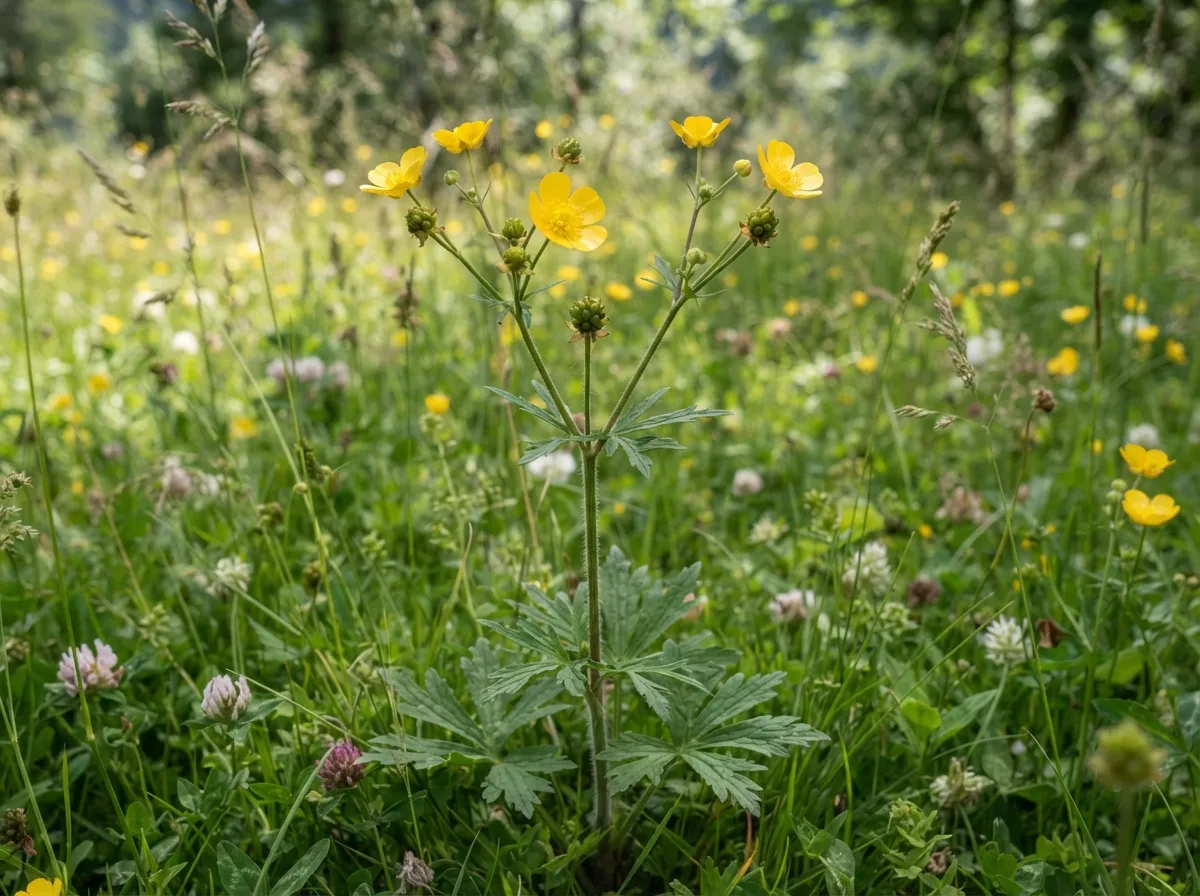
The classic meadow buttercup, featuring glossy bright yellow flowers well known to children. Its fresh sap contains a blistering substance that burns the mouth and skin. The toxicity almost entirely disappears upon drying (in hay), which explains why livestock avoid it in the pasture but can consume it safely once withered.
- shiny, waxy, bright yellow 5-petaled flower, typical of the entire Ranunculus genus
- deeply divided leaves with 3 to 7 toothed lobes
- erect, hairy stem branching towards the top
- slightly acrid and irritating sap when crushing fresh stems or leaves
⚠️ Not to be confused with
To tell them apart: the risk comes mainly from prolonged contact of fresh sap on the skin (holding a bouquet for a long time) or chewing out of curiosity; the plant loses its toxicity when dried into hay
To tell them apart: lesser celandine blooms much earlier (starting in February) with glossy 8-12 petaled flowers and fleshy, heart-shaped leaves; meadow buttercup blooms in summer with 5 petals and deeply lobed leaves
☠️ What kills
First steps : Rinse skin or mouth thoroughly with clear water in case of prolonged contact or chewing. Call a poison control center if a large quantity is ingested by a young child. Do not let a child hold a tight bouquet of buttercups in their hand for long periods.
No entry replaces a certain identification in the field, or medical advice. When in doubt: don't eat it. If ingestion is suspected: poison control or 112/911.