🌾 Common Reed
Phragmites australis · Poaceae
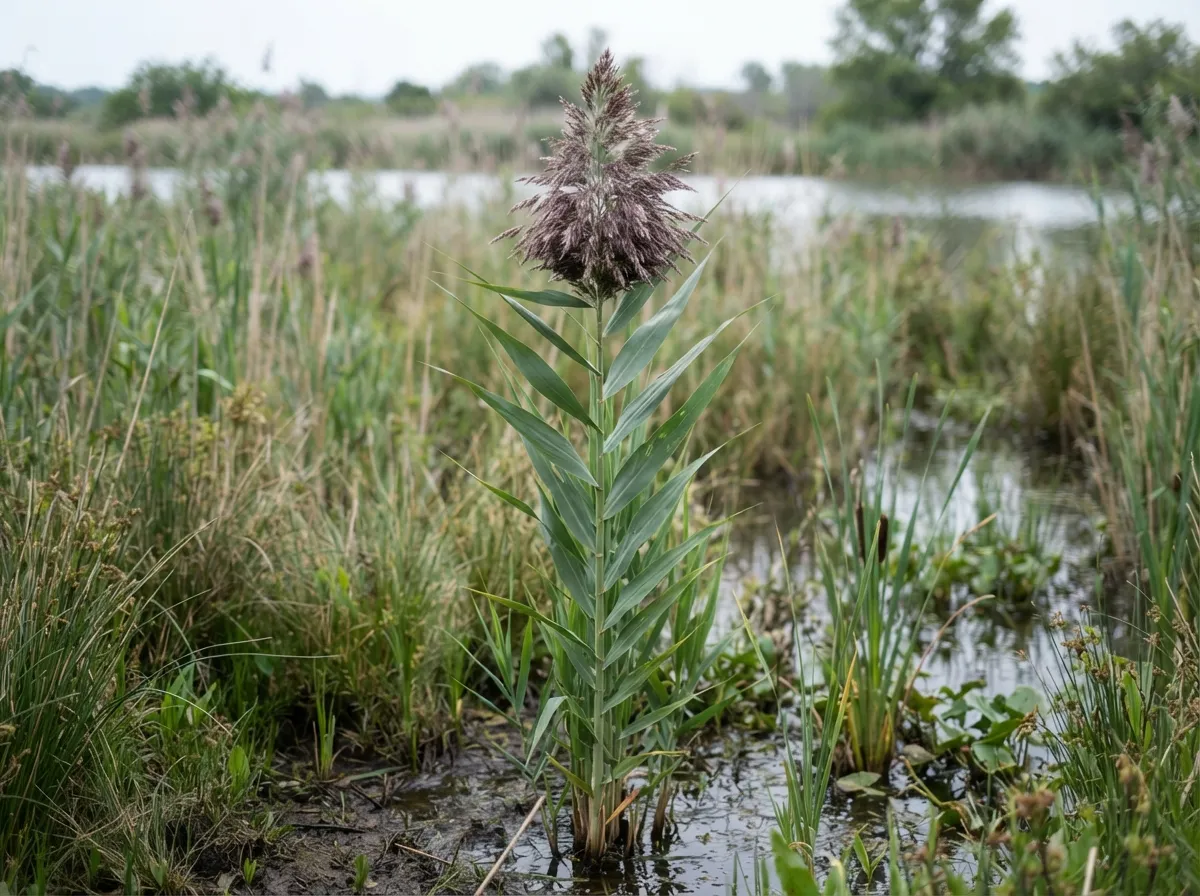
🔍 Identify it without mistakes
Large perennial grass forming huge, dense reed beds along water edges, with stiff upright stems up to 4 m, broad flat leaves arranged in two rows, and a large feathery brownish-purple to silvery panicle in late summer that persists through winter. It is one of the most widely distributed flowering plants in the world, found on every continent except Antarctica.
- stiff, upright stems forming dense monospecific reed beds
- feathery terminal panicle, brownish-purple then silvery
- broad leaves arranged in two opposing rows
- creeping rhizomes forming a dense network beneath the mud
⚠️ Not to be confused with
To tell them apart: common reed has round, hollow, jointed stems bearing flat leaves arranged in two rows along a cane, with a large feathery terminal panicle; yellow flag grows in a fan of strap-like leaves directly from a fleshy, segmented rhizome (never a jointed upright cane) and produces a characteristic bright yellow flower in summer — if no flower is present, break a piece of the rhizome: reed rhizomes are fibrous and stringy, while iris rhizomes are fleshy and smooth
🍽️ Eating it
Preparation : peeled young shoots eaten raw or cooked like asparagus; starch-rich rhizome pounded and dried into a supplementary flour by many North American and Eurasian Indigenous peoples
🪓 Other bushcraft uses
- dry hollow stems traditionally woven into thatch roofing, mats, and partitions throughout Eurasia
- dry stem used as quick-burning kindling and as arrow shafts
No entry replaces a certain identification in the field, or medical advice. When in doubt: don't eat it. If ingestion is suspected: poison control or 112/911.