🏹 Arrowhead (duck potato)
Sagittaria sagittifolia · Alismataceae
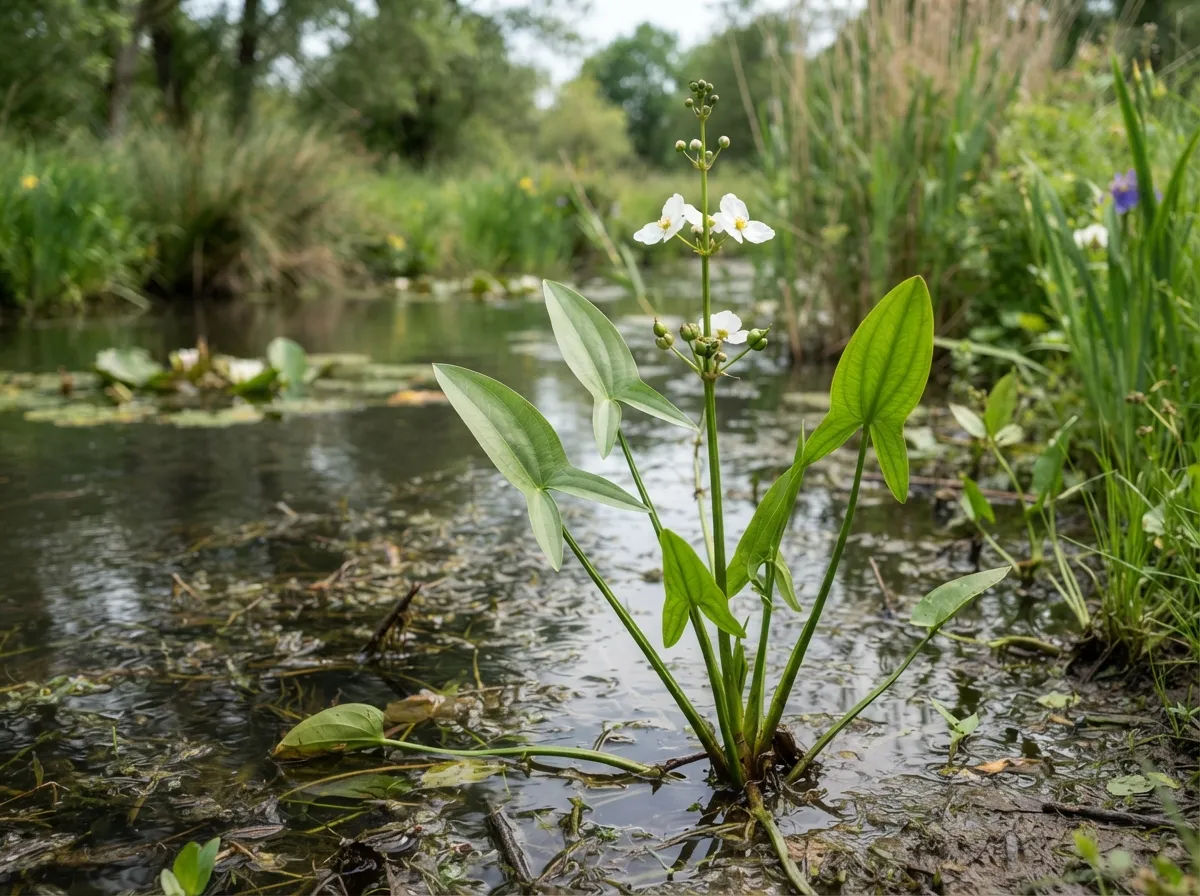
🔍 Identify it without mistakes
An aquatic plant instantly recognizable by its large emergent leaves shaped like arrowheads (hence its name, from the Latin sagitta, "arrow"), standing above the water on long, triangular stalks. Beneath the water and mud, it produces small starchy tubers in late summer similar to small potatoes, edible once cooked — the same species is cultivated in East Asia as Chinese arrowhead.
- distinctive arrowhead-shaped emergent leaves with 3 lobes, two of which point backward
- small white flowers with 3 petals, spotted with purple at the base, arranged in whorls along an erect stem
- round to oval tubers, yellowish-white, forming at the end of the season at the tip of underground stolons in the mud
- submerged leaves, when present, ribbon-like and elongated, very different from aerial leaves
- grows in shallow, calm water, often in dense colonies
⚠️ Not to be confused with
To tell them apart: the arrowhead leaf has a very distinct 3-pointed arrow shape, while the water-plantain leaf is oval-lanceolate, lacking the two characteristic rear lobes
🍽️ Eating it
Preparation : tubers harvested by hand or with a rake in the mud, peeled then boiled or fried like potatoes, never eaten raw; the species is cultivated on a large scale in China and Japan (variety leucopetala), where the tubers are a traditional New Year dish
🪓 Other bushcraft uses
- arrowhead-shaped emergent leaves are sometimes used as an improvised navigation landmark along slow-moving streams, as their shape always points downstream
Sources (1)
No entry replaces a certain identification in the field, or medical advice. When in doubt: don't eat it. If ingestion is suspected: poison control or 112/911.