🌰 Australian sandalwood
Santalum spicatum · Santalaceae
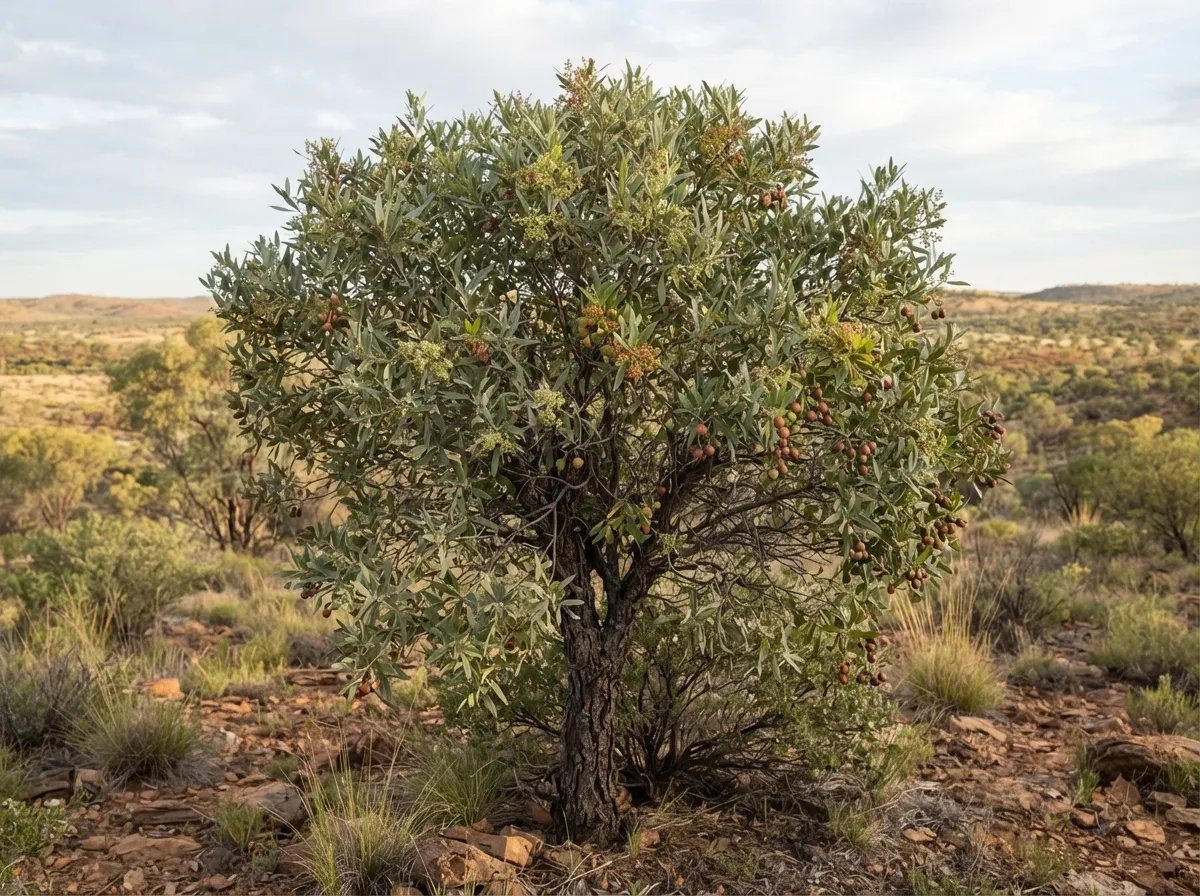
🔍 Identify it without mistakes
Small hemiparasitic tree or shrub about 6 m tall with grey-green foliage, growing in the semi-arid zone of southwestern Australia. Like the desert quandong, it draws part of its nutrients via the roots of a host plant. Its spherical orange fruit, about 3 cm across, contains an edible nut with a smooth shell—smoother than that of its close relative, the quandong.
- grey-green foliage on a shrub or small tree about 6 m tall
- spherical orange fruit about 3 cm in diameter
- hard-shelled nut with a smooth surface (smoother than quandong)
- hemiparasitic roots depending on a host plant for part of its nutrients
⚠️ Not to be confused with
To tell them apart: both species are hemiparasitic Santalum sharing the same semi-arid habitat, but Australian sandalwood has a smoother nut shell compared to the rougher, pitted shell of the quandong; sandalwood timber is also far more fragrant (coveted essential oil), unlike the quandong
🍽️ Eating it
Preparation : crack open the hard nut to extract the kernel, which can be eaten raw or roasted, just like quandong; used as a survival bushfood for thousands of years by Indigenous Australians of the southwest
💊 Healing with it
traditionally used by Indigenous Australians as bushfood and traditional medicine, particularly in fumigation ceremonies using its fragrant wood
Level of evidence : traditional use — Wikipedia — Santalum spicatum
⚠️ no specific precautions known for the nut kernel
🪓 Other bushcraft uses
- sandalwood essential oil, valued at around 1,000 AUD/kg, exported for perfumery and used for its antimicrobial properties
- wood used in traditional fumigation ceremonies
Sources (1)
No entry replaces a certain identification in the field, or medical advice. When in doubt: don't eat it. If ingestion is suspected: poison control or 112/911.