🌲 Fir and Spruce (buds)
Abies alba / Picea abies · Pinaceae
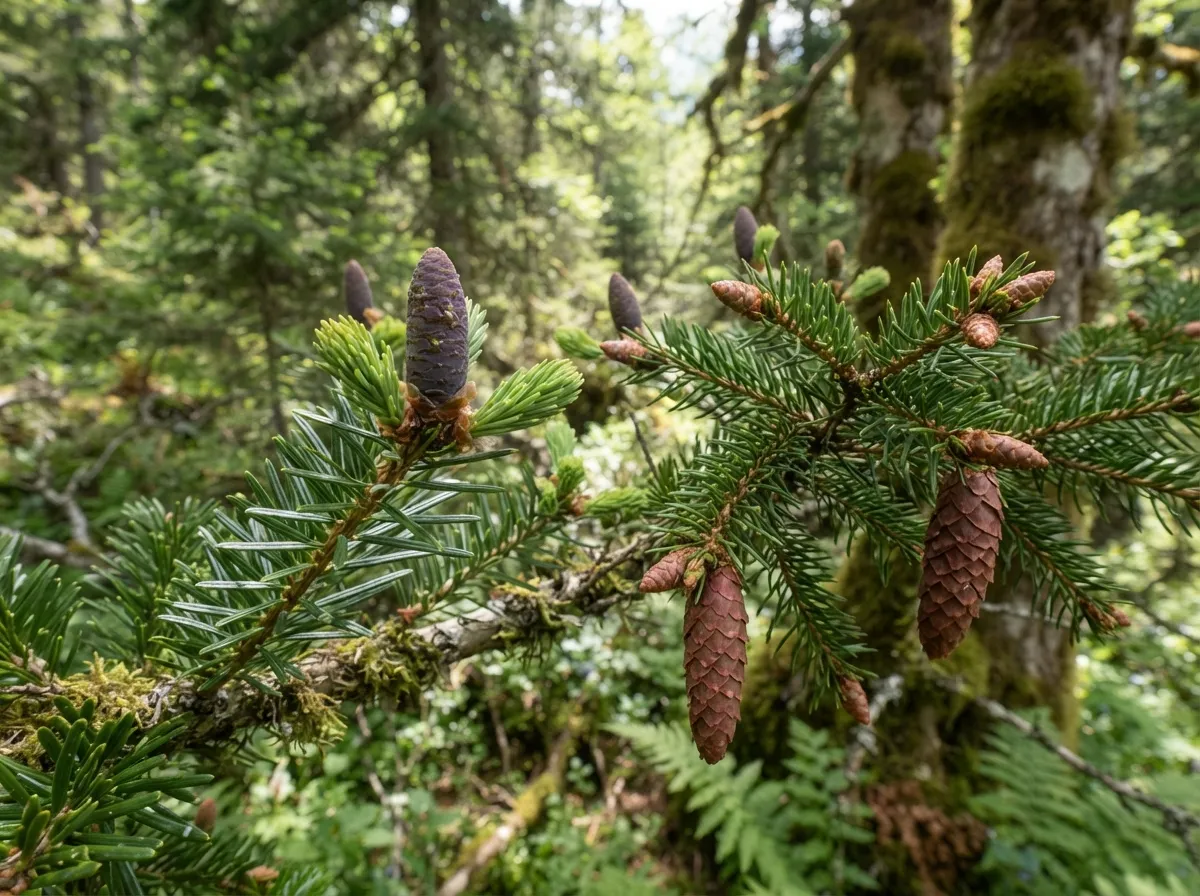
🔍 Identify it without mistakes
Two large conifers often confused by beginners, but easy to distinguish by their needles and cones. The silver fir has flat needles arranged flat on either side of the twig (like a comb), marked with two white bands on the underside, and its upright skyward cones disintegrate on the tree without ever falling whole to the ground. The Norway spruce has sharp needles arranged all around the twig (3D square cross-section), and its hanging cones fall whole to the ground once mature.
- fir: flat needles laid out flat like a comb, upright cones that never fall whole
- spruce: sharp needles all around the twig, hanging cones falling whole
- fir: two white stripes on the underside of the needle
- spruce: scaly reddish-brown bark, very slender arrowhead silhouette
- both: resinous terminal buds in spring, the base of the edible harvest
⚠️ Not to be confused with
To tell them apart: yew has flat needles arranged in 2 comb-like rows like the fir, but its bark is scaly brown-reddish and above all it never produces woody cones: its fruits are fleshy red arils open to a single visible toxic black seed — if you have any absolute doubt about a young conifer without identifiable cones, do not harvest
🍽️ Eating it
Preparation : young tender shoots eaten raw (resinous-citrus taste) or processed into fir bud syrup (well-established Vosges and Alpine tradition); chopped needles infused for 10 minutes in an herbal tea rich in vitamin C
approx, young shoot tea/syrup, order of magnitude cited by several Alpine and Nordic phytotherapy sources
💊 Healing with it
buds traditionally used in syrup and inhalation for respiratory ailments (cough, mild bronchitis), balsamic and mild expectorant properties
Level of evidence : traditional use — Alpine and Nordic phytotherapeutic compilations (Fournier, Vosges tradition of fir syrup)
⚠️ pure essential oil of fir/spruce is irritating and should never be ingested directly; bud syrup and tea at usual doses are safe
🪓 Other bushcraft uses
- resin used as a fire starter and waterproofing pitch
- spruce historically the main wood species for luthiery (violin soundboards, the famous "tonewood" of the Val di Fiemme used by Stradivarius)
- lower branches as an insulating ground layer under a makeshift shelter in the forest
No entry replaces a certain identification in the field, or medical advice. When in doubt: don't eat it. If ingestion is suspected: poison control or 112/911.