🍐 Service tree (corm)
Sorbus domestica · Rosaceae
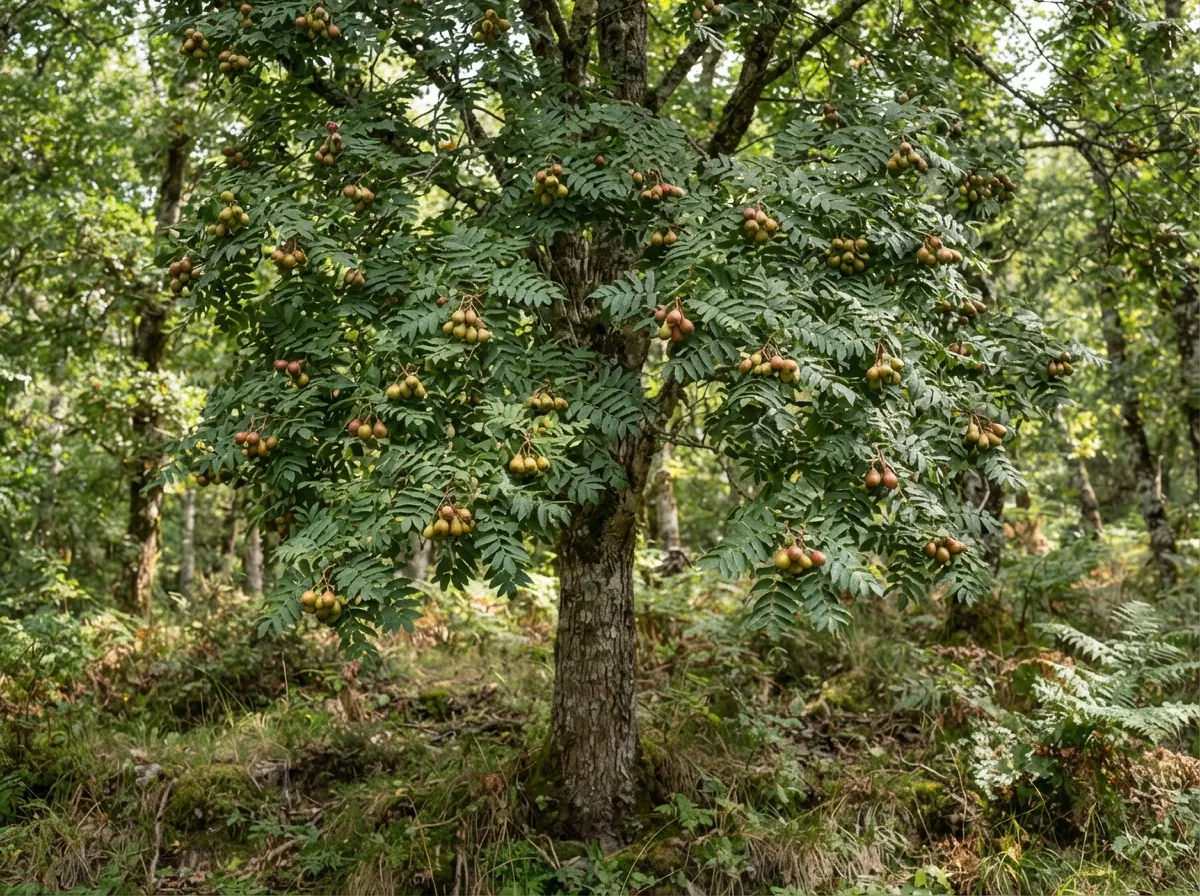
🔍 Identify it without mistakes
Large, rare, and very slow-growing tree, a more imposing cousin of the common rowan. Its fruits (service berries or corms), shaped like small pears or apples depending on the tree, are much larger (up to 3 cm) than the small red berries of the rowan. Its bark remains smooth for longer, cracking into small square plates with age—a trait that earned it the nickname 'tree of a hundred crowns' in reference to the pattern of its mature bark.
- fruits (corms) shaped like small pears or apples, up to 3 cm, much larger than rowan berries
- leaflets with rounded edges, often symmetrical and untoothed at the base (unlike rowan, which is toothed to the base and asymmetrical)
- buds hairless and sticky (rowan has hairy buds)
- bark smooth when young, cracking into characteristic small square plates with age
- extremely slow growth, tree capable of living for several centuries
⚠️ Not to be confused with
To tell them apart: rowan has much smaller round fruits (under 1 cm), bright red, leaflets toothed to the base, and hairy buds, unlike the service tree
🍽️ Eating it
Preparation : like medlars, the corm is acrid and astringent (tannins) when picked: you must let it blet (soften) after the first frosts or after several weeks of storage before eating it raw, or cook it into jelly, compote, or fruit brandy (traditional corm cider/spirit)
🪓 Other bushcraft uses
- extremely hard and dense wood (one of the hardest in Europe, denser than oak), traditionally used for press screws, mallets, and mechanical clock parts before the industrial era
Sources (3)
No entry replaces a certain identification in the field, or medical advice. When in doubt: don't eat it. If ingestion is suspected: poison control or 112/911.