🫐 American elderberry
Sambucus canadensis · Adoxacées
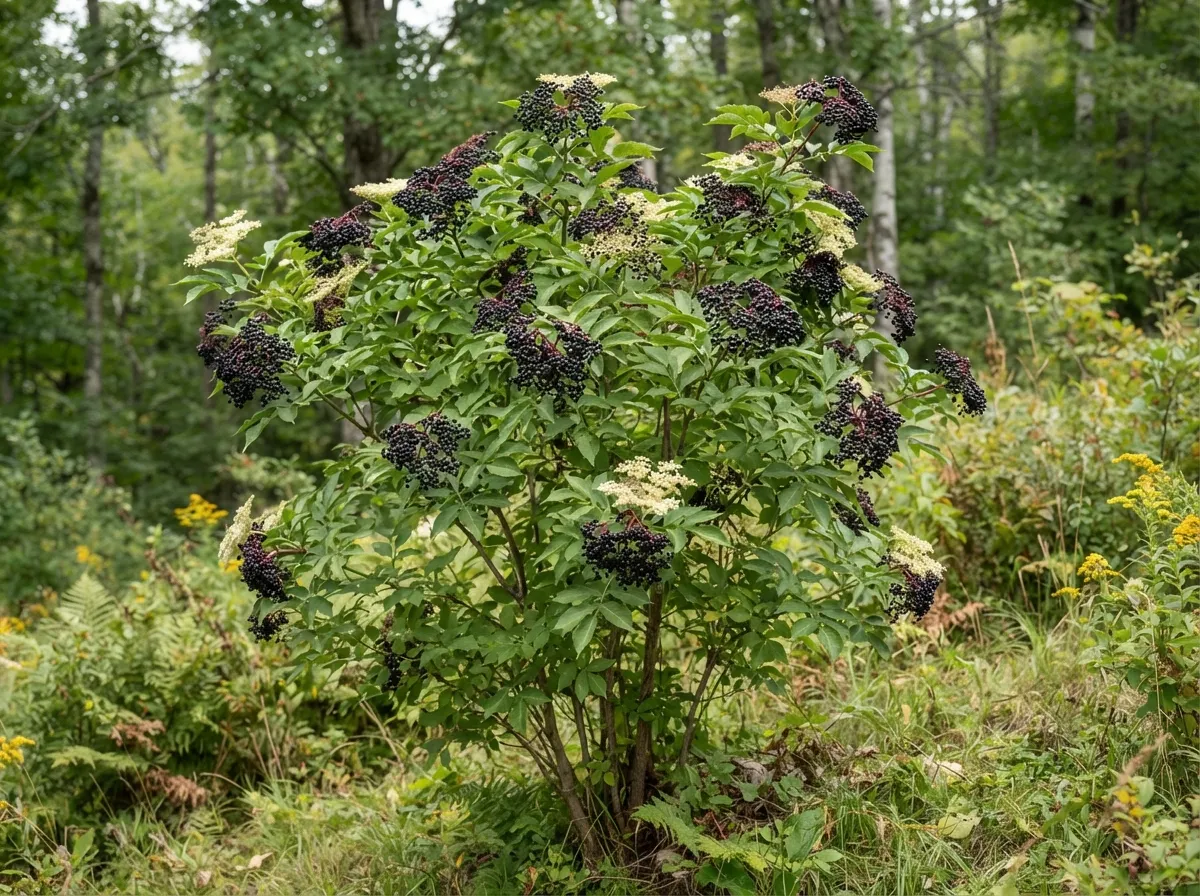
🔍 Identify it without mistakes
Fast-growing shrub, hollow stems with thick white pith, opposite compound leaves with serrated leaflets. Large, flat clusters of creamy white, highly fragrant flowers in summer, followed by drooping clusters of small purple-black berries when ripe.
- opposite compound leaves, 5-11 serrated leaflets
- stems with spongy white pith clearly visible in cross-section
- flat flower clusters, never pointed cones
- purple-black berries in drooping clusters when ripe
⚠️ Not to be confused with
To tell them apart: flower clusters form a pointed cone (not a flat cluster) and bright red berries (rarely black) ripening early in spring; avoid out of caution unless carefully cooked and with confirmed local knowledge
To tell them apart: chokecherry bears an elongated cylindrical cluster of drupes containing a single large pit, on wood with a bitter almond scent; elderberry bears broad, flat clusters of berries containing several tiny seeds, on stems with white pith
🍽️ Eating it
Preparation : eat the flowers fresh in fritters or infused in syrups/cordials; berries MUST be cooked (heat) before consumption, never eaten raw in large amounts — use them cooked in jams, syrups, wine, or sauces, as the seeds and raw skin contain cyanogenic glycosides
💊 Healing with it
elderberry syrup is traditionally used against cold and flu symptoms; flower tea acts as a diaphoretic and anti-inflammatory remedy for respiratory tracts
Level of evidence : limited studies — PubMed / review on processed Sambucus nigra products, ScienceDirect S002364381630247X
⚠️ roots, bark, leaves, and stems (including pith) contain significantly higher concentrations of cyanogenic glycosides (sambunigrin) than the berries and must never be consumed; raw green berries cause nausea, vomiting, and diarrhea; cooking reduces these compounds by 80 to 96% depending on the preparation
🪓 Other bushcraft uses
- hollow stems used as traditional blowguns, flutes, and blowpipes (once the pith is hollowed out)
- purple dye extracted from the berries
Sources (3)
No entry replaces a certain identification in the field, or medical advice. When in doubt: don't eat it. If ingestion is suspected: poison control or 112/911.