🌲 Northern white-cedar (Eastern arborvitae)
Thuja occidentalis · Cupressaceae
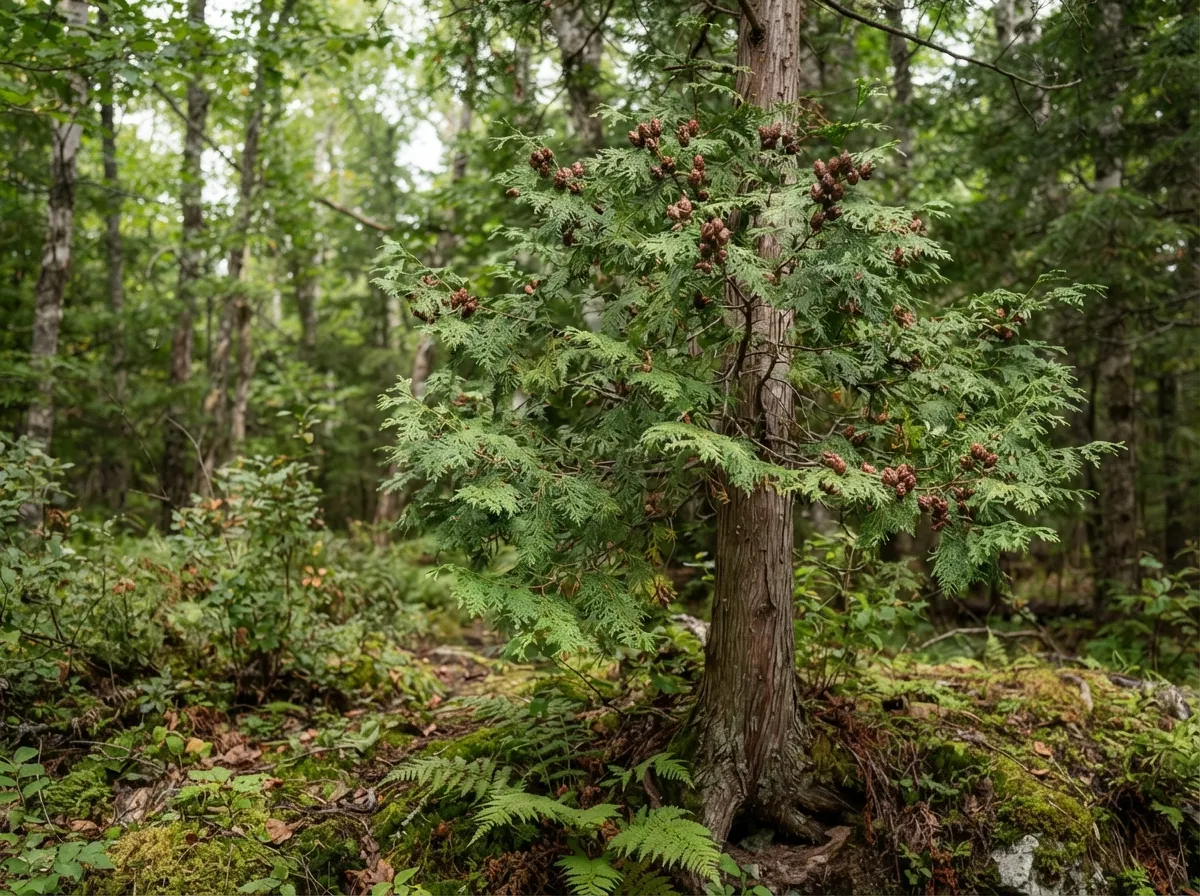
🔍 Identify it without mistakes
Small to medium conifer with flat, fan-shaped foliage of scale-like leaves, aromatic when crushed (resinous scent). Fibrous reddish-brown bark peeling off in long vertical strips. Small erect ovoid cones with few scales. Grows in dense stands ("cedar swamps") on moist, calcareous soils.
- flat, fan-shaped foliage with scale-like leaves (not needles)
- strong aromatic scent when crushed (resinous, slightly medicinal)
- fibrous reddish-brown bark peeling in long vertical strips
- small erect ovoid cones (1 cm) with few scales
⚠️ Not to be confused with
To tell them apart: white-cedar has flat fan-like foliage, while redcedar has sharp needle-like leaves or finer scale-like leaves on rounded branchlets
To tell them apart: western redcedar is much larger and grows on the Pacific coast, with more fibrous and reddish bark; their native ranges do not overlap
💊 Healing with it
inner bark and leaves are rich in vitamin C, infused into tea by Indigenous peoples of northeastern America to prevent and treat scurvy — this very remedy saved Jacques Cartier's crew in 1536 during his second voyage to Canada, identified as white-cedar by botanist Jacques Rousseau in the 20th century
Level of evidence : traditional, historically confirmed (rapid and documented recovery of Cartier's entire crew) — Wikipédia FR — Thuya occidental (recounts the identification by Jacques Rousseau)
⚠️ essential oil and concentrated preparations contain thujone, which is neurotoxic and abortifacient in high doses — never ingest essential oil, drink light tea only, and never consume if pregnant
🪓 Other bushcraft uses
- cordage and basketry: the fibrous inner bark peels into long, tough strips, used by Indigenous peoples for cordage, basketry, and weaving mats
- shingles and posts: wood is highly rot-resistant, a North American benchmark for roofing and fencing — cedar that lasts for decades without treatment
- boreal tinder: the fibrous, dry outer bark, shredded into fine fluff, catches fire easily even when slightly damp, comparable to birch
- smudging: burned resin and foliage release an aromatic smoke traditionally used in purification ceremonies by First Nations
- fine cordage: flexible roots used in fine basketry and for lashing birch bark canoes, similar to spruce roots
- winter vitamin C: evergreen foliage rich in vitamin C, a reliable anti-scurvy resource even in the depth of boreal winter
- lightweight paddles: light and soft wood, easy to split into thin boards with an axe to craft paddles and chests
No entry replaces a certain identification in the field, or medical advice. When in doubt: don't eat it. If ingestion is suspected: poison control or 112/911.