🌳 Common Aspen
Populus tremula · Salicacées
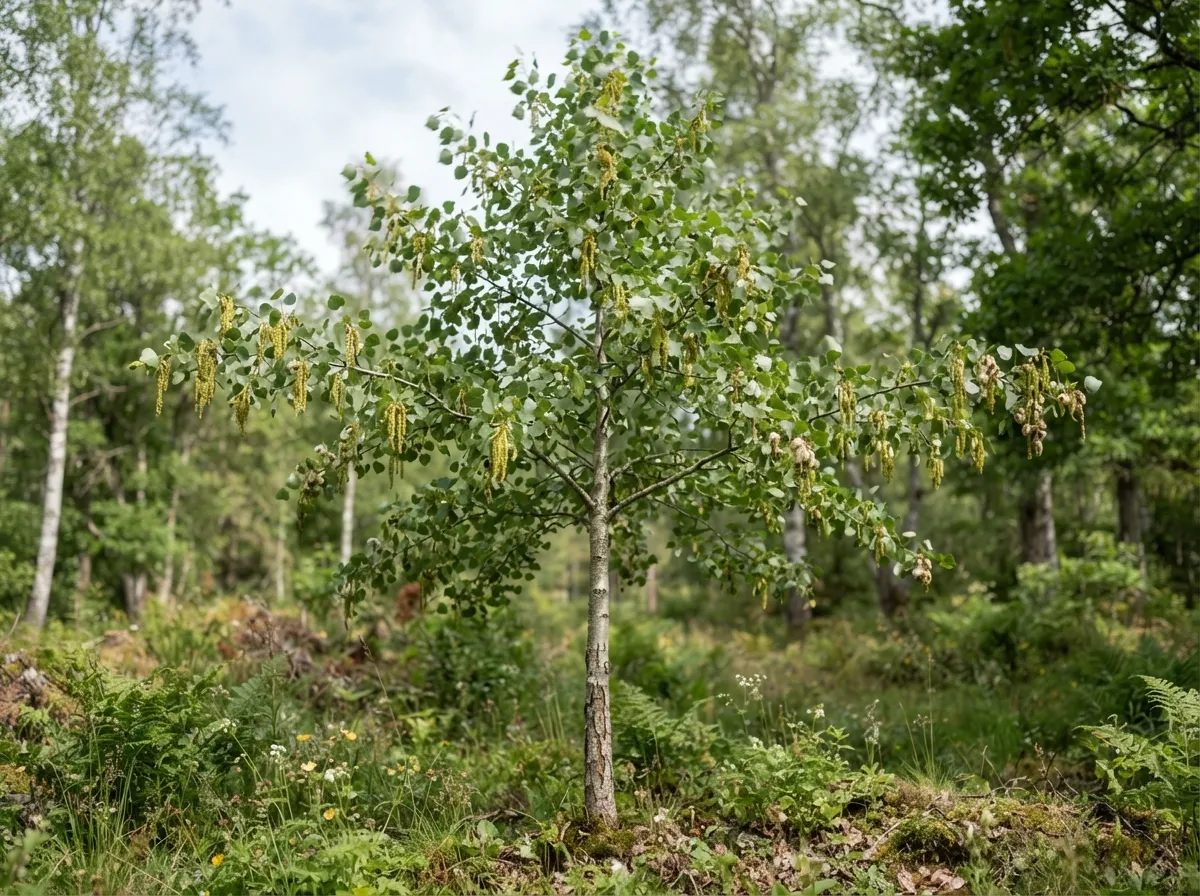
🔍 Identify it without mistakes
Pioneer tree with greenish-white to grey-green bark that stays smooth for a long time (marked with diamond shapes), blackening and cracking only at the base of old specimens. Rounded leaves borne on a petiole flattened perpendicularly to the blade, making them tremble at the slightest breeze — hence its name. Brown, shiny, sharp, and sticky buds.
- smooth grey-green to whitish bark, remaining uncracked for a long time
- rounded leaves on a petiole flattened perpendicularly to the blade: they tremble continuously
- shiny, pointed, and sticky brown buds
- pioneer species quickly colonizing clearings and burned areas
⚠️ Not to be confused with
To tell them apart: black poplar stays confined to riverbanks, has darker and furrowed bark, and its leaves do not tremble the same way (less flattened petiole)
🍽️ Eating it
Preparation : cambium scraped with a blade under the outer bark, eaten raw (slightly sweet-astringent) or dried and ground into flour to stretch meal — a documented survival food among Sami and Siberian peoples; young catkins eaten raw or sautéed
💊 Healing with it
buds and bark rich in salicin and populin (precursors of salicylic acid), traditionally used as a fever reducer and painkiller, just like willow bark
Level of evidence : traditional use — conservation-nature.fr ; European phytotherapy literature
⚠️ salicylate allergy, caution if taking blood thinners
🪓 Other bushcraft uses
- friction fire (bow-drill): soft and dry wood, classic in Northern Europe and Scandinavia for hearth board and spindle
- tinder: the cottony down from seeds ('summer snow' in June) catches fire instantly from a spark
- bark: strips off in wide sheets usable for small containers or light emergency shelter roofs (less waterproof than birch, but good for quick fixes)
- edible cambium: survival resource documented among Sami and Siberian peoples during winter/spring food shortages
- light wood (density ~0.4) easy to carve with a knife for crude spoons, whistles, and small items
- fodder: leaves and twigs are highly favored by elk/moose and beaver — a good indicator of their presence
- auditory landmark: the characteristic rustling of the trembling foliage in the slightest wind signals the tree's presence before you even see it
No entry replaces a certain identification in the field, or medical advice. When in doubt: don't eat it. If ingestion is suspected: poison control or 112/911.