🌾 White veratrum
Veratrum album · Melanthiaceae
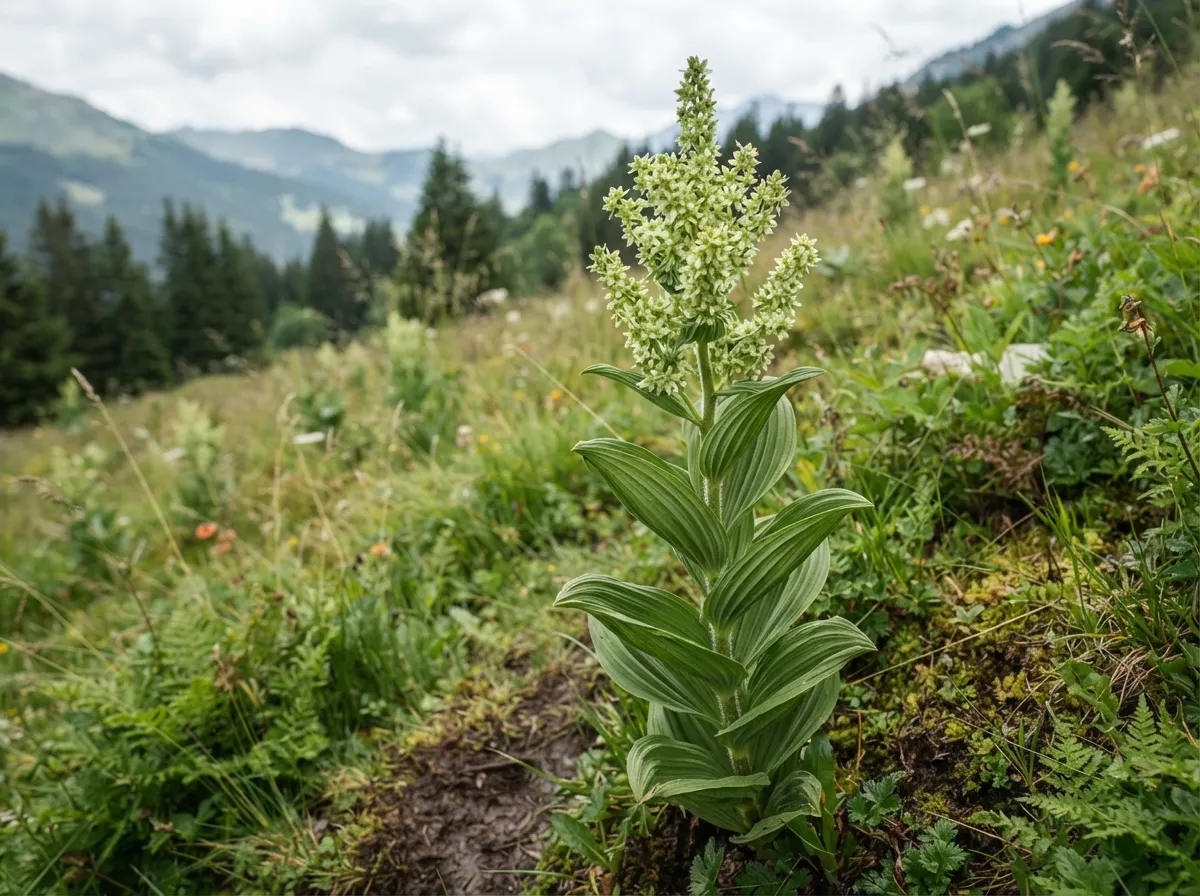
🔍 Identify it without mistakes
Large, upright, and robust alpine plant whose broad, fan-pleated leaves at the base closely resemble those of yellow gentian in the vegetative stage, before flowering — a classic and well-documented confusion among gatherers of gentian roots for traditional aperitifs, responsible for collective poisonings every summer in the Alps.
- broad, oval leaves, strongly pleated longitudinally (prominent parallel veins), arranged spirally along the stem
- greenish-white flowers in a large erect panicle (only in flowering years, often after several vegetative years)
- stout, unbranched stem, hairy at the top
- short, fleshy root (rhizome), very bitter
⚠️ Not to be confused with
To tell them apart: gentian leaves are OPPOSITE in pairs on the stem and hairless, whereas veratrum leaves are ALTERNATE (spiral) and pleated with fine hairs on the underside at the top of the stem; if in doubt, never pull up a root before flowering confirms its identity
To tell them apart: alpine dock has very large heart-shaped leaves with pinnate veins, a fleshy petiole, and a distinctly sour taste; veratrum has oval leaves with very prominent parallel veins, pleated, alternately clasping the stem, without acidity
☠️ What kills
First steps : Call the poison control center at the first sign of vomiting after drinking tea or spirits made from a root mistaken for gentian. Do not induce further vomiting (vomiting is already the main symptom and often uncontrollable). Keep a sample of the harvested root to confirm the species.
Sources (3)
No entry replaces a certain identification in the field, or medical advice. When in doubt: don't eat it. If ingestion is suspected: poison control or 112/911.