🍇 Riverbank grape (wild grape)
Vitis riparia · Vitacées
🔍 Identify it without mistakes
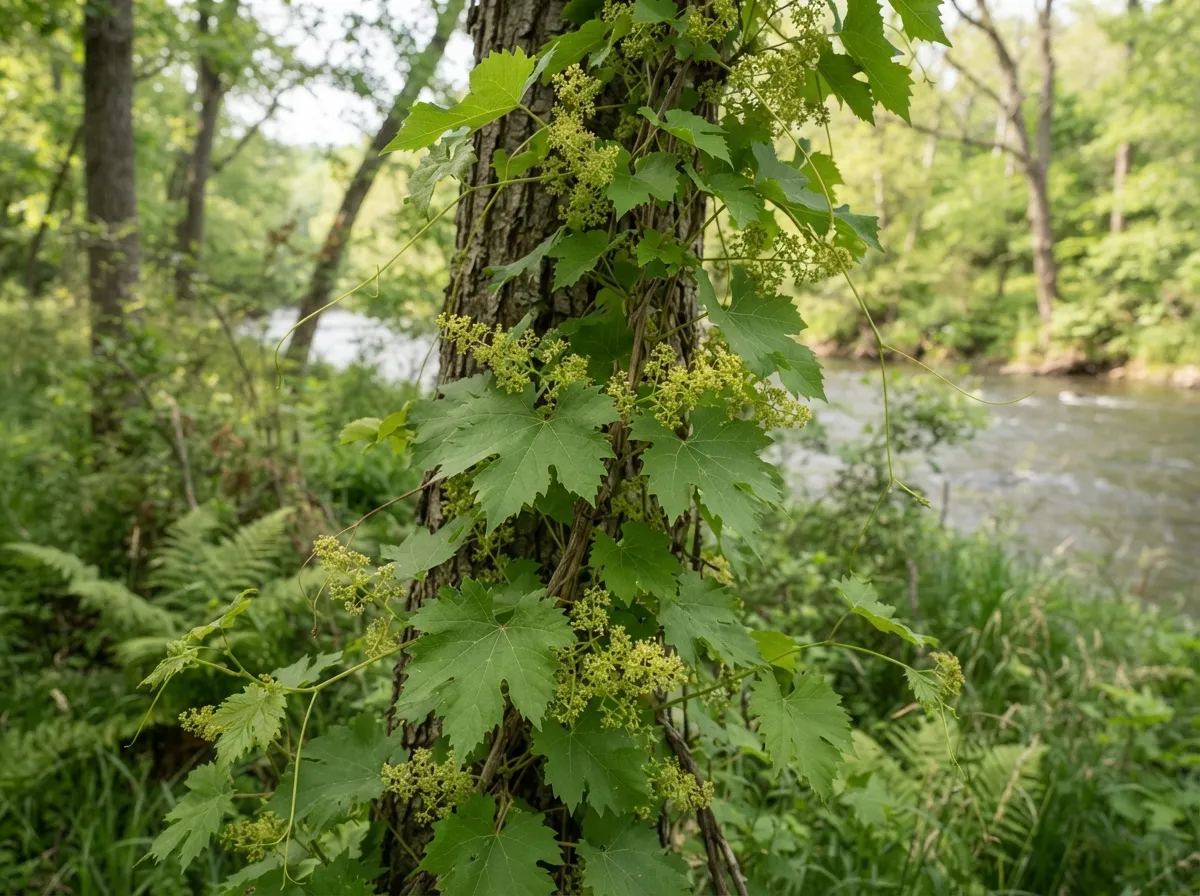
Vigorous vine climbing by bifid (forked) tendrils over trees and bushes, simple leaves broadly lobed with coarse teeth, bark on old stems peeling off in long stringy strips. Clusters of small round blue-black grapes when ripe, each berry containing several round seeds.
- forked (bifid) tendrils opposite the leaves, not at every node
- bark peeling in long stringy strips on older stems
- round seeds, several per berry
- hanging clusters of blue-black grapes at maturity
⚠️ Not to be confused with
To tell them apart: forked tendrils present on the grape vine, ABSENT on moonseed (which climbs by twining without tendrils); multiple round seeds in grape berries versus A SINGLE crescent moon-shaped seed in moonseed — a decisive feature if fruit is already picked; grape leaves have coarse teeth and clear palmate veins versus moonseed leaves with usually smoother edges and petiole attached slightly inside the margin (peltate)
🍽️ Eating it
Preparation : eat the grapes raw (tart) or make them into jelly, juice, or vinegar; blanch young leaves to wrap rice like Mediterranean grape leaves; eat tender tendrils raw in salads
💊 Healing with it
spring sap ("tears" from cut vines) traditionally used as an eyewash; leaf poultice applied to headaches
Level of evidence : traditional use — Native American Ethnobotany Database (Moerman, University of Michigan)
⚠️ always double-check for forked tendrils AND seed shape before eating any wild grape look-alike
🪓 Other bushcraft uses
- resistant rootstock used worldwide in viticulture (phylloxera resistance that saved European vineyards in the 19th century)
- vine used for basketry and coarse cordage
Sources (3)
No entry replaces a certain identification in the field, or medical advice. When in doubt: don't eat it. If ingestion is suspected: poison control or 112/911.