Falling Into Ice-Cold Water: 1 Minute, 10 Minutes, 1 Hour
The ice cracks, and you're in the water before you even realize what happened: three clocks start ticking at once, and only one decides if you make it out.
The ice cracked without warning, and now you’re in 2 °C water, your breath knocked out of you like you just got punched in the gut. You want to scream, but you can’t. That’s normal: your body has just entered the first of three phases that, over the course of an hour, decide whether you survive — and most people who drown in cold water die before hypothermia even has time to set in.
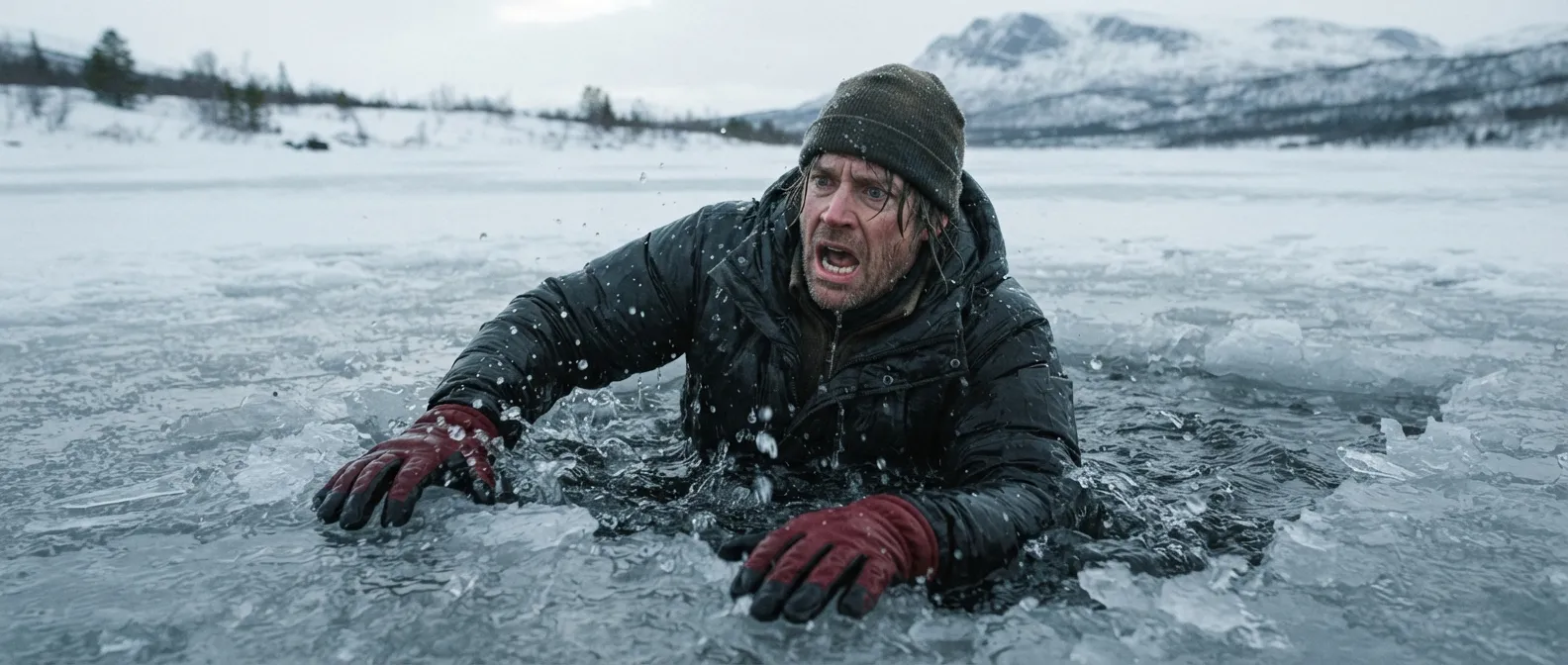
The First Minute: Cold Shock Response
When your body hits water below 15 °C, it triggers a cascade of reflexes that willpower alone can’t stop: your skin contracts, your heart rate spikes, and above all, an involuntary gasp reflex makes you inhale sharply — right when your head might be underwater. This cold shock response, documented by Canadian physiologist Gordon Giesbrecht, is what kills the fastest: inhaling water at the wrong moment causes drowning in seconds, without a single trace of muscle exhaustion coming into play.
Giesbrecht summarized what you need to do in a rule popularized on American television in 2004: the 1-10-1 principle. One minute to regain control of your breathing, ten minutes of useful movement left, one hour before losing consciousness from hypothermia. Three numbers, three different priorities, in that exact order.
- Don’t swim immediately. The gasp reflex usually lasts less than sixty seconds; trying to swim through it means swallowing water.
- Hold onto anything that floats or the nearest solid edge — broken ice, an object, the rim of the hole — just to keep your head above water.
- Take small, controlled breaths, counting if it helps you focus on something other than panic.
- Wait until your breathing settles before making any rescue attempt. One minute max — after that, every second lost counts twice as much.
The Ten Minutes: Rising Incapacitation
Once the initial shock passes, a different countdown begins: the one for your muscles. The cold slows down nerve conduction and stiffens muscle fibers in your hands, arms, and legs. In about ten minutes, most people lose the ability to swim effectively, pull themselves up, or even wrap a fist around a thrown rope. Giesbrecht emphasizes that actual hypothermia takes over an hour to set in for an adult, but you can drown way before that simply because your body stops obeying your commands.
The Remaining Hour: Hypothermia
If you haven’t made it out of the water by this point, your core body temperature starts dropping significantly. Medical science categorizes this into several stages, from intense shivering while still conscious (around 33–35 °C) to the cessation of shivering and confusion (30–32 °C), followed by unconsciousness with a barely perceptible pulse (below 28 °C). Full details on these stages and the symptoms to watch for at each level are available in the site’s Cold Tool.
If the Ice Breaks Under You: Self-Rescue
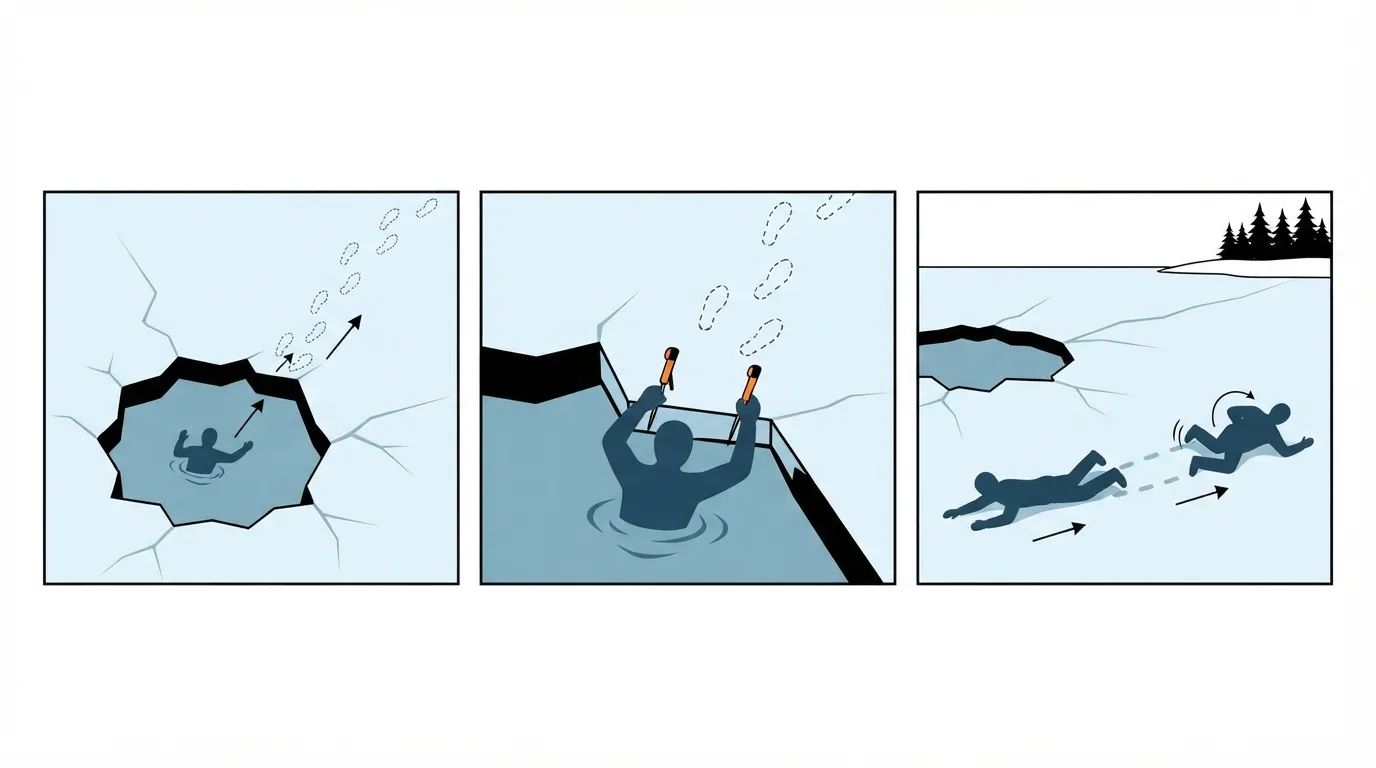
The technique that works always follows the same logic: distribute your weight, never concentrate it, and head back the way you came since that ice already proved it could hold you.
- Turn around back toward the direction you came from: it’s the only section of ice already tested by your weight.
- Spread your arms flat on the unbroken ice in front of you, as wide as possible, to spread your weight across a larger surface area.
- Kick your legs horizontally, like swimming, to push yourself forward rather than trying to pull yourself straight up with just your arms — that’s the main reason self-rescues fail.
- Crawl onto the ice once your torso is out, without standing up right away.
- Roll like a log once you reach an area you think is solid, keeping your weight spread out until you reach the shore.
Rescuing Someone Else: Never Step Out There Yourself
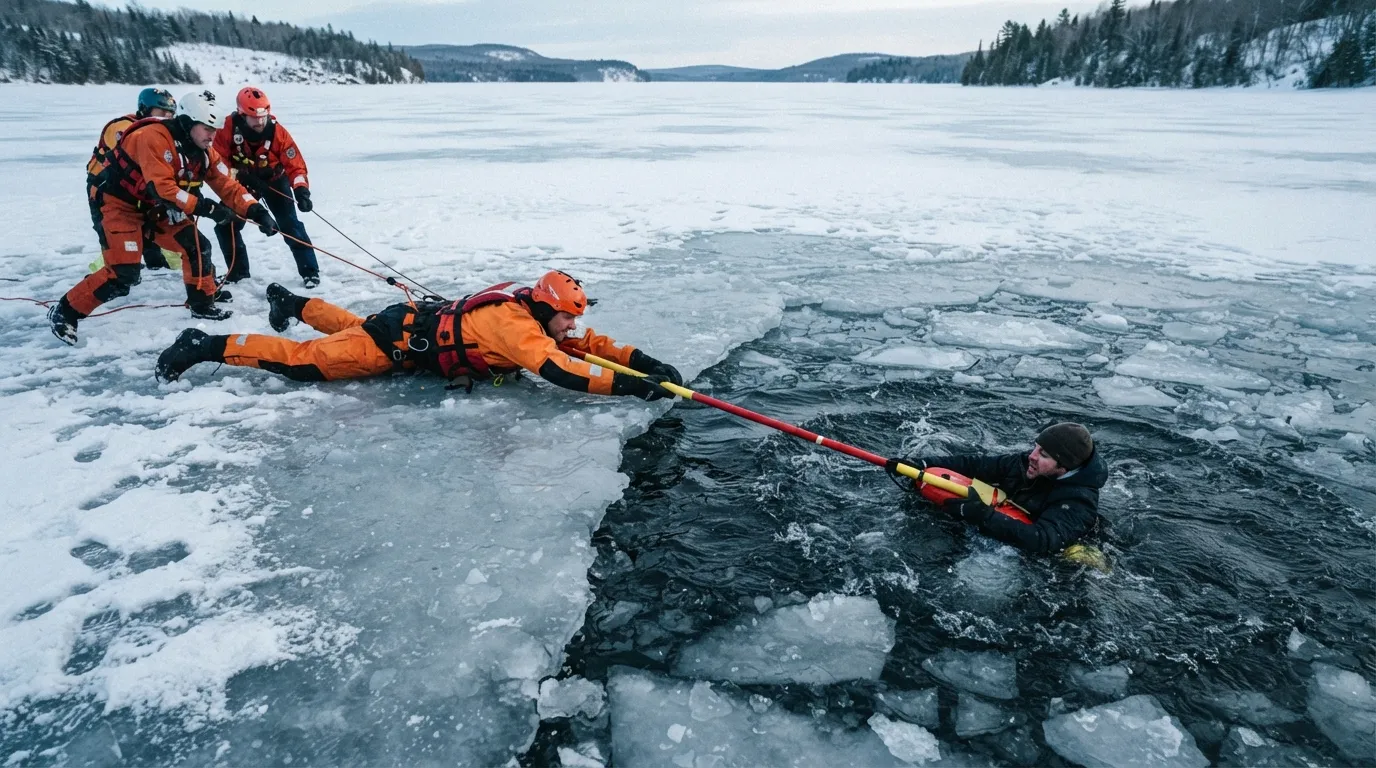
The most natural instinct — running toward the victim — is also the most dangerous: ice that already broke once will break even easier near the hole, turning a single rescue into two victims. Water rescue organizations teach a simple hierarchy, in this order:
| Reach | Throw | Row | Go | |
|---|---|---|---|---|
| Risk to rescuer | None | None | Low if using suitable craft | Maximal |
| What to use | Pole, branch, scarf, rope | Lifebuoy, weighted rope, any floating object | Boat, canoe, sled laid flat on the ice | Your own body, as an absolute last resort |
| When | Always first | If the victim is too far to reach | If reach/throw options aren't enough | Never without a flotation device and a line held from shore |
Afterward: The Danger of Afterdrop
Getting out of the water doesn’t mean you’re out of the woods. The coldest blood, trapped in your arms and legs during immersion, rushes back toward your core as soon as peripheral circulation restarts. This phenomenon, known as afterdrop, can cause your core body temperature to drop even further after leaving the water, sometimes causing cardiac arrest in a victim who seemed to be stabilizing.
- Remove wet clothing and replace it with dry layers, or wrap the victim over their clothes if nothing dry is available — wet fabric keeps leaching heat even out of the water.
- Insulate them from the ground and wind using whatever is available: sleeping bags, blankets, or body heat from others.
- Provide sugar if the victim is conscious and able to swallow, to fuel internal heat production.
- Never rub their limbs or apply direct, localized heat (hot water, fire, heaters): rewarming the extremities too fast speeds up afterdrop toward the heart.
- Get them to a hospital even if they seem fine: cardiac arrest from afterdrop can happen hours after getting out of the water, even when someone appears fully recovered.
Car in the Water: The Life-Saving Method
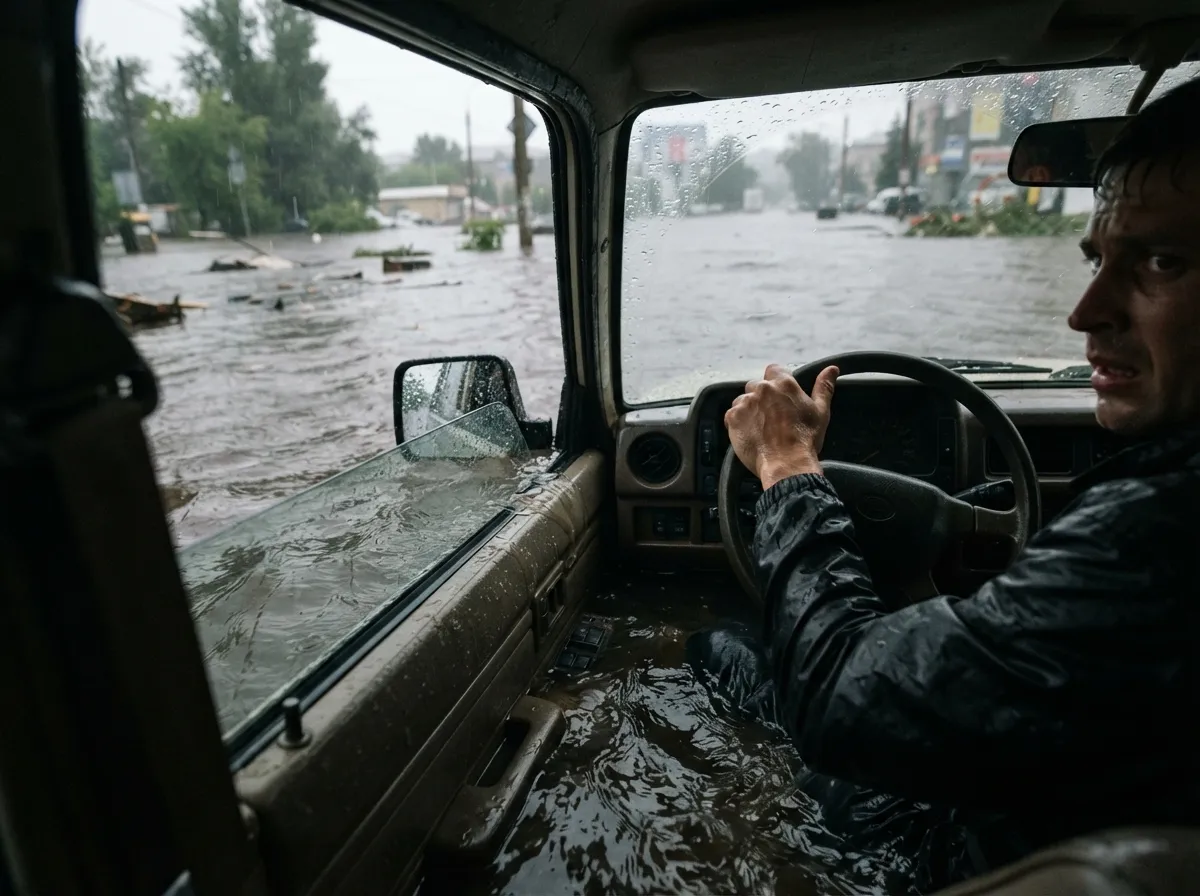
Gordon Giesbrecht dedicated part of his career to this exact scenario after testifying in an inquiry on the drowning death of a snowplow driver who fell through ice on a winter road — work that revealed up to 10% of all drownings occur inside a vehicle. His method, summarized in an acronym taught to North American emergency services, comes down to four words: Seatbelts off, Windows open, Children out, Exit (SWOC) — in that exact order, before the vehicle sinks too deep for electric windows to work.
- Unbuckle seatbelts for all passengers immediately, before doing anything else.
- Open the windows while the electrical system still works — water doesn’t need to rise very high to short the electronics.
- Free children from their seats first: they go out through the window first, assisted by an adult inside.
- Exit through the open window, not the door: outside water pressure makes opening a door nearly impossible until the cabin is completely full of water.
American media summarized Giesbrecht’s message with a striking headline: “What if you had 30 seconds to save your life?” — roughly the amount of time electric windows stay functional before short-circuiting.
Cold Acclimatization: Real Benefits, Real Risks
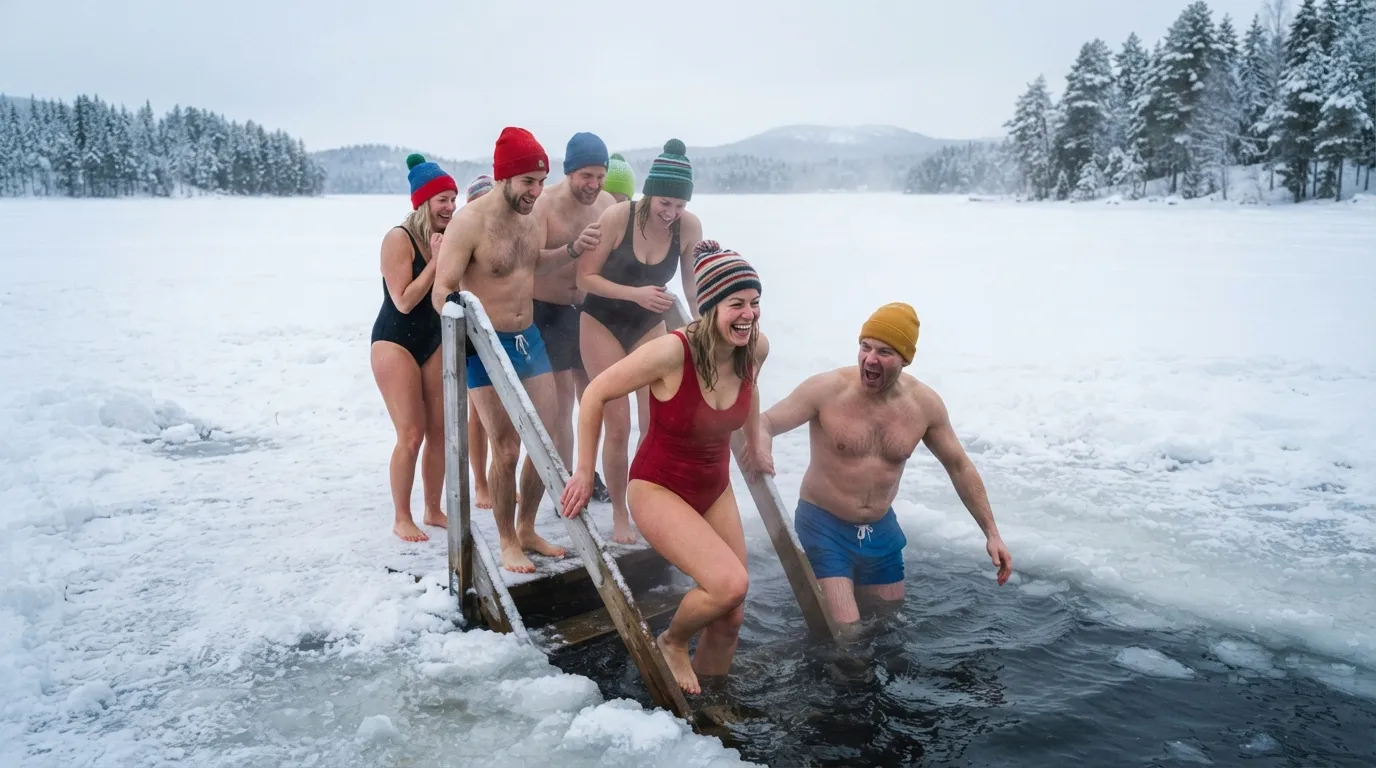
Organized winter swimming (winter swimming, or ice swimming under the ice) boasts measurable perks: regular winter swimmers report up to 40% fewer respiratory infections compared to control groups according to some studies, alongside lower perceived stress levels. The body can genuinely adapt: the traditional haenyeo female divers of South Korea’s Jeju Island naturally possess higher subcutaneous fat and a delayed shivering threshold compared to average — before adopting neoprene wetsuits, they still capped their winter dives at around an hour; with suits, they can go five to six hours today.
| Healthy, supervised person | Person with heart condition | Alone, unsupervised | Without gradual progression | |
|---|---|---|---|---|
| Cold shock | Manageable through training | Life-threatening danger | Real danger | Real danger |
| Measured benefit | Stress, immunity (limited studies) | Not recommended | Same, but without monitoring | None, increased risk |
| Recommendation | Gradual, a few minutes max | Medical approval required | Always go with someone | Always ease into the water |
What Ice Thickness Can Support What
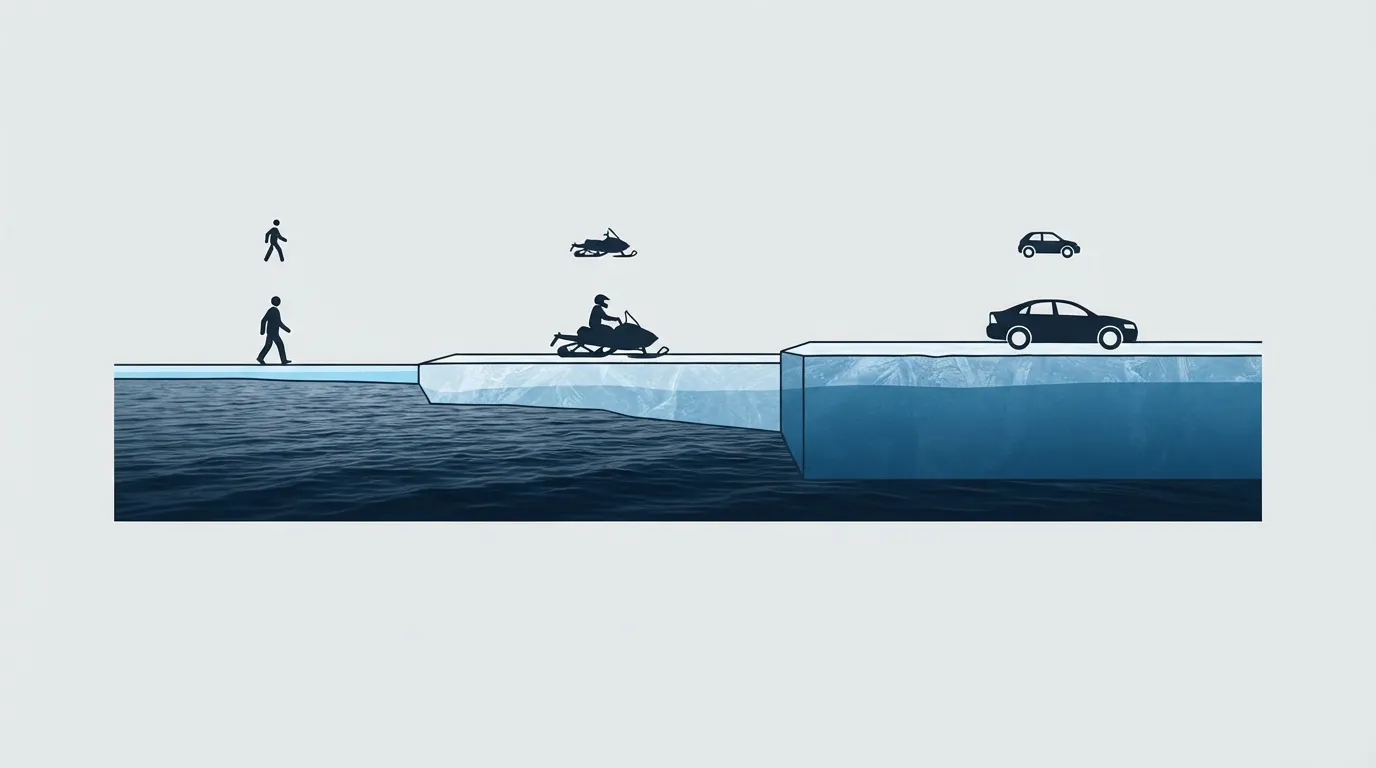
| Single Pedestrian | Snowmobile | Car (under 5 tons) | |
|---|---|---|---|
| Minimum thickness | ≈10 cm (4 in) | ≈12.5 to 18 cm (5–7 in) | ≈30 to 38 cm (12–15 in) |
| Safety margin | No clear ice = do not venture out | Drill test holes every 150 m | Limit speed to 25 km/h, never park long-term |
Never trust river ice: currents beneath the ice erode its thickness unevenly and invisibly from the surface — ice that looks just as thick as a frozen lake can be paper-thin or completely nonexistent in spots. North American safety agencies issuing these benchmarks repeat it constantly: these numbers apply only to clear, stagnant water, never to moving rivers.
Kayaking: Drysuit Above All
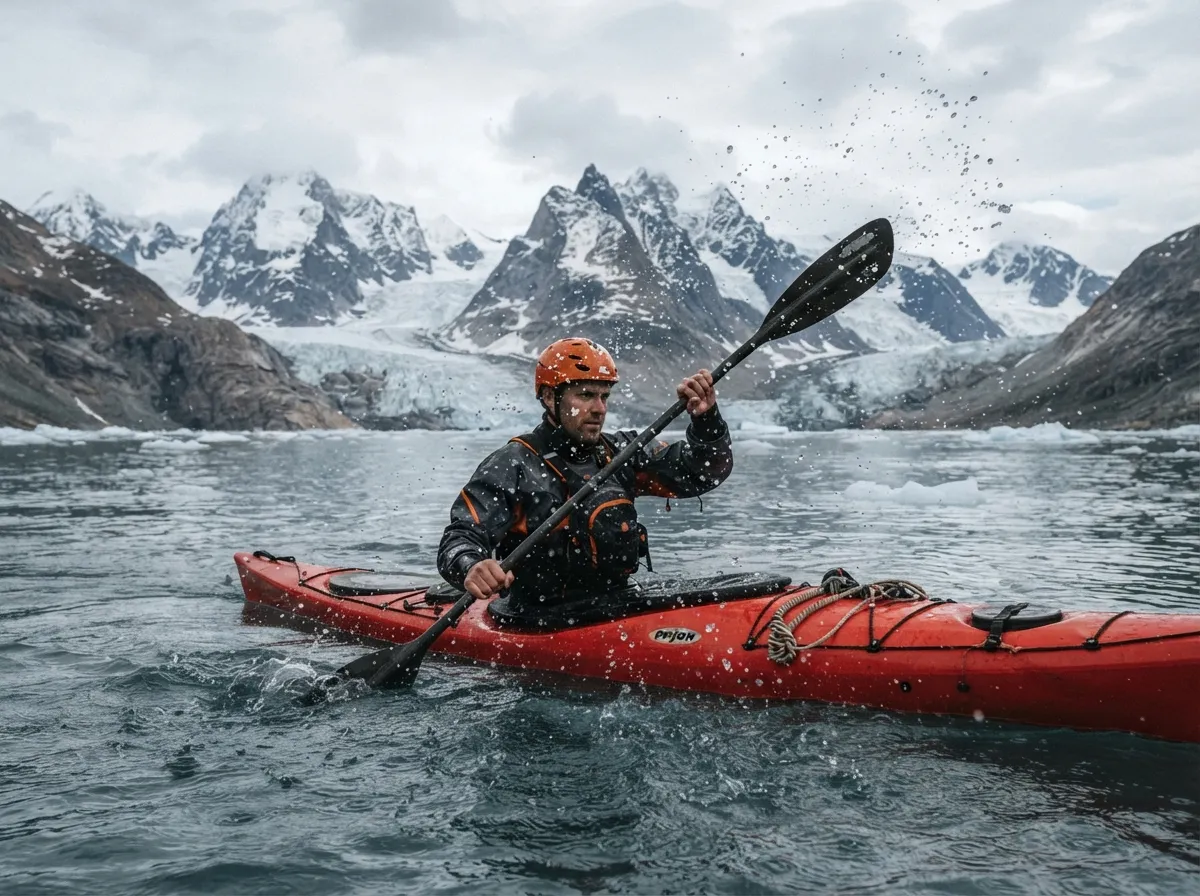
For anyone taking part in cold-water sports — kayaking, paddleboarding, sailing — proper gear completely rewrites the 1-10-1 math: a full drysuit, unlike a simple neoprene wetsuit, traps an insulating layer of air against your skin and significantly delays both cold shock and incapacitation, stretching Giesbrecht’s one-minute and ten-minute limits into a much safer window. It’s not a luxury accessory: it’s the gear that turns an accidental spill from a fatal disaster into a non-event.
Anna Bågenholm: 13.7 °C, and Alive
On May 20, 1999, 29-year-old Swedish radiologist Anna Bågenholm crashed while skiing near Narvik, Norway, getting trapped under twenty centimeters of ice in a frozen stream. She found an air pocket and clung to it for forty minutes before her heart stopped beating. She remained submerged for eighty minutes in total. Upon arrival at the hospital, her core temperature was measured at 13.7 °C — the lowest core body temperature ever recorded in an adult who survived accidental hypothermia. Her heart was restarted after two hours and thirty-five minutes of cardiac arrest. She woke up paralyzed from the neck down ten days later, spent thirty-five days on a ventilator, and returned to work as a radiologist in October of that same year — with only minor nerve damage remaining years later.
Why Spring Kills More Than Winter
Frequently asked questions
How long can you survive in ice-cold water?
Physiologist Gordon Giesbrecht’s 1-10-1 rule gives a solid baseline: one minute to control your breathing against cold shock, ten minutes of useful movement to attempt self-rescue, and about one hour before losing consciousness from hypothermia. Most cold-water drownings happen well before the one-hour mark — usually within the first two minutes or the following quarter-hour, and rarely from pure hypothermia alone.
Why shouldn’t you try to swim right away after falling into cold water?
Sudden contact with water below 15 °C triggers an involuntary gasp reflex that can cause you to inhale water if your head goes under. You need to grab onto something solid and spend about a minute stabilizing your breathing before trying to swim or pull yourself out.
How do you get out alone if you fall through the ice?
Turn back toward the direction you came from — that’s the only ice already tested by your weight. Spread your arms flat on the surface to distribute your load, then kick your legs horizontally to propel yourself forward instead of pulling straight up with your arms. Once out, crawl and roll across the ice toward shore before standing up.
Should you go out on the ice to rescue someone who fell in?
Never step onto the ice or approach the hole without proper gear: water rescue guidelines strictly follow a reach, throw, row, go hierarchy. Extend a long object, throw a floating line, use a boat, and enter the water only as an absolute last resort with a harness and safety rope. An untrained rescuer stepping out on thin ice almost always creates a second victim.
What should you do after pulling someone out of cold water?
Strip off wet clothing, insulate them from the ground and wind, give sugary drinks if conscious and alert, and never rub their limbs or apply direct heat. Cold blood sitting in their extremities can surge back to the heart (afterdrop), triggering cardiac arrest even after getting out of the water. Always take the victim to a hospital even if they seem to be recovering fine.
What ice thickness is safe to walk on?
North American safety guidelines recommend at least 10 cm (4 in) of clear ice for a single pedestrian, 12.5 to 18 cm (5–7 in) for a snowmobile, and 30 to 38 cm (12–15 in) for a small car under five tons. These benchmarks apply strictly to clear, standing lake water: on rivers, currents erode ice from underneath invisibly, meaning no thickness is ever truly safe.
Key Takeaways
- Three clocks start ticking the moment you fall into icy water: one minute to breathe, ten minutes to move, one hour before unconsciousness — in that exact order.
- Cold shock response and muscle incapacitation kill far faster and far more often than hypothermia itself.
- Self-rescuing from broken ice requires staying horizontal, kicking your legs, and crawling back in the direction you came from.
- Never walk out onto thin ice to grab someone: reach, throw, row, and only go into the water as a last resort.
- Afterdrop kills after rescue: no rubbing, no direct heat, and head straight to a hospital even if the victim feels fine.
Going Further
- Cold Water Boot Camp, Gordon Giesbrecht’s educational program (University of Manitoba) — video demonstrations of the 1-10-1 principle and Operation ALIVE.
- Gilbert M. et al., “Resuscitation from accidental hypothermia of 13.7°C with circulatory arrest”, The Lancet, 2000 — the landmark Anna Bågenholm medical case that reshaped severe hypothermia resuscitation protocols.
- The Cold Tool on this site, for specific details on hypothermia stages and wind chill calculations.
- Canadian Red Cross and SNSM — prevention and cold-water safety programs.
Sources for this module (10)
- Gordon Giesbrecht, University of Manitoba — principe 1-10-1, Cold Water Boot Camp, Opération ALIVE
- Wikipedia (EN) — Cold shock response
- Wikipedia (EN) — Hypothermia
- Wikipedia (EN) — Drowning (statistiques eau froide)
- Wikipedia (EN) — Anna Bågenholm
- Wikipedia (EN) — Ice (épaisseurs de sécurité)
- Wikipedia (EN) — Winter swimming / ice swimming
- Wikipedia (EN) — Haenyeo (acclimatation au froid des plongeuses coréennes)
- Wikipédia (FR) — Société nationale de sauvetage en mer (SNSM)
- ABC News — What If You Had 30 Seconds to Save Your Life? (Opération ALIVE, Giesbrecht)
Continue in "Critical situations"
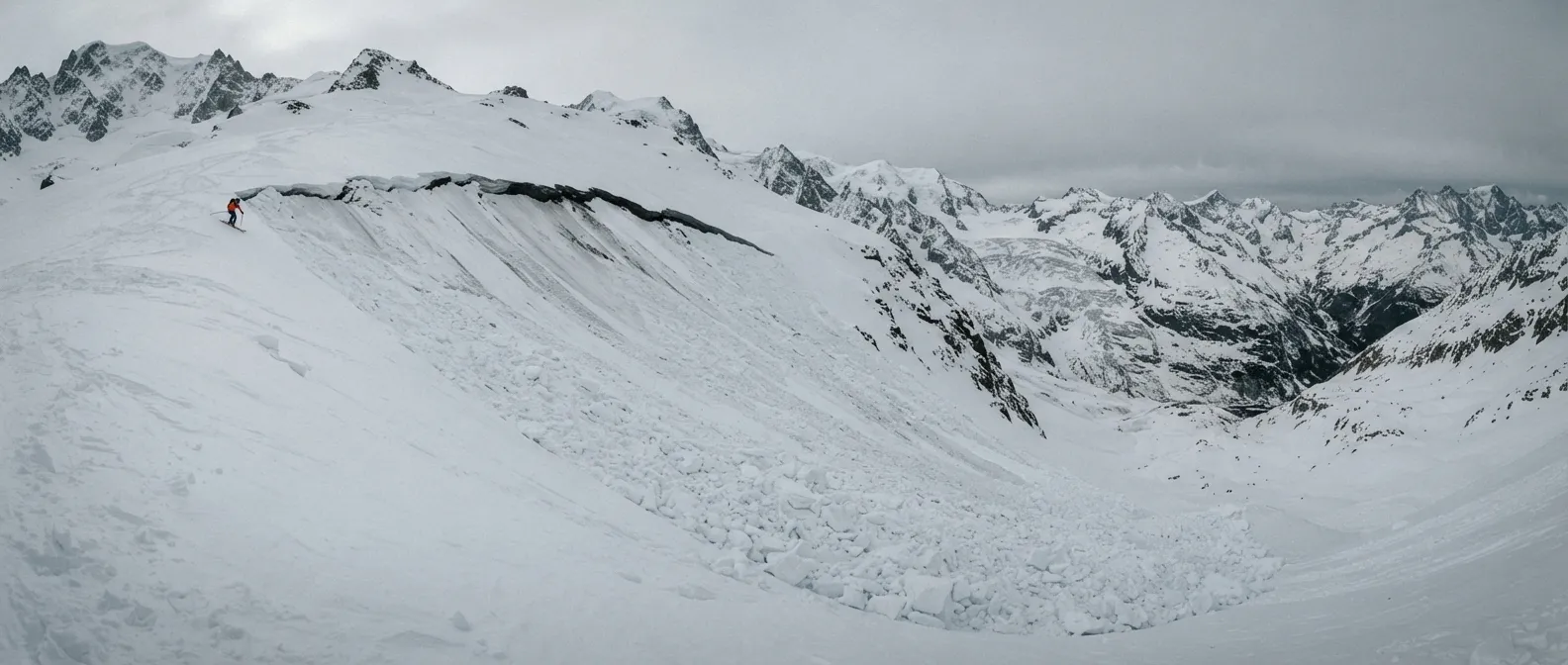
Avalanche: the 15 minutes that decide
A slab breaks loose under your skis, you have fifteen minutes before the stats turn against you: what you need to know instinctively, the night before heading out.

Lightning: When the Sky Targets You
In 3 seconds, a lightning bolt heats the air to 30,000 kelvins and kills 10% of those it strikes: here is what is at stake before you count to thirty.

Flash Flood: Water Arriving Faster Than You
It isn't raining where you are, the creek has been dry all morning, yet you have less time than you think before a wall of water rushes down the valley.