The temperate forest
The most generous environment in the world can also swallow you in ten minutes: here is how to read it instead of fearing it.
It is 3 p.m., you stepped onto a marked trail, took a small side path “just to see,” and suddenly realize that all the trees look identical. No peak to target, no horizon, no clear sun above the canopy. You walk for twenty minutes in what feels like a straight line. You stumble upon a familiar stump. It is the exact same one as earlier. The forest is not hostile: it is simply the only natural environment that strips away all your reference points at once, while giving you, in return, almost everything you need to get by. It is this generosity, and this trap, that we are going to dissect.
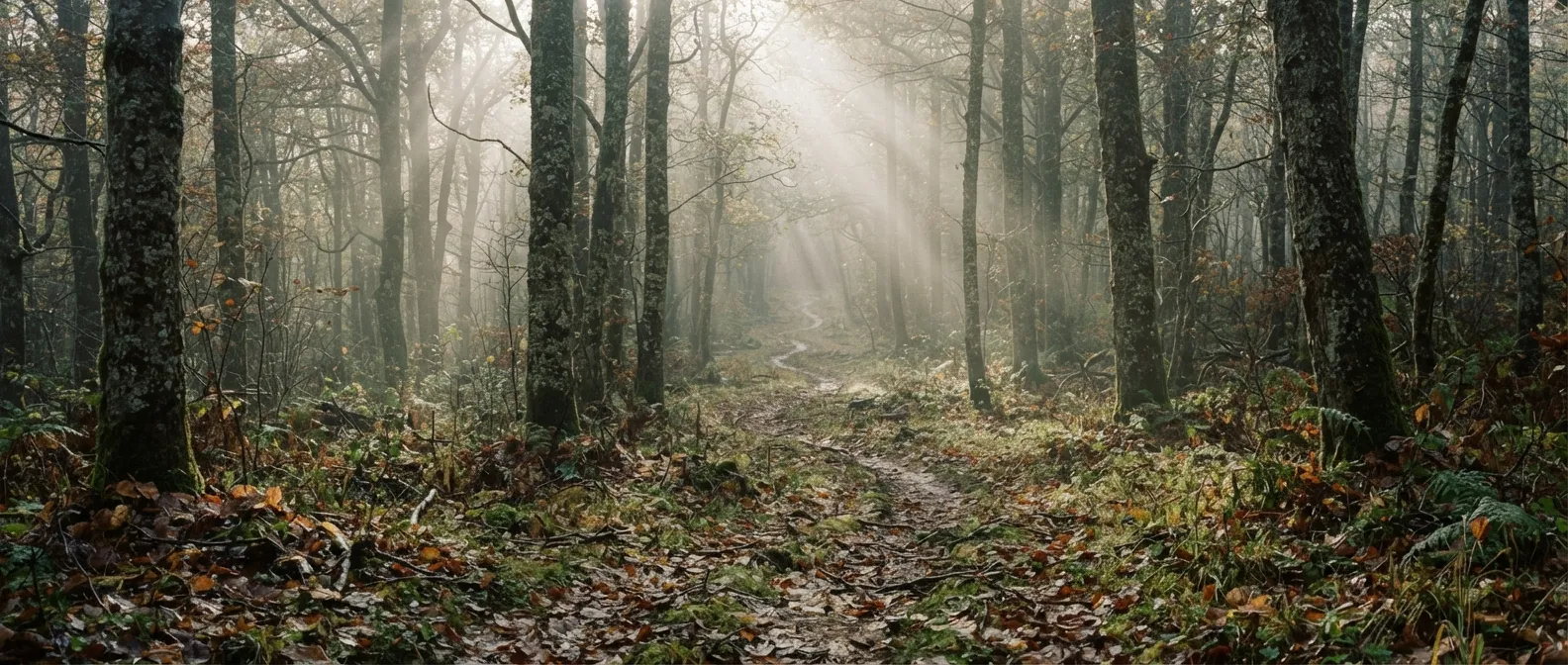
Why you get lost in the forest in twenty minutes
Your brain doesn’t walk straight on its own. In open country, you constantly correct your trajectory using distant visual landmarks: a peak, a pylon, the sun. Researchers who made blindfolded or overcast-day volunteers walk without any reference points observed that they all ended up walking in circles, some crossing their own tracks several times without realizing it. It isn’t that your body is asymmetrical: it’s that your internal sense of “straight ahead” accumulates tiny heading errors. Without anything to correct them, they add up until they form a loop, often in less than an hour.
In the forest, this weakness turns into a full-scale trap. Trees hide the sun, one trail looks like the next, a clearing you’ve already seen feels brand new. The classic result cited by outdoor guides: ten hours of walking in dense forest might only net you barely ten kilometers as the crow flies, even though you feel like you’ve covered double that distance—because a huge chunk of that distance was lost in detours, navigating windfalls, and unconscious loops.
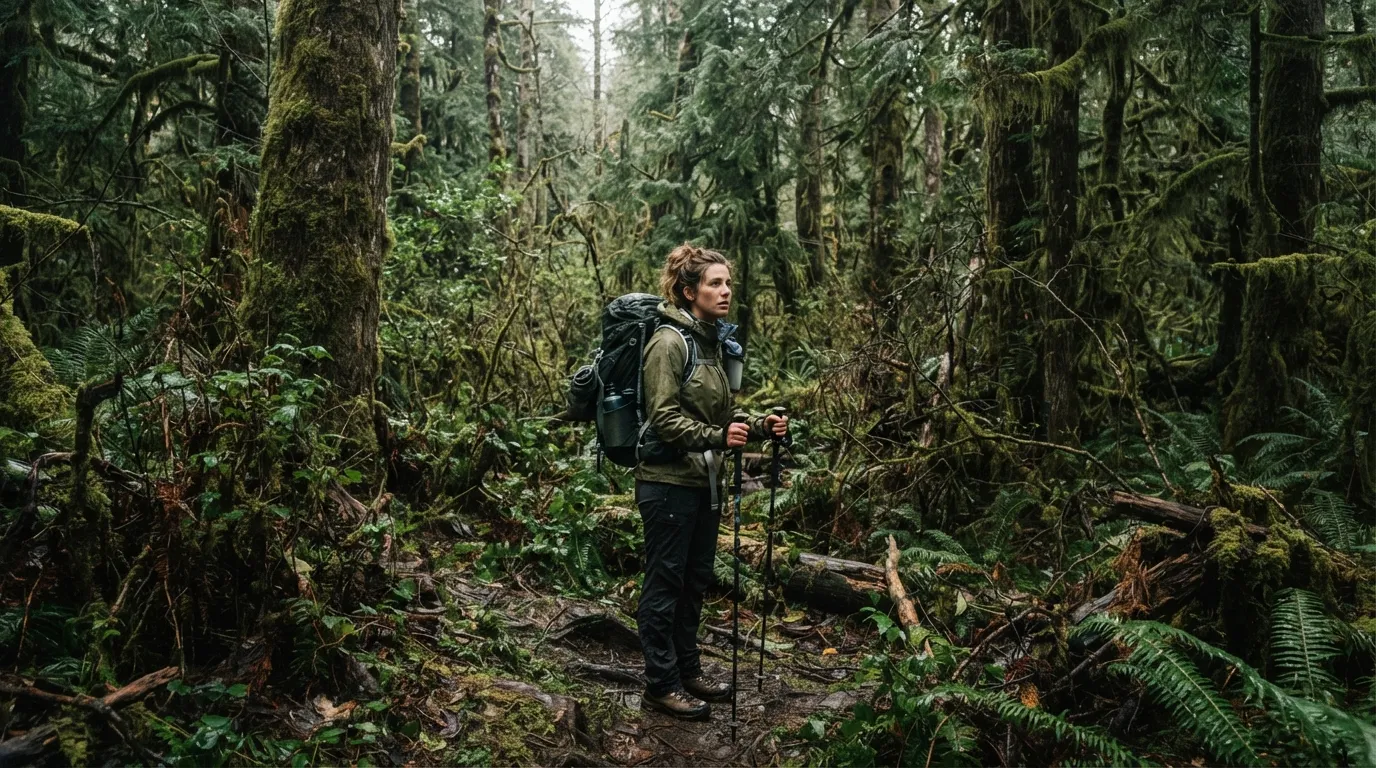
The second trap is psychological rather than sensory: as soon as you think you spot a path, even a faint one, even a simple animal track, you have an almost automatic urge to follow it rather than cut through the woods. Mountain search and rescue databases call this “track-following behavior”—along trails, streams, or ridgelines—and it is by far the most common behavior among lost individuals, much more than staying put. The issue is that a game trail can lead you anywhere except back to civilization.
The forest, a supermarket that never lists its prices
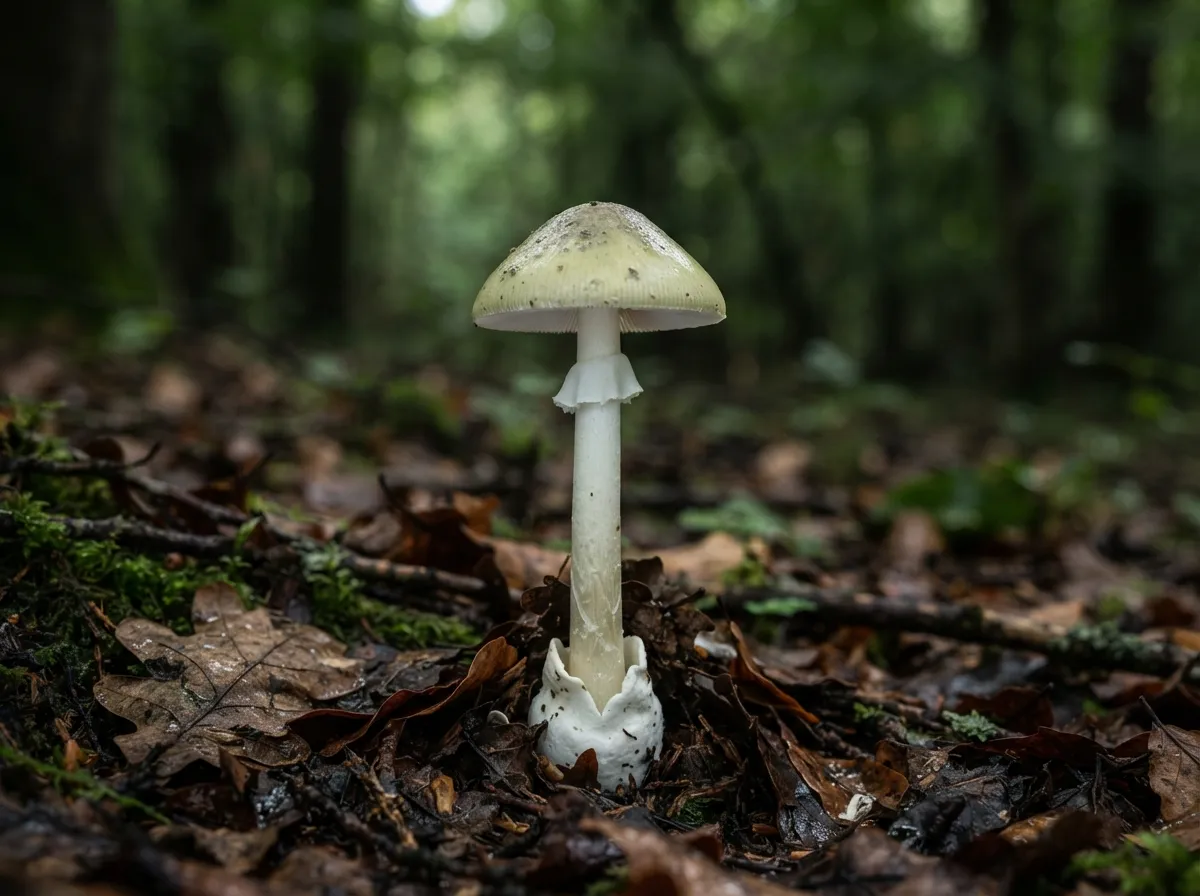
Compared to a desert or an ice field, the temperate forest is the richest environment on earth for anyone who knows how to read it: water almost everywhere, wood for fire and shelter in abundance, edible plants in every season, cordage materials, and medicine straight from the bark. The trap is that this abundance never comes with labels. A delicious mushroom and a death cap grow thirty centimeters apart, and nothing in their appearance screams danger.
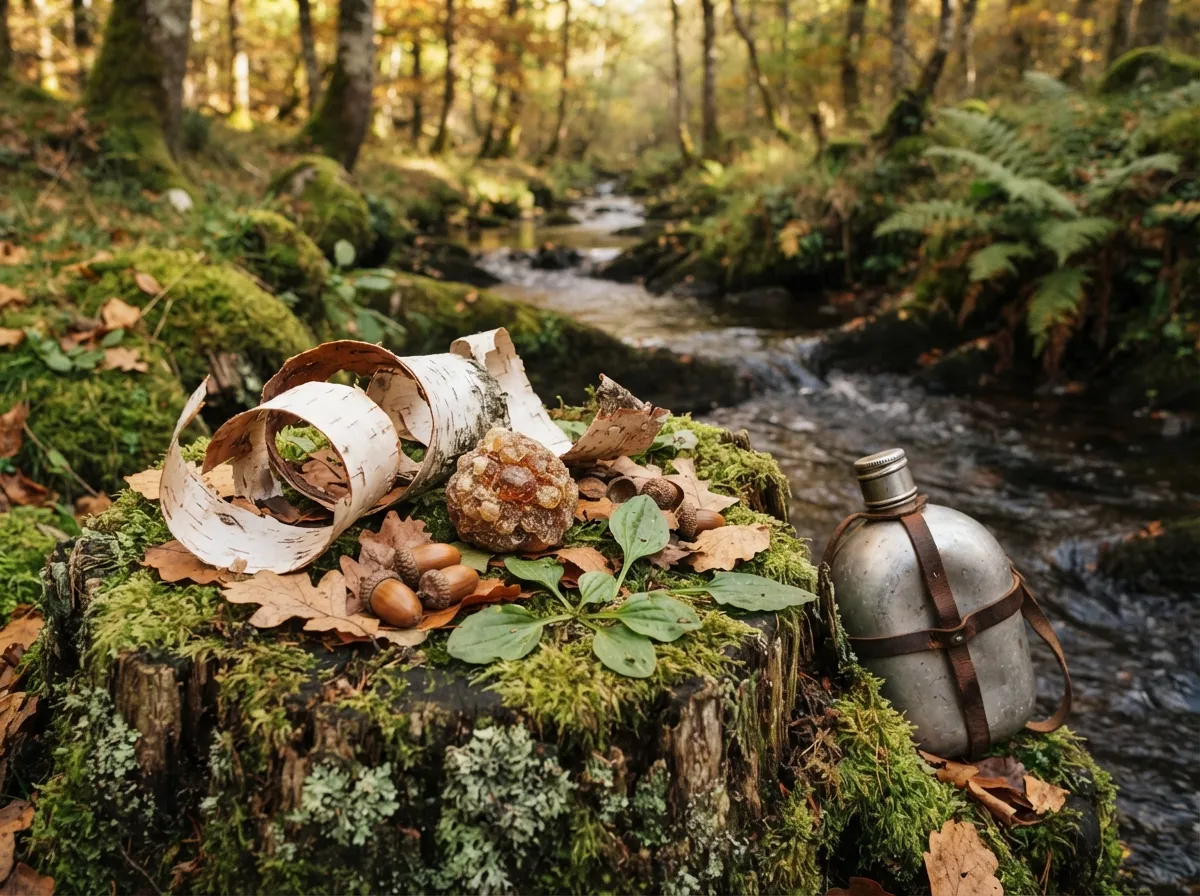
Water first: a stream, a pond, a puddle after rain, birch sap in spring—the temperate forest is rarely dry for more than a few hours’ walk, except in peak summer on limestone soil. Then wood: standing deadwood gives you fire; bundled sticks give you shelter. Edible plants can be counted by the dozen depending on the season—nettles, plantain, wild sorrel, blackberries, blueberries, chestnuts, leached oak acorns. And field medicine truly exists: willow bark for pain, pine resin as a makeshift antiseptic, crushed plantain leaf for bites and stings.
The flip side of this abundance is that the forest never warns you. Fatal poisoning from a death cap almost always stems from a mix-up with an edible mushroom that looks like it—specifically the green-cracking russula, which gets confused with it in some of the most tragic cases in mycology. Around 90 to 95% of fatal mushroom poisonings in Europe are attributed to it.
The traps the forest hides well
The forest rarely kills by starvation: it kills by falls, poorly anticipated cold, or complications you didn’t see coming.
The wood that falls on you
A windfall (or “chablis”) is a tree—or an entire group of trees—toppled, uprooted, or snapped by the wind, heavy snow, or simple age; if it breaks clean off at the trunk without uprooting, it’s called a snap. After a storm, windfalls tangle together and make walking through the forest much slower and far more dangerous than it looks: unstable wood underfoot, branches under extreme tension that snap back suddenly when cleared.
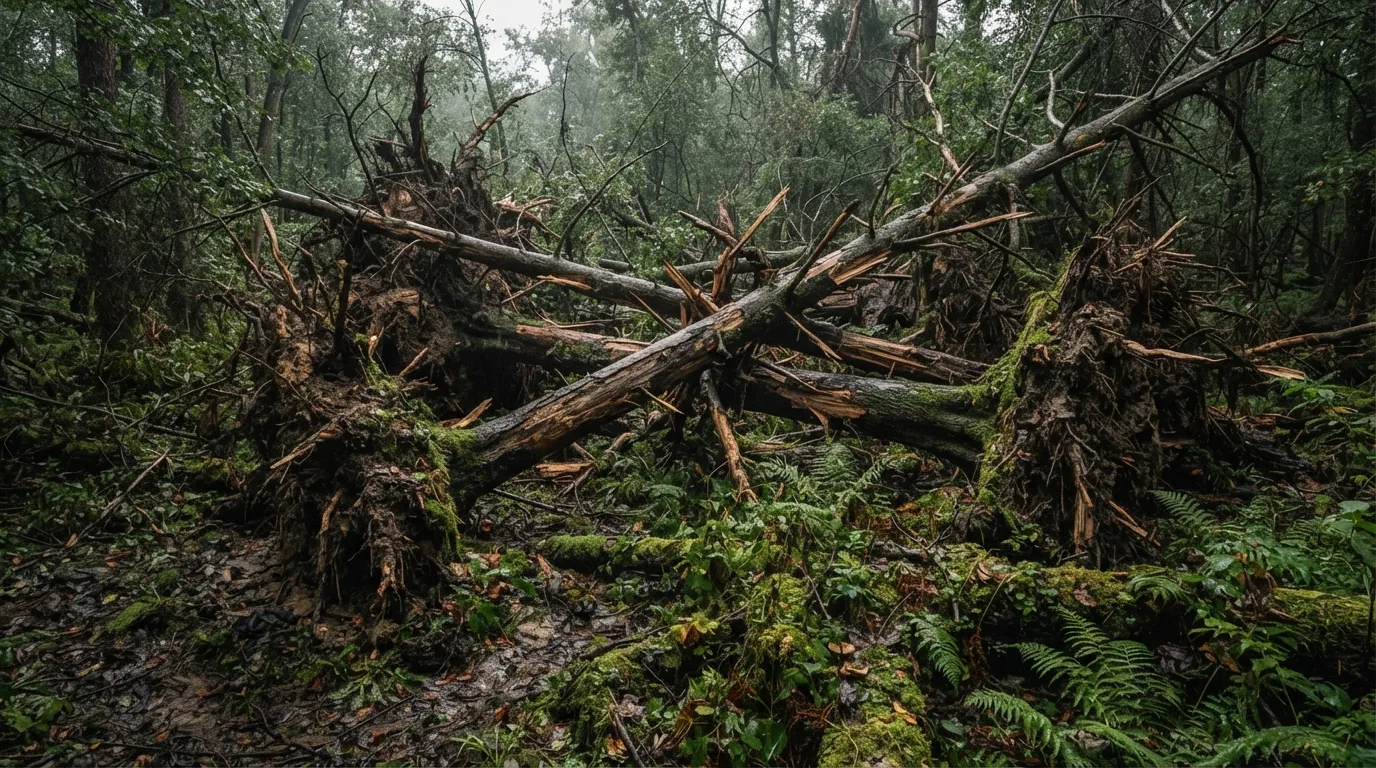
Even more insidious: the “widowmaker,” a logging term officially recognized by North American workplace safety authorities, refers to a large dead branch caught high in the canopy, detached from the trunk but held up by other branches. It can stay there for months, seemingly stable, until a gust of wind or a simple temperature shift drops it without warning—in the forest, wind remains the most common trigger for its fall. The only reliable protection: never pitch your tent or rest for long under a large tree with a visibly sparse, broken, or asymmetrical canopy, with winter being the highest-risk period due to the weight of snow.
Cold that flows like water
Cold air is denser than warm air: it slides down slopes and pools in hollows, valley bottoms, and depressions, exactly like water. On a clear, windless night—prime conditions for this radiative cooling—a campsite pitched at the lowest point of a clearing can end up 5 to 8 degrees colder than one on a slope just a few dozen meters away. This is known as a “cold pocket” or “frost hollow.” The key lesson for picking a camp spot: neither the wind-exposed ridge nor the soggy valley bottom—the lower third of a gentle, sheltered slope is almost always the best compromise.
What stings, what charges, what drops from above
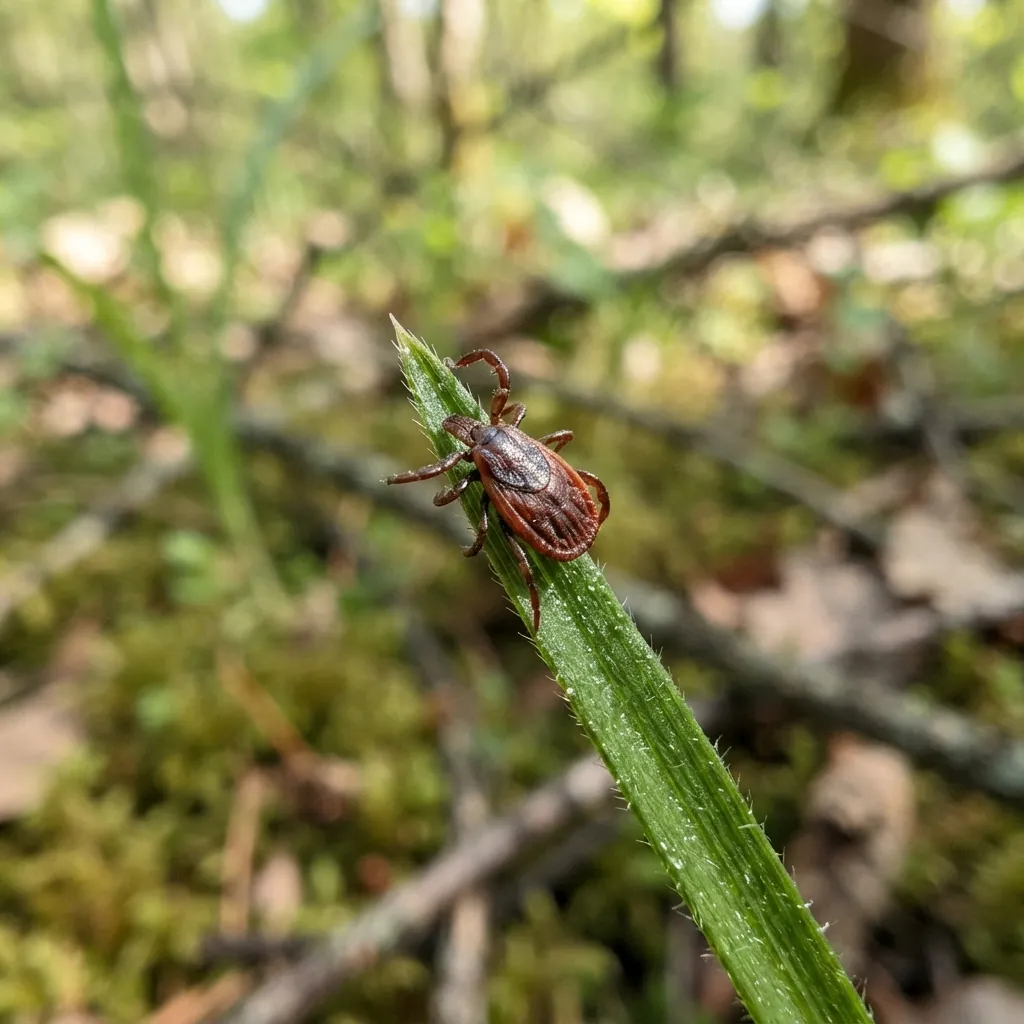
Statistically, the tick is the most underrated health hazard in temperate forests. They climb up from high grass and brush, never dropping from trees, and only 10 to 20% of them carry Lyme disease bacteria—but the risk of transmission increases the longer they remain attached, making quick removal with a tick tool the best defense alongside long, light-colored clothing. A expanding red rash around the bite (erythema migrans) appears in about 85% of infected people within six weeks of the bite: that is the warning sign to watch for, not pain, which is usually absent.
The wild boar, on the other hand, causes far more fear than actual harm: in the vast majority of encounters, the animal runs away as soon as it senses your presence, and a charge only happens if it feels cornered or if a sow is protecting her piglets. Boars are mainly active at dawn and dusk; making noise while walking (talking, singing) is usually enough to signal your presence early so they can slip away. The Asian hornet requires a simple, non-negotiable rule: never approach within ten meters of a spotted nest, and turn back calmly—a massive group attack only happens in the immediate vicinity of the nest, never at a distance.
Finally, thunderstorms: the legend of the hiker sheltering “under a tall tree” is one of the fastest ways to get killed in sparse woods or along tree lines. The risk of an isolated tree being struck by lightning is roughly fifty times higher than that of a person standing in an equivalent open area, and the ground current can then spread outward for ten meters or more, with injuries reported up to fifteen to thirty meters from the point of impact. In a dense forest, the right move is to step away from trunks and low branches, crouch with your feet together away from anything tall, and insulate yourself from the ground with a backpack or mat if no sturdy shelter is near.
Reading a forest like a book
A forest is not a uniform backdrop: it is a collection of signals, if you know how to read them. British natural navigator Tristan Gooley, who wrote an entire book on the topic (How to Read a Tree), highlights nearly twenty directional clues just by observing a single tree: leaves often grow denser on the side with the best sun exposure, roots stretch further on the side facing prevailing winds, and the overall shape of an isolated tree tells the story of the wind and light on that exact spot.
Tree species that reveal water
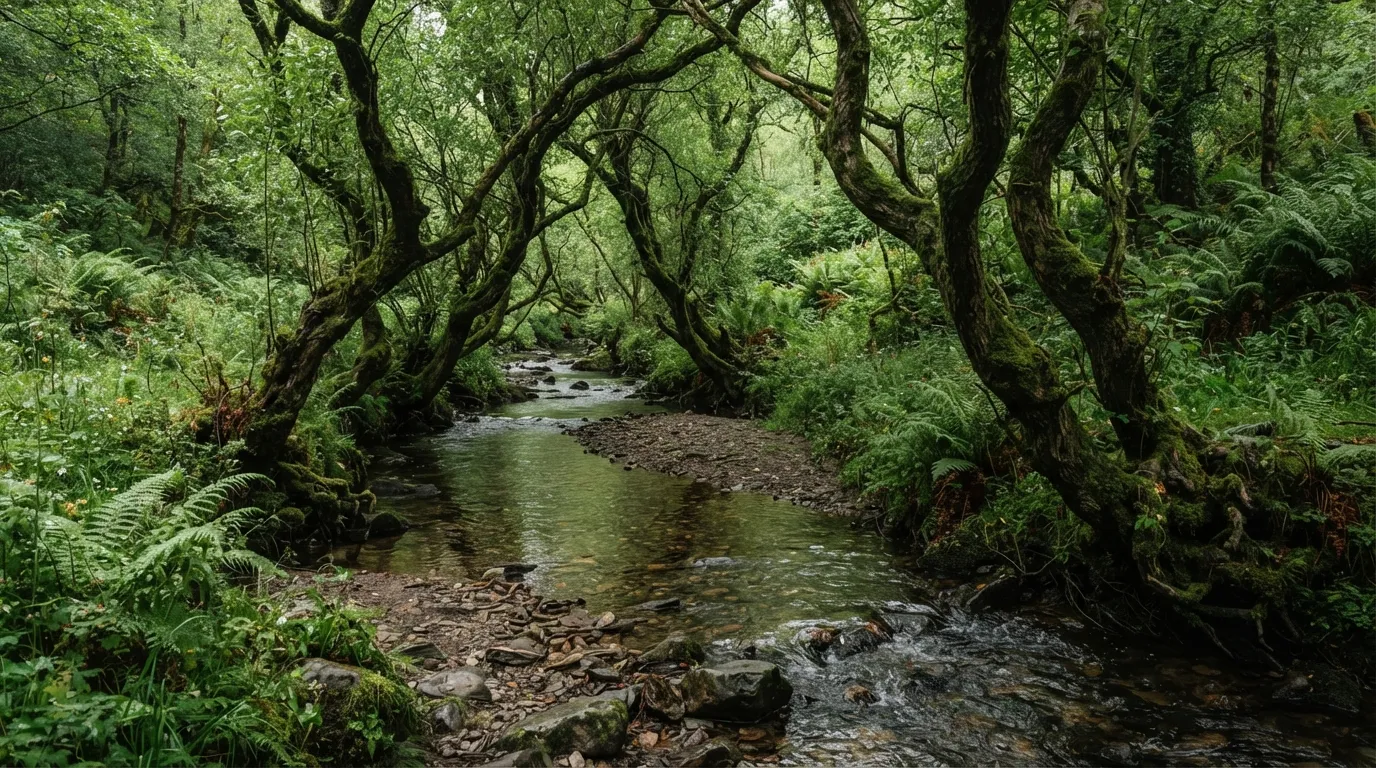
Some trees simply will not grow far from water-saturated soil: black alder, willow (goat or white willow), and quaking aspen are the three most reliable indicators of a wetland or nearby stream in temperate forests. Spotting a line or patch of these species amid an oak and beech forest points, almost without fail, to a spring, a stream, or a high water table.
Slopes that change everything
In mountains and hills alike, south-facing slopes (the adret) are warmer, drier, and colonized earlier by oaks, pines, and drought-tolerant vegetation; north-facing slopes (the ubac) remain cooler and damper, more heavily wooded with mixed hardwoods or conifers, with leaf litter that dries much slower. This single piece of information—which slope you are currently traversing—tells you where to look for water (usually the north slope) and where to hope for drier ground to camp (usually the south slope).
Animal trails: arrows pointing to water
Game animals have the exact same needs you do: water, food, shelter. An animal trail heading down a slope almost always leads to a water source eventually; a trail heading up tends to lead to bedding areas or resting spots. When multiple trails converge in a “V” shape, the point of the V generally points in the direction of the water source where they all join.
The myth of moss
No, moss does not grow exclusively on the north side of trees—it is one of the most repeated and least reliable survival myths out there. Moss seeks moisture and shade; in the Northern Hemisphere, the north side of a trunk is statistically shaded more often, making it slightly more favorable, but a nearby boulder, a slope, a stream, or simply a leaning trunk is enough to completely flip the trend on any given tree.
What every tree offers you
A temperate forest provides a true pharmacy and workshop, tree by tree.
| Birch | Pine | Oak | Willow | Linden | Hazel | |
|---|---|---|---|---|---|---|
| Water / Sap | ✅ spring sap | ❌ | ❌ | ❌ | ❌ | ❌ |
| Tinder / Fire starter | ✅ bark (betulin) | ✅ resin, fatwood | fair | ❌ | ❌ | ❌ |
| Food | ❌ | ✅ needles (vitamin C) | ✅ leached acorns | ❌ | ❌ | ✅ hazelnuts |
| Field medicine | ❌ | ✅ antiseptic resin | ❌ | ✅ bark (salicin) | ❌ | ❌ |
| Cordage / Basketry | ✅ bark (tar) | ❌ | ❌ | ✅ wicker, basketry | ✅ bast fiber, rope | ❌ |
| Building / Poles | ❌ | fair | ✅ dense, durable wood | fair | ❌ | ✅ poles, handles |
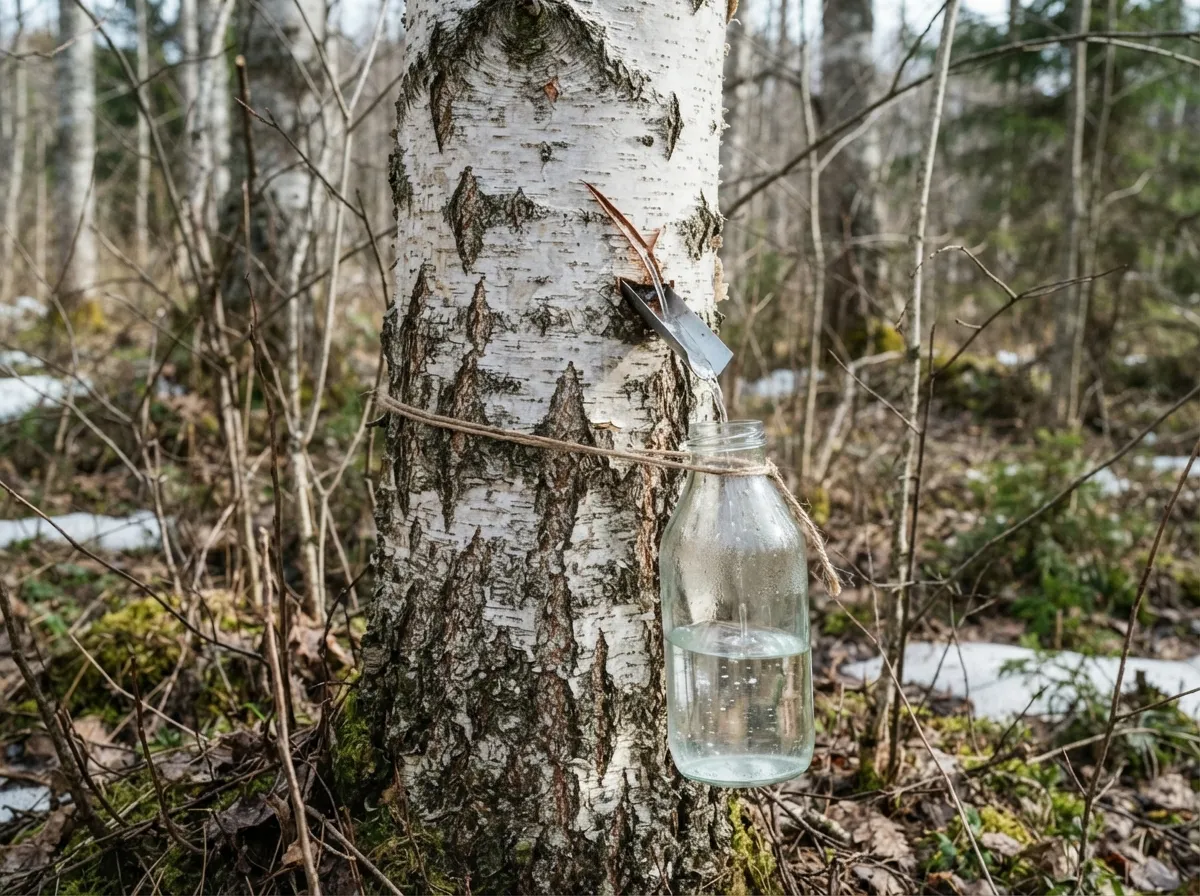
Birch gives water before it gives fire. Its raw sap, packed with minerals, can be harvested in early spring during a tight window of barely three weeks between the thaw and the opening of the first leaves—after that, the tree redirects it to its foliage and the flow drops off. Its bark, loaded with betulin, is one of the rare natural tinders that lights even when soaking wet; boiled down into a fibrous pitch, it provided “birch tar,” a black resinous glue used since prehistoric times to haft tools.
Pine yields a resin that acts as a field antiseptic on minor cuts—it seals out moisture that bacteria need to thrive—and when warmed, it can waterproof fabric or boot soles. Its needles, rich in vitamin C, make a quick tea (steep for no more than twenty minutes, as prolonged heat destroys the vitamin).
Oak is a forgotten calorie goldmine: once leached to remove bitter tannins (through multiple boils or prolonged soaking in running water), its acorns yield 390 to 500 kilocalories per 100 grams—nearly double that of chestnuts. It is a staple that sustained entire human populations before cultivated grains became widespread.
Willow is the forest’s aspirin: its bark contains salicin, which the body converts into salicylic acid, an anti-inflammatory recognized since Hippocrates that directly inspired modern synthetic aspirin in the 19th century. Its pliable shoots (wicker) have been woven into baskets and bindings for millennia.
Linden (Basswood) hides long, tough bast fibers beneath its bark, used for cordage and nets from prehistoric times up through the 20th century: on a dead branch that has been down for a few months, nature has already handled the retting process, allowing the fibers to peel away with minimal effort.
Hazel was the utility tree of old rural countrysides: fruit poles, tool handles, garden stakes, woven hurdles—traditional countryside crafts feature dozens of items carved from its flexible, workable wood, all the way to the famous dowsing rod, whose supposed effectiveness relies on superstition rather than science.
Fire and shelter when everything is wet
In temperate forests, rain isn’t an anomaly: it’s the baseline condition to prepare for. Standing deadwood, still attached to the tree, stays significantly drier than wood lying on the ground—gravity pulls moisture downward—and splitting a branch to get to its core (heartwood) reveals dry wood even after several days of continuous rain. Once wood moisture exceeds about 30%, combustion becomes extremely difficult: all the heat energy from the flame goes into boiling off the water inside before the wood can ever reach its gasifying temperature.
Birch bark, once again, remains the most reliable fire starter in a soaked forest, specifically because its betulin resists water and catches fire at low temperatures. Once the flame takes hold, build up the kindling in an open, airy structure—never a dense pile—to let oxygen flow. Blow gently with long, steady breaths at the base of the flames rather than short huffs, which blow out young embers instead of feeding them.
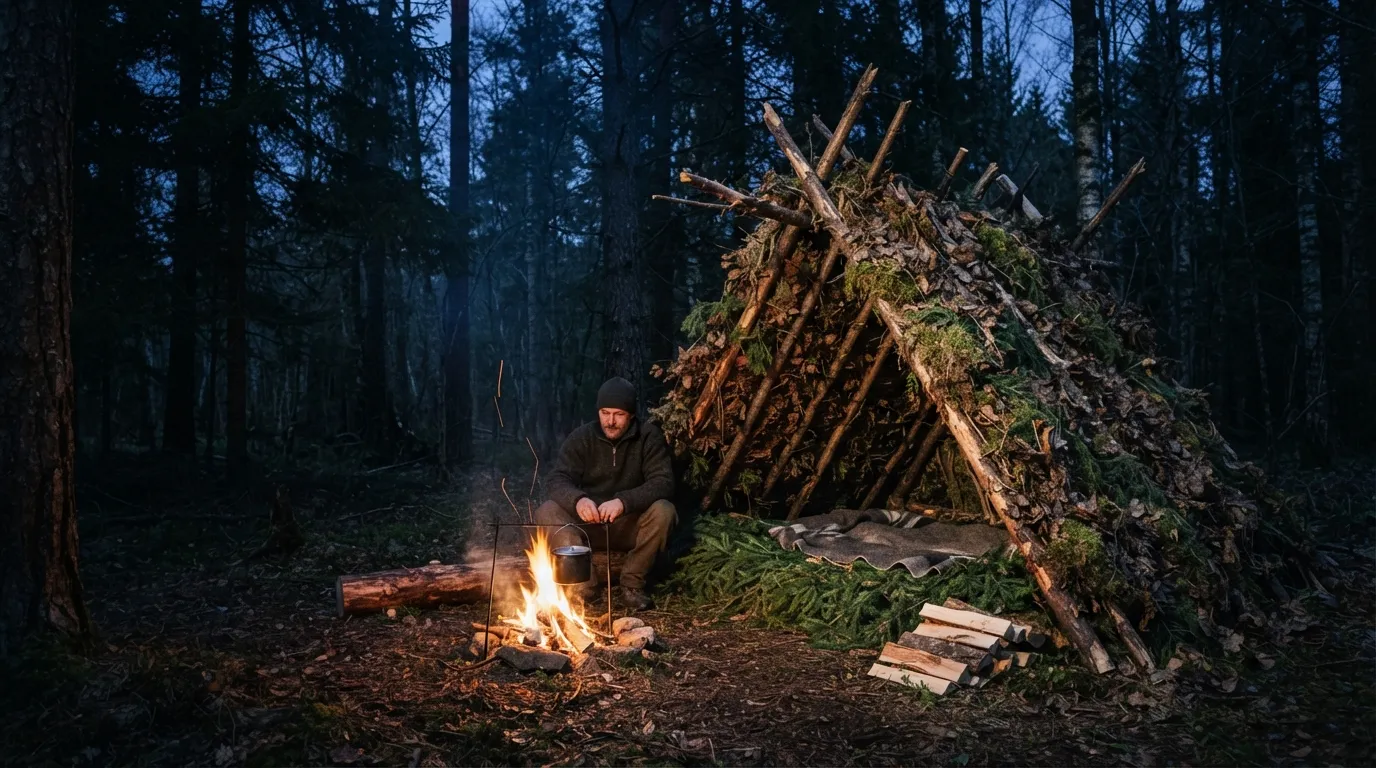
For shelters, the setup depends on your available time and conditions. A lean-to—a ridge pole secured between two trees, branches angled at 45 degrees, and a debris layer at least 30 centimeters thick—takes an hour or two to build and pairs great with a fire burning right in front of the opening. When cold or rain are severe and no fire is planned, a debris hut, sized snugly to your body and heaped with a thick blanket of dead leaves (60 centimeters to a meter deep), insulates far better: it is your own trapped body heat keeping you warm, not the structure itself.
Getting found: what rescue teams actually know
A question people rarely consider in advance: where and how do search teams actually look? The answer comes from a massive dataset: the International Search and Rescue Incident Database (ISRID), compiled since the 1980s by American researcher Robert Koester. It tracks over 145,000 search cases worldwide, detailed in his landmark work Lost Person Behavior.
His findings challenge common intuition. The most frequent behavior in a lost individual is not staying put—it is, by a wide margin, continuing to move along a linear terrain feature (trail, ridgeline, stream), a strategy researchers call “track-following behavior.” According to modeling based on this data, remaining stationary makes up a tiny fraction of observed behaviors, far behind continuing to walk along a path or terrain feature. While official guidelines repeatedly advise “stay where you are,” in practice, almost nobody does.
This reality changes how rescue teams structure their searches: rather than drawing a expanding circle around the last known point assuming the person stayed put, they prioritize nearby trails, ridgelines, and watercourses first, because statistically, that’s where most lost people are recovered.
Another finding, reassuring for families: among lost toddlers, the survival rate for children under three years old exceeds 95% in the first 24 hours—though it drops sharply after that, explaining the extreme urgency assigned to these searches right from the initial hours.
To assist search teams, two simple habits carry huge weight: mentally log an out-and-back route rather than wandering aimlessly—a clear four-kilometer out-and-back line is vastly easier to search than ten kilometers of random, unmapped wandering—and carry a whistle as a core safety tool rather than a novelty item. Its sound cuts through dense woods far better than the human voice, which gets exhausted after a few minutes of shouting. The international distress signal consists of six clear blasts within one minute, followed by a one-minute pause, repeated until answered—rescuers typically reply with three blasts to confirm they have pinpointed your location.
- Stop. Never keep walking just “to see where this goes”—it is the knee-jerk reaction that turns a minor issue into a crisis.
- Check the time and remaining daylight. If you have less than two hours of light left, shift your focus to building a shelter before searching for a way out.
- Look for a known linear feature (trail, power line, stream) within line of sight or hearing, rather than pushing blindly through bush.
- If no clear path is visible and night is falling, pick an open, visible spot—a clearing or small knoll—and set up your signals (whistle, fire, bright gear laid flat).
- Save your voice and rely on your whistle: six blasts, a one-minute pause, repeat.
Night, seasons, and across the Atlantic
When light fades
Night in the forest isn’t inherently more dangerous—most animals you might worry about are far more terrified of you than you should be of them—but it drastically alters your perception. Deprived of sight, your other senses heighten: a fox’s call a few dozen meters away, drowned out by ambient noise during the day, suddenly feels alarming. The best response to a close, unfamiliar sound: stay inside your shelter, listen, and never step out blindly into the dark to “investigate.” Learning to recognize three or four common night sounds (a barking roe deer, a tawny owl, a foraging wild boar) diffuses most of this fear, which stems from unfamiliarity rather than genuine threat.
One forest, four seasons, four approaches
In spring, sap flows—opening the window for birch tapping—and tender shoots (nettles, wild garlic carpeting damp woods, fiddlehead ferns) offer easy foraging before the tree canopy closes off light. Summer slows down direct wild food availability but offers optimal access to surface water and edible insects. Autumn is the most bountiful season: acorns, chestnuts, hazelnuts, and walnuts drop by the thousands, ready to collect, and mushrooms thrive—provided you can identify them with absolute certainty. Winter shuts down most edible plant life, but stripping away the leaves clears sightlines through the woods, making navigation and tree identification by bark and silhouette surprisingly easier.
What shifts across the Atlantic
North American temperate forests present different wildlife and environmental demands compared to European woods. Bears (black bears across most of Canada and the northern US, grizzlies in parts of the West) mandate strict camp sanitation protocols—hanging food out of reach, maintaining safe cooking distances—that aren’t necessary in Western Europe, where brown bears and wolves remain localized. Moose, while generally placid, become unpredictable and aggressive during the autumn rut or when cows are protecting calves—requiring the same distance you’d give a rutting red stag, but in an animal capable of inflicting fatal kicks. And summer mosquitoes in northern boreal forests reach densities virtually unheard of in European woods, turning head nets and treated clothing from optional comfort items into essential gear.
Frequently asked questions
Why do people walk in circles when lost in the forest?
Without a distant visual landmark (sun, mountain peak, skyline), your brain accumulates small directional errors that wrap into a loop in under an hour. The only reliable fix is targeting a close, visible point, walking straight to it, and repeating the process along that exact line.
Should you stay put or keep walking when lost?
Search statistics show that most people keep moving—usually along a path, ridge, or stream—rather than staying still. If a clear terrain feature or trail is visible, following it makes sense; if not, and especially if daylight is fading, setting up camp in a visible, open location is far safer than aimless wandering.
Will a wild boar actually attack a hiker?
It is extremely rare. In almost every encounter, the animal runs away as soon as it detects human presence. A charge almost exclusively occurs if the animal feels trapped, injured, or if a sow is actively defending her piglets.
Does moss really point north?
Only as a faint statistical tendency, never as a guaranteed rule on an individual tree. Moss thrives on shade and moisture, not a cardinal direction; a nearby rock, slope, or trunk tilt easily flips where it grows.
How do you safely remove a tick?
Use a dedicated tick tool (never bare fingers or standard tweezers, which can crush the tick or leave mouthparts embedded), pulling straight out or twisting gently without squeezing the body. Afterwards, disinfect the bite and watch the area for about six weeks for any expanding red ring.
Can you eat oak acorns raw?
No, raw acorns are bitter and packed with tannins that cause digestive distress and stomach irritation in large quantities. After leaching them through repeated boils or soaking in running water to strip the tannins, they become a dense, highly nutritious food source.
Key takeaways
- People get lost in the forest because the brain, lacking visual reference points, drifts into loops in less than an hour: target close fixed landmarks, one after another.
- The forest is rich but unforgiving: it offers just as many rashes, tick bites, and toxic lookalikes as it does wild food and clean water—rigorous identification is never optional.
- The true dangers are rarely what people expect: overhead deadwood, cold air pooling in low hollows, ticks, and never sheltering under an isolated tree during a thunderstorm.
- Reading forest clues (water-indicator trees, slope aspects, game trails) can replace a missing compass—relying solely on moss cannot.
- If you are lost, the most useful data comes from real SAR records: most people keep moving along terrain features, so make yourself visible along those corridors rather than waiting blindly in dense cover.
Going further
- Robert J. Koester, Lost Person Behavior: A Search and Rescue Guide on Where to Look — the definitive global statistical study on lost person behavior, drawn from the ISRID database.
- Tristan Gooley, How to Read a Tree and The Lost Art of Reading Nature’s Signs — comprehensive guides on navigating forest environments using natural visual indicators.
- ONF — Que faire face aux tiques en forêt — updated tick prevention guidelines provided by the French National Forests Office.
- Esprit Survie — Construire un abri de survie en forêt — step-by-step practical guides for constructing core emergency shelters.
Sources for this module (24)
- Robert J. Koester (ISRID) — The Psychology of Lost, via NZSAR
- An agent-based model reveals lost person behavior based on data from wilderness search and rescue — Scientific Reports / PMC
- ONF — Que faire pour se protéger des tiques en forêt ?
- GR10.org — Le sanglier sur le GR10
- ARS Centre-Val de Loire — Frelon asiatique : que faire face à un nid ?
- Croix-Rouge française — Orage et foudre : les bons réflexes
- Gouvernement du Canada — Dangers de la foudre
- Tristan Gooley — How to Read a Tree (The Natural Navigator)
- GUEPE — La mousse et le nord
- Le Chemin de la Nature — Récolter et consommer la sève de bouleau
- Herbiolys — Le saule blanc, aspirine naturelle depuis l'Antiquité
- Montviette Nature en Pays d'Auge — Petits usages du noisetier
- Charlee K — Glands de chêne : éliminer les tanins et cuisiner maison
- T-O-T — 5 clés pour allumer un feu sous la pluie
- Esprit Survie — Construire un abri de survie en forêt
- Allo Docteurs — Le plantain contre les piqûres d'insectes
- Expert de Cueillette — Amanite phalloïde : reconnaître le champignon mortel
- Wandering Gamist — Game Trails
- PMC — Ant schnapps for health and pleasure: Formica rufa
- Jeretiens — Adret et Ubac : chaud ou froid, nord ou sud ?
- Météo-France — Trous à froid
- GearJunkie — Outdoor Hazards: Falling Branches
- Wikipédia — Chablis (arbre)
- Espaces.ca — Quoi faire quand on est perdu en forêt ?
Continue in "By environment"
Mountains: Where the Weather Decides for You
The weather changes in thirty minutes, altitude works against you, the terrain is unforgiving: the signs to read before it's too late.
Snow, extreme cold, and the Far North: surviving at minus 30
Cold doesn't kill you: humidity, exhaustion, and panic do. What you need to know to stay alive below zero.
Desert: water, shade, and keeping still during the day
It isn't 45 °C because there's no shade: it's 45 °C, and on top of that, there's no shade. The difference is paid in liters.