Caves and Underground: Total Darkness
A shelter that never moves seems like a no-brainer — except underground, almost everything that would save you elsewhere turns against you.
It’s been raining for two hours, you are soaked, and the dark entrance of a cave appears on the hillside like an obvious solution: finally a place where the sky can’t fall on your head. That’s the exact knee-jerk reaction that has cost the lives of hikers caught in flash floods, buried miners, and trapped twelve Thai children and their coach for eighteen days. An unknown cave is not a shelter: it’s a full-fledged environment with its own set of rules, and rule number one is knowing you don’t just walk into one like you’d step under a tree.
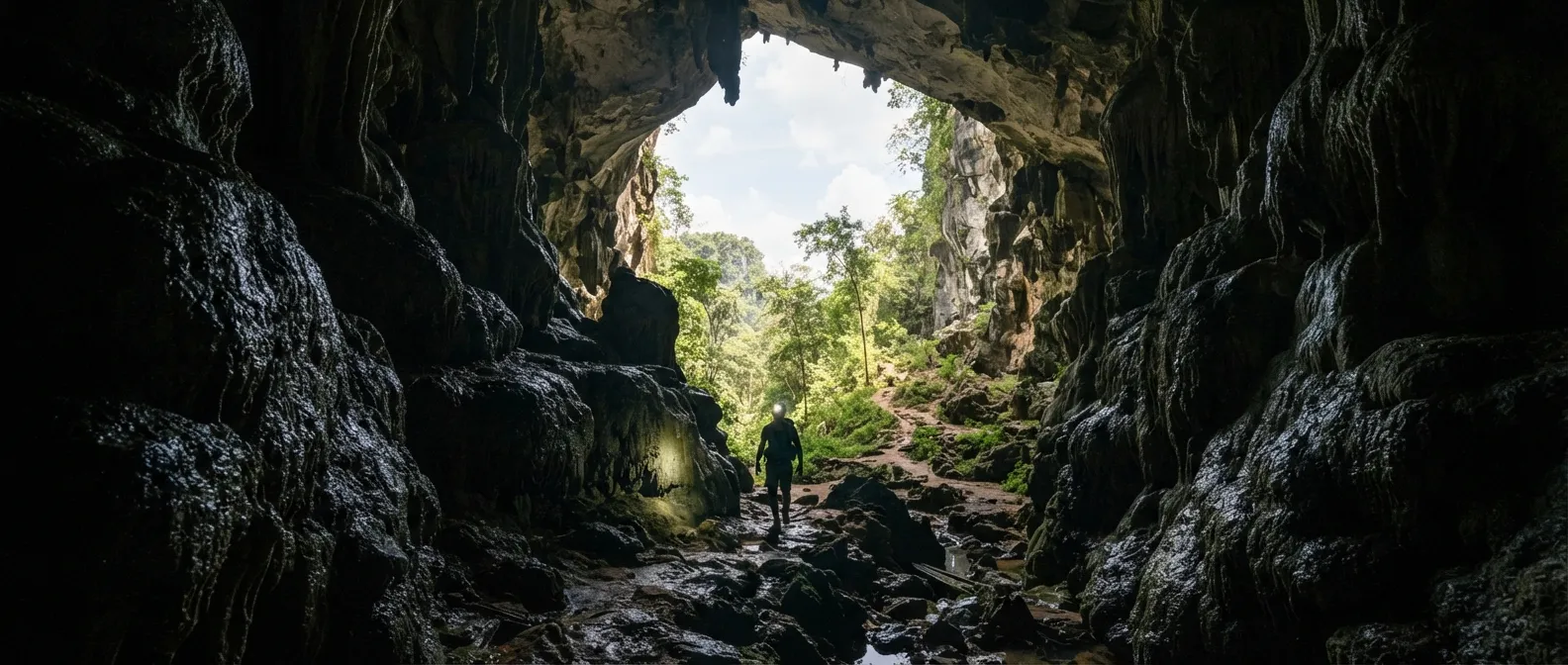
Why you shouldn’t seek shelter in an unknown cave
The idea sounds appealing because it seems logical: rock overhead, no more rain, no more wind. The problem is that every single one of these apparent benefits hides a danger your eyes won’t spot at first glance.
- Rockfalls. A cave is never a static structure: it constantly erodes, cracks, and drops blocks, sometimes years after the last visible fall. The entrance, in fact, is the area most exposed to freeze-thaw cycles that shatter surface rock.
- “Bad air” pockets. In certain poorly ventilated cavities, carbon dioxide settles near the ground — it’s denser than air — with no smell or color to warn you. At 6% CO2 in inhaled air, mental confusion sets in within thirty minutes; above 7%, severe respiratory distress and confusion can occur in just a few minutes. Victims usually feel nothing coming before losing consciousness.
- Underground flash floods. A downpour on the surface, even miles away, can turn a dry passage into a flooded conduit in minutes. This is precisely what trapped twelve young Thai soccer players and their coach in the Tham Luang system on June 23, 2018: entering during dry weather, rising monsoon waters cut off their exit, requiring an eighteen-day international rescue effort.
- Hypothermia. A cave stays at an almost constant temperature year-round, usually close to the region’s average annual surface temperature — in temperate climates, often between 8 and 12 °C. This stability, a plus in summer, becomes a trap during prolonged wet exposure: your wet body constantly loses heat without ever benefiting from a warm spell like outside.
- Total loss of bearings. Without artificial light, a cave’s darkness is pitch-black — no stars, no residual glow, nothing. Deprived of visual cues, the human brain rapidly loses all sense of time and direction.
- Bats and histoplasmosis. Accumulations of guano under bat colonies can harbor a fungus, Histoplasma capsulatum, whose inhalation causes a condition nicknamed “cave sickness”: coughing, fever, and flu-like symptoms that show up 12 to 14 days after exposure, posing severe risks for immunocompromised individuals.
- Bears. In mountain or boreal zones, a cave, rock cavity, or hollow trunk can serve as a wintering den for a brown bear — stumbling in unannounced, especially around a female with cubs, is one of the few situations where the animal, though slow during hibernation, can react violently despite its lethargy.
How a cave actually kills
Cave safety studies and underground rescue manuals, in France and worldwide, categorize severe accidents into four main groups: falls (crossing shafts, drops, or slippery spots without proper gear or techniques), hypothermia (often after immersion or prolonged waits in constant humidity), drownings linked to flash floods or sumps (passages completely filled with water, passable only with specialized cave diving gear), and fouled atmospheres in poorly ventilated cavities or old mines. The French Speleological Federation (FFS) publishes technical and safety regulations and maintains a specialized organization, the Spéléo Secours Français (SSF), mobilized for complex underground rescues — a distinct force from surface emergency services, built specifically around specialized hauling, communication, and cold-management techniques.
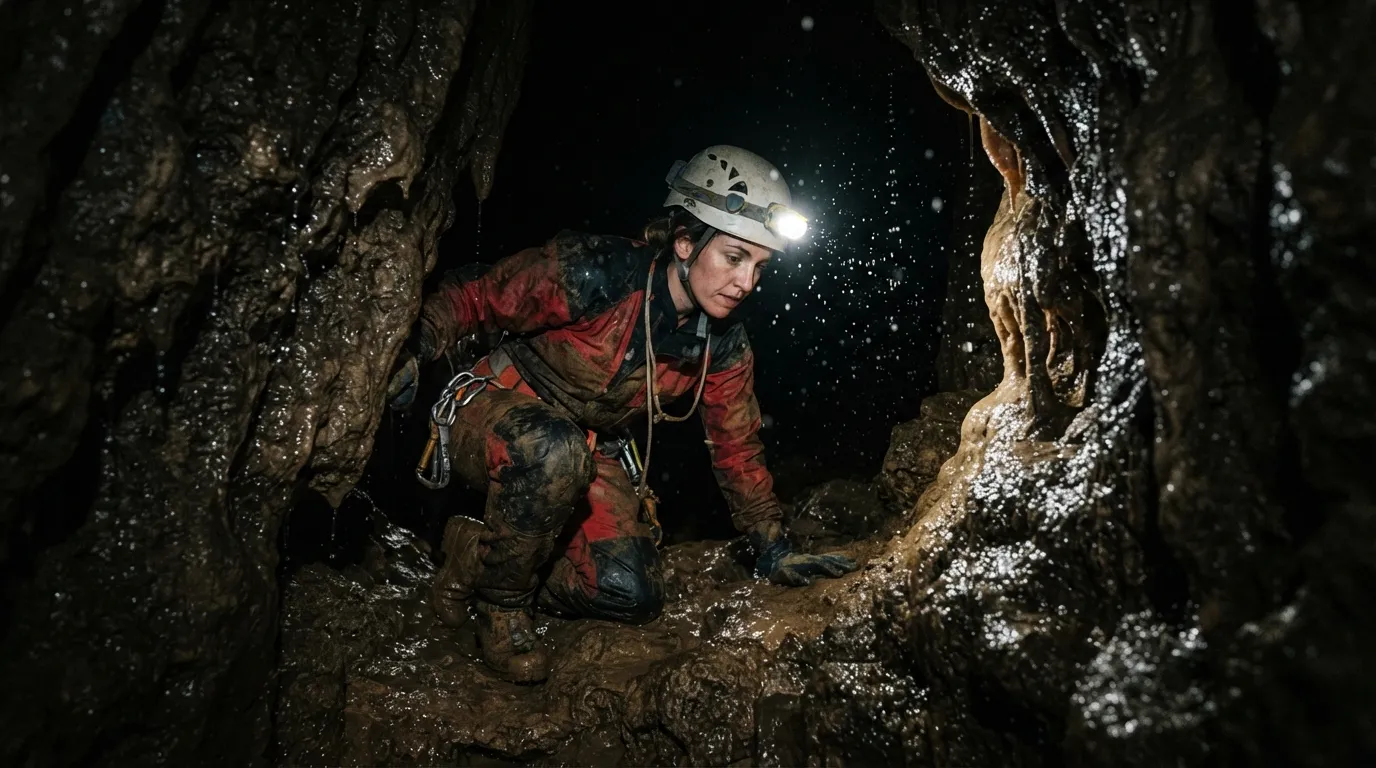
Tham Luang, 2018: eighteen days in the dark
On June 23, 2018, twelve members of a Thai junior soccer team, aged 11 to 16, entered the Tham Luang cave complex in northern Thailand with their 25-year-old coach after practice. They didn’t return that evening; bikes locked to a railing and shoes near the entrance alerted local authorities. Nine days later, on July 2, two British cave divers located them alive about two kilometers inside, perched on a narrow ledge above the rising water. The subsequent rescue, from July 8 to 10, involved dozens of international divers: each child, sedated and fitted with a full-face oxygen mask to prevent underwater panic through completely submerged passages, was extracted one by one through miles of partially flooded galleries before forecasted monsoon rains hit on July 11. The entire group was brought out safe and sound after eighteen days underground — one of the most complex cave rescues ever mounted.
If you are stuck: what to do, and what not to do
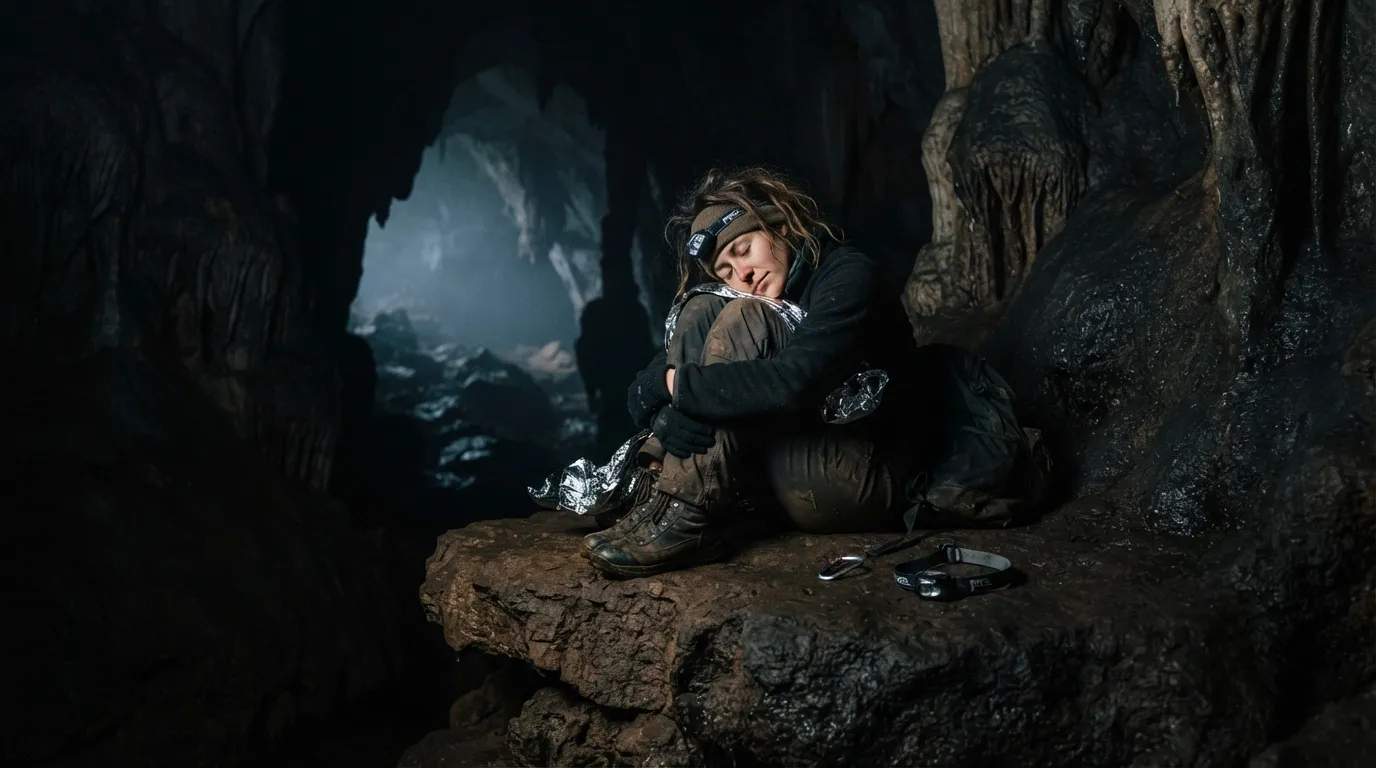
- Stop. Never keep moving without a reliable light or absolute certainty of your route: most severe accidents happen when people panic and try to “find a way out” instead of waiting for help.
- Find a dry, elevated spot, far from any area where water could rise during a flash flood, and sit down.
- Conserve your lights. Turn off every non-essential light source; keep one light strictly in reserve for vital tasks (drinking, adjusting position). Cold drains battery life: keep spares warm against your body to extend runtimes.
- Insulate yourself from the ground. Cold, wet rock drains body heat far faster than surrounding air: put a backpack, spare clothes, or anything available between you and the stone.
- Huddle together if you aren’t alone: shared body heat significantly slows down hypothermia.
- Urinate far from your water source or sleeping spot to avoid contaminating potential drinking water.
- Wait. A person who properly left their plan and expected return time with someone before heading out will be actively searched for; moving in pitch darkness almost always makes things worse.
Finding your way underground
Getting lost underground doesn’t require a massive network: in total darkness, a few junctions are enough to make the return path unrecognizable. The classic technique, drawn from the Greek myth of Ariadne giving Theseus a thread to escape the Minotaur’s labyrinth, is still used in modern caving: laying out a rope or guide line from the entrance, anchored at regular intervals, which you can follow by hand even with zero visibility in a flooded or smoky passage.
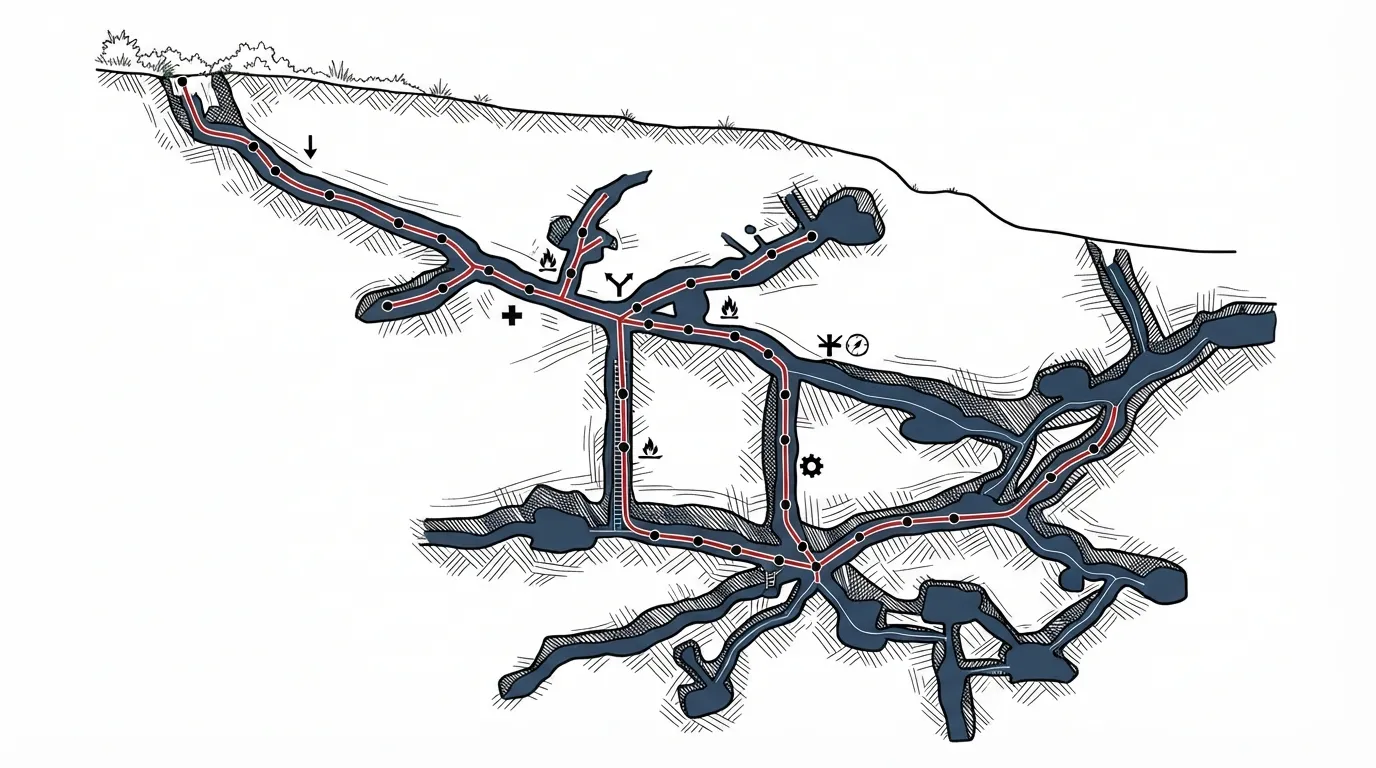
If you don’t have a guide line, several habits reduce the risk of going in circles: mark junctions with chalk or small rock cairns, always on the same side (for instance, on your right as you enter, making them easy to spot on your left during return); actively memorize every fork by turning around to see what the passage looks like coming from the opposite direction; and follow an air draft if one exists — a steady breeze, even faint, almost always signals a connection to the outside, whereas a passage with zero air movement usually ends in a dead end.
Lighting: three sources, never just one
The three independent light sources rule is one of the oldest, most universal principles of caving: a single broken light should never leave anyone stranded in pitch darkness. In an extreme emergency, a candle provides faint light, but it consumes oxygen and produces carbon monoxide in confined spaces: it never replaces a real lamp and must never be left burning unattended or without airflow.
Water and food underground
Water dripping from walls or flowing in underground streams is often — but not always — safe to drink: naturally filtered by yards of rock, it usually avoids surface pollution, but it can still run through guano deposits or contaminated areas upstream. To be safe, treat it like any wild water source before drinking it long-term. Sumps — sections of a passage that are completely submerged, ceiling included — must never be attempted without specialized cave diving gear and training: this exact obstacle made extracting the kids in Tham Luang so hazardous.
When it comes to food, there is strictly nothing to eat underground: no plants (no light means no photosynthesis past the entrance zone), and a tiny, practically inedible cave fauna. Biologists break cave dwellers into three categories: troglobites, species that live nowhere else and spend their entire lifecycle underground (often blind and pigment-free, like certain cave fish or crustaceans); troglophiles, capable of living in caves or surface habitats; and trogloxenes, which use caves occasionally without completing their lifecycle there — bats being the best-known example. None of these species offer a realistic food source in a survival situation: they are rare, tiny, and often protected. In a constant 8 to 12 °C environment, your body burns energy nonstop just to stay warm: waiting underground drains your reserves fast — one more reason to stay still and save your strength rather than wander around looking for an unlikely exit.
Ice caves
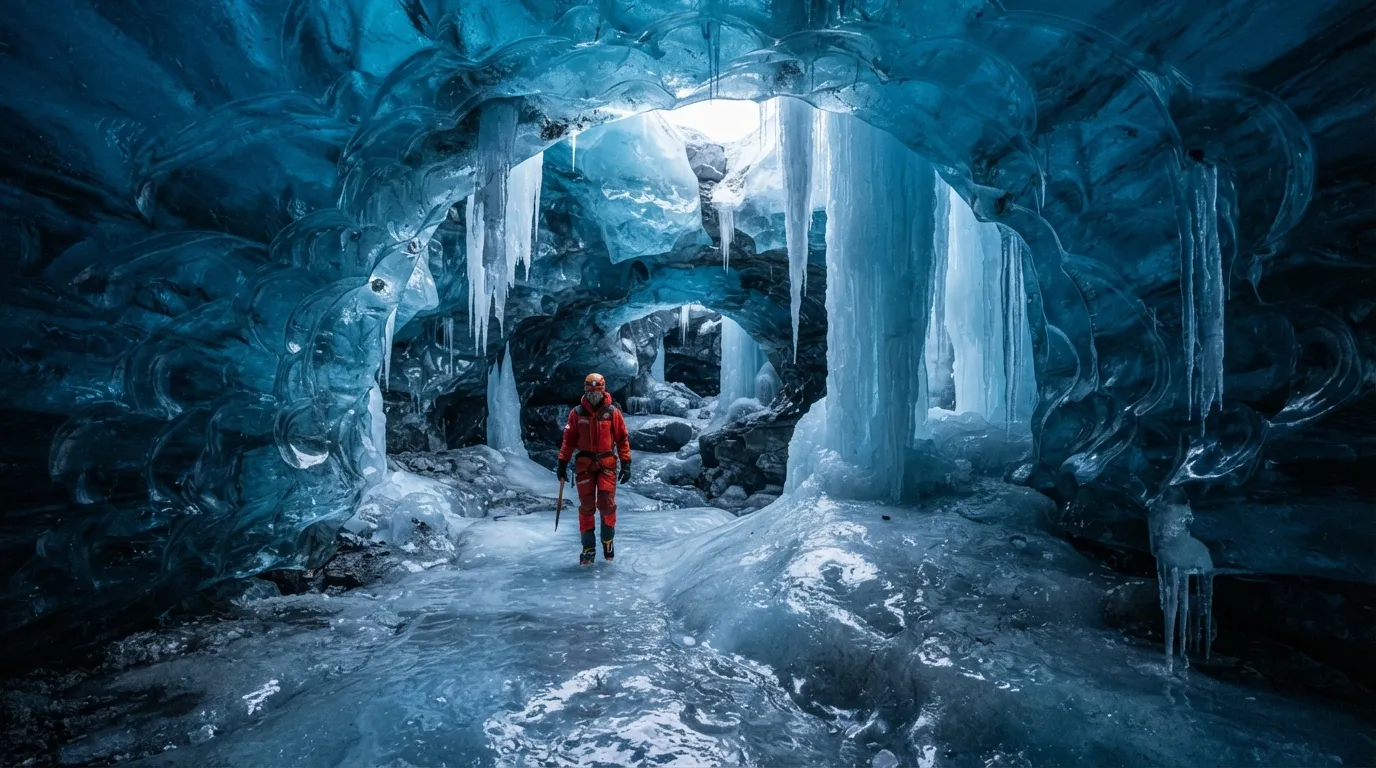
An ice cave isn’t a standard cave: it’s a natural cavity (often a limestone cave or lava tube) where a portion of ice remains frozen year-round thanks to a cold-air trap (heavy winter air stays trapped at the bottom while summer warm air can’t drop in), permafrost in surrounding rock, or evaporative cooling. Some are static and barely change year to year; others are seasonal, partially melting and refreezing with the seasons. The ice itself takes various forms depending on how it deposits: frozen pools of clear ice, accumulated coarse-crystal snow, dripping stalactites and stalagmites, frost crystallizing from ambient vapor, or glacier tongues pushing directly from the surface. In either case, the floor is permanently slick, falling ice blocks present a constant hazard, and hypothermia sets in even faster than in a traditional cave — stepping into an ice cave during summer when outside temperatures are high creates a treacherous thermal shock if you are dressed light.
Abandoned mines: worse than nature
Rock shelters: proper use, right at the entrance
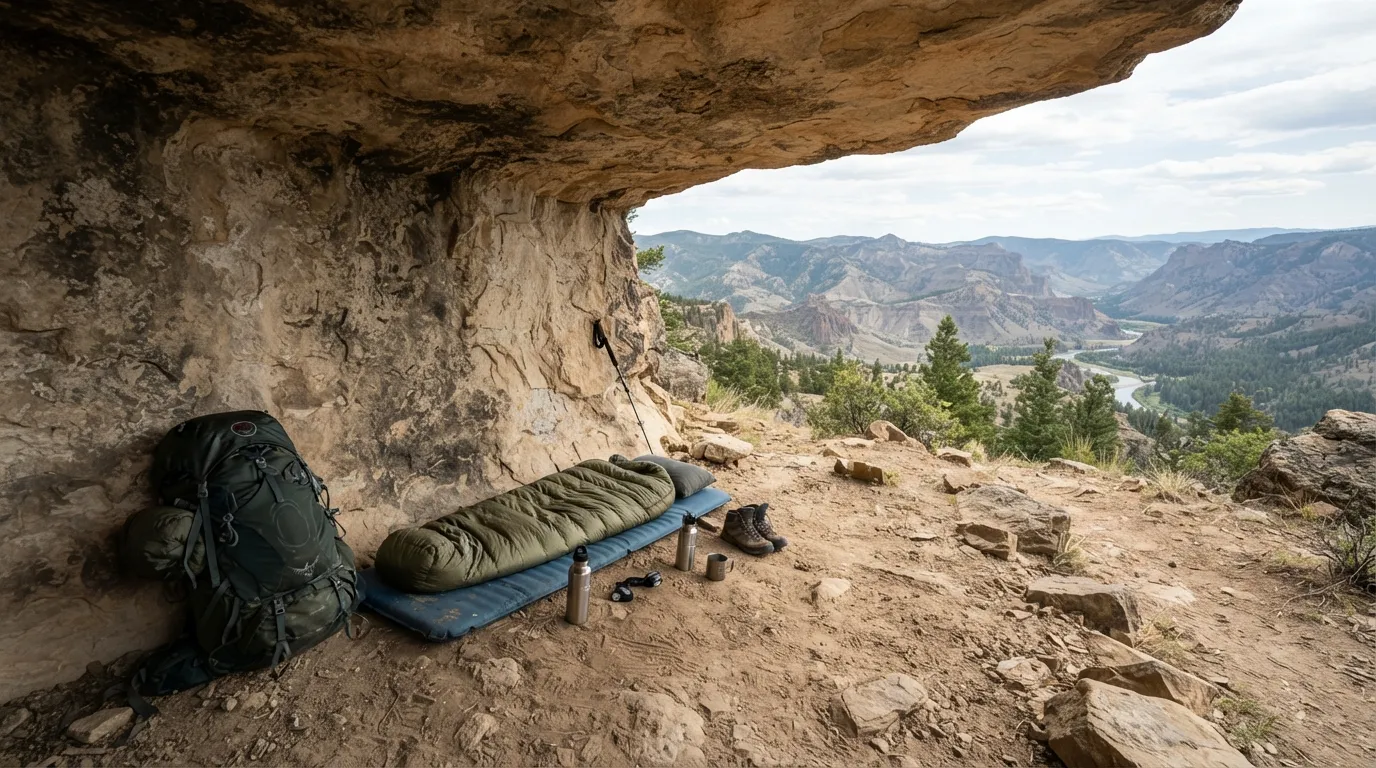
Unlike a deep cave, a rock shelter — an overhang or shallow alcove at the base of a cliff — served as human housing for tens of thousands of years, particularly during the Paleolithic era: the Bhimbetka site in India shows occupation signs going back over a hundred thousand years. The reason is simple: this space stays lit by natural sunlight, ventilated, easy to watch over, and quick to leave, avoiding deep-underground hazards (bad air, total pitch-black, flash floods). The takeaway rule for emergency shelters holds true today: camp at the entrance, never deep inside.
Polar night and total blackness: what it does to your brain
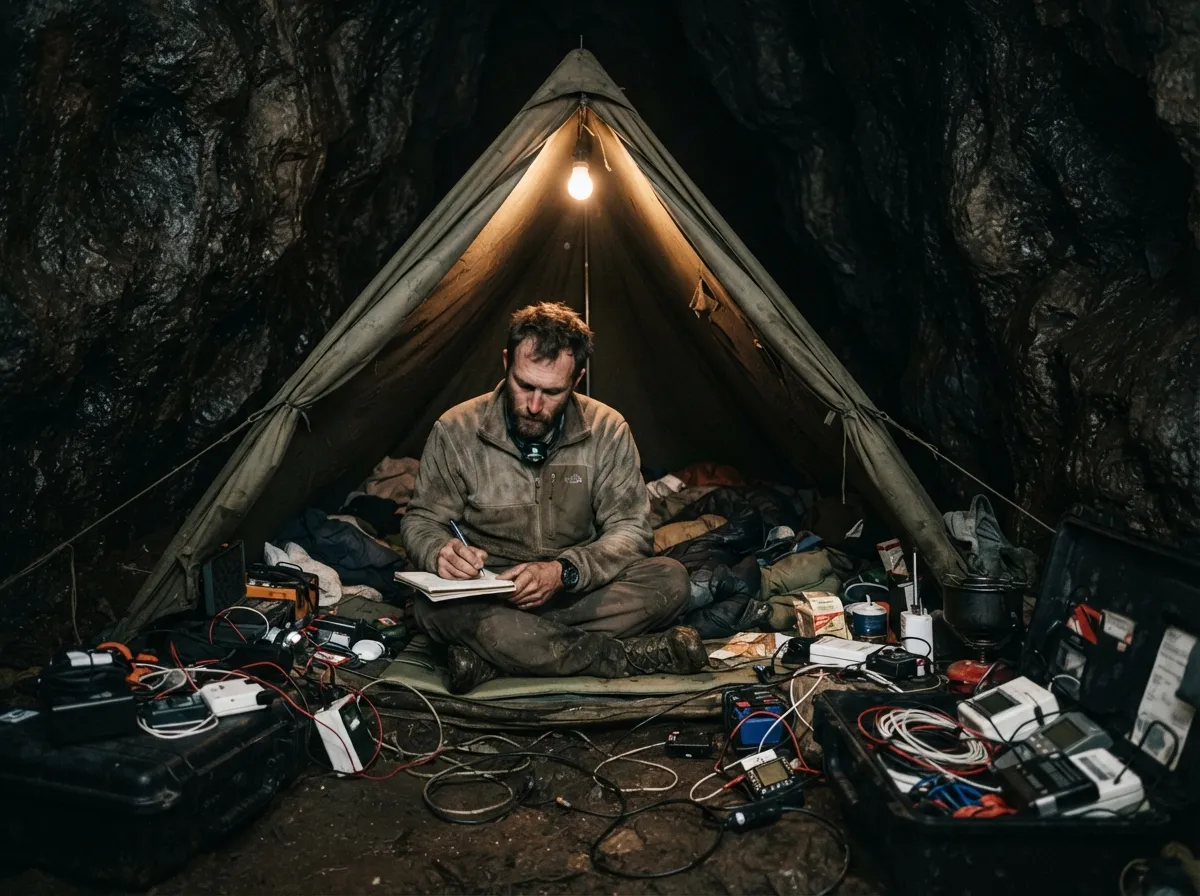
In July 1962, French geologist Michel Siffre shut himself in the Scarasson chasm in the French Alps, 130 meters underground, without a watch, calendar, or any clue of time or day outside. Scheduled to last two weeks, it stretched to sixty-two days: cut off from time cues, his body drifted, losing track of the 24-hour day — a breakthrough experiment for modern chronobiology still studied by NASA for long-duration space missions. During his second experiment — six months in Texas’s Midnight Cave in 1972 — Siffre documented this drift toward a roughly 48-hour sleep-wake cycle instead of 24, along with psychological and physical tolls he admitted he never fully recovered from.
In 2021, fifteen volunteers replicated a group version of this test inside the Lombrives cave in France: forty days at a constant 10 °C and 100% humidity, with zero daylight or outside contact, led by explorer Christian Clot and the Human Adaptation Institute — a project named Deep Time, whose findings serve future space crews and personnel working in underground or isolated settings.
Psychologically, prolonged total darkness can also trigger visual hallucinations in some people — a phenomenon documented in cavers stuck without light and individuals in sensory deprivation, as the brain generates its own visual input in the absence of real signals from the eyes.
Floyd Collins, 1925: when the rock seals the exit
On January 30, 1925, American explorer Floyd Collins was working alone in Sand Cave near Mammoth Cave, Kentucky, hunting for a new cave to commercialize. His carbide lamp began to flicker; hurrying toward the exit in the dimming light, he knocked over his lamp, lost all light, and dislodged a rock that pinned his left leg under a 27-pound stone while gravel trapped the rest of his body. He was found the next day, stuck 150 feet from the entrance and 55 feet underground. His brother managed to squeeze in to bring him food and water; an attempt to pull him out with ropes on February 2 failed and worsened the trap. After a collapse on February 4 sealed off direct access, rescuers opted to dig a parallel vertical shaft: seventy-five volunteers worked around the clock with pickaxes for days. Collins died of exposure, starvation, and hypothermia after fourteen days alone — rescuers finally reached his body on February 16, three days after his estimated death. Covered via telegraph and radio, the tragedy became one of the biggest media sensations in interwar America.
Lascaux: artists didn’t live in there
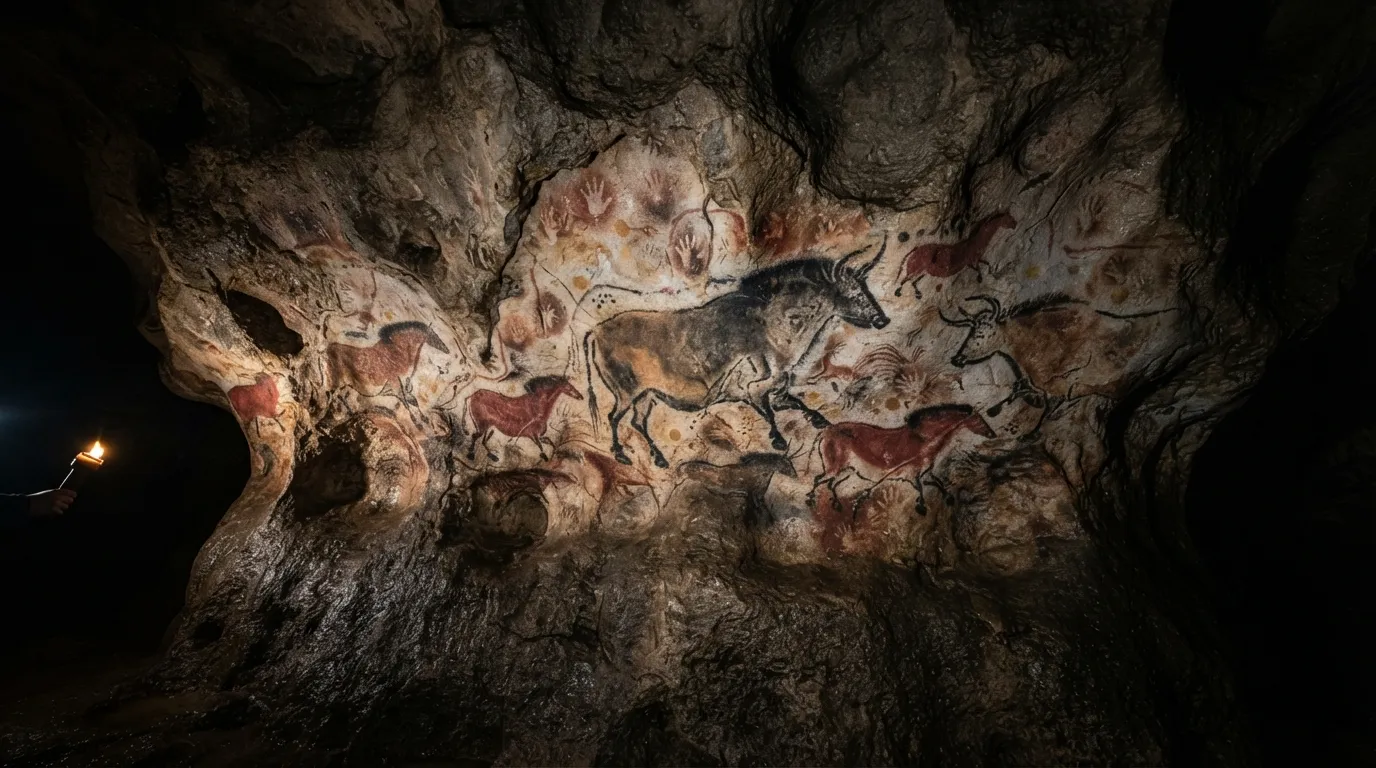
Contrary to popular belief, the prehistoric humans who painted the walls of Lascaux roughly 17,000 to 22,000 years ago didn’t live inside: the cave served as a sanctuary, visited and added to across generations, but was not an everyday home. Actual living sites from the same period nearby in Les Eyzies-de-Tayac numbered in the dozens — rock shelters with wide, bright entrances, exactly like those described above, not the dark depths of a cave system. Discovered by chance in September 1940 by a teenager, Marcel Ravidat, whose dog explored a hole left by a fallen tree, the cave opened to the public in 1948 before closing permanently in 1963, as visitors’ breath and heat began damaging the artwork.
| Rock shelter (entrance) | Deep cave (passage) | Abandoned mine | |
|---|---|---|---|
| Natural light | yes, continuously | no, past the entrance | no |
| Bad air risk | nearly zero | real in unventilated spots | high (residual gases) |
| Rock stability | generally stable | variable, rockfalls possible | unstable, rotted timber |
| Good survival shelter? | yes, with basic precautions | no, unless route is fully known | never, strictly off-limits |
Frequently asked questions
Can you seek shelter in an unknown cave during an emergency?
Only at the entrance, never deep inside. A wide, well-lit cave mouth works just like a traditional rock shelter — which is how prehistoric humans used them. Pushing into unknown passages exposes you to invisible hazards (bad air, floods, rockfalls, losing your way) that no untrained hiker can assess on the spot.
What is a “bad air” pocket and how do you spot it?
It’s a concentration of carbon dioxide, an odorless gas that is heavier than air and collects near the floor in poorly ventilated cavities. At a 6% concentration, mental confusion starts within half an hour; above 7%, severe symptoms hit in minutes. There is no reliable way to detect it without a gas meter — another key reason never to push into unknown caves.
What should you do if you are lost or trapped in a cave?
Stop immediately, find a dry and elevated spot, conserve your lights, insulate yourself from the cold rock floor, huddle together if you aren’t alone, and wait for rescue instead of wandering deeper into the unknown. For this to work, you must have left your plan and expected return time with someone before heading in.
Why didn’t prehistoric humans live deep inside the caves they painted?
Because the back of a cave like Lascaux is pitch-black, cold, and impractical for daily life: these areas served as sanctuaries visited occasionally over generations, while daily life took place in nearby rock shelters opened to daylight and much easier to live in.
How long can you survive without food inside a cave?
There is nothing to eat underground — no plants grow without sunlight past the entrance zone. A human body can theoretically last several weeks without food, but starvation is almost never what kills you first: hypothermia in a constant 8-12 °C, high-humidity environment moves much faster.
What’s the difference between a cave and an abandoned mine?
A natural cave formed over millions of years, achieving a degree of geological equilibrium. An artificially excavated mine is far more dangerous: timber supports rot over time, passages collapse easily, and the air can hold toxic residual gases from historical mining. Abandoned mines are strictly off-limits without exception.
Key Takeaways
- An unknown cave is never just a simple shelter: rockfalls, bad air pockets, flash floods, and hypothermia are real, invisible hazards that strike without warning.
- If you are trapped or lost, your best bet is almost always to wait in a dry spot, stay still, and save your lights — never wander deeper into the unknown.
- Never rely on instinct underground: guide lines, clear markers, and tracking air currents replace visual cues that don’t exist in pitch blackness.
- Always pack three independent light sources, and always leave your route and return time with someone before heading underground.
- An abandoned mine is not a cave: it is structurally far more dangerous and remains strictly off-limits.
Further reading
- French Speleological Federation, technical and safety regulations — the French-language benchmark for safe caving practices.
- Michel Siffre, Beyond Time (1963) — a first-hand account of the Scarasson experiment, foundational to chronobiology.
- Wikipedia (EN), Tham Luang cave rescue — a detailed, hour-by-hour account of one of the most complex cave rescues ever mounted.
- National Speleological Society (NSS), caves.org — the primary English-language resource for caving safety and education.
Sources for this module (17)
- Wikipedia (EN) — Cave
- Wikipedia (EN) — Cave rescue
- Wikipedia (EN) — Floyd Collins
- Wikipedia (EN) — Michel Siffre
- Wikipedia (EN) — Lascaux
- Wikipedia (EN) — Tham Luang cave rescue
- Wikipedia (EN) — Histoplasmosis
- Wikipedia (EN) — Carbon dioxide poisoning
- Wikipedia (EN) — Abandoned mine
- Wikipedia (EN) — Ice cave
- Wikipedia (EN) — Rock shelter
- Wikipedia (EN) — Bhimbetka rock shelters
- Wikipedia (EN) — Brown bear
- Wikipédia — Grotte de Lombrives / mission Deep Time
- Fédération française de spéléologie (FFS) — Sécurité et règles techniques
- Fédération française de spéléologie (FFS) — Accident/sinistre
- Human Adaptation Institute — Mission Deep Time
Continue in "By environment"
The temperate forest
The most generous environment in the world can also swallow you in ten minutes: here is how to read it instead of fearing it.
Mountains: Where the Weather Decides for You
The weather changes in thirty minutes, altitude works against you, the terrain is unforgiving: the signs to read before it's too late.
Snow, extreme cold, and the Far North: surviving at minus 30
Cold doesn't kill you: humidity, exhaustion, and panic do. What you need to know to stay alive below zero.