Snow, extreme cold, and the Far North: surviving at minus 30
Cold doesn't kill you: humidity, exhaustion, and panic do. What you need to know to stay alive below zero.
It is -28 °C, the wind is blowing at 30 km/h, and the thermometer you’re looking at isn’t telling the whole truth: your skin actually feels like -40 °C. You’ve been walking for three hours, your back is soaked with sweat under your down jacket, and the sun is already setting. In an hour, that sweat will freeze against your skin. Cold, in itself, isn’t going to kill you today. What you do in the next twenty minutes will.
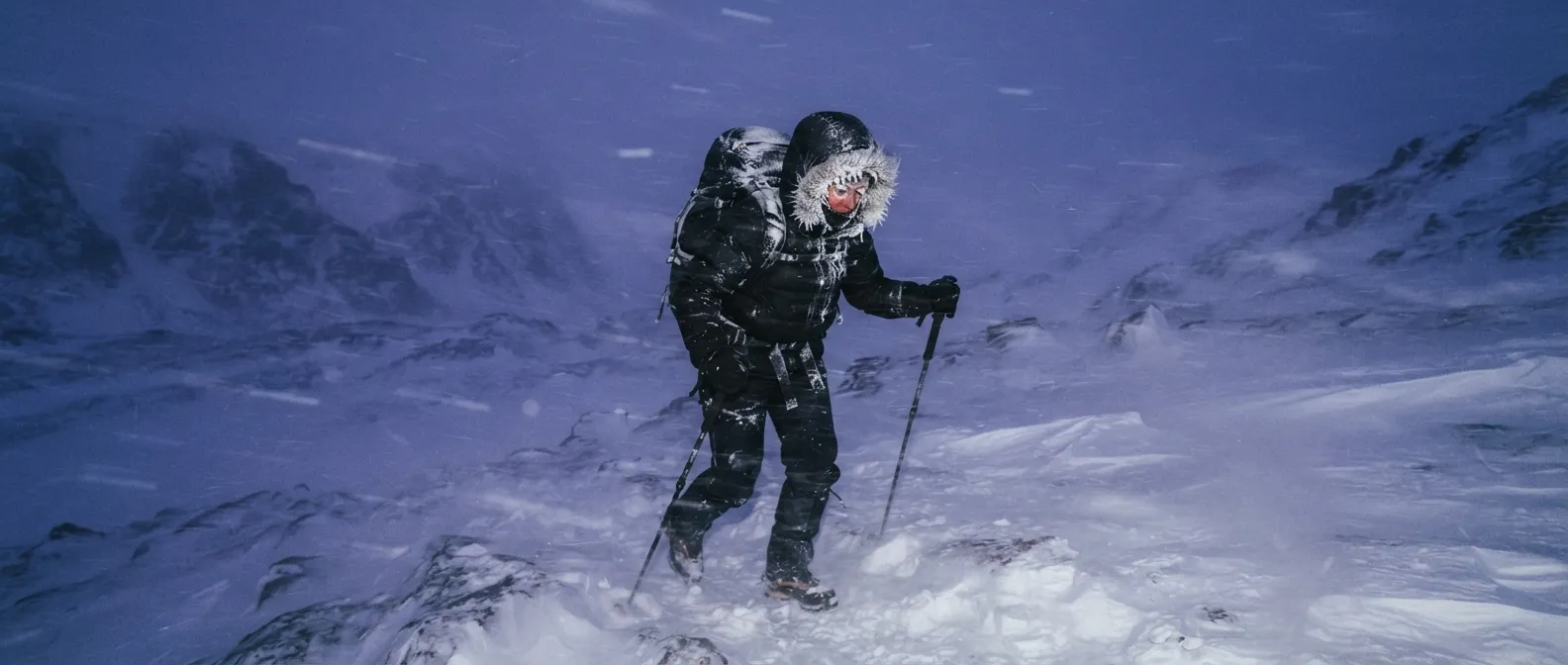
The physics of cold: four doors through which heat escapes
Your body constantly produces heat through metabolism and movement. It loses heat through four pathways, and knowing which one dominates dictates what you need to do.
- Conduction: direct contact with a cold surface. Sitting on snow, placing a sleeping bag on frozen ground without an insulating pad: heat leaves through direct transfer, and heat loss through ground contact can be roughly three times faster than through air contact. It’s the doorway most often forgotten because it makes no noise.
- Convection: moving air (or water) carrying away the layer of warm air trapped against your skin and replacing it with cold air. This is the mechanism behind wind chill: wind doesn’t lower the actual temperature, it merely accelerates the speed at which your skin reaches it. A wind that doubles its speed can roughly double your heat loss through convection.
- Evaporation: every gram of water that evaporates from your skin or wet clothes carries heat away with it — it’s the exact same principle that cools a water pitcher wrapped in a damp cloth. In summer, it saves your life. In winter, if it’s your own sweat-soaked clothes evaporating against you, it drains your core energy.
- Radiation: infrared heat that your body constantly emits, even when sitting still, toward everything colder around you — the air, the snow, the night sky.
From these four mechanisms comes the formula that every winter survival instructor repeats: cold doesn’t kill, humidity kills. A dry piece of clothing, even a thin one, traps a layer of still air that protects you from the other three mechanisms. A wet garment — from rain, melting snow, or your own sweat — loses most of this insulating power, sticks to your skin, and accelerates conduction and evaporation at the same time. That’s why falling into ice water at -5 °C kills faster than a dry night at -30 °C.
Dressing: never wet what keeps you warm
The golden rule of mountaineers comes down to four words: “be bold, start cold.” If you feel nice and cozy right at the start, you are setting yourself up to swim in your own sweat within fifteen minutes of walking, once your metabolism ramps up. The right approach is to start out feeling slightly chilly and rely on movement to warm you up in a few minutes.
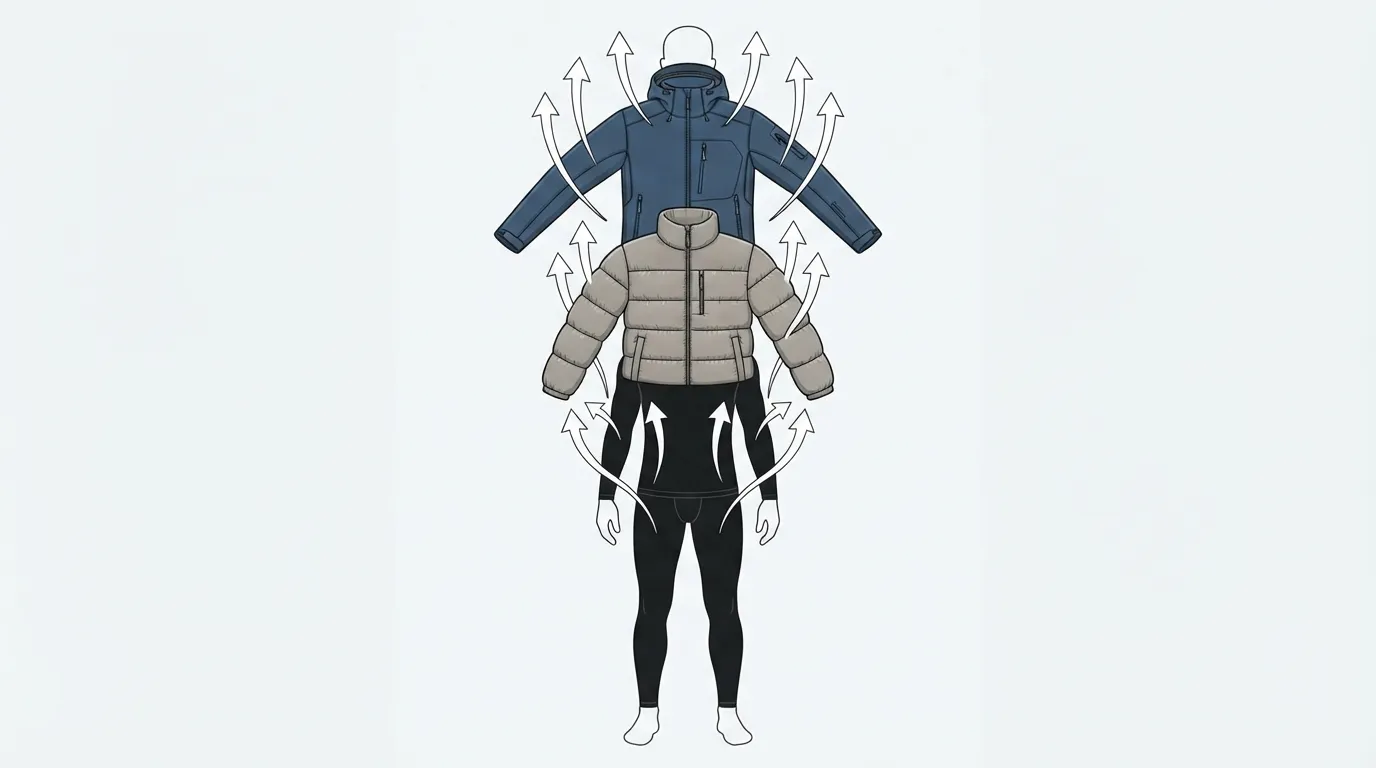
The three-layer system, inherited from mountain military units, remains the gold standard:
- The base layer, next to skin: its sole job is to wick away sweat, not to keep you warm. Merino wool or technical synthetic, never cotton.
- The middle layer: it traps warm air. Fleece, thick wool, or down, depending on the intensity of the upcoming effort.
- The outer layer (shell): it blocks wind and snow without preventing moisture vapor from escaping.
| Merino wool | Technical synthetic | Cotton | |
|---|---|---|---|
| Insulates when wet | ✅ (fibers trap air even when damp) | medium (dries fast but insulates poorly when wet) | ❌ |
| Water absorption | up to 30% of its weight without feeling wet | low, practically hydrophobic | 24 to 27 times its weight |
| Drying speed | slow | fast | extremely slow |
| Odor control | naturally resistant | retains odors | retains odors |
| On skin in deep cold | ✅ | ✅ | ❌ dangerous |
Wet cotton doesn’t just insulate poorly: it actively leaches heat from your body through combined conduction and evaporation. North American wilderness guides even have a saying for it: “cotton kills.” A pair of jeans soaked by melting snow on a winter hike plays a role in a huge portion of recreational hypothermia cases every year.
The vapor barrier liner (VBL): the layer you wear backward
Counterintuitive, but brutally effective in prolonged extreme cold: a vapeur-impermeable membrane worn directly over a thin base layer, before your insulation. It blocks insensible perspiration (the moisture you don’t even feel losing) before it can reach and soak your down jacket or sleeping bag filling. Result: your insulation stays bone-dry and effective day after day, even on multi-week expeditions where drying gear is impossible. The trade-off is feeling like a tropical greenhouse right against your skin — that’s the point, not a defect — and needing to manage your exertion carefully so you don’t drown in sweat inside.
On your feet: mukluks vs. rigid boots
Mukluks, the traditional soft boots of Arctic peoples (caribou skin, seal skin soles), work on the exact opposite principle of modern rigid winter boots: the soft sole lets your foot flex and work with every step, which stimulates circulation and generates muscle heat. Will Steger, a polar explorer who skied to the North Pole, reported never suffering frostbite on his feet even at -45 °C while wearing them. A Canadian Military study measured that a rubberized version of the mukluk retained 20 to 30% more sweat moisture than a breathable cloth-topped version — a difference that wearers in the field didn’t actually notice in practice.
Frostbite and hypothermia: recognize it, then act fast
This module doesn’t dive into full wilderness first aid protocols — that is covered extensively in the First Aid in the Wild module, which details the stages of hypothermia, the “burrito wrap” technique for warming a victim, and frostbite treatment. Just remember the crucial basics to act in time: frostbite hits extremities first (nose, ears, fingers, toes), starting with numbness and pale skin, becoming a severe emergency as soon as the tissue hardens and loses flexibility. Hypothermia sets in as soon as shivering stops while it’s still cold — a body that stops shivering has given up heating itself. In both cases, the rule is identical: insulate from cold and moisture before hoping for improvement, and never rapidly thaw frostbitten skin if there is any risk of it refreezing later. Complete stage-by-stage details are in the emergency module.
The snow shelter: snow as an insulator, not an enemy
Packed snow contains countless microscopic air pockets, and trapped air is a terrible heat conductor: that’s exactly what makes a wool sweater work. A well-built snow shelter blocks wind — which is often the real killer, rather than dry cold air — and can stay significantly warmer inside than outside, even without a heater.
The snow trench
The fastest shelter to build with minimal tools: a trench slightly longer than you are, a bit wider than your shoulders, roofed with branches, topped with a tarp or cloth, and covered with a layer of snow on top. It cuts out the wind in minutes of digging for an emergency night.
The quinzhee
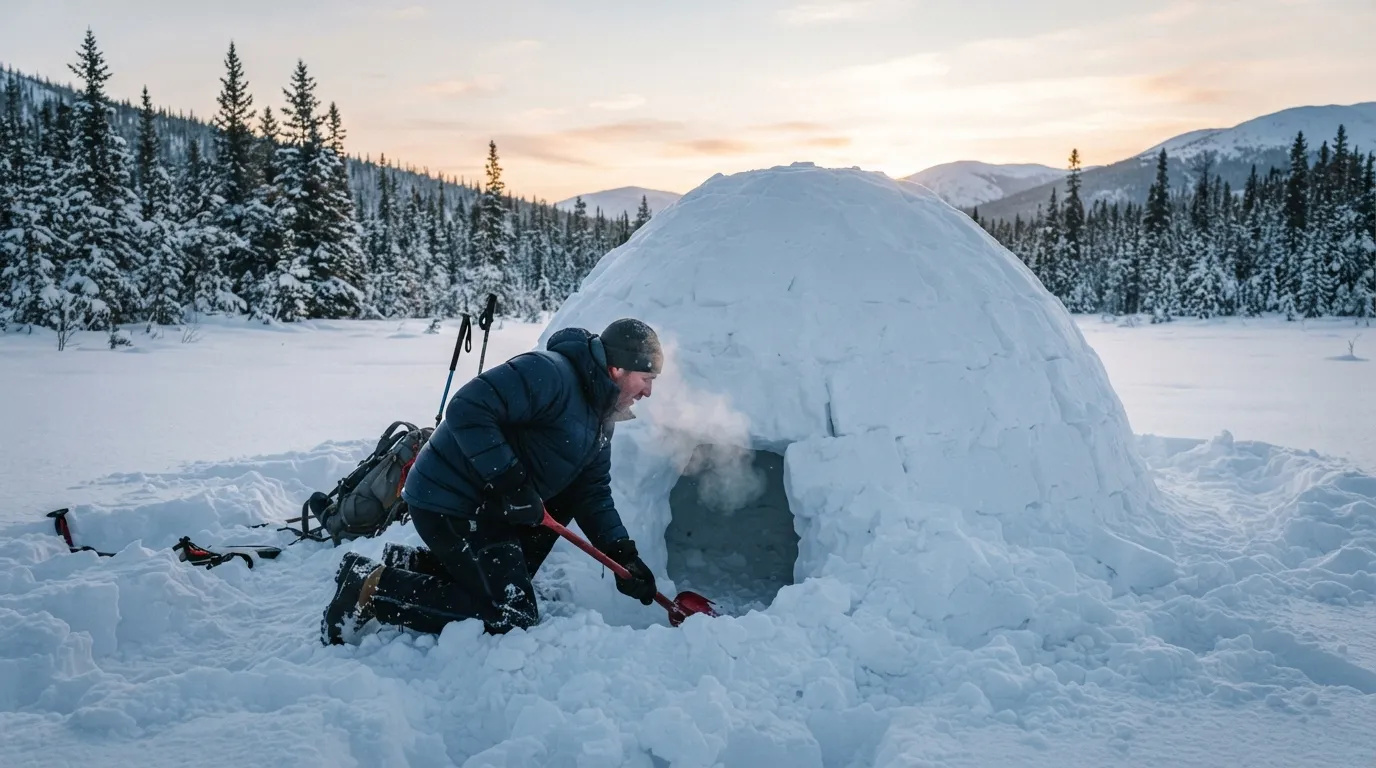
A quinzhee is a shelter built by piling snow up and then hollowing it out. It doesn’t require hard, compact snow blocks like an igloo — you can build one using ordinary powder.
- Mark a circle on the ground and stomp it down with your boots (or snowshoes) to eliminate air pockets underneath the future mound.
- Pile snow into a dome roughly two meters high, mixing snow from different temperature layers as you pile it: this mixing speeds up sintering, the natural process where snow grains freeze together.
- Let it settle for at least 90 minutes, ideally two to three hours. This is the step everyone wants to skip, and the one that prevents a collapse.
- Push sticks about 30 cm long into the dome all over, leaving only 5 cm sticking out: these act as depth gauges while you dig.
- Dig a low entrance tunnel that drops down before sloping up into the main chamber: this “cold-air trap” keeps warm air up high around the sleeping area.
- Hollow out the inside until you reach the tip of each guide stick: this creates walls roughly 25 cm thick — not too thin (risk of collapse), not too thick (extra snow adds no insulating benefit).
- Poke two or three fist-sized ventilation holes through the wall, about one-third of the way down from the top.
The snow cave
On a slope where deep snow has drifted — at the base of a snowbank or against a ridge — you can dig horizontally instead of piling a mound. The design principle matches the quinzhee: a low entrance and an elevated sleeping platform relative to the doorway, forcing denser cold air to drop and drain away from the sleeper.
The igloo: Inuit architecture
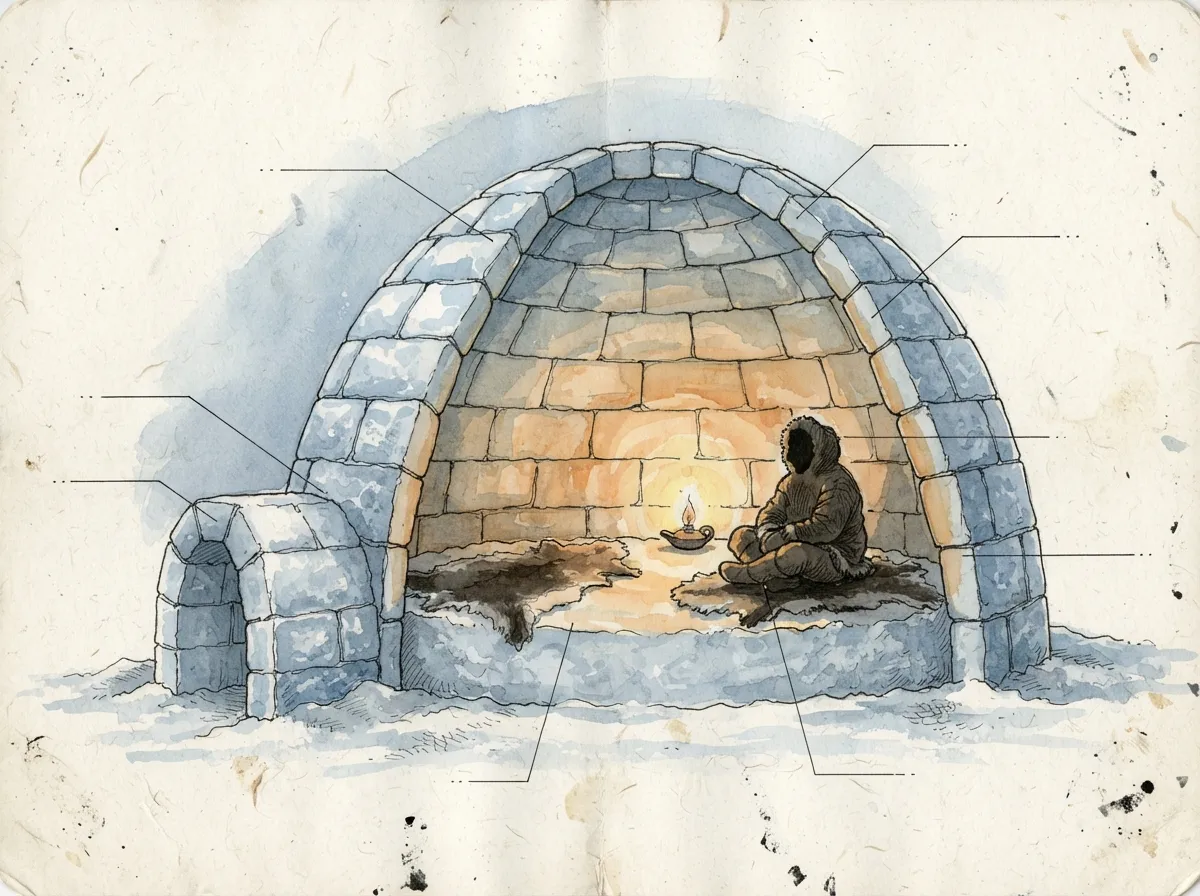
An igloo isn’t just a mound of snow: it’s a self-supporting catenary arch, built from blocks cut out of wind-compacted snow (never fresh powder, which is too weak), stacked in a rising inward spiral that caps at the top — the same engineering logic as a stone vault, but made of snow. The Inuit of Central Arctic Canada and Greenland turned it into a science: outside, -45 °C; inside, up to 16 °C, heated solely by body heat and a small oil lamp, the qulliq. This lamp does more than heat: it slightly melts the inner layer of the dome, which then refreezes into a thin shell of ice — making the igloo structurally stronger as you use it.
Fires on snow
The Fire module details fire lighting and lay structures; here, the challenge is unique: a fire built directly on snow melts the snow beneath it, sinks down, and drowns in its own meltwater. You need a solid platform.
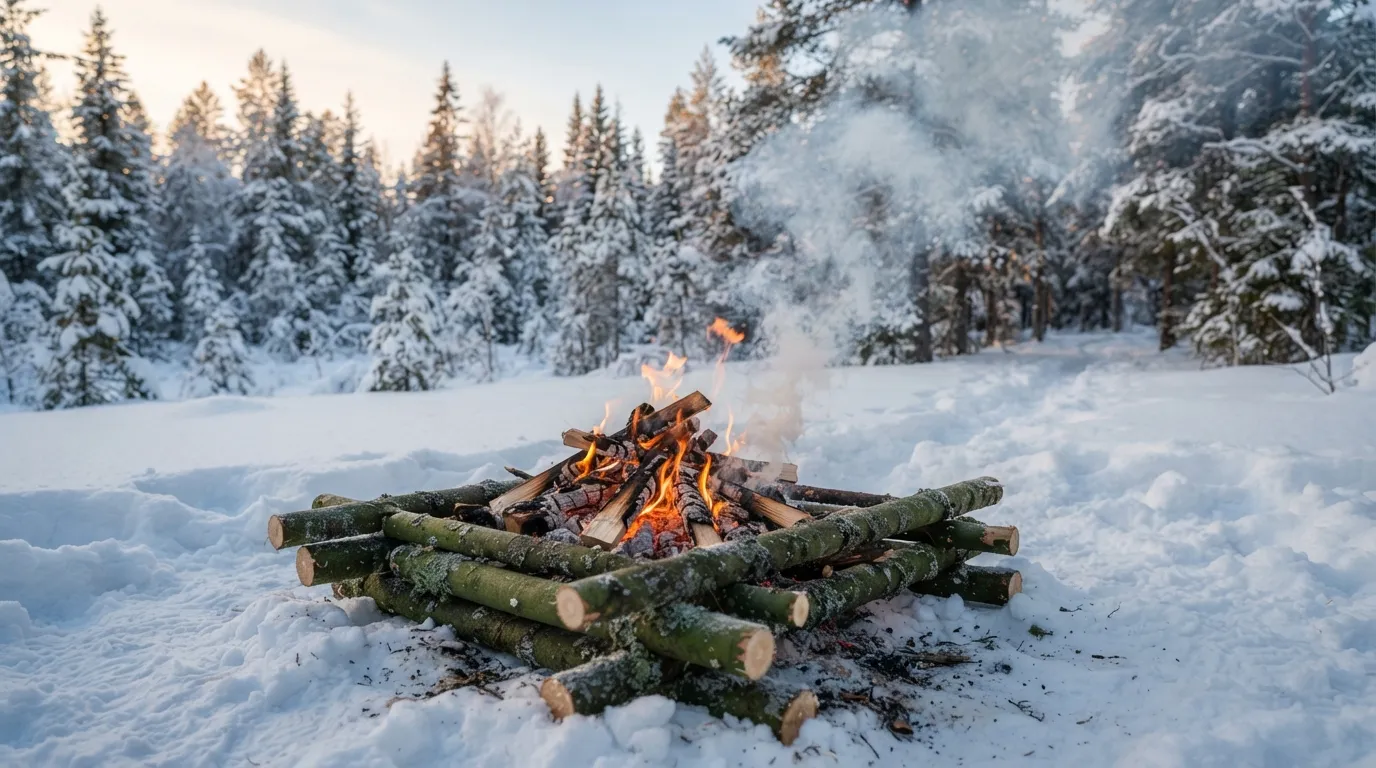
- Cut several green or wet logs, about 10 to 15 cm in diameter: their moisture keeps them from burning through before serving as a base.
- Lay two crisscrossed layers of these logs directly on packed snow to build a raft.
- Build your fire structure on top of this timber raft, just as you would on normal ground.
- Monitor it: even on a platform, heat will eventually melt through after a few hours. An overnight fire requires a much wider and thicker timber bed than a quick one-hour cooking fire.
Standing dead wood is your best source of dry fuel in winter, just as it is in heavy rain: snow slides off vertical bark, whereas it collects and slowly melts into fallen logs. Birch bark, rich in betulin oil, ignites even after freezing and thawing cycles, making it a reliable tinder when everything else is wet.
Water: melting snow vs. eating snow
Melting snow consumes valuable energy and fuel: a golden rule among wilderness guides is to always keep a bit of liquid water in the bottom of your pot before adding snow. Without that liquid base, dry snow insulates so well that it delays its own melting and can scorch the bottom of a metal pot before generating liquid. Add snow gradually, never packing it tightly to the rim.
Under frozen lakes or rivers, liquid water keeps flowing all season long: an ice hole drilled with an auger or chopped with an axe, well away from unstable shorelines, provides fresh water. You still need to purify or boil it, just like any open surface water source. At sea, multi-year ice (ice that has survived several summer melts) loses almost all its salt through drainage channels over time: Inuit hunters and Arctic sailors identified it by its bluish tint and brittle structure, distinct from salty, milky white first-year ice, and melted it directly for drinking water.
Food and metabolism: why you need fat
Your body heats itself by burning calories, and deep cold demands a lot of them: polar expeditions pulling sleds for hours a day regularly burn 5 000 to 7 000 kilocalories per day, combining physical labor with thermogenesis — the energy spent simply keeping core body temperature stable. Fat is the most calorie-dense fuel available: providing more than twice the energy per gram compared to carbohydrates or protein, making it the top priority in cold-weather rations.
Travel: snowshoes, ice safety, and the cold water clock
Walking through deep snow without flotation will exhaust you in a matter of hundreds of meters. Improvised snowshoes, even crude ones, distribute your weight over a much larger surface area and make travel possible.
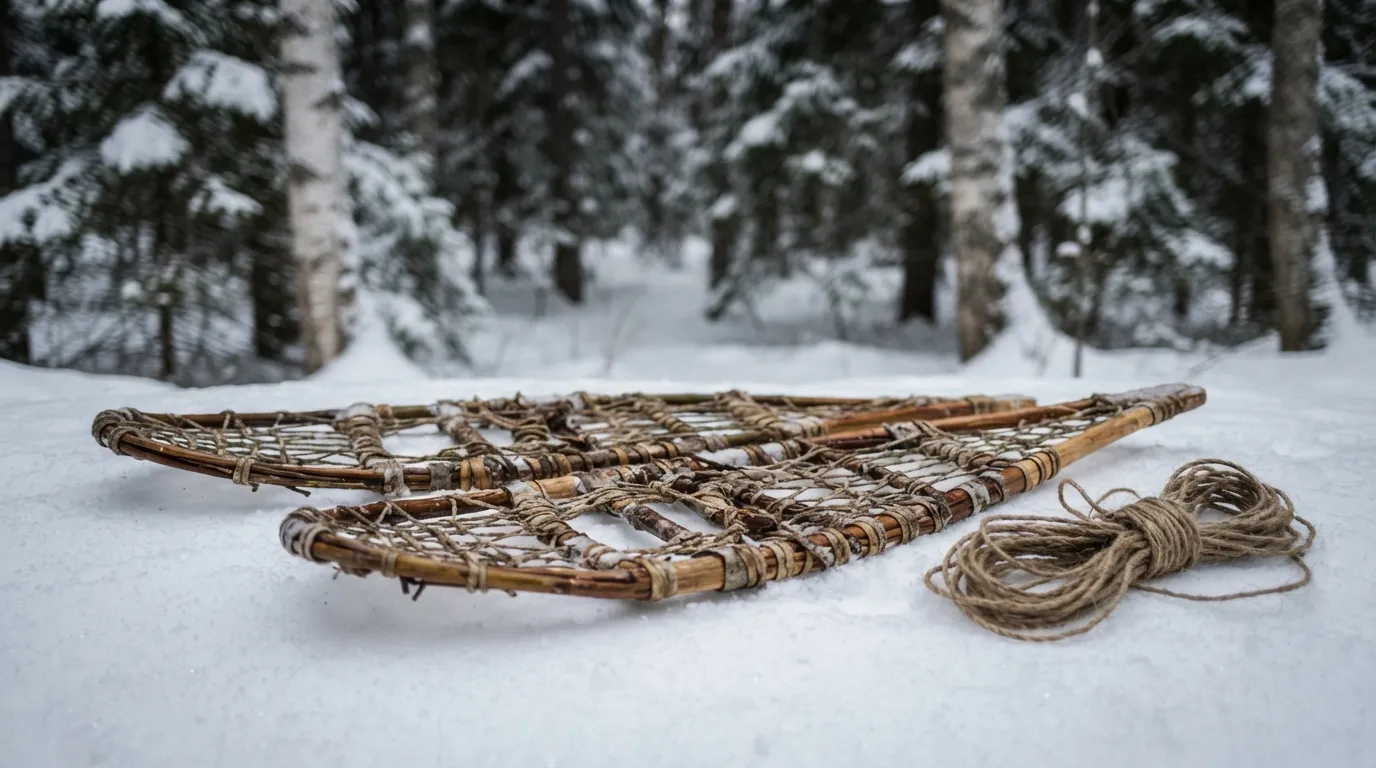
The classic traditional design — popularized by Mors Kochanski as the “Roycroft” snowshoe — uses flexible green branches roughly four feet long, bent into an oval frame, bound with a simple X-shaped cord harness across the ball of the foot: your heel stays free to lift with every step while the toe remains secured. A functional pair can be crafted in about an hour with a knife and cordage.
Frozen lakes: reading ice thickness
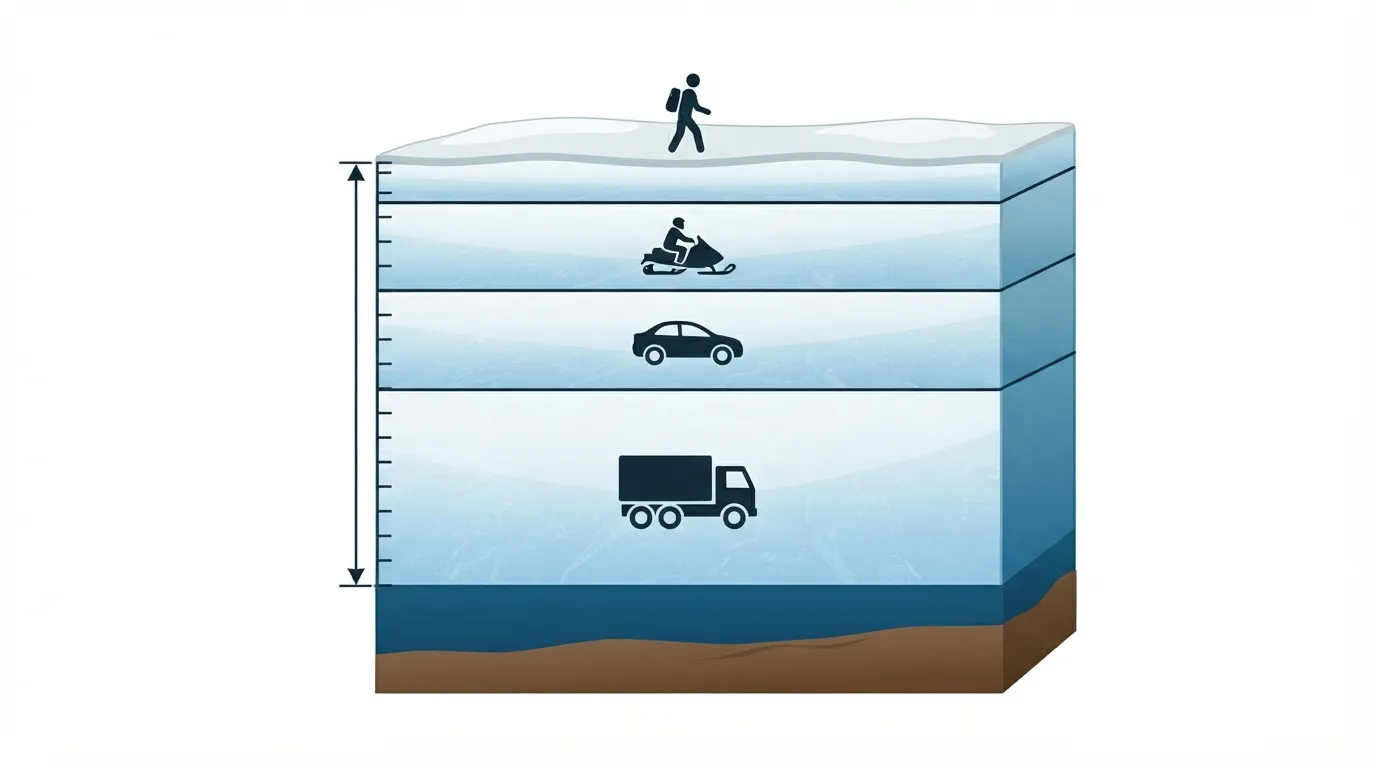
- Less than 10 cm: stay on shore, no exceptions.
- 10 cm: safe for a single person on foot.
- 13 to 18 cm: snowmobiles and ATVs.
- 20 to 30 cm: small groups or light vehicles.
- 30 cm and up: heavy trucks.
These guidelines apply exclusively to clear, black ice, formed from direct freezing of lake water: it is the strongest type. White, cloudy ice, formed from slush and melted snow refreezing, has only half the strength of clear ice for the same thickness — snow acts as an insulator, slowing down and weakening solid ice formation beneath it.
- Do not panic during the first minute: the initial cold shock response (the “gasp” reflex) is violent but short-lived. Controlling your breathing is your absolute priority during that first minute — full details on Gordon Giesbrecht’s 1-10-1 rule are in the emergency module.
- Turn back toward the direction you came from: that ice held your weight moments before, making it the strongest surface to climb onto.
- Rest your arms flat on the ice edge, and if you have ice picks, plant them into the ice ahead of you. Kick your legs horizontally to float your body out while pulling yourself forward, like swimming crawl, without trying to stand up suddenly.
- Once out, roll away from the hole before standing up, spreading your body weight over uncertain ice.
- Change out of wet gear as soon as possible, or at minimum, roll in dry snow to let it absorb surface moisture before it freezes into your clothing — then keep moving immediately to generate muscle heat: you have roughly ten minutes of useful movement before muscles stop responding.
Polar night and snow blindness
In high latitudes, winter reduces daylight to a few short hours or weeks of complete darkness. The lack of sunlight impacts morale and sleep cycles — Arctic populations and wintering scientists manage this with strict routines using artificial light and physical activity.
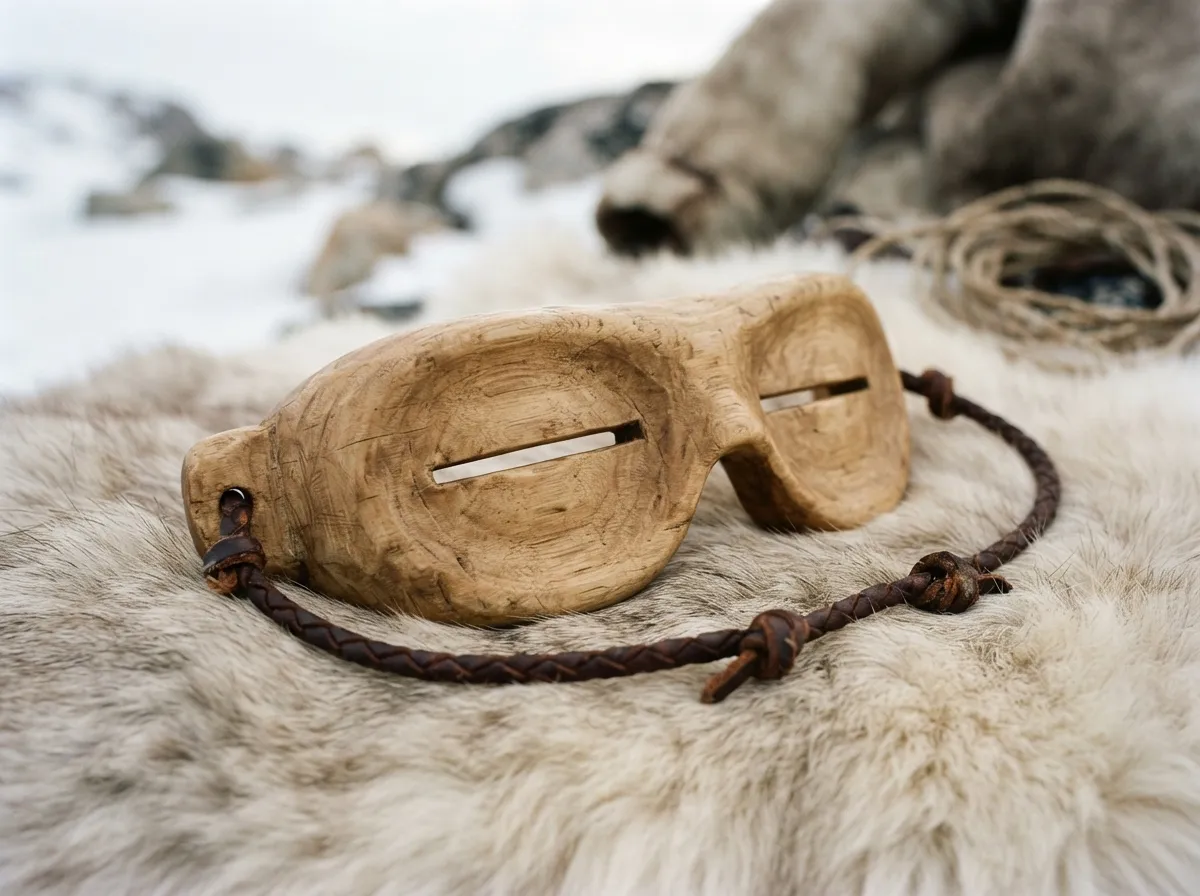
The main eye hazard, however, comes from below: snow reflects up to 80% of solar ultraviolet radiation. This double dose — direct and reflected — can literally sunburn your cornea in hours, causing snow blindness: a painful condition that causes temporary vision loss for several days. Inuit and Yupik peoples solved this thousands of years ago by carving goggles out of wood, bone, or antler featuring a narrow horizontal slit: this cuts down incoming UV light, and as documented by anthropologist Ann Fienup-Riordan, it also sharpens visual acuity through a pinhole camera effect. If you lack goggles, smearing soot or charcoal under your eyes reduces glare through contrast, a trick shared by indigenous Arctic hunters and modern athletes alike.
Northern wildlife safety
- Polar bears: the only large predator that actively views humans as potential prey rather than a threat. Prevention is everything: maintain a minimum distance of several hundred meters in protected habitats, never store food near sleeping areas, and travel in groups. If confronted closely, loud metallic noises (banging pots) and signal flares are among the primary deterrents recommended by wildlife agencies.
- Wolves: wild wolf attacks on humans are extraordinarily rare compared to other northern wildlife; the main risk involves hungry packs approaching poorly managed campsites or working dogs, rather than active hunting of people.
- Moose: widely underestimated, yet statistically more dangerous in North America than bears and wolves combined — injuring more people every year than both species put together. Winter increases the danger: exhausted by moving through deep snow, moose stick to cleared roads and packed trails where encounters happen at close range without warning. Protective cows or rutting bulls will charge aggressively without obvious preliminary signs.
The peoples and expeditions that shaped winter survival
Nothing in this module was invented in an armchair: it comes from centuries of field trial.
- The Inuit perfected the igloo, mukluks, slit snow goggles, and sea-ice navigation — a depth of knowledge that Western explorers adopted to survive extreme polar conditions.
- The Sámi, reindeer herders of Northern Scandinavia, crafted boots lined with dried sedge grass (sennegrass) which absorbs moisture and insulates better than many modern synthetic liners, paired with hollow-haired reindeer fur clothing — an exceptional biological insulator.
- Canadian trappers inherited and refined these methods for life in the boreal forest, where winter lasts six months.
- Roald Amundsen vs. Robert Falcon Scott (Race to the South Pole, 1911-1912) remains the ultimate case study: Amundsen spent years studying Inuit survival, wore loose fur garments that let sweat escape, used dog sleds, and returned safely with his entire team in 99 days. Scott wore wool layers under restrictive windproof shells that trapped perspiration — which froze solid inside his gear —, hauled sleds by human muscle power, and his entire party died of starvation, cold, and scurvy 18 km from a supply depot, 70 days after reaching the pole.
- Fridtjof Nansen, who also learned from Greenlandic Inuit, intentionally let his ship Fram freeze into Arctic pack ice, later surviving nine months with a single companion in a hut built from walrus hides, whale bones, and sledges, living off polar bears and seals.
Stranded in a snowbound car
A common winter hazard, and one of the deadliest every year in cold climates: a car gets stuck in a drift or slides off the road during a blizzard, far from immediate help.
Avalanches: a distinct mountain hazard
Avalanche safety requires entirely different skill sets and gear from general cold-weather survival: it demands specialized tools (avalanche transceiver, shovel, probe), terrain analysis, snowpack testing, and companion rescue drills practiced long before heading out. It is a topic far too extensive for a single paragraph — just remember that avalanche risk exists on any slope steeper than roughly 30 degrees covered in unstable snow, that victims die primarily from asphyxiation under snow rather than trauma, and that the single best protection is avoiding avalanche terrain without proper equipment and training.
Frequently asked questions
How long can you survive in ice water before drowning?
Your body reacts in three distinct phases governed by the 1-10-1 rule: roughly 1 minute of cold shock response to control, 10 minutes of functional movement to pull yourself out, and about 1 hour before losing consciousness from hypothermia. Most cold-water drownings occur within the first 10 minutes due to physical incapacitation, not after an hour.
Should you eat snow if you have no water?
It isn’t ideal, but it isn’t the instant poison people sometimes claim: the primary danger is failing to hydrate adequately due to the effort involved, rather than lowering your core temperature. It is far better to melt snow over a heat source, but if you must eat it, compress it into small firm balls and let them melt in your mouth rather than chewing large freezing scoops.
What ice thickness is safe to walk on over a frozen lake?
Roughly 10 centimeters of clear, solid black ice for a single person on foot, and 20 to 30 centimeters for a light vehicle. These guidelines apply only to clear ice formed directly from freezing lake water: milky white ice formed from refrozen slush is half as strong at the same thickness.
Does an igloo actually stay warm inside?
Yes, without exaggeration: relying solely on body heat and a tiny oil lamp, a well-constructed igloo can maintain an internal temperature up to 40 degrees warmer than the outside air — holding at 16 °C inside when it is -45 °C outside, an insulation performance documented among Central Arctic Inuit.
Why is cotton so dangerous in winter?
Because cotton absorbs huge amounts of water (24 to 27 times its dry weight) and loses almost all insulating value when wet, clinging cold against your skin. Once soaked — by rain, melting snow, or sweat — it accelerates body heat loss through rapid conduction and evaporation, right when you need insulation most.
What should you do if your car gets stuck in the snow?
Stay inside or right next to your vehicle, ensure the exhaust pipe is completely clear of snow before turning on the ignition, run the engine intermittently for heat rather than continuously, and make your vehicle visible to rescuers. The main hazard isn’t just the cold, but carbon monoxide poisoning caused by a blocked tailpipe.
Summary checklist
- Humidity kills far faster than cold air: prioritize staying dry over staying warm, and start your trek feeling slightly cold rather than sweating.
- Layer up, avoid cotton against your skin, and use a vapor barrier system on extended trips — but never on your hands.
- Snow is a great insulator if packed down and kept off your skin: build a quinzhee, snow trench, or igloo, always leaving an air vent open.
- Fat is cold-weather fuel — polar expeditions burn 5 000 to 7 000 kcal per day, and relying strictly on lean meat can lead to protein poisoning.
- If you break through ice or get stranded in a vehicle, the first few minutes dictate survival: control your breathing, keep moving, and clear your exhaust pipe before running an engine.
Further reading
- Gordon Giesbrecht (“Professor Popsicle”), Cold Water Boot Camp — the physiological research behind the 1-10-1 rule, tested firsthand.
- Wilderness Medical Society, Clinical Practice Guidelines for Frostbite, 2024 Update — the primary free medical guideline for frostbite field care.
- Fridtjof Nansen, Farthest North (1897) — first-hand account of the Fram ice drift and wintering on Franz Josef Land.
- Roland Huntford, Race for the South Pole — a detailed analysis comparing the equipment, logistics, and choices of Amundsen and Scott.
Sources for this module (22)
- Wilderness Medical Society — Clinical Practice Guidelines for Frostbite, 2024 Update
- McGill Office for Science and Society — Professor Popsicle's Physiological Proof (Gordon Giesbrecht)
- National Center for Cold Water Safety — The 1-10-1 Myth
- Andrew Skurka — Vapor Barrier Liners: Theory & Application
- SectionHiker — Vapor Barrier Clothing and Sleeping Bag Liners
- Washington Trails Association — How to Build a Quinzee
- Moss Design — Warmth Around The World: Igloos
- Hektoen International — Rabbit Starvation (Protein Poisoning)
- Smithsonian Magazine — These Snow Goggles Demonstrate Thousands of Years of Indigenous Ingenuity
- GudGear — Safe Ice Thickness Guide
- Boreal.net — 'Don't Eat Snow', Another Survival Myth
- CoolAntarctica — The Race to the South Pole: Amundsen and Scott, 1911-1912
- Survival Skills Guide — Winter Boots for Survival
- Wikipedia — Nansen's Fram Expedition
- The Art of Manliness — How to Make Improvised Snowshoes
- Battlbox — Best Survival Shelter for Cold Weather
- Northern Wilds Magazine — Self-Rescue: What To Do If You Fall Through Ice
- U.S. Fish & Wildlife Service — Safety in Polar Bear Habitat
- Alaska Department of Fish and Game — Aggressive Moose
- Snopes — Can You Get Carbon Monoxide Poisoning from Sitting in a Snowed-In Car?
- Rothschild, Schneider — 'Terminal burrowing behaviour', International Journal of Legal Medicine (1995)
- Army.mil — Soldiers learn arctic survival from northern neighbors
Continue in "By environment"
The temperate forest
The most generous environment in the world can also swallow you in ten minutes: here is how to read it instead of fearing it.
Mountains: Where the Weather Decides for You
The weather changes in thirty minutes, altitude works against you, the terrain is unforgiving: the signs to read before it's too late.

Desert: water, shade, and keeping still during the day
It isn't 45 °C because there's no shade: it's 45 °C, and on top of that, there's no shade. The difference is paid in liters.