Jungle: everything grows, everything rots, everything stings
Here water is everywhere yet you can still die of thirst, the ground crawls with everything, and what will kill you is almost never what you fear.
It’s 34 °C in the shade and the air sticks at 95% humidity: you are soaked before walking a hundred meters, and the rain hasn’t even fallen yet. The ground is spongy, it smells of dirt and sap, and behind every leaf there is something that stings, crawls, or bites. Reassure yourself right away: it’s not the movie you think it is. Here, you almost always die from the same tiny untreated wound, never from the wild beast lurking in the ferns.
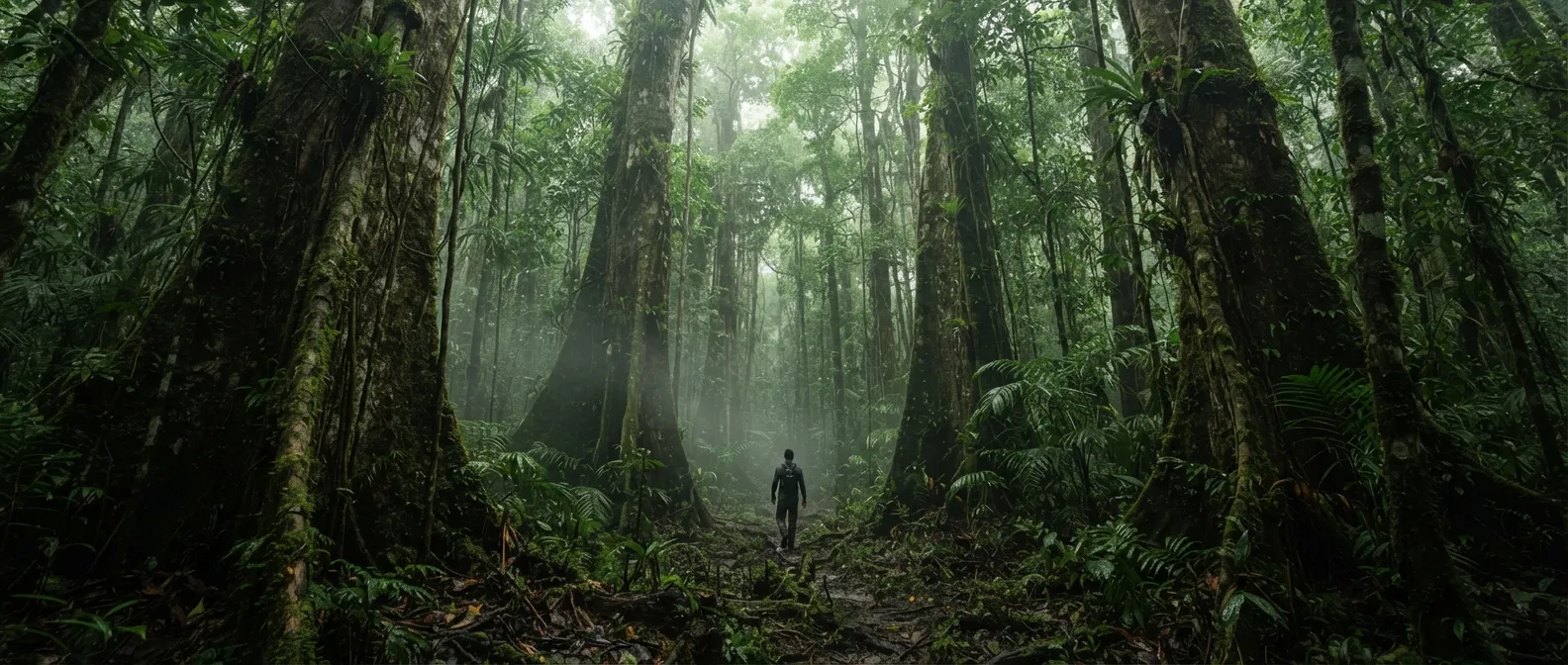
What actually kills in the jungle
Forget the ambushing snake and the starving jaguar: studies on attacks record fewer than two a year across the entire Amazon basin. What kills in the jungle is much quieter and much dumber.
Infection. A minor scratch, in 95% humidity and 30 °C, festers instead of drying out. Bacteria multiply ten times faster than in temperate climates, and a forgotten cut turns into an ulcer in three days. It is the leading cause of evacuation in jungle warfare schools, far ahead of anything that bites.
Dehydration, despite water everywhere. Counterintuitive, yet very real: saturated air prevents sweat from evaporating, thus failing to cool the body, so the body produces even more to compensate. A hiker can lose 1 to 2 liters of sweat per hour while walking, and the humidity tricks the thirst reflex — you sweat profusely without feeling like you lack water. Without a strict discipline to drink on a schedule rather than waiting for thirst, dehydration sets in within an hour of continuous walking in high heat.
Mosquitoes, detailed below — statistically, the most consistent killer in the entire jungle.
Flash floods. A calm river in the morning turns into a wall of brown water twenty minutes after rain upstream, even if the sky stayed blue right where you stand. Seemingly dried riverbeds and yesterday’s fords are classic traps.
Falls. Slippery terrain, roots, collapsing banks: the second leading cause of serious injury after infection in military jungle school statistics.
The mosquito, killer number one that nobody thinks about
Malaria and dengue are both transmitted by mosquito bites, active mostly at dusk and dawn. During the Vietnam War, malaria affected over 40,000 American soldiers alone, despite preventive treatments. The countermeasure is boring but effective: long sleeves and light colors at dusk, DEET or picaridin repellent on the skin, permethrin on fabric, and above all a mosquito net that touches the ground or closes completely — a single hole the size of a coin is enough for an entire night of bites.
The rule of humidity: two sets of clothes, never mixed
The SAS Jungle Survival Manual gives a simple rule, remembered by all tropical warfare schools since the Burma campaigns: two sets of clothes, one for the day, one for the night — and you never swap them. The daytime set is meant to be wet: sweat, rain, river crossings, nothing helps, so stop fighting it. The nighttime set, however, remains sacred: you put it on dry right before sleeping, take it off at first light, and never use it for anything else. Cotton, which pulls body heat away 25 times faster when wet than when dry, must be avoided for both — wool or technical synthetics dry faster and insulate even when damp.
Under the hammock, the soaked daytime set hangs to drip — it won’t truly dry before morning, but it will lose its free water, which makes a huge difference for the feeling of night cold, even at 25 °C.
Feet: the battle lost without realizing it
If a single body part decides the outcome of a jungle expedition, it’s your feet. Twenty-four hours in soaked boots are enough to start maceration; forty-eight hours, and the skin begins to break down.
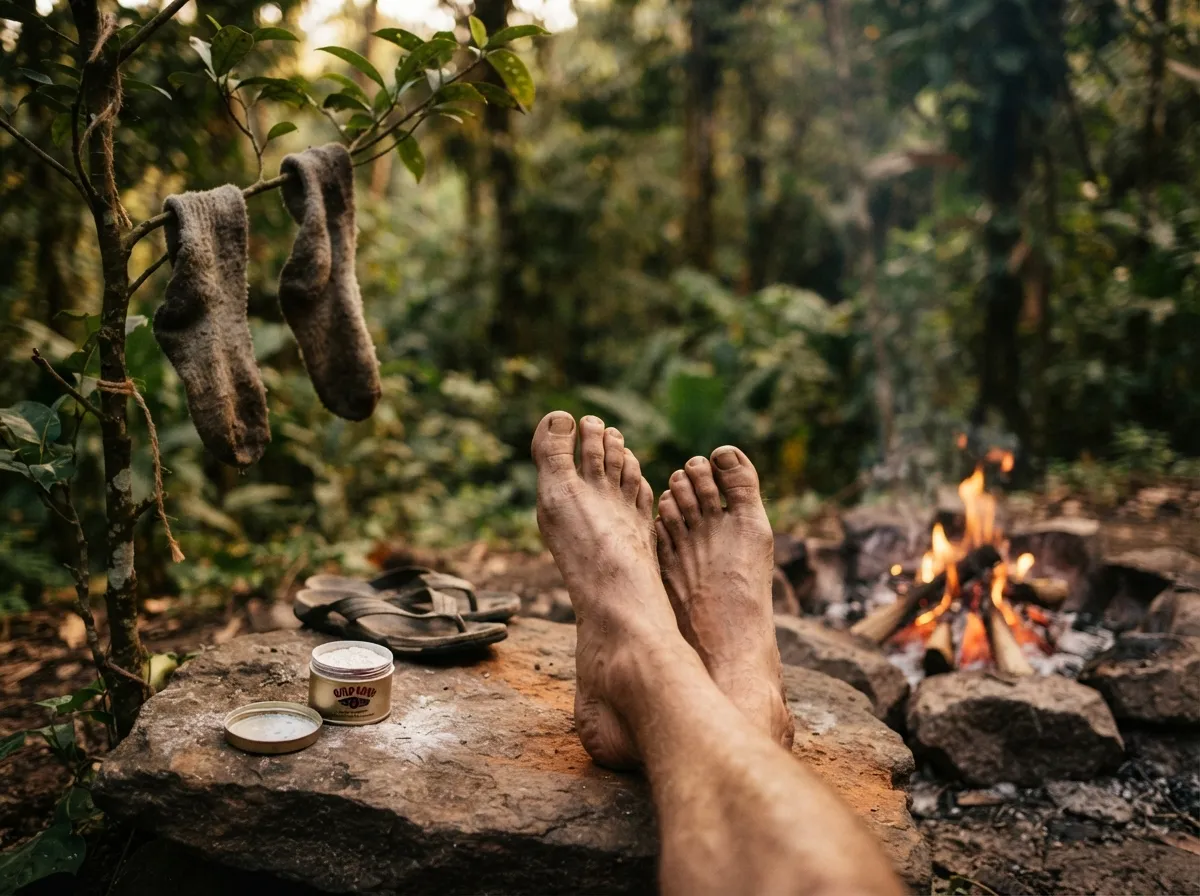
- Remove boots as soon as you stop, even before setting up the hammock: the longer they stay closed, the more moisture builds up.
- Wash quickly with clean water if available, then dry thoroughly between the toes with a cloth or, failing that, air-dry for a good ten minutes.
- Apply talcum powder generously between toes and under the sole: talc absorbs residual moisture and reduces friction that opens up cracks.
- Put on a clean, dry pair of socks reserved strictly for sleeping — never the ones worn during the day.
- Inspect carefully at the same time: redness, blisters, cuts. A blister caught in the evening takes five minutes to treat; caught three days later, it’s infected.
Water: it’s everywhere, except what you can drink without thinking
The jungle drowns you in rain and dehydrates you at the same time — that’s the core paradox. The good news: finding raw water is often easier here than anywhere else. The bad news: almost all of this water must be treated before drinking, with three specific exceptions.
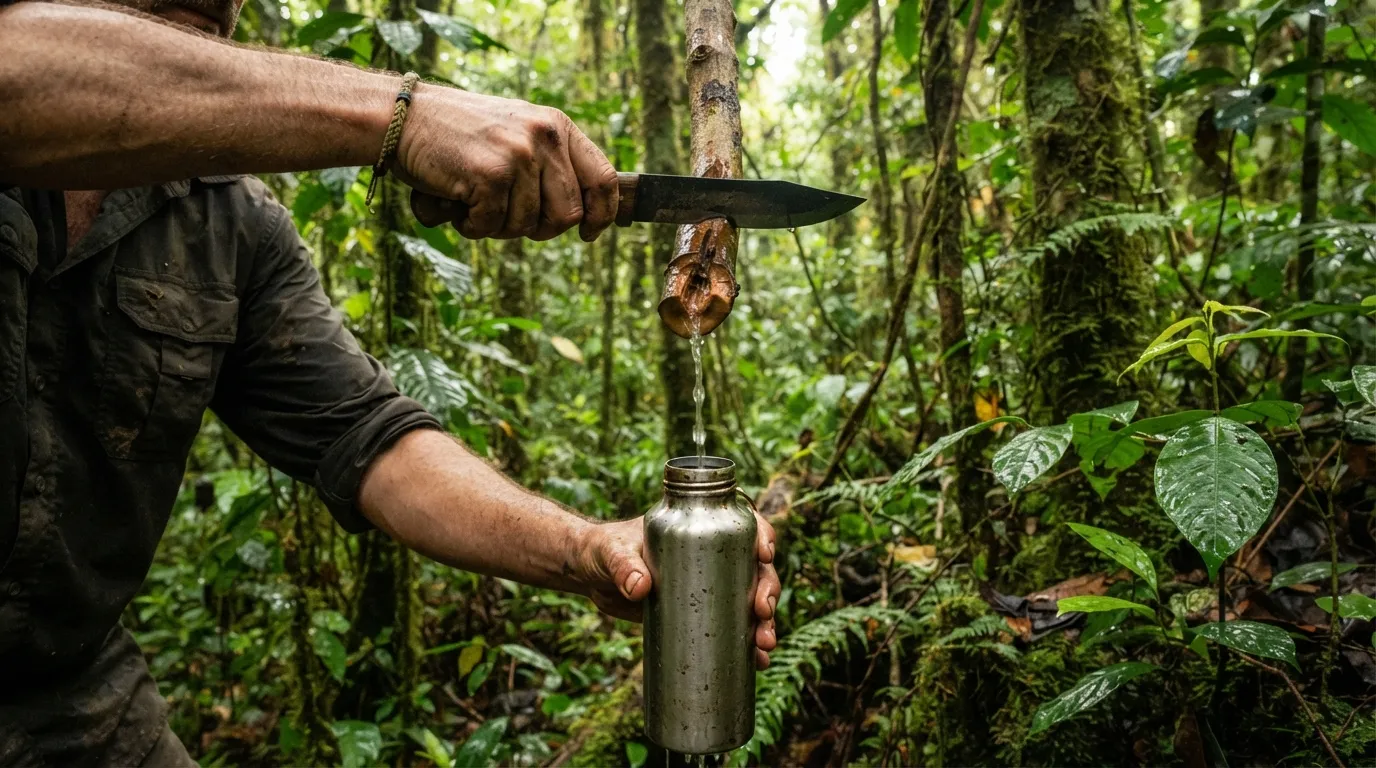
Water vines. Certain woody vines (water vines, including several Cissus and wild grapevines) carry water that is safe to drink directly. The identification rule fits in one sentence: clear sap, with no strong smell, and a neutral or slightly fruity taste is safe to drink; milky, sticky, or bitter sap must be spat out and avoided — it usually signals a toxin.
- Always cut the top first, at arm’s height if possible: never start with the bottom cut, otherwise the sap drains downward by gravity before you can catch it.
- Then cut the bottom, one or two meters lower, holding the cut section downward over a container.
- Let it flow: sap drips out, sometimes for several minutes.
- When flow stops, cut another thirty centimeters off the top: this restarts the flow, and you repeat the move until the stem’s reservoir is exhausted.
Bamboo. Water collects naturally between the nodes of certain stems, especially after heavy rains. Tap the culm: a clear, hollow sound signals water inside; a dull thud signals a solid or dry stem. Pierce the base of the swollen segment, tilt, and collect directly into your canteen.
Rain and funnel-leaves. The bracts and rolled leaves of large plants, like Heliconia, form natural cups that catch rainwater — up to a liter for the largest ones. It’s clean water provided you drink it quickly: it also harbors insect larvae that settle in within days. A tarp stretched on a slope toward a container, or simply a tilted trunk you follow during a storm, often catches water faster than any plant.
What must always be treated. Rivers, ponds, puddles: boil for three to five minutes, or use purification tablets/iodine/chlorine with at least thirty minutes of contact time. Identified water vines and freshly fallen rain are the only waters you can drink raw without a second thought.
The fire that lasts under perpetual rain
The principle remains the same as in all forests: dry wood is inside the wood, not on the ground. In the jungle, look for dead branches still hanging or standing dead trees — thick bark protects a core that is often dry even after a week of rain. Split it into quarters, shave fine feather sticks from the first centimeter of core wood, and build a tight teepee so concentrated heat dries the tinder before it goes out.
Shelter: always up, never on the ground
The jungle floor is never a sleeping option: it retains moisture, harbors ants and centipedes, and can end up underwater during a night flood. The universal response, from the British military to indigenous populations, is the hammock.
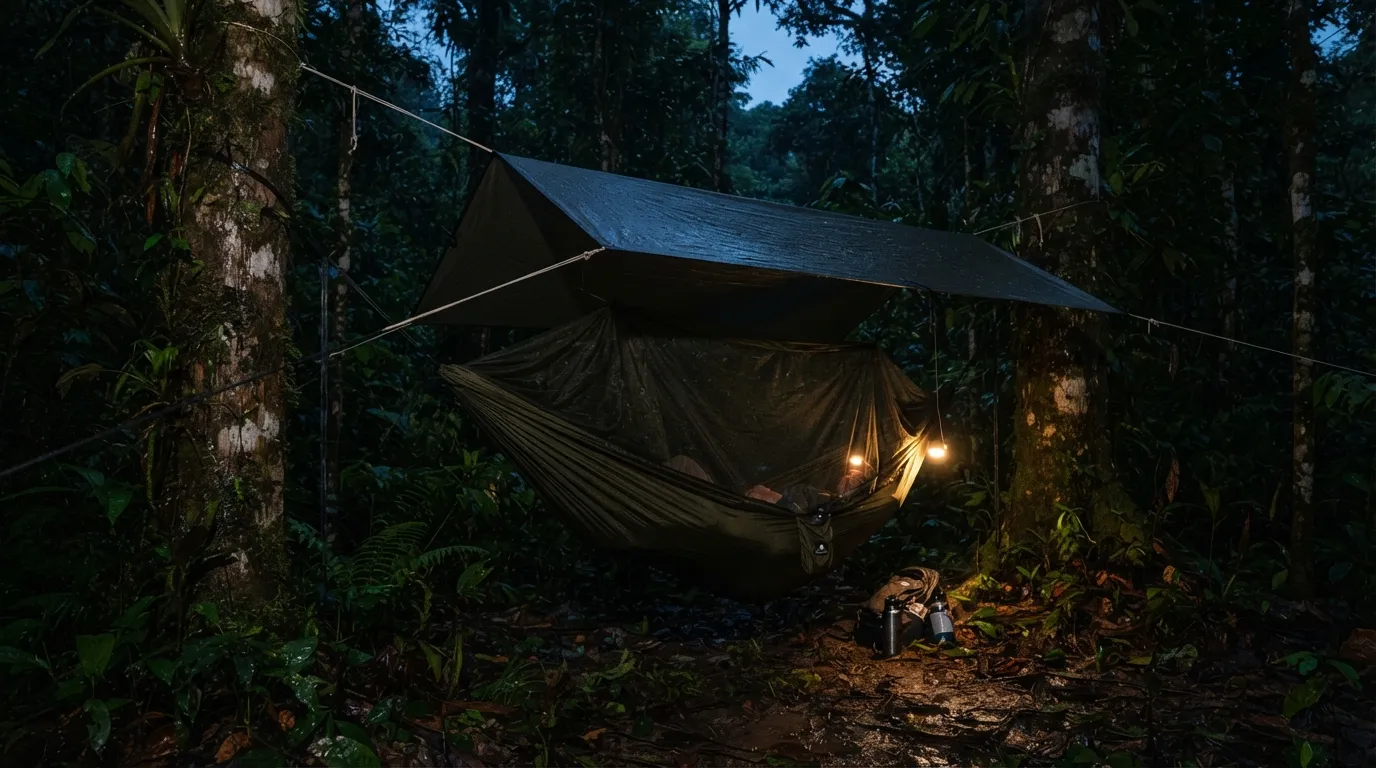
- Pitch the tarp first, diagonally over your chosen spot: as with building a fire in the rain, everything that comes after must be protected before it exists.
- Set up the hammock underneath, tied securely between two solid trees at hip height so you can sit down effortlessly.
- Close the integrated mosquito net or secure one over it before dark — not after the first bite.
On a practical level, a hammock can be set up on almost any terrain — slopes, roots, waterlogged ground — where a tent fails. And it instantly solves snakes, ground ants, and rising moisture.
Moving: the machete, water, and the one-kilometer-per-hour rule
The jungle teaches a lesson in humility to anyone who has hiked in temperate forests: one kilometer measured by compass, in dense understory, can take an entire hour. Progress estimates for bushwhacking (clearing your path without a trail using a machete) consistently drop to around one kilometer per hour in the thickest vegetation, compared to several kilometers per hour on an ordinary forest trail.
The machete is swung using short, angled strikes, never with one massive swing in the same spot: clear light growth first to reveal hidden branches behind, always angling the sharp edge away from your body. A wrist lanyard prevents losing it during a slip, and a sharp blade causes less fatigue and cuts cleaner than a dull blade you have to force.
Following water downstream remains the reflex that has saved the most lives in the jungle — streams become rivers, and rivers lead to settlements. But it’s not an absolute rule: the riverbed can plunge into waterfalls, become boxed in between sheer cliffs you can no longer walk along, or pass through impassable swamps. In these cases, climb onto the bank and walk parallel at a safe distance rather than forcing your way through the riverbed.
Ridges, when present, offer an alternative: less mud, better visibility for navigation, and zero risk of flash floods — unlike valley floors, where water levels can rise several meters while you sleep.
| Follow river (downstream) | Follow a ridge | Direct bushwhacking | |
|---|---|---|---|
| Speed | Variable, depends on banks | Moderate | ~1 km/h in dense vegetation |
| Chance of meeting people | ✅ High | Medium | ❌ Low |
| Flood/drowning risk | ❌ High | ✅ None | Medium |
| Navigation | ✅ Easy (follow the stream) | Medium (compass helpful) | ❌ Difficult without compass |
| Energy required | Medium | Medium | ❌ High |
Harmful wildlife: snakes, ants, scorpions, leeches
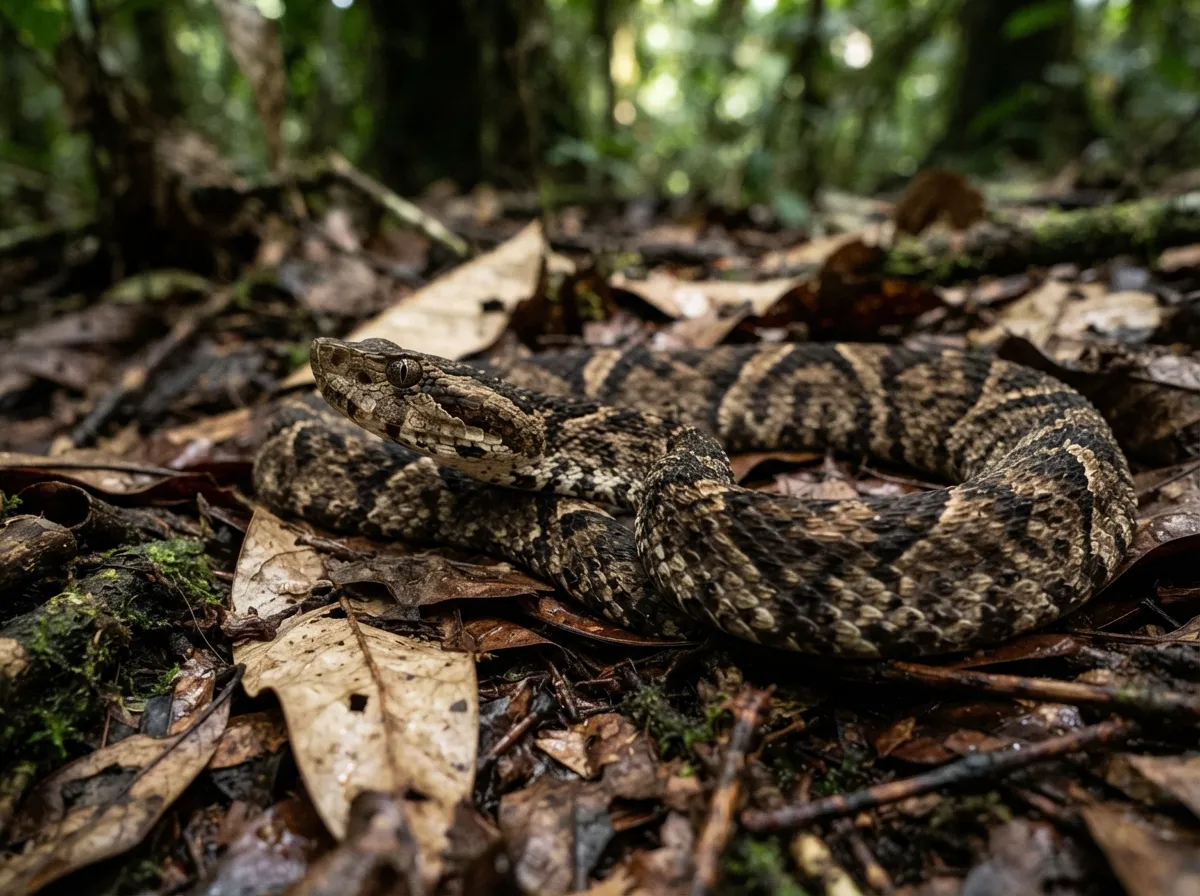
The fer-de-lance (Bothrops asper) causes more bites than any other species in its range: in Costa Rica, it accounts for 46% of snakebites and 30% of envenomation hospitalizations. Nocturnal and unpredictable when threatened, it doesn’t always flee upon contact — which is why you must watch where you put your hands and feet, especially at night.
The bushmaster (Lachesis), the longest venomous snake in the Americas (up to 3-4 meters), has the longest fangs of any venomous snake, roughly 5 centimeters. Even a young female can kill an adult human, but encounters remain rare — it is generally a elusive snake that avoids contact whenever possible.
Scorpions, wrongly feared everywhere, are truly dangerous only among a few specific species. Tityus serrulatus, the most documented in Brazil, was involved in 728 deaths out of 482,616 reported stings between 2000 and 2012 — a mortality rate of 1 to 2%, concentrated among children and the elderly. Reported stings exploded from 12,000 in 2000 to over 140,000 in 2018, mainly due to urbanization bringing scorpions closer to homes — not a sudden increase in the animal’s aggressiveness.
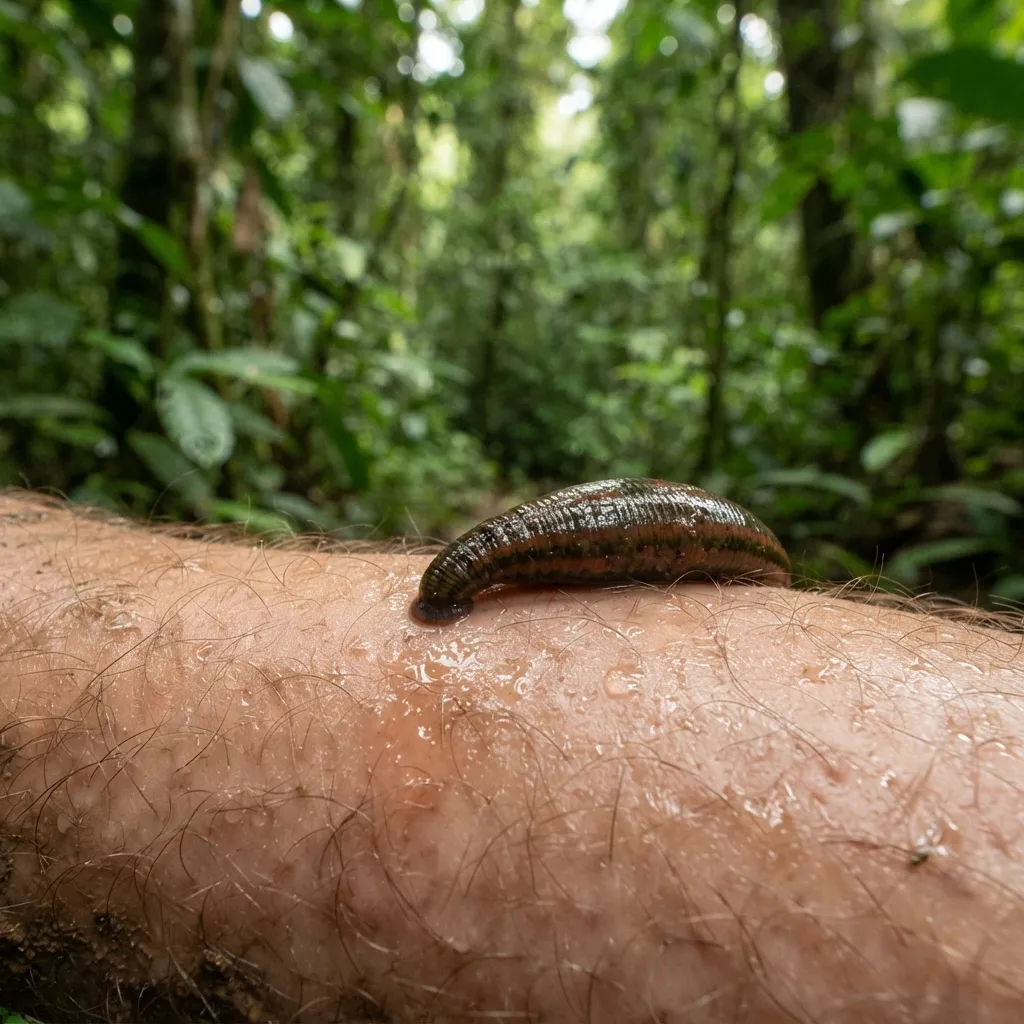
Leeches almost never transmit serious diseases, but removing them improperly causes more damage than the bite itself: pulled off forcefully, a leech can regurgitate into the wound, increasing the risk of infection, or leave mouthparts under the skin that itch for days.
River myths: candiru, piranhas, electric eels, jaguars, caimans
Amazonian freshwater carries more urban legends than actual dangers.
The electric eel is very real in its power: certain species discharge up to 860 volts and nearly one ampere per pulse, enough to repel a horse when the animal leaps out of the water to strike. The real danger to a human is almost never the electric shock alone, but drowning following a shock received in deep water far from shore.
The jaguar remains one of the most elusive apex predators in the world: 84 documented attacks across the entire Brazilian Amazon basin between 1950 and 2025, or just over one per year, mostly on individuals alone doing subsistence work. This is infinitely lower than lion, tiger, or cougar attacks elsewhere in the world. The black caiman was involved in 43 attacks between 2008 and 2013, with less than a fifth proving fatal — it hunts mainly at night by ambush from the water and rarely targets a healthy adult away from the bank.
| Candiru | Piranha | Electric eel | Black caiman | |
|---|---|---|---|---|
| Proven real danger | ❌ Almost zero | Low | ✅ (Shock) | ✅ (Rare) |
| Frequent unprovoked attack | ❌ | ❌ | ❌ | ❌ |
| Worst realistic scenario | Local irritation | Warning bite | Drowning after shock | Severe bite, rarely fatal |
What the jungle offers as food
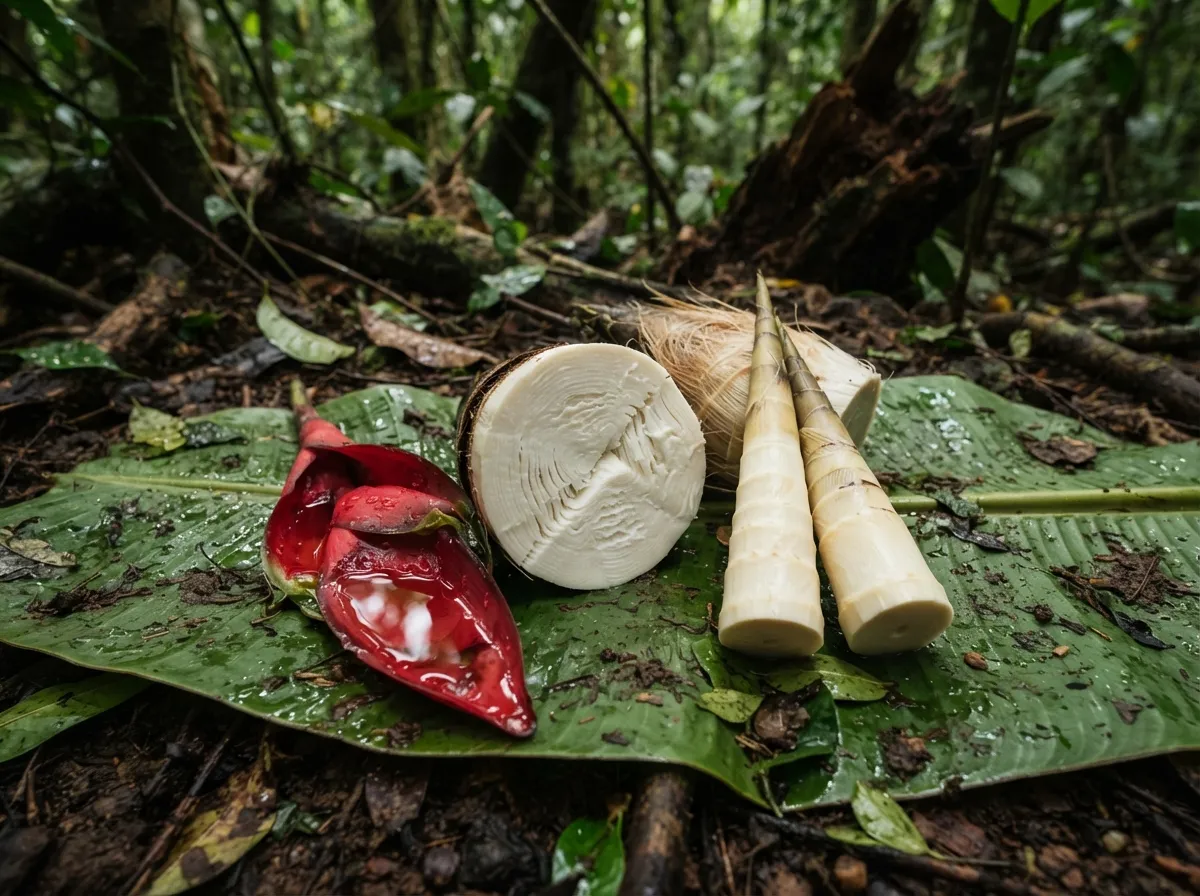
Heart of palm — the tender growing tip at the top of the trunk — can be eaten raw or cooked and has a texture similar to an artichoke. However, harvesting it requires killing the growth point: on most species, this destroys the tree. It is an occasional survival move, not a harvest to repeat on the same plant.
Young bamboo shoots, tender and pale at the base of new stems, are eaten cooked — raw, some varieties contain cyanogenic compounds that break down with cooking. Wild banana trees yield plenty of water inside their trunks, as mentioned earlier, and sometimes small fruits packed with seeds, low in calories but edible.
When dealing with unknown fruits, one rule overrides all others: what monkeys eat is a clue, never proof. Their digestive systems tolerate substances that are toxic to humans — mistletoe, eaten without issue by certain birds, is a classic example elsewhere in the world. Before trying any new plant, the Universal Edibility Test remains the only method that truly minimizes risk.
- Smell the sample by rubbing it between your fingers: a strong bitter almond or unpleasant odor stops the test immediately.
- Taste a tiny amount on your tongue without swallowing: if it’s bitter or burning, spit it out and move on.
- Swallow a tiny bite and wait at least thirty minutes, watching closely for nausea, pain, or burning sensations.
- If nothing happens, eat a slightly larger portion and wait another hour before increasing the amount.
Touch them and you die
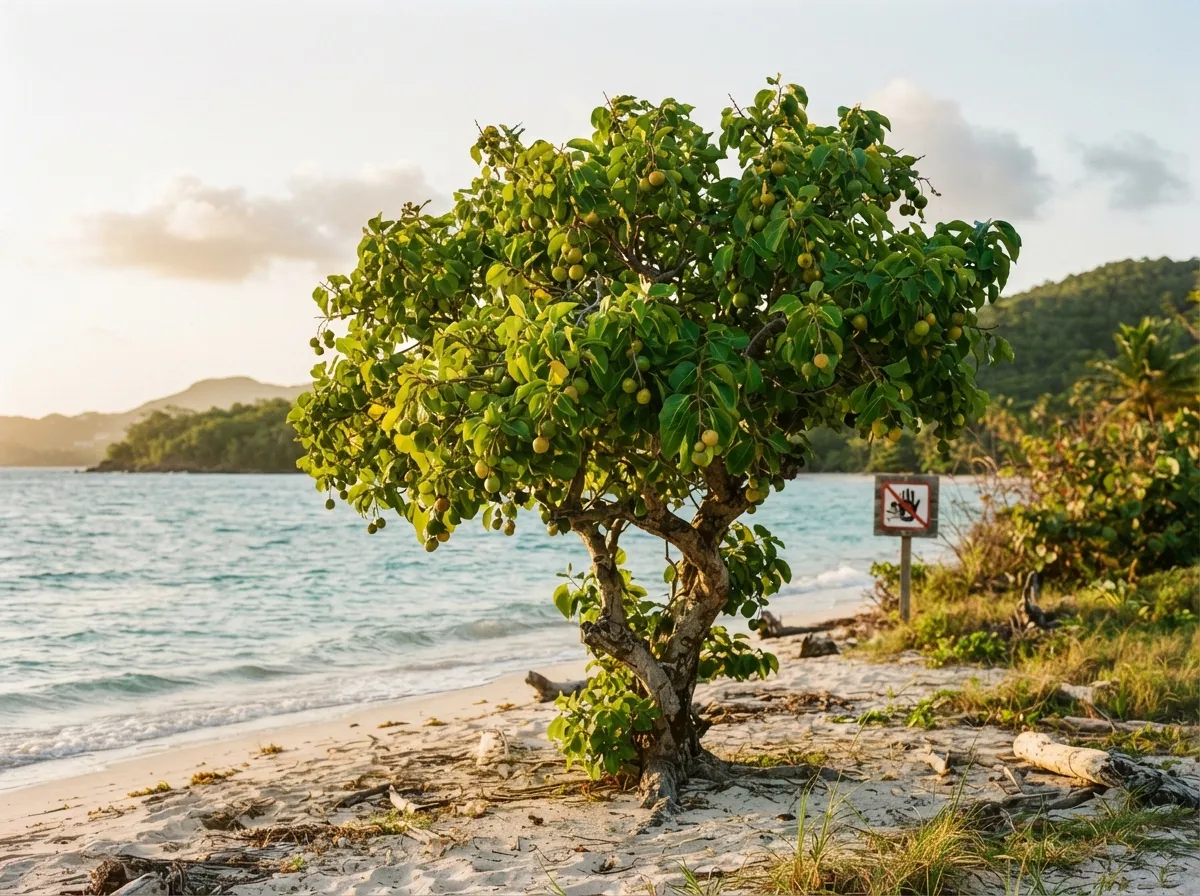
The manchineel (Hippomane mancinella), recognizable by its small fruits resembling miniature green apples and its shiny leaves, is considered the most dangerous tree in the world. Its white, milky sap burns skin on contact and can cause temporary blindness if splashed into the eyes. Simply taking shelter under its branches during rain can cause blistering: dripping water carries the toxin down from the leaves. Eating its fruit causes blisters in the mouth and throat, internal bleeding, and can be fatal. Even inhaling smoke from burning its wood is toxic.
The Strychnos genus, including several vines used to prepare curare, contains alkaloids in its bark that paralyze respiratory muscles — forming the basis of Amazonian blowgun poisons. Irony of fate: this same poison, in controlled doses and administration routes, became a muscle relaxant used in modern heart surgery. In nature, it looks no different from an ordinary vine: do not touch it, and never chew it.
Fishing and signaling under the canopy
Forest peoples often fish without hooks: the Baka of the Congo Basin practice dam fishing, building a small temporary wall to lower the water level in a stream branch and pick fish out of the mud by hand. Elsewhere, woven fiber fish traps, set across a narrow current, remain a near-universal technique — working while you sleep. The blowgun, used in the Amazon and Borneo, historically serves far more for hunting small mammals and birds than for warfare: among the Ticuna of the Amazon, a dart dipped in curare paralyzes and kills a monkey in eight to ten minutes.
Signaling from under the canopy is almost impossible: the thick layer of foliage blocks the view from above and disperses smoke before it breaks through. The only effective solution is to get out from under cover — find a natural clearing, an open riverbank, or clear one with a machete if you face a long wait. Once above the canopy, dense white smoke (created by tossing green leaves or damp moss onto the fire) stands out sharply against the dark forest background; three fires arranged in a triangle remain the internationally recognized distress signal.
Those who know: the people of the deep forest
The Yanomami, of the Venezuelan and Brazilian Amazon, use roughly 500 different plant species daily — for food, remedies for fever and snakebites, fish poisons, dyes, and building materials. An entire pharmacopeia held entirely in memory, without a single book.
The Dayak of Borneo weave rattan and bamboo using oral knowledge passed down through generations.
Pygmy peoples of the Congo Basin (Baka, Mbuti, Efe) hunt using vine-woven nets, stretched in a semicircle nearly a kilometer long by the women while the men drive the game — full group coordination built around a single plant-based tool.
The Korowai of Papua, dubbed the “Bedouins of the jungle” for their constant movement in search of game, build treehouses perched up to 25 feet (around 7.5 meters) above the ground — far out of reach of floods, insects, and historically, raids by neighboring groups.
Two legendary survival stories
Juliane Koepcke, 17 years old, was the sole survivor of the 92 passengers on LANSA Flight 508 in December 1971: she fell approximately 3,000 meters strapped to her seat after the plane broke up in mid-air, suffering a broken collarbone, a deep cut on her arm, and a concussion. Her biologist parents had taught her one simple rule: follow the water. She walked for eleven days following a stream to a larger river, her wounds infested with maggots, with no food except a small bag of candy found at the crash site. On the eleventh day, she reached a lumbermen’s camp, where they treated her and evacuated her by canoe.
Yossi Ghinsberg, a young Israeli backpacker, became separated from his group after a raft accident on a Bolivian river in 1981. Alone for three weeks during the height of the rainy season, he nearly drowned in a flash flood, watched his feet cover with fungal infections, went days without food, and repelled a jaguar one night by improvising a flamethrower using a lit can of insect repellent. He was found by a local search party three days before official rescue operations were set to give up.
Three key lessons emerge from both stories: following water remains the fastest way to find human settlements; an untreated wound becomes infested before it becomes infected, in that order; and composure matters far more than equipment — neither had a survival kit.
Frequently asked questions
Can you drink water dripping from leaves during rain?
Yes, fresh rainwater is one of the few water sources in the jungle you can drink without treatment, provided it hasn’t trickled down a toxic tree like the manchineel. Funneled by a tarp or a tilted trunk into a container, it remains the safest and fastest source to collect.
Should you really sleep in a hammock rather than on the ground in the jungle?
Yes, always. The jungle floor holds moisture, harbors ants and centipedes, and can end up underwater during a flash flood at night. An elevated hammock with a mosquito net and tarp solves all three problems at once on almost any terrain.
Are piranhas truly dangerous to swimmers?
Very rarely. A study tracked thirty people bitten over ten years: all walked out of the water on their own. Real attacks are warning bites during breeding season, not collective hunting frenzies like in movies.
How do you identify a vine with safe drinking water?
Clear sap with no strong smell and a neutral or slightly fruity taste is safe to drink. A milky, sticky, or bitter sap must always be spat out: it often signals a toxin, as with the manchineel or vines of the Strychnos genus.
Should you always follow a river downstream to get out of the jungle?
It is the best reflex most of the time, because waterways almost always lead to human settlements. But not if the riverbed plunges into waterfalls, becomes boxed in between impassable cliffs, or flows into an impenetrable swamp: in those cases, walk along the bank at a distance rather than forcing your way through the water.
What should you do for a snakebite deep in the jungle, far from help?
Stay calm and immobilize the bitten limb, keeping it below heart level to slow the spread of venom. Remove rings and tight clothing before swelling sets in, never cut or suck the wound, and move toward the nearest help without running. This is a life-threatening emergency beyond this module: it requires evacuation, never a makeshift remedy.
Key takeaways
- What kills in the jungle is the infection of a minor wound, dehydration despite high humidity, mosquitoes, and flash floods — almost never large predators.
- Two sets of clothes, never mixed: a wet one for the day, a dry and sacred one for the night. And dry and powder your feet every evening, without exception.
- Water is everywhere but must be earned: clear vines and fresh rain can be drunk directly; everything else requires treatment.
- Always sleep elevated in a hammock, never on the ground, under a tarp pitched before doing anything else.
- Candirus and killer piranhas are myths; fer-de-lance, bushmaster, scorpions, and infections are the true dangers — and what monkeys eat is only a hint, never proof.
Going further
- FM 21-76, US Army Survival Manual, chapter 14 Tropical Survival — the foundation of US military tropical survival, free on Internet Archive.
- Alan Jeffreys, The Jungle Survival Manual 1939-1945 — a compilation of British and American jungle warfare manuals detailing tropical hazards.
- Barry Davies, SAS Jungle Survival — an SAS instructor’s guide to working with the jungle rather than fighting it.
- Survival International, Yanomami botanical knowledge — to go beyond tactics and understand a complete relationship with the forest.
Sources for this module (28)
- FM 21-76, US Army Survival Manual, ch. 14 Tropical Survival
- British Army Jungle Warfare Training School (Wikipedia)
- Alan Jeffreys, The Jungle Survival Manual 1939-1945
- Barry Davies, SAS Jungle Survival
- Wikipedia — Jungle rot
- Wikipedia — Immersion foot syndromes
- Wikipédia FR — Pied de tranchée
- CherriesWriter — 19 Brutal Realities Soldiers Faced in the Jungles of Vietnam
- IFLScience — Fact Check: Will A Fish Swim Up Your Urethra If You Pee In The Amazon?
- Rainforest Cruises — Do Human-Eating Piranha Exist?
- Wikipedia — Bothrops asper (fer-de-lance)
- Wikipedia — Bushmaster (Lachesis)
- Wikipedia — Electric eel
- Wikipedia — Tityus serrulatus
- Wikipedia — Paraponera clavata (fourmi balle)
- Wikipedia — Juliane Koepcke
- Wikipedia — Yossi Ghinsberg
- Mental Floss — Manchineel, the world's most dangerous tree
- Wikipedia — Curare
- Survival International — Yanomami botanical knowledge
- PLOS ONE — Differences between Pygmy and Non-Pygmy Hunting in Congo Basin Forests
- Lone Sentry — WWII Tactical and Technical Trends n°34, Drinking Water from the Rattan Vine
- Jungle Training Center — Amazon Jungle Survival: Finding Water
- Survival-Kompass — Universal Edibility Test
- Wikipedia — Fish trap
- Wikipedia — Blowgun
- Storm Crow — Jungle Survival
- ecoevoRxiv — Jaguars Attacks on Humans in the Brazilian Amazon
Continue in "By environment"
The temperate forest
The most generous environment in the world can also swallow you in ten minutes: here is how to read it instead of fearing it.
Mountains: Where the Weather Decides for You
The weather changes in thirty minutes, altitude works against you, the terrain is unforgiving: the signs to read before it's too late.
Snow, extreme cold, and the Far North: surviving at minus 30
Cold doesn't kill you: humidity, exhaustion, and panic do. What you need to know to stay alive below zero.