Tracking and Nature Reading: What Animals Tell You
A footprint, a droppings, a silence from the birds: the ground and the air tell you everything, if you still know how to read them.
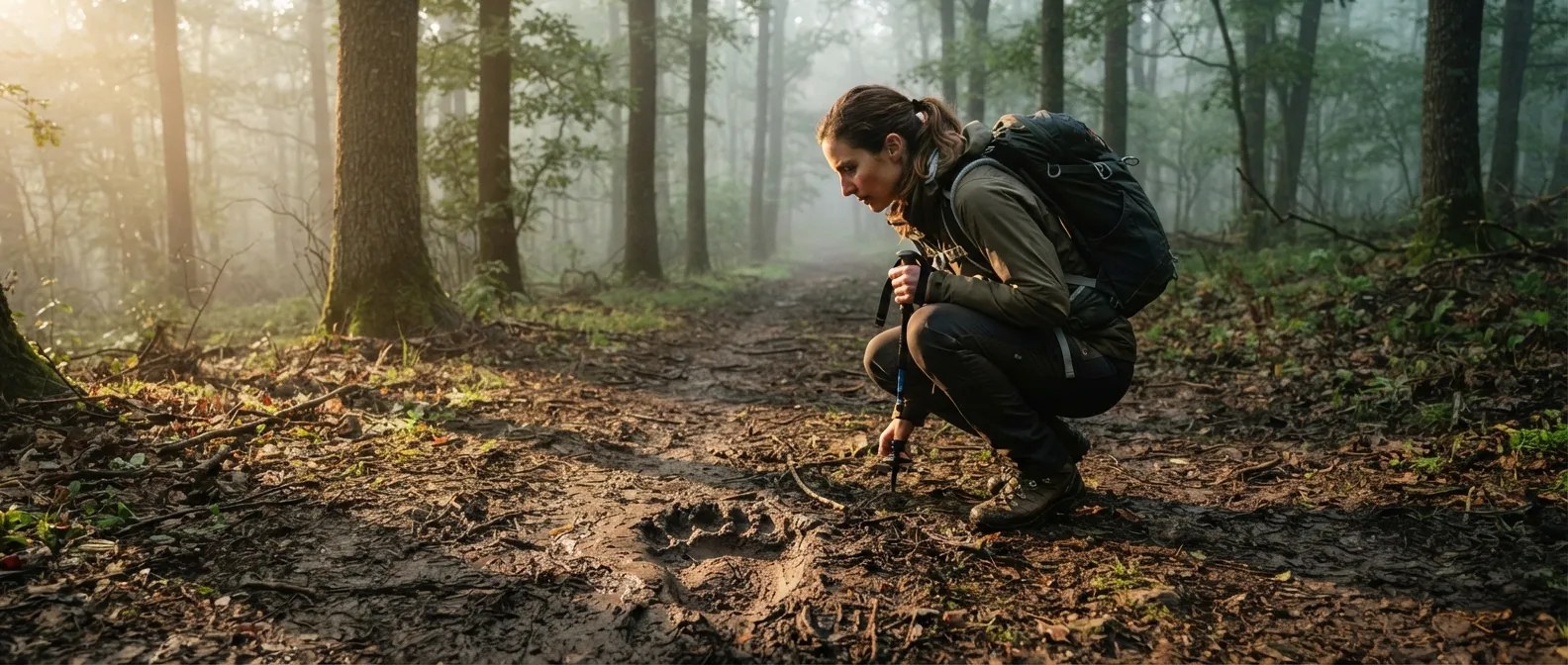
It’s 7 a.m., dew is still on the grass, and in front of your shelter, in the soft dirt of the trail, four toes and a triangular palm print outline a neat oval: a fox passed here less than an hour ago, as crushed dew hasn’t reformed in the depression. A bit further, a well-packed animal run heads straight down to the bottom of the valley — this is what will lead you to water before you even hear the stream. You don’t know it yet, but the ground just spoke to you.
What tracking is actually for
It’s not just hunter folklore. In survival, knowing how to read a track solves very concrete problems, in the order they arise.
- Find water without a map or GPS. Large herbivores and most predators drink at dawn and dusk, and their repeated trips create game trails — narrow, well-trodden paths, often more visible than human trails, that almost always converge toward a low point: a stream, pond, or spring. Following a descending trail means following the collective intelligence of all local animals on where to drink.
- Know who lives there before setting up camp. A big, fresh wild boar or bear print near a water point changes your decision to camp at that exact spot, or to leave food lying around.
- Set a trap in the right place. A trap set at random catches nothing; a trap set on an active game trail, where it narrows between two obstacles, stands a real chance.
- Don’t camp on a game trail. That well-trodden path that seems convenient for pitching your tent is actually the highway local animals use at night to go drink. Finding that out at 3 a.m. isn’t fun for anyone.
- Find your way back. Your own tracks in snow, sand, or mud are the most reliable trail for backtracking when you’ve ventured too far.
- Rescue. The same skills used to track a deer can track a lost child: human tracks are read, estimated, and dated just like an animal’s — which is the entire basis of tracking units used in search and rescue for missing persons (see below).
Footprints you need to know
The first question to ask yourself in front of a track isn’t “which animal?” but “canid or feline?” — this single distinction instantly eliminates half the possible species.
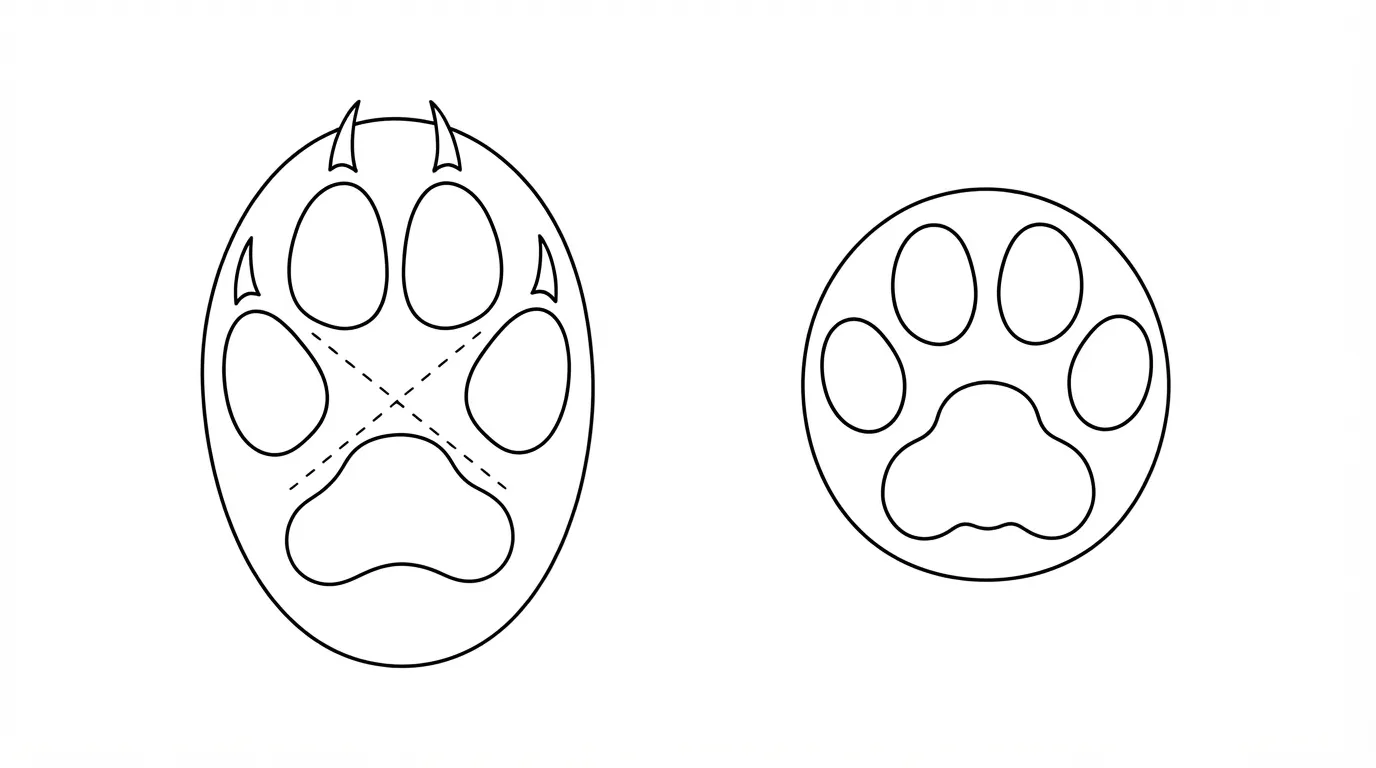
| Canid (dog, fox, wolf, coyote) | Feline (cat, lynx) | |
|---|---|---|
| Overall shape | Oval, longer than wide | Round |
| Claws | Visible, pointed | Absent (retracted) |
| The X test | An X can be drawn in the empty space between heel pad and toes | Impossible to draw without crossing a pad |
| Main heel pad | Trapezoidal, two lobes at the rear | Wider, three distinct lobes at the rear |
| Trajectory | Often straight, efficient | More winding, cautious |
The “X test,” taught in most CyberTracker-style tracking courses: try drawing an X-shaped line connecting the empty spaces between the four toes and the main heel pad, without touching any pad. In a canid, non-retractile claws and toe placement leave this space open — the X fits. In a feline, tighter pads and toes block the way: the X cannot be drawn. It’s fast, works in mud as well as snow, and prevents the most common beginner mistake.
Ten common footprints in Europe and North America
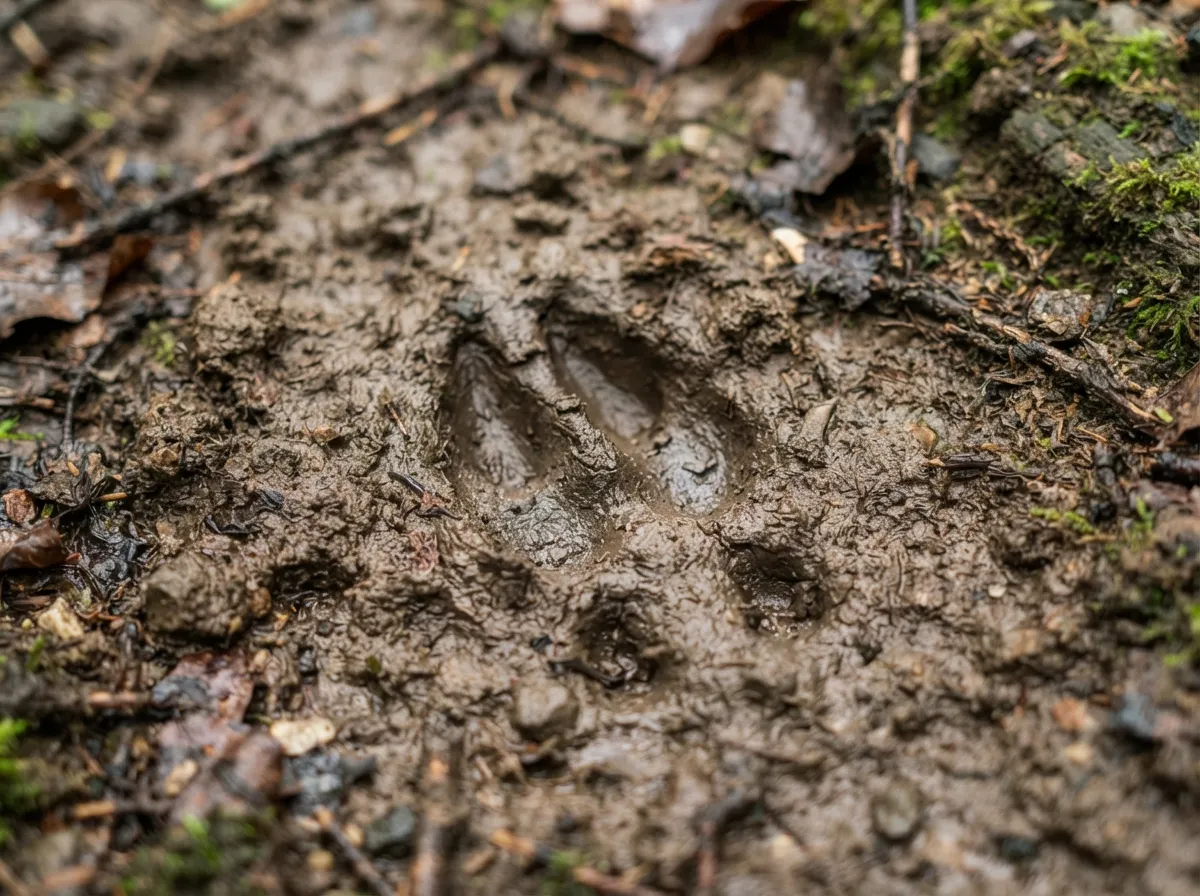
- Wild boar (Sus scrofa): two rounded, inverted heart-shaped hooves, and crucial on soft ground, two dewclaws that mark behind, spaced wider than a deer’s. This detail — dewclaws touching the ground — distinguishes it at a glance from a roe deer track on hard ground.
- Red deer and roe deer: cloven hoof split into two pointed toes, without visible dewclaws except in deep mud or while running. Roe deer leave a neat, delicate print described by field guides as one of the easiest signs to identify in temperate forests; the heavier red deer leaves a noticeably larger track with wider spacing between the toes.
- Red fox: oval canid print, front foot about 60 mm long by 45 mm wide, hind foot slightly smaller (55 × 38 mm). In direct register — hind foot stepping almost precisely into the front footprint — the track forms a nearly straight line of very regular dots at its usual trotting gait.
- Dog and wolf: same family, same basic shape — this is where the X test and context matter most. A dog wanders, backtracks, stops to sniff everything; a traveling wolf moves in one direction, in near-perfect direct register, with a steady, efficient stride over long distances. Size alone is never enough: a large sheepdog leaves a print as big as a wolf’s.
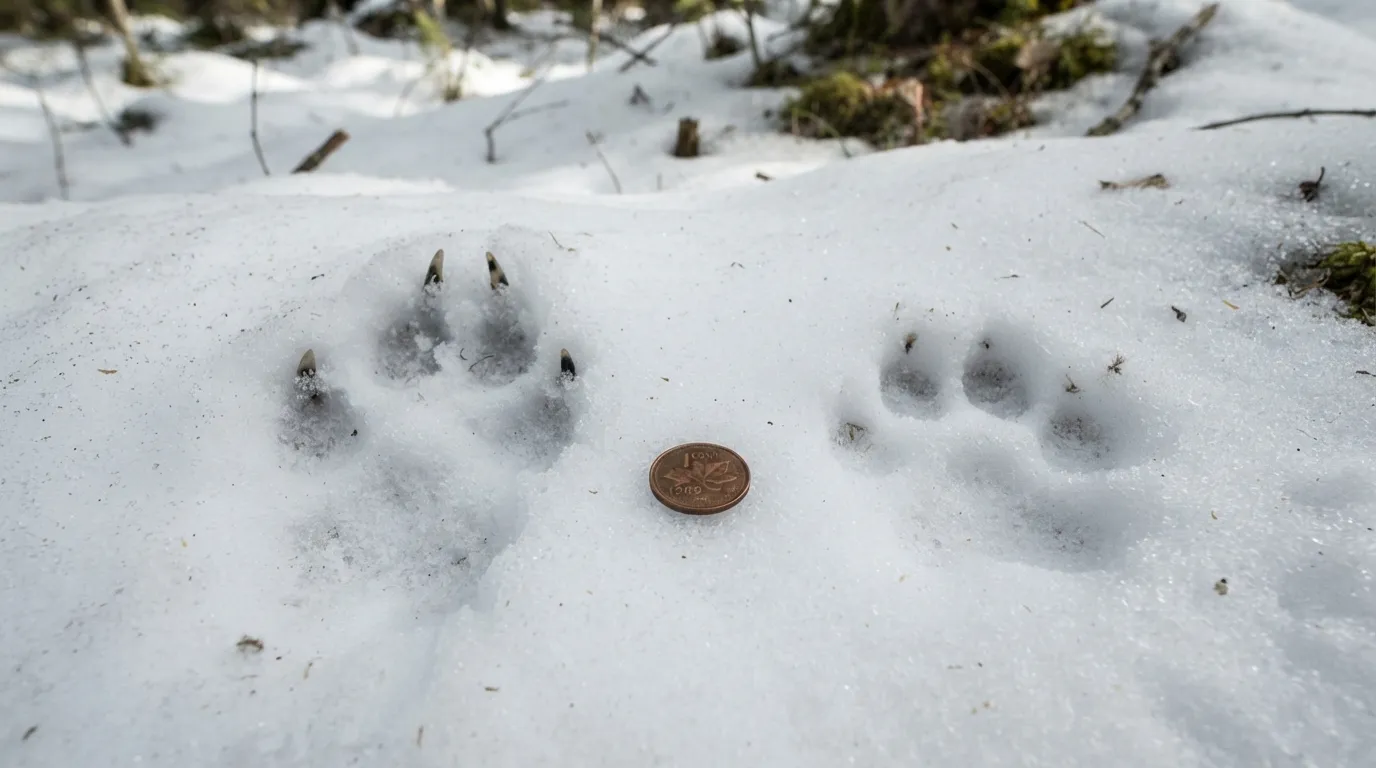
- Lynx: round feline track, no claws, with a massive three-lobed main heel pad. Its feet, wide and heavily furred, act like snowshoes: they spread the animal’s weight over a much larger surface, dramatically reducing ground pressure compared to a wildcat of the same family — a key feature distinguishing its track from a large wildcat in Europe.
- Badger: five toes (unlike four in most canids and felines), and long, powerful claws built for digging that mark far ahead of the pads. Its trail almost always leads to a complex burrow, identifiable by multiple entrances and freshly excavated earth out front.
- Hare (and rabbit, smaller): four prints grouped in a trapezoid at each leap, with the two large hind feet landing ahead of the small front feet. It’s counterintuitive: in a leaping animal, the rear feet pass the front feet on landing.
- Squirrel: same trapezoidal pattern as the hare, but miniature, and almost always traveling tree-to-tree rather than in a straight line across a field.
- Black bear and brown bear: in the black bear, the front foot measures roughly 5 to 13 cm long and wide, the hind foot significantly longer (up to 20 cm), with five short, curved, well-defined claws; the brown bear features an overall larger print, much longer front claws that mark far ahead of the toes (used for digging), and a concave skull profile that comes with shoulder musculature you can’t see in the track but will see on the animal.
- Moose: two large, heart-shaped hooves that splay under weight, an adaptation that increases surface area and prevents the animal from sinking into soft snow or mud — the same physical principle as a snowshoe, applied to a hoof.
- Coyote: slighter silhouette than a wolf, narrower snout, tail carried low while walking (wolves hold it horizontally) — useful indicators to cross-reference an ambiguous track with the observed animal’s behavior.
Gaits: walk, trot, gallop, bound
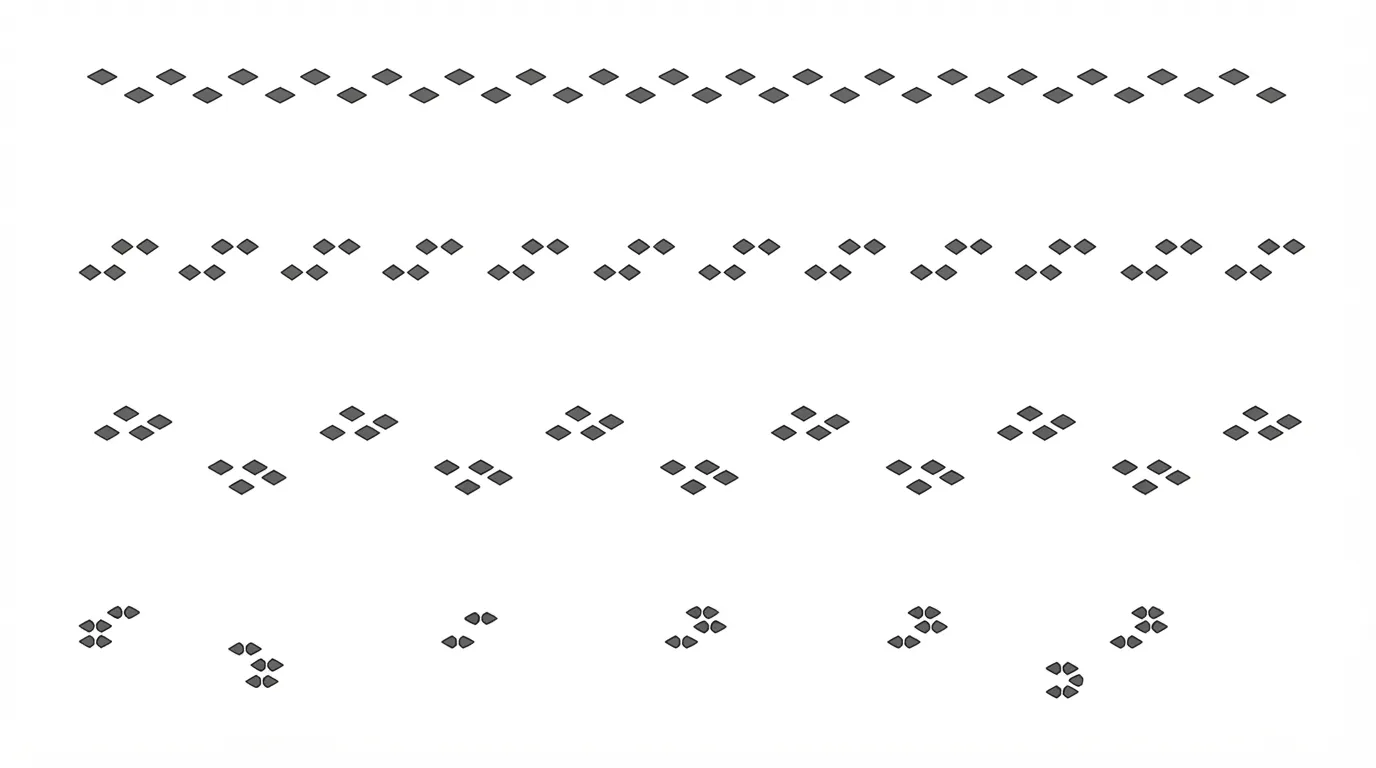
An isolated footprint reveals little; a sequence of footprints — the trackway — tells almost everything, because spacing and layout shift with speed.
-
The Walk: Footprints follow each other regularly at short, steady intervals, often in direct register for canids (the hind foot steps directly onto the front footprint). It’s the default gait of an unhurried animal going about its day.
-
The Trot: Same principle as the walk, but with wider, highly consistent spacing diagonally — this is the cruising gait of foxes and traveling wolves, highly energy-efficient over long distances.
-
The Gallop: Footprints group in sets of four, clearly separated by a large gap, because the animal launches itself off all four limbs almost simultaneously. This is the gait of escape or pursuit.
-
The Bound: The most recognizable pattern, typical of hares and squirrels — two large hind tracks set ahead of two small front tracks in a trapezoid, followed by a large gap before the next leap.
The core rule behind these patterns: the faster the animal moves, the wider the gap between sets of tracks, and the fewer feet touch the ground at any given moment.
Other sign: everything that isn’t a footprint
The ground betrays an animal even without a clean print. Most of the time in temperate forests, these signs are far more common than prints themselves.
- Scat: Shape, contents, and freshness reveal the species, diet, and time of passage. Fibrous scat filled with hair and bone fragments indicates a carnivore; fibrous, plant-filled pellets indicate a herbivore. Freshness is judged by moisture, odor, and in winter, unfrozen ground directly beneath it.
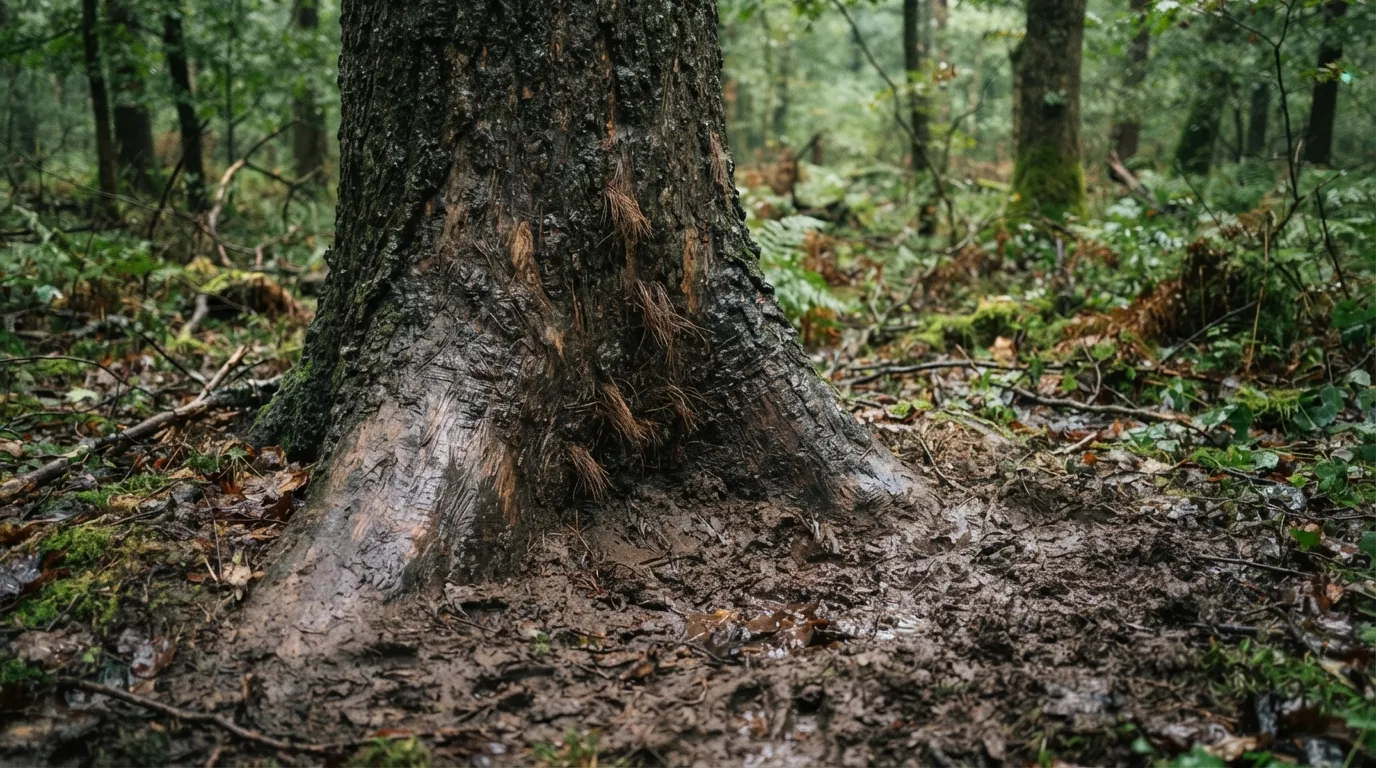
- Rubs: Polished, scratched, or stripped bark on young trees — a red deer or roe deer scraping velvet off its antlers or marking territory.
- Scrapes: Scraped earth with leaf litter kicked into small piles — often a scent signal left by deer or wild boar depositing scent from glands on their feet.
- Wallows: Muddy depressions repeatedly used by wild boar, usually surrounded by trees with trunks polished from post-bath rubbing — mud helps shed parasites and regulate body temperature.
- Beds: An oval depression in flattened grass or leaf litter, often warm if the animal just left — where a deer spent the night or rested, usually on a forest edge with its back to an obstacle and a clear view ahead.
- Kill/Pluck sites: A ring of plucked feathers, sometimes with bases still attached to bits of skin — signature of a raptor or fox plucking a bird on the spot before eating or carrying it off.
- Feeding sign: A pinecone chewed down to its core, looking like a stripped corn cob, indicates a squirrel; the same cone gnawed more crudely and abandoned with scattered scales points to a field mouse or vole working at ground level. A hazelnut shell opened with clean, curved tooth marks around the hole also signals a squirrel.
- Runs and gaps: A clear hole at the base of a fence, with packed, polished dirt on both sides and hair caught on the wire — the regular passage of a badger or fox, almost always reused night after night.
Aging a track: how to date a print
A track has no value unless you know when it was made. Clues are read together, never in isolation.
- The edges: A fresh track has crisp, sharp edges, with tiny soil particles resting in unstable equilibrium along the rim. Over time, wind and rain round these edges, causing them to slowly slump inward.
- Fallen debris: A leaf, twig, or pine needle sitting inside the print proves the track is older than that debris’s fall — a simple, reliable indicator when you know the rate of leaf or needle drop for the season.
- Dew and frost: A track made after morning dew breaks the uniform moisture film coating surrounding grass — creating sharp contrast visible until dew falls again or evaporates under the sun.
- Rain effects: A track made before a rainstorm has smoothed edges, sometimes filled with water or pitted by raindrop craters; a track made after rain features sharp edges on saturated, dark soil.
- Snow effects: Fresh snow preserves extremely crisp prints that degrade hour by hour under freeze-thaw cycles and wind — a morning track checked in late afternoon will already show melted, enlarged edges compared to a fresh track beside it.
Reading a landscape: what birds are telling you
Before even looking for a track on the ground, a tracker listens. American naturalist Jon Young, trained by traditional trackers and founder of the Wilderness Awareness School, formalized what he calls “bird language”: the baseline behavior of local birds — and what breaks it.

- The Baseline: Normal behavior for a given place and time — birds singing, feeding on the ground, flitting unhurriedly between branches. A tracker who knows a area’s baseline notices anything abnormal within seconds.
- Sudden Silence: When all birds abruptly go quiet over a wide area, it almost always means a predator — human or animal — has entered the zone. It’s one of the most reliable signals cited by trackers using Jon Young’s methods.
- The Five Voices: The method identifies distinct avian communication states — routine song, companion calls between flock members, mild alarm calls, mobbing calls that rally multiple birds against a spotted predator, and sudden, noisy panic flights (“bird plow”) revealing a threat directly beneath them. Recognizing these voices lets you know where and what is moving through dense cover without seeing the animal.
- Mobbing: Multiple birds converging noisily on a single spot with jerky flight and repeated wide-spectrum calls — a classic reaction to a spotted ground or perched predator, like an owl.
Tracker techniques
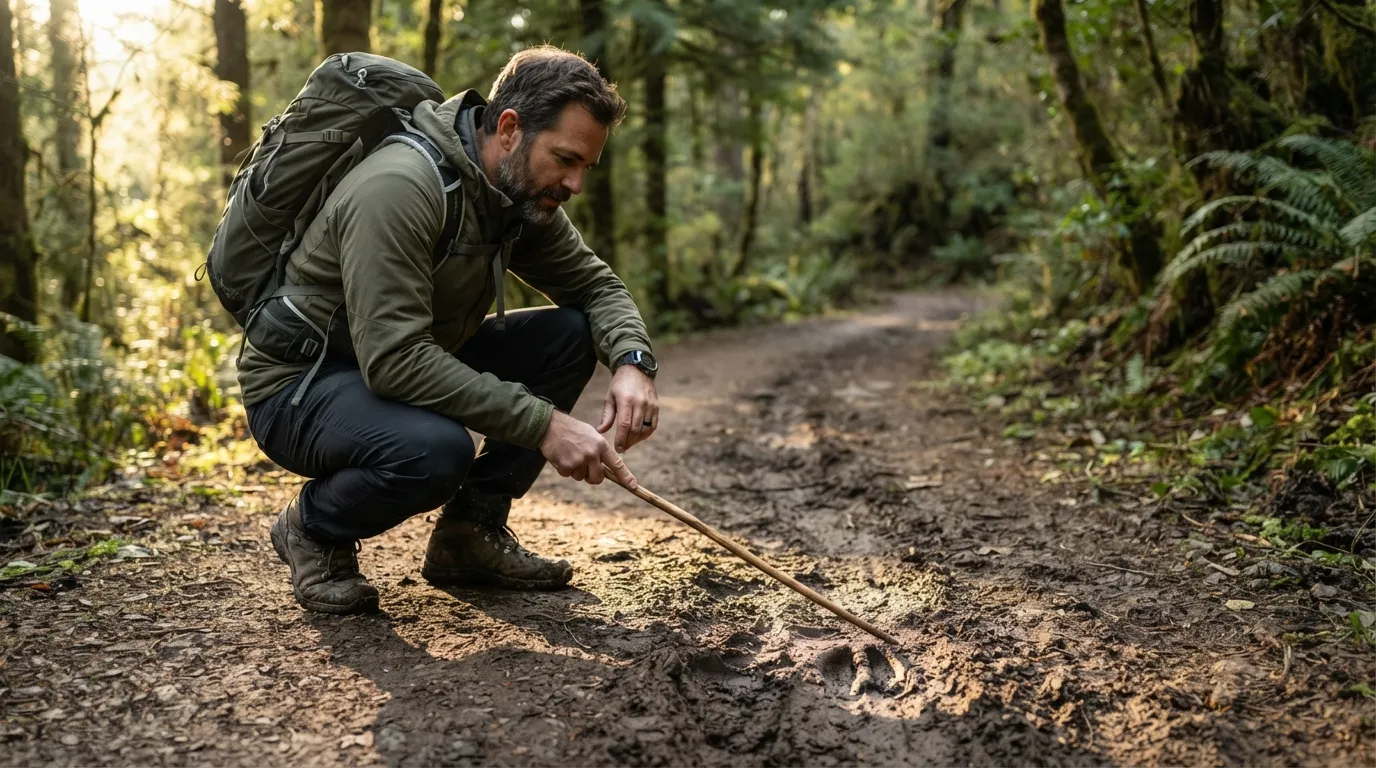
- Sidelighting / Backlighting: A track is barely visible when viewed head-on in flat lighting; the same track pops out when the sun is low and raking across from the side or behind the tracker, throwing deep shadows into the footprint’s relief. This is why the best tracking hours are early morning and late afternoon.
- The Tracking Stick: A thin stick held horizontally, used to measure and transfer the exact stride length between consecutive tracks in a trail — invaluable for predicting where the next footprint lands on difficult ground (grass, needles, gravel).
- Walk beside the trail, never on it: Rule number one for any serious tracker. Stepping on a track destroys it for further examination and ruins evidence for anyone following (another tracker, or yourself an hour later).
- Blind tracking: A classic training drill in tracking schools — following a trail blindfolded or in the dark using only a stick or fingers along track edges, developing tactile sensitivity rather than relying strictly on sight.
Animals as a compass and clock
Without a watch or compass, animal behavior offers rough but useful reference points.
- Dusk flights: Many bird species that roost together fly in a relatively direct line toward their roost or a water source during the last light of day. Watching multiple groups converge in the same direction provides a rough directional hint toward water or dense woodland cover in unfamiliar terrain.
- Ants and bees: Traditional survival manuals recommend following active ant columns, which frequently lead toward moisture, and noting the flight direction of bees traveling back and forth between their hive or swarm and a source of water or nectar. This offers a general indicator, not a pinpoint map — foraging insects regularly cover several kilometers, though most activity remains centered relatively close to their nest.
Human tracks: how search and rescue finds missing people
The exact same skills used to track deer are used to track a lost child — with additional clues.
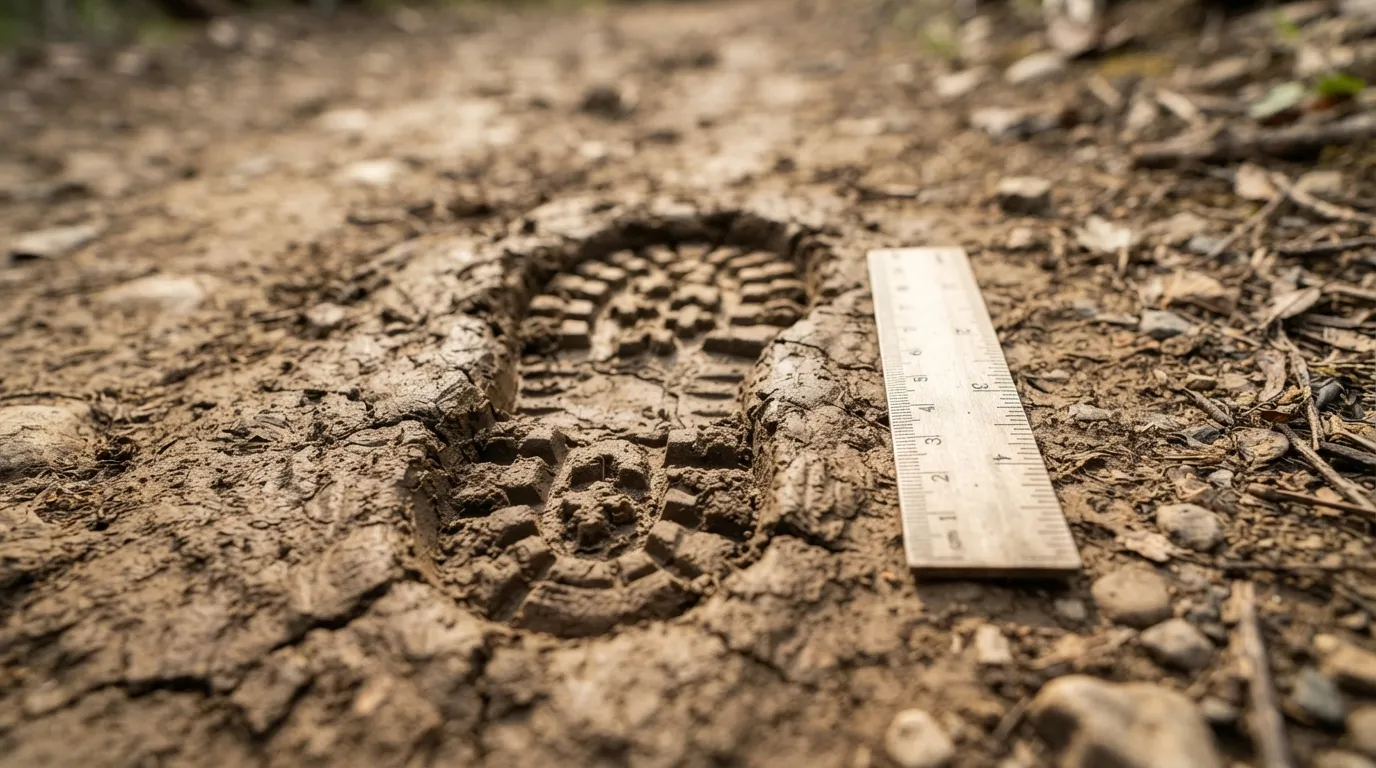
- Sole print signature: Every shoe model features a distinct tread pattern, and individual wear — a heel worn down on one side, a unique nick — makes a footprint print as identifiable as a fingerprint for a specific person and pair of shoes.
- Stride length and changes: A shortening, uneven stride with dragging or veering tracks signals fatigue, injury, or panic; a suddenly lengthened stride with abrupt direction shifts can indicate a fall or running.
- Hesitation marks: Tracks that stop, pivot in place, head off in one direction, and double back — classic signs of a lost person searching for landmarks, very different from the purposeful line of someone who knows where they’re going.
- Age of the track: Same criteria as animal tracks — edge sharpness, fallen debris, dew or rain effects — allowing rescuers to estimate when the person passed that spot.
American tracker Joel Hardin, a former U.S. Border Patrol agent who spent time with the Idaho Air National Guard, developed an advanced human tracking curriculum starting in 1974. After retiring in 1990, he founded Universal Tracking Services, a benchmark organization in the field. He took part in major investigations — including tracking serial killer Gary Ridgway and hunting defector Christopher Boyce — as well as search and rescue missions, notably for a missing teenager in Washington State in 1989. In 1982, brought in to inspect tracks attributed to Bigfoot, he concluded they weren’t left by an animal — a great reminder that tracking is just as useful for ruling out hypotheses as confirming them.
Approaching an animal undetected: wind, cover, and movement
- Wind direction: Always stay downwind or crosswind relative to the animal, never upwind — most mammals rely primarily on scent, long before vision.
- Silhouette: Avoid skylining yourself on ridges or standing against light backdrops; stay in front of dark cover (bushes, trunks, landforms) to break up your outline.
- Movement: Animals pick up movement far faster than a stationary form. Move slowly in phases, freezing instantly whenever the animal’s head comes up.
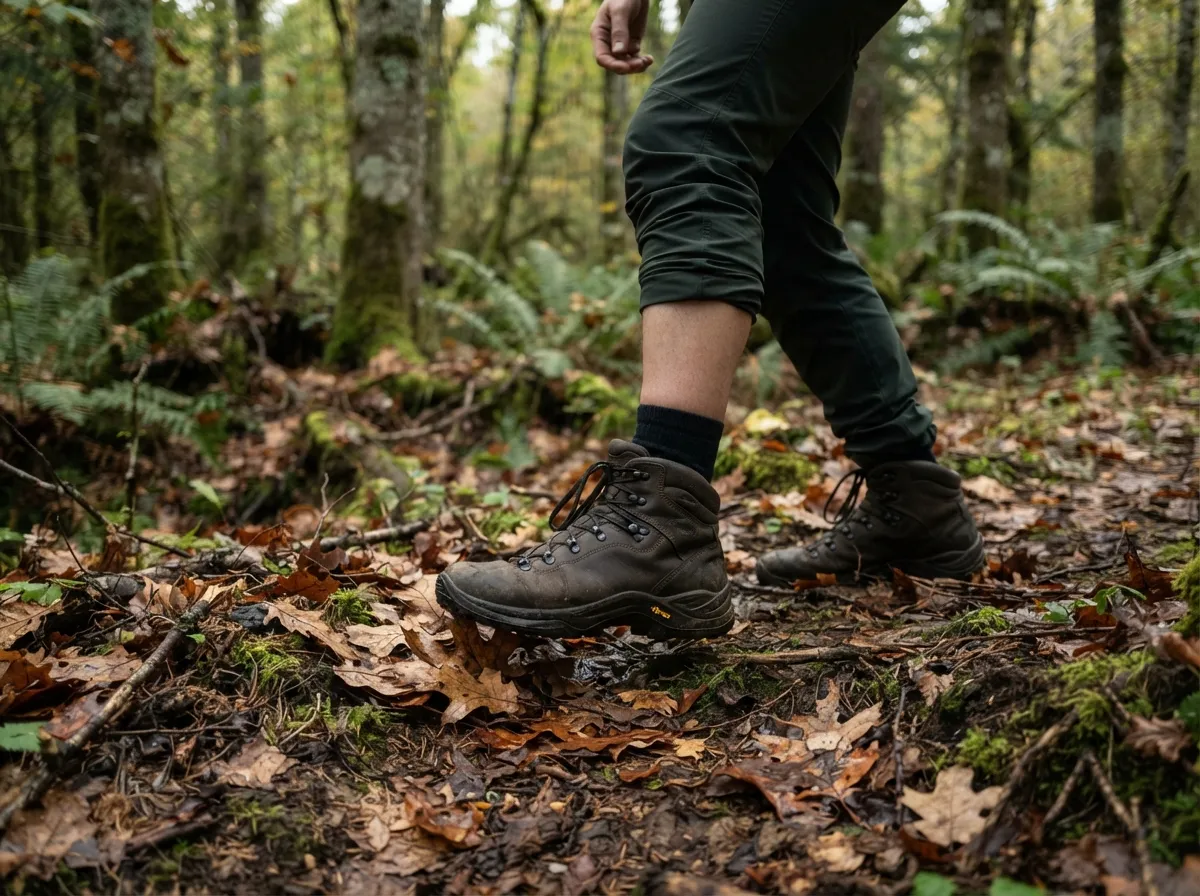
- The Fox Walk: A walking technique popularized by North American tracking schools (including Tom Brown Jr.’s) — the foot rolls gently onto its outer edge first, with body weight shifting over only after feeling the ground surface, allowing you to stop mid-step silently if a twig creaks underfoot.
Tracking cultures around the world
Tracking wasn’t invented in a textbook: it comes from cultures for whom it was literally a matter of daily survival.
- The San of the Kalahari: Their practice of persistence hunting — chasing prey over vast distances in extreme heat until the animal collapses from exhaustion — was captured by the BBC in The Life of Mammals (2003) and documented by South African researcher Louis Liebenberg. A 2024 study compiled hundreds of historical examples of persistence hunting across every inhabited continent, proving it wasn’t just an African anomaly. Liebenberg derived a core thesis from his work with San trackers: their critical debate over sign — weighing hypotheses, testing them, and revising them in the field — represents the same rationalist tradition as modern science, predating Greek philosophy. He went on to create CyberTracker, a field data collection tool designed to allow non-literate indigenous trackers to record complex biodiversity observations using icons rather than text — a project that earned him a Rolex Award for Enterprise.
- Aboriginal Australians: Their tracking expertise, refined over tens of thousands of years, was widely utilized by colonial and modern police forces (such as Mogo, Mollydobbin, and Jimmy James mentioned above). Australia’s last full-time police tracker, Barry Port, retired in 2014.
- Native Americans: Apache Scouts served the U.S. Army from 1849 to 1947, described by commanding officers as the “eyes and ears” of military columns in desert terrain. Naturalist Ernest Thompson Seton, co-founder of the Boy Scouts of America and author of Animal Tracks and Hunter Signs (1958), built much of his tracking system on direct observation in North America. More recently, American author Tom Brown Jr. claimed to have learned tracking starting at age seven from his childhood friend’s Lipan Apache grandfather, known as “Stalking Wolf”; he founded his Tracker School in the New Jersey Pine Barrens and published eighteen books on the subject.
- Siberian Hunters: Among the Evenks, a hunting and reindeer-herding people, traditional game — moose, wild reindeer, roe deer, bear, wolverine, lynx, wolf, Siberian marmot, fox, sable — demanded precise reading of the landscape long before firearms arrived in the 18th century, back when steel-tipped bows were still standard.
Mistakes to avoid
The lynx suffers from the opposite misconception: long viewed as a myth or ghost due to its elusive nature, formal scientific tracking in Western Europe only began in earnest in the 1980s. Its population remains fragile, concentrated in specific mountain corridors — a round, clawless print in these areas is worth reporting to wildlife monitoring networks rather than brushing off as “just a big feral cat.”
Frequently asked questions
How can I quickly tell a dog track from a wolf track?
Draw an imaginary X in the negative space between the toes and the main heel pad: in any canid, the lines pass through without intersecting a pad. But to tell a dog from a wolf specifically, look at the whole trackway: a wolf moves in near-perfect direct register along a straight, energy-saving line, while a dog wanders, stops, and backtracks. Size alone is never enough, as a large shepherd dog can leave a print as big as a wolf’s.
How do I tell a wildcat track from a lynx track?
Both are round, clawless feline tracks. A lynx has much larger feet covered in thick fur that distributes its weight over a broader surface, creating a significantly bigger footprint with far lower ground pressure relative to its body mass. Geographic location also helps narrow it down, as lynx populations are localized to specific mountain ranges.
How do I find water using animal tracks?
Look for game trails — narrow paths packed down by repeated travel — and follow them toward the lowest point in the landscape. Large herbivores and most predators drink at dawn and dusk, and their travel routes almost always converge on a water source. A well-traveled trail leading downhill is a far more reliable compass for finding water than signs like moss on trees, which depend mostly on microclimates.
Why do trackers treat bird silence as an alarm signal?
Because every environment has a steady baseline behavior, and a sudden disruption (abrupt silence, panic flight, frantic mobbing calls) almost always signals that a predator — human or animal — has entered the area. This concept was formalized by naturalist Jon Young as “bird language,” but it relies on a broader biological truth: different, unrelated species constantly listen to each other to detect danger.
Is tracking actually used in wilderness search and rescue?
Yes, directly: the exact skills used to follow a deer trail apply to finding a missing person — identifying sole signatures, stride length, gait regularity, hesitation marks, and track age. Professional trackers like Joel Hardin standardized these techniques for search and rescue operations, and Aboriginal trackers in Australia historically rescued lost children after hours of tracking through tough terrain.
Can I learn tracking on my own without formal training?
To a large extent, yes, starting right in your local area: a backyard, park, or dirt path after rain, or early in the morning when low sunlight highlights relief in the dirt. The basics (canid vs. feline shapes, gaits, aging tracks) come with practice and a good illustrated field guide. Advanced human tracking for search and rescue, however, requires hands-on instruction.
Key Takeaways
- Canid vs. feline first: oval shape with visible claws vs. round shape without claws, plus the X test to confirm.
- An entire trackway — spacing, regularity, direction — always tells you more than an isolated footprint.
- A descending game trail almost always leads to water: animals did the scouting for you.
- Sudden bird silence is one of the most reliable alarm signals in the forest.
- Tracking isn’t folklore: search and rescue professionals use it today to locate missing people.
Going further
- Louis Liebenberg, The Art of Tracking: The Origin of Science (1990) — the foundational work on Kalahari San tracking as a scientific method.
- Mark Elbroch and Casey McFarland, Mammal Tracks & Sign: A Guide to North American Species (2019, Stackpole Books) — the most comprehensive reference guide for North American animal sign.
- Jon Young, What the Robin Knows — on reading bird language and avian behavior.
- Tom Brown Jr., The Tracker (1978) — the classic story of his training under “Stalking Wolf.”
Sources for this module (28)
- CyberTracker — Louis Liebenberg et les pisteurs San du Kalahari
- Wikipedia — CyberTracker
- Wikipedia — History of science and technology in Africa (le pistage comme tradition rationaliste)
- Wikipedia — Persistence hunting
- Wikipedia — Tom Brown Jr.
- Wikipedia — Ernest Thompson Seton
- Internet Archive — A Field Guide to Tracking Animals in Snow (Forrest, 1988)
- Wikipedia — Red fox (dimensions des empreintes)
- Wikipedia — European badger
- Wikipédia — Sanglier (bauges, souilles, frottis, boutis)
- Wikipédia — Chevreuil européen
- Wikipedia — Moose (empreinte et sabot qui s'écarte)
- Wikipedia — American black bear
- Wikipedia — Eastern gray squirrel (restes de repas)
- Wikipedia — Coyote
- Wikipédia — Lynx boréal (pression au sol, absence de griffes)
- Wikipédia — Loup en France (population et répartition 2025)
- Wikipedia — Aboriginal tracker
- Wikipedia — Jimmy James (tracker, died 1991)
- Wikipedia — Apache Scouts
- Wikipedia — Evenks (gibier et techniques de chasse en Sibérie)
- Wikipedia — Joel Hardin
- Wikipedia — Search and rescue dog
- Wikipedia — Tracking (hunting)
- Wikipédia — Pistage
- Wikipedia — Bird vocalization (Jon Young, Bird Language, 2008)
- Wikipedia — Jungle warfare (pistage de combat, éclaireurs iban)
- Europe PMC — Baotic et al., pondération des cris d'alarme inter-espèces chez la girafe
Continue in "Cross-cutting skills"
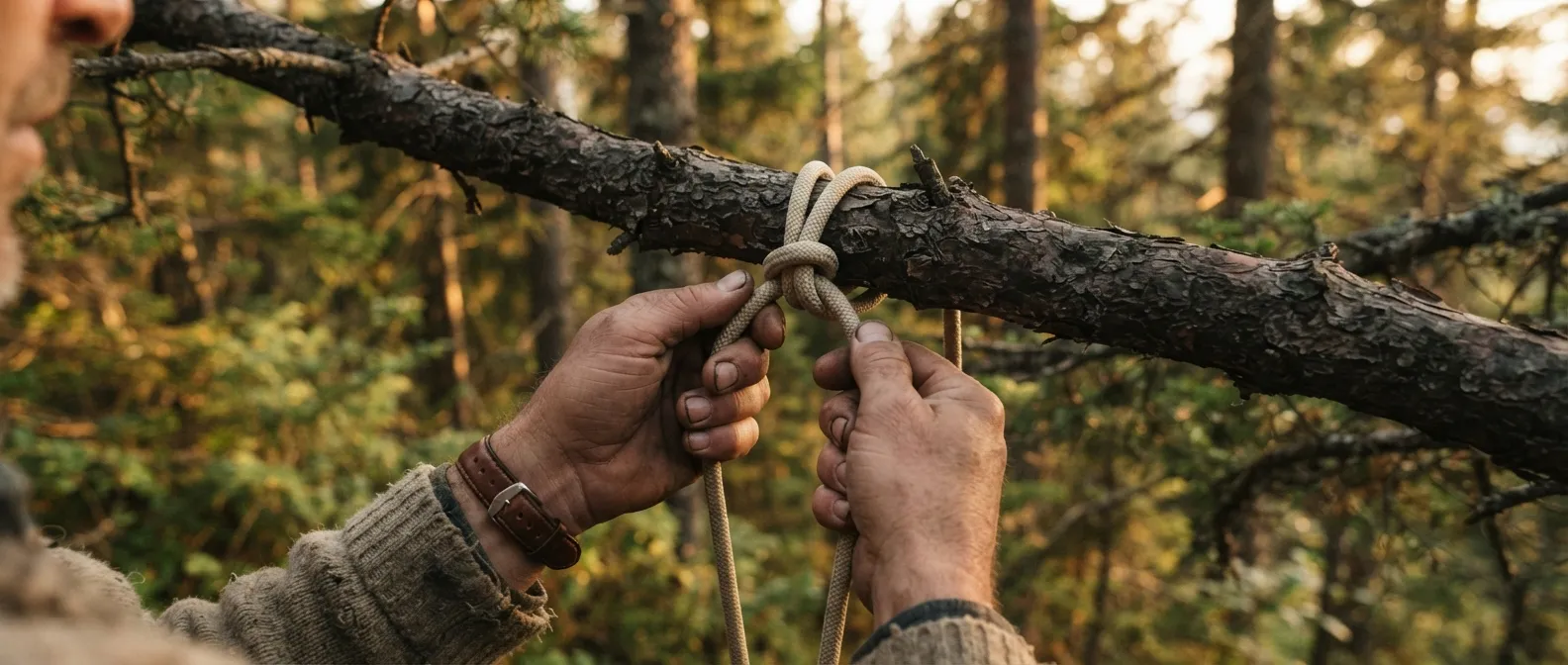
Knots and Cordage: The 10 That Actually Matter
3,857 knots listed in the reference book, and ten that are enough to pitch a shelter, scale a cliff, or save a life.
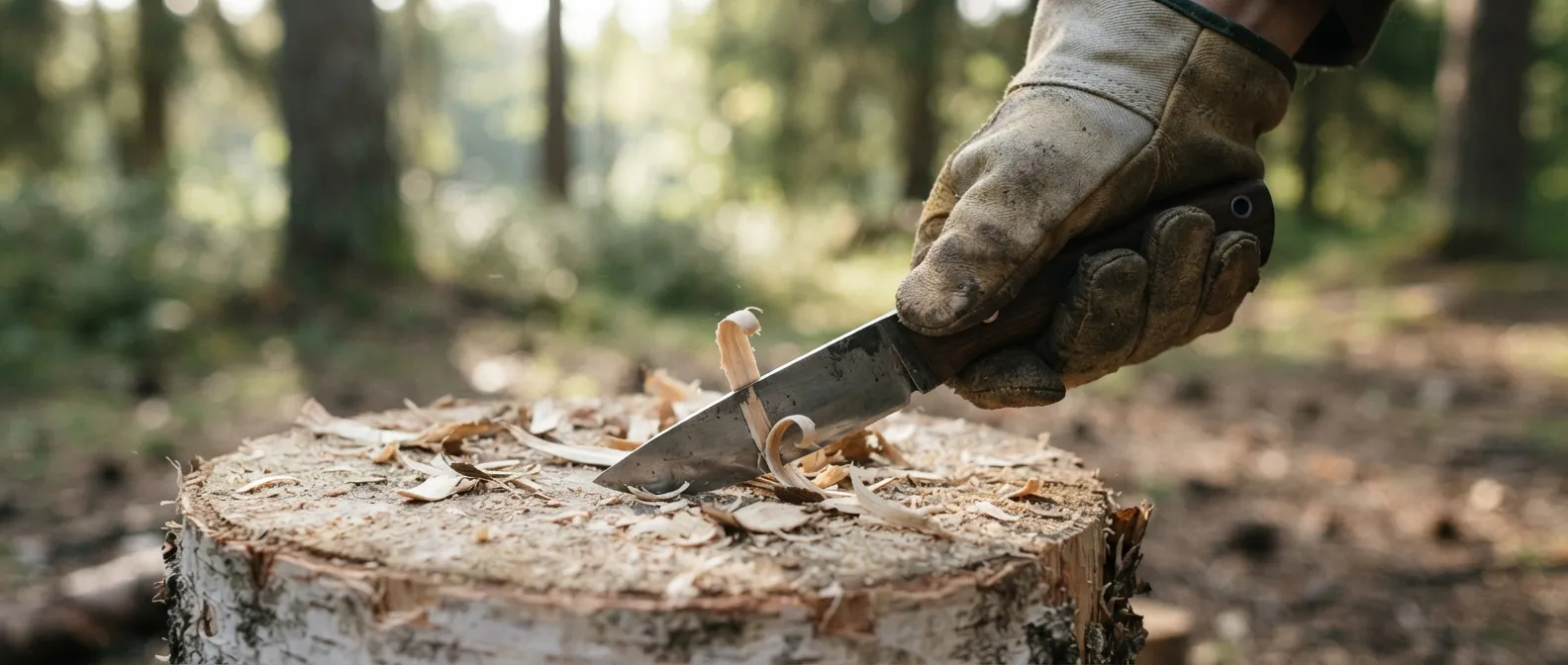
Knife, axe, saw: tools and the techniques that prevent injuries
The 'best knife' doesn't exist: only the one that fits your hand and your task—and the movements that keep you from getting hurt.
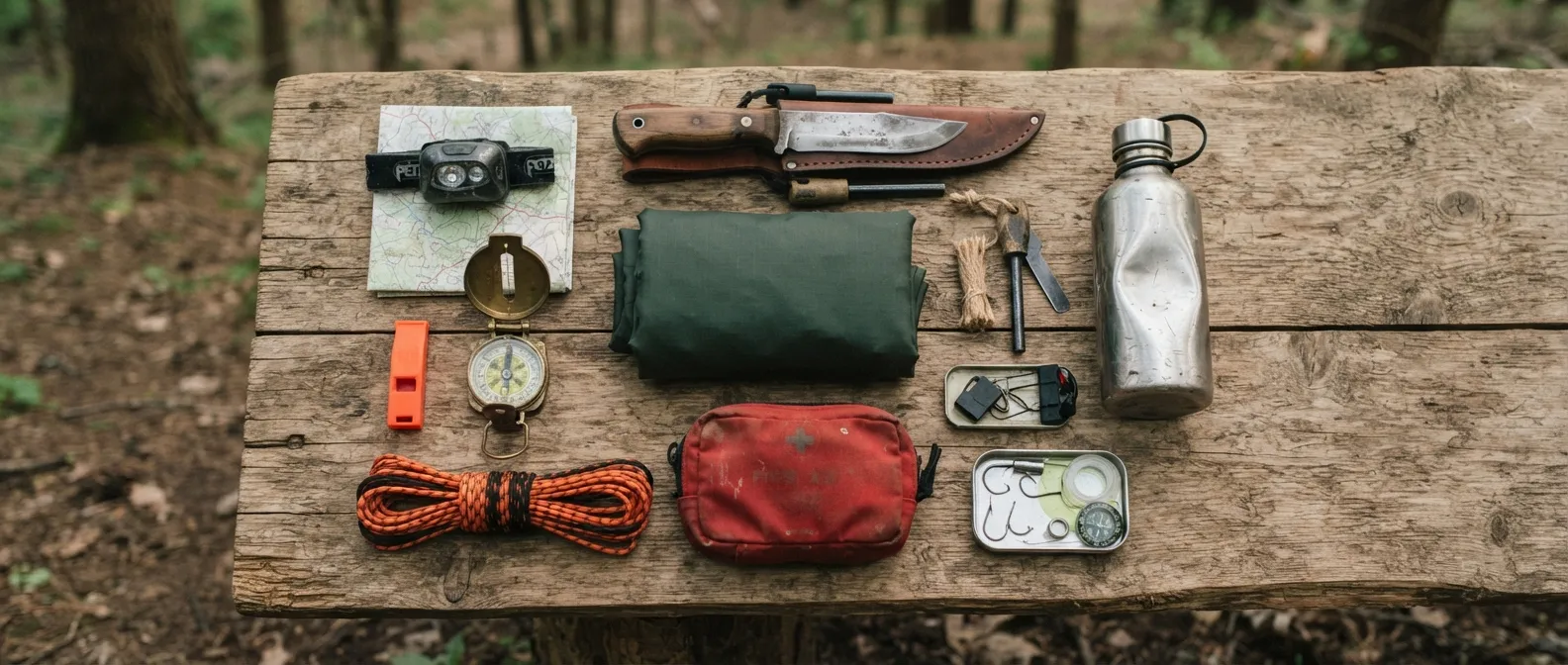
The Kit: What Should Be in Your Pockets, Backpack, and Car
What you carry on you saves you when you lose your pack: the kit hierarchy and essential checklists you shouldn't improvise.