Wild plants: eat without dying
You can last three weeks without food, but a single autumn crocus leaf will kill you: here is what you need to know, in this exact order.
Third day. You have water, a shelter that holds up, and a smoking fire. Your stomach has been rumbling since last night, and your eyes lock onto every green tuft like it’s a promise. This is exactly when people make a huge mistake: they taste. This module is here so you don’t taste—or only taste what you know by heart.
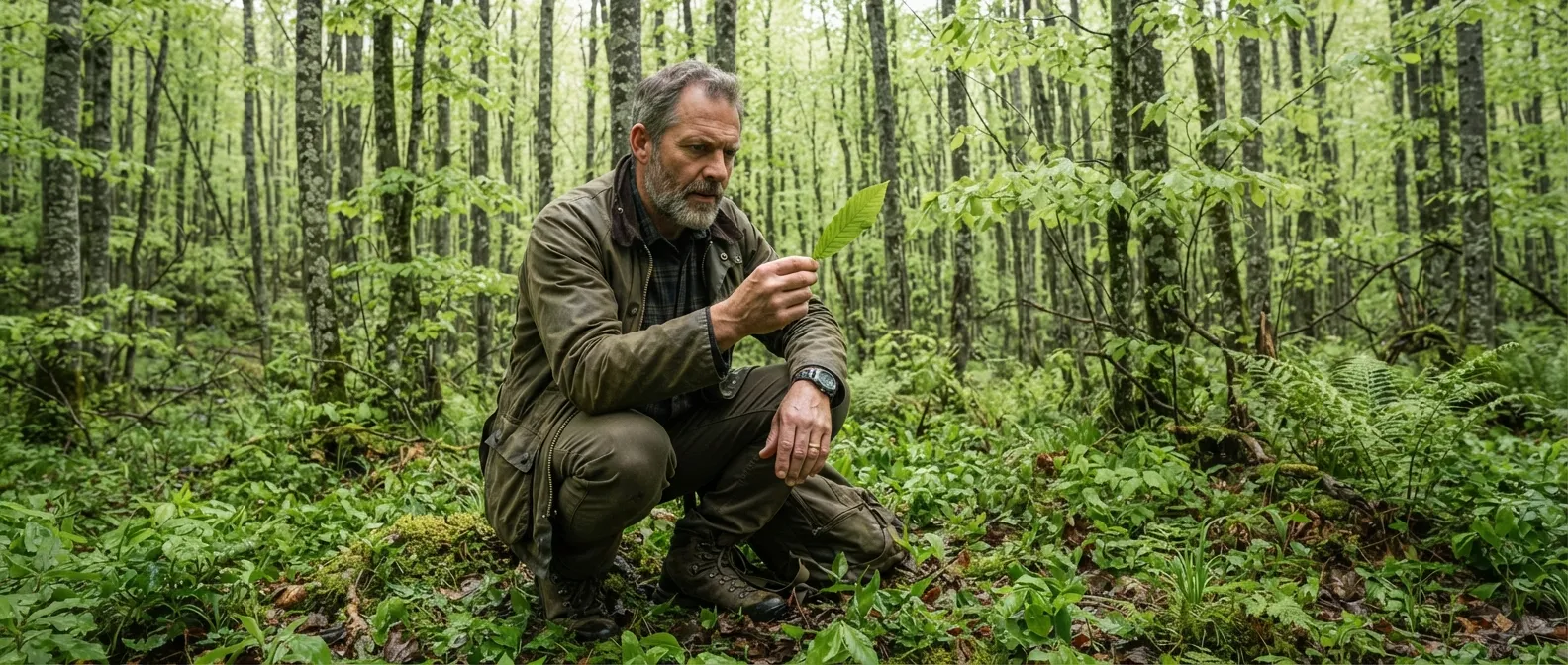
The reality: eating is your absolute last priority
The rule of threes tells you: 3 minutes without air, 3 hours without shelter in the cold, 3 days without water, 3 weeks without food. And for food, that rule is actually pessimistic: many hunger strikers have surpassed 40 days, and the medical record for a supervised fast is 382 days. Without eating anything, an adult generally dies after about two months, once they have lost 18 to 20% of their body mass. Your body doesn’t panic: after a day or two, your liver switches to fats and produces ketone bodies, and your brain reduces its glucose needs by nearly two-thirds.
What kills you quickly is cold, dehydration, an injury, or panic. Hunger “only” makes you weak, irritable, and obsessed: the 36 volunteers in the Minnesota Starvation Experiment (1944–45), fed 1,570 kcal per day for six months, spent their nights reading cookbooks. So in a real survival situation, foraging is neither your first nor your second task. It comes after water, shelter, fire, and signaling.
Second inconvenient truth: foraging costs energy. A wild leaf salad gives you 20 to 40 kcal per 100 g; you can easily spend more energy gathering it than it returns. British bushcraft instructor Paul Kirtley puts it bluntly: in a survival situation, the only things worth moving for are starchy roots and tubers, nuts, and fruits—not greens. Keep this in mind for everything that follows: greens give you vitamins and a morale boost, but starches buy you days.
The Universal Edibility Test: what it is, and why it can kill you
It comes from FM 21-76, the US Army survival manual, written for downed pilots in unknown territory. Here is the procedure as taught.
- Separate a single part of the plant (leaf, stem, root, fruit) and test only that part.
- Smell it: if it has a strong, sour, or bitter almond smell, stop immediately.
- Fast for 8 hours beforehand, drinking pure water only.
- Skin contact: rub a crushed piece on the inside of your elbow or wrist for 15 minutes, then observe for 15 minutes.
- Lip contact: place the piece on your outer lip for 3 minutes. Burning or tingling means stop.
- Tongue contact: hold it on your tongue for 15 minutes without chewing.
- Chew a piece without swallowing for 15 minutes.
- Swallow one bite, then wait 8 hours without eating anything else.
- Eat a quarter cup prepared the exact same way, and wait another 8 hours.
Do the math: almost 24 hours for a single part of a single plant, prepared in a single way (raw and cooked must be tested separately). The manual also lists things you shouldn’t even attempt to test: milky sap, umbels, sprout leaves growing from a bulb without an onion smell, beans and seeds in pods, carrot- or dill-like foliage, fine spines or hairs, bitter almond smell, grain ears with black or pink ergots, three-lobed leaves.
Now for the criticisms, and they are severe:
- It misses deadly plants. The cicutoxin in water hemlock, the coniine in poison hemlock, colchicine, and the cardiac glycosides in foxglove or lily of the valley don’t burn your skin or lips. At the test dose (one bite, then 50 g), a fatal plant can pass without a single symptom… and kill you on your third plate. As for amatoxins in amanita mushrooms, they show no signs of poisoning for 6 to 24 hours.
- It gives false positives. Nettle stings your lip, yet it’s edible. Dandelion produces a milky sap, yet it’s edible.
- Fasting skews the results. An organism in ketosis and dehydrated doesn’t react like a healthy one—which is precisely your state in a survival scenario. A French study notes that wall germander becomes hepatotoxic on a weakened liver.
- It was never designed for recreational foraging. Kirtley states it clearly: using it to “see if something is edible” is “foolish and dangerous.” It is a last resort for an unknown starch when you truly have nothing left—and never for mushrooms.
Key rules before foraging
Christopher Nyerges, who has been teaching foraging in California since 1974, sums it up: “You don’t need to know a single toxic plant. You just need to know what you’re eating.” Still, keep these safeguards in mind:
- Never eat wild mushrooms without true expert knowledge. No simple rule, no test, no exceptions.
- Be extremely cautious with umbellifers (the carrot family, featuring umbrella-like flower clusters): this family includes poison hemlock and hemlock water-dropwort, responsible for two of the seven deaths recorded by French Poison Control Centers between 2012 and 2021.
- Milky sap, bitter almond smell, white berries, shiny three-lobed leaves, fine spines: these are red flags, not final verdicts. Dandelion has latex and is edible; spurge has latex and will burn your cornea. When in doubt, let the red flag win.
- Don’t harvest in batches. Anses documented a fatality in 2020 in Alsace: wild garlic pesto containing one or two autumn crocus leaves picked accidentally along with the rest.
- A bitter or unusual taste: spit it out and stop. Autumn crocus is bitter; colocynth is bitter. This is the official advice from Poison Control Centers.
- Take a photo of what you forage. Another official recommendation: if you get poisoned, the photo helps identify the plant and treat you faster.
- Stay away from roadsides, sprayed fields, and polluted water: cattails and chickweed readily accumulate lead and cadmium.
The look-alikes that actually kill
Poison Control Center statistics don’t lie. Out of 1,159 poisoning incidents caused by misidentification (2012–2018), half involved: ornamental bulbs mistaken for onions (12%), horse chestnuts mistaken for sweet chestnuts (11%), wild gourds/colocynths (8.5%), cuckoopint/lords-and-ladies mistaken for sorrel (7%), hemlocks (4%), and laburnum mistaken for acacia (4%). The most severe cases almost always come from four main pairs: autumn crocus/wild garlic, white hellebore/yellow gentian, foxglove/comfrey, and hemlock water-dropwort/wild carrot.
Wild garlic, lily of the valley, autumn crocus
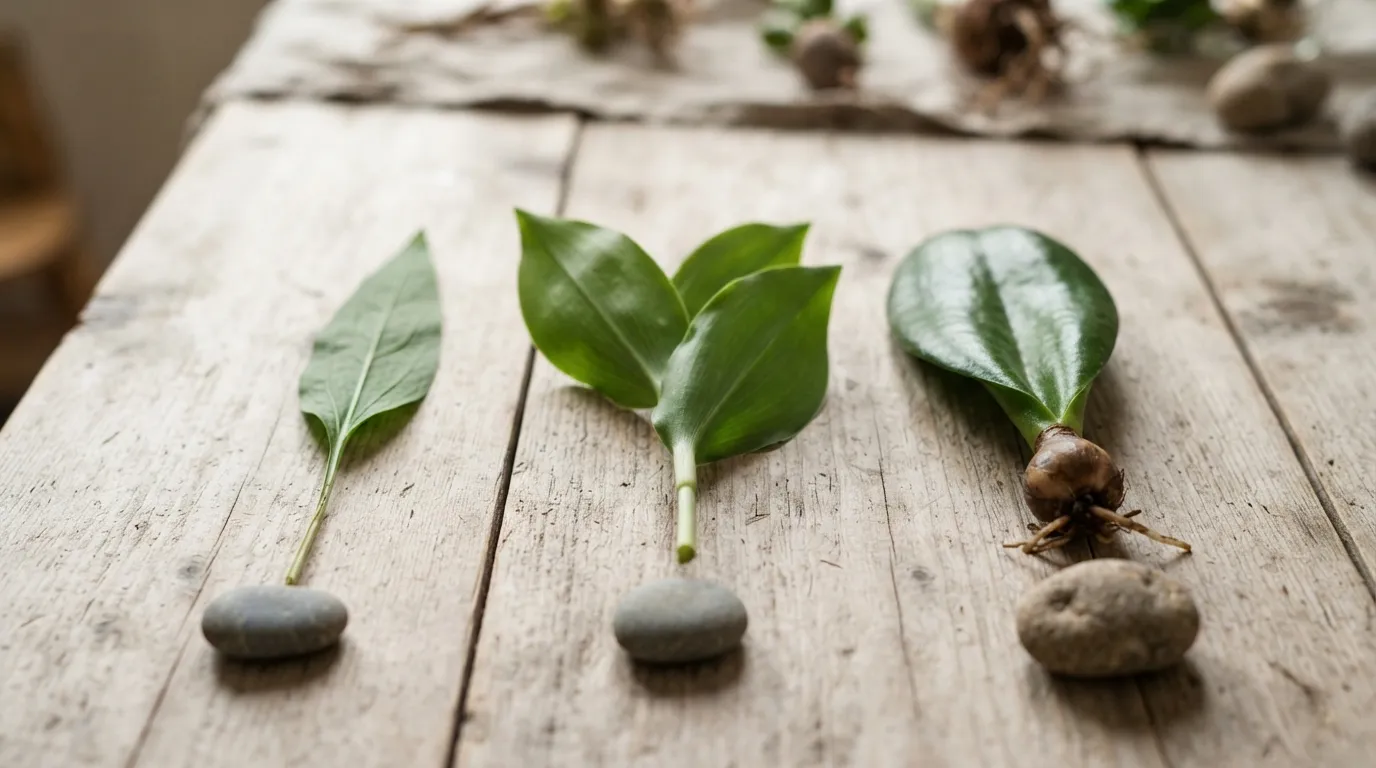
Wild garlic (Allium ursinum) carpets damp woodlands from February to May. It has an oval-pointed leaf, one per stem, with a distinct petiole, a shiny upper side, and a dull underside, bearing white star-shaped flowers. When crushed, it smells distinctly of garlic. This is the only decisive test—though if your hands have smelled like garlic for ten minutes, your nose won’t help you anymore.
Autumn crocus (Colchicum autumnale) grows in the same spots at the exact same time. Its leaves are thick, rigid, shiny, have no petiole, and sprout directly from the ground in clusters of three or four, with rounded tips, no smell, and a bitter taste. Its purple flowers only appear in autumn without leaves: in spring, nothing obvious warns you. Colchicine has no antidote, and death occurs within a few days from multi-organ failure. It caused two deaths in France between 2020 and 2022.
Lily of the valley (Convallaria majalis) bears two sheathing leaves on a single stem and has no garlic smell. Its cardiac glycosides can stop your heart; even the water in a vase containing it is toxic.
Wild carrot and hemlocks
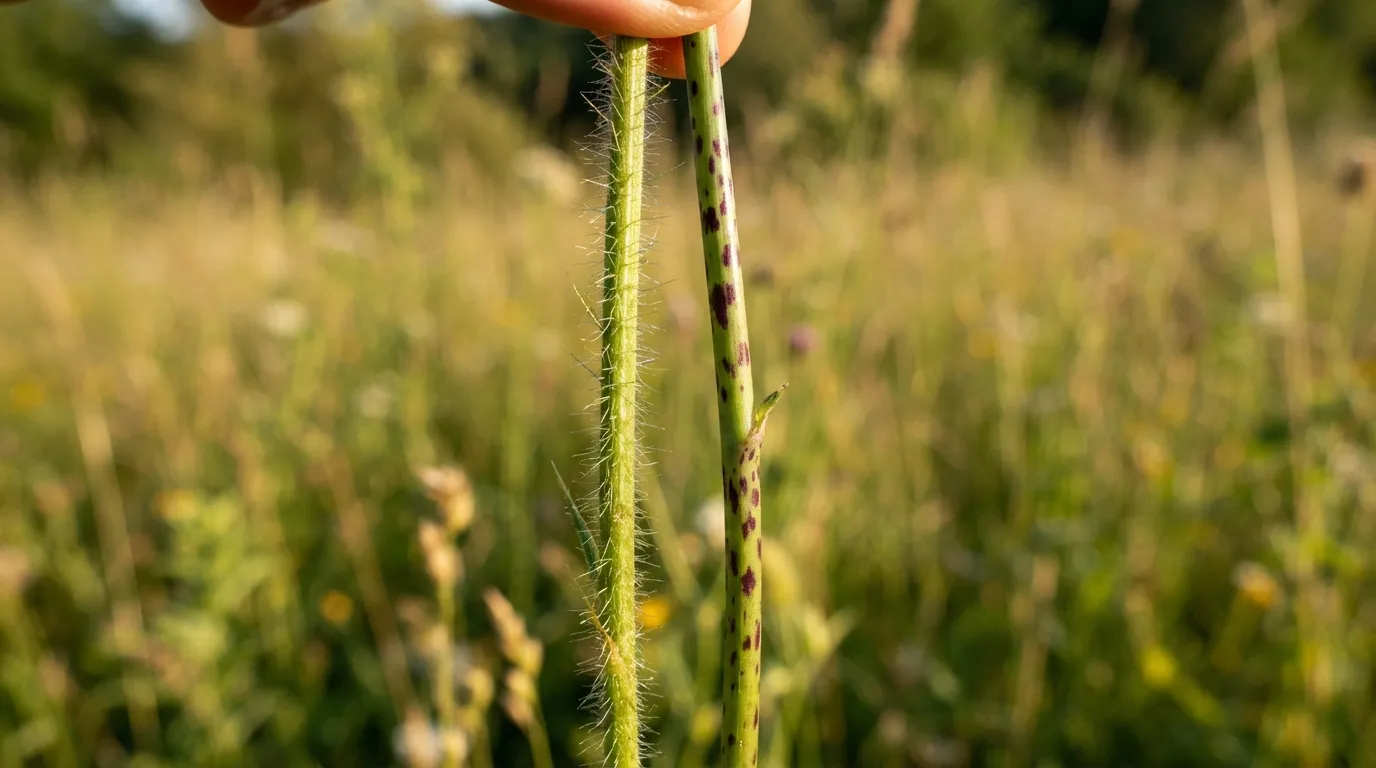
Wild carrot (Daucus carota) has a hairy stem, a carrot smell at the root, and often a tiny dark purple flower right in the center of its white flower head. Poison hemlock (Conium maculatum) has a smooth, hollow stem covered in purple spots, smells like mouse urine, and can grow over two meters tall; six to eight fresh leaves are enough to kill, causing paralysis that travels from your legs up to your respiratory muscles while you remain fully conscious. This is the poison that killed Socrates. Fool’s parsley (Aethusa cynapium) mimics parsley and chervil: shiny leaf undersides, three long hanging bracteoles under each small flower cluster. Water hemlock (Cicuta virosa) grows with its roots in water: it has a hollow chambered rootstock that oozes an oily yellow sap turning brown in the air; convulsions begin within 15 minutes, and children have died just from using its hollow stem as a whistle. Hemlock water-dropwort (Oenanthe crocata), mistaken for wild carrot due to its roots, has killed twice in France in the past decade.
Adopt the rule of a cautious foraging practitioner: avoid all wild umbellifers until you can name five of them with your eyes closed.
Sweet chestnut vs. horse chestnut
Sweet chestnut (Castanea sativa): spiky brown burr densely covered in long spines, containing two or three flattened nuts with a tufted tip, found in woods. Horse chestnut (Aesculus hippocastanum): thick green capsule with short, widely spaced spikes, containing a single round nut, found in urban parks. If the burr isn’t fiercely spiky, it’s not a sweet chestnut. Horse chestnuts cause vomiting and severe throat irritation, accounting for 11% of plant mix-ups in France.
Safe greens along the trail
These are the plants recommended for beginners: common, without deadly look-alikes, and easy to recognize. They supply vitamins and minerals, not significant calories.
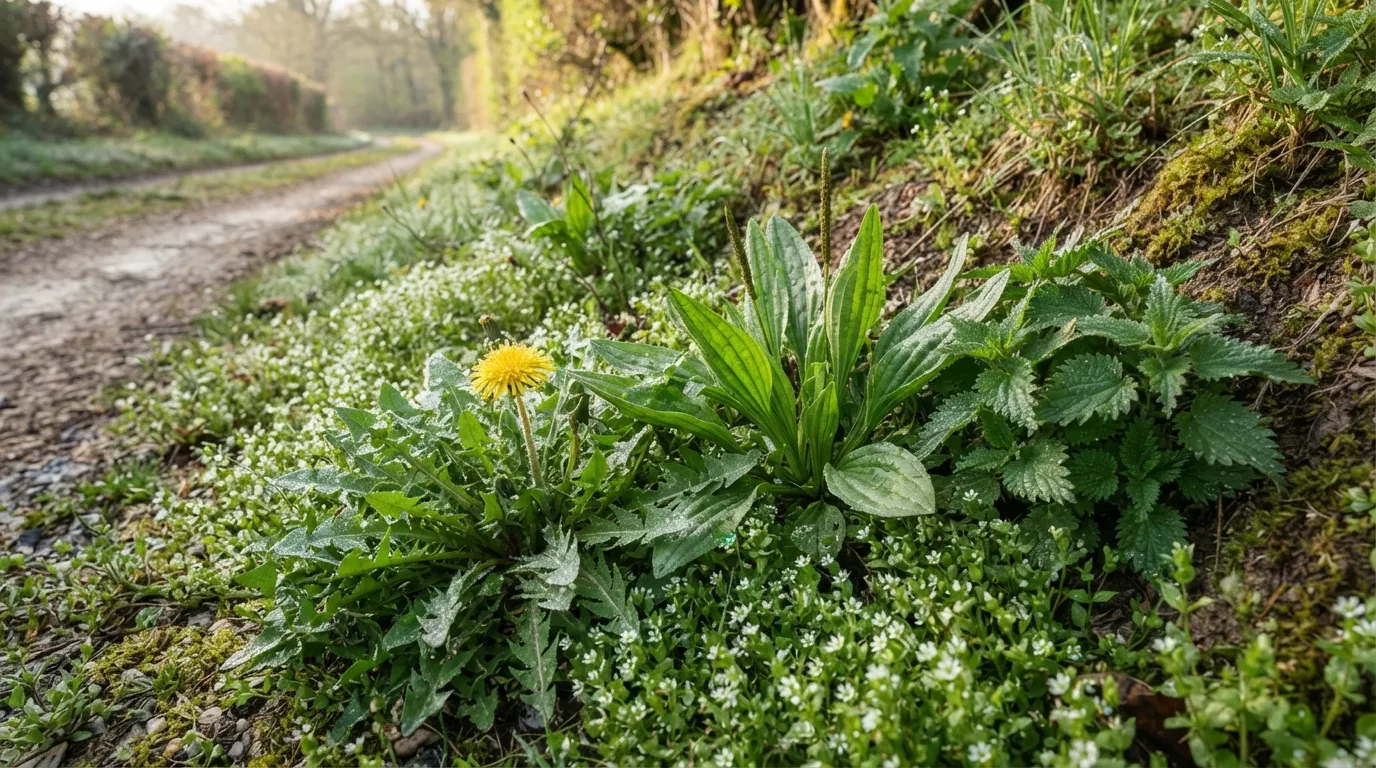
- Dandelion (Taraxacum officinale): rosette of jagged leaves, hollow stem, single yellow flower, white milky sap. Eat leaves raw before flowering (rich in vitamin C and beta-carotene), unopened buds as “capers,” and roasted roots as a coffee substitute. Its look-alikes with milky sap and yellow ray flowers are all edible, just slightly more bitter.
- Plantain (Plantago major and lanceolata): leaves with parallel veins that leave elastic threads when snapped. Young leaves work in salads; seeds are mucilaginous. Crushed leaves soothe nettle stings and insect bites. Native Americans called it “white man’s footprint” because it spread wherever settlers traveled.
- Stinging Nettle (Urtica dioica): cooking or drying destroys the stinging hairs. Leaves are packed with protein, iron, calcium, and vitamins A and C. Pick them bare-handed by pinching the stem upwards in the direction of the hairs. White dead-nettle looks similar, doesn’t sting, and is also edible.
- Clover (Trifolium pratense and repens): three leaflets with a white V-shaped mark. Sweet flowers, leaves taste great cooked—eating them raw can cause bloating.
- Chickweed (Stellaria media): small creeping plant with tiny white star-shaped flowers. Unmistakable signature: a single line of hairs running along the stem that switches sides at every joint, and an elastic inner core when pulled apart. Tastes like raw hazelnuts. Don’t confuse it with scarlet pimpernel (Anagallis arvensis), which has orange flowers and contains toxic saponins.
- Shepherd’s purse (Capsella bursa-pastoris): rosette of lobed leaves and flat heart-shaped seed pods. Tastes like peppery cabbage.
- Lamb’s quarters (Chenopodium album): often called “wild spinach.” Young leaves feature a white powdery coating that makes water bead off, and red-tinged leaf joints. Provides 43 kcal and 89% of your daily vitamin C per 100 g. When young, it resembles black nightshade: the white powder and reddish joints help tell them apart.
- Sorrel (Rumex acetosa): arrow-shaped leaves with backward-pointing basal lobes, sour taste. High in oxalic acid: consume in moderation, and blanch if eating large amounts. Caution: young leaves can resemble cuckoopint (Arum maculatum), which has a glossy underside and pale veins, and contains oxalate crystals that burn your mouth instantly. Cuckoopint accounts for 22% of all plant poison calls in France.
- Burdock (Arctium lappa): large heart-shaped leaves with a whitish underside, hook-covered flower heads (the inspiration for Velcro). First-year roots taste like artichoke heart and are rich in inulin: this is Japanese gobo. Never confuse its leaves with the soft, velvety rosette of foxglove.
Calories: marshes, forests, coasts
Cattail, the “marshland supermarket”
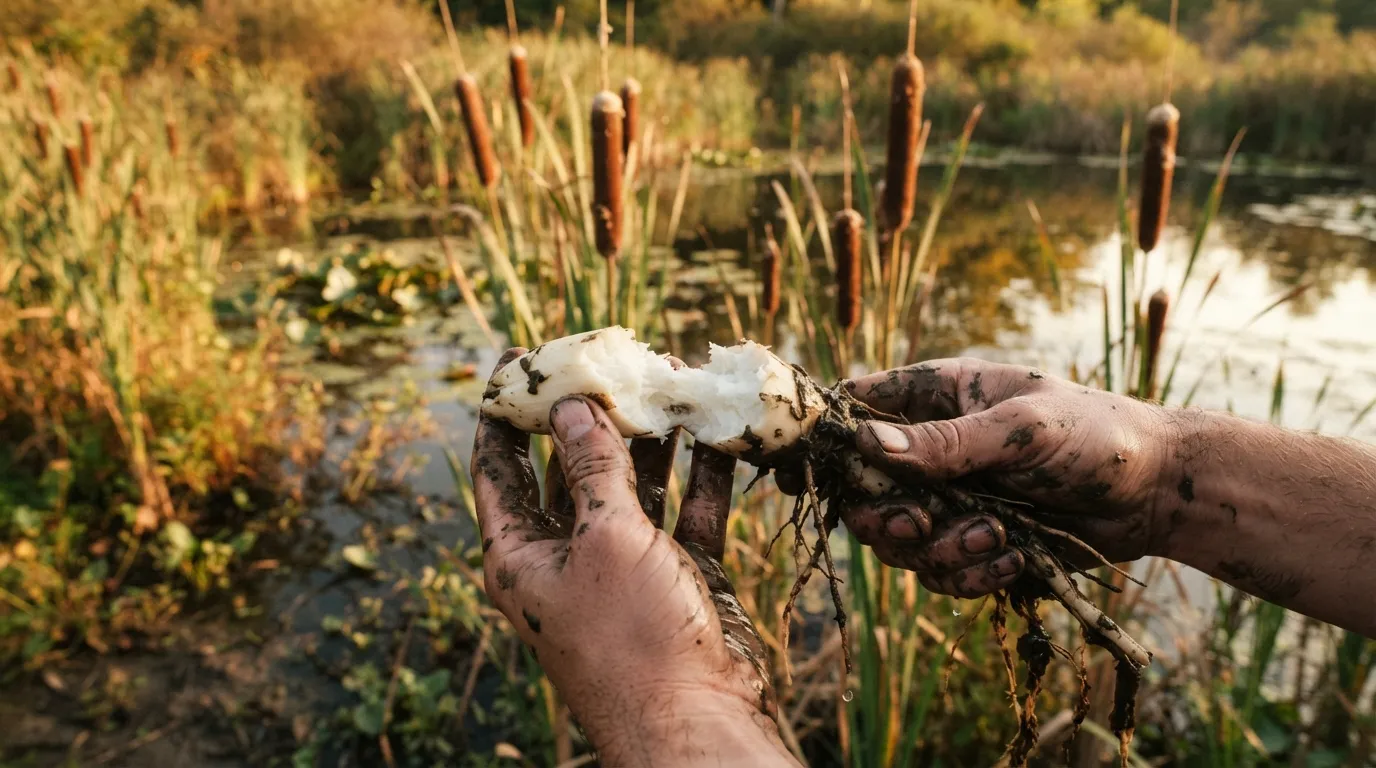
Cattail (Typha latifolia, T. angustifolia) grows in freshwater locations across the Northern Hemisphere and offers food almost year-round: young spring shoots peeled like asparagus (“Cossack asparagus”), green immature flower heads boiled like corn on the cob in early summer, yellow pollen shaken into a bag in mid-summer (rich in protein, great for flour), and autumn/winter rhizomes, which yield starch providing 266 kcal per 100 g, with as much protein as rice. Extract it by crushing peeled rhizomes in water and letting the starch settle to the bottom, or by roasting them over embers and chewing out the starch—spitting out the tough fibers. A source cited by Euell Gibbons estimated a single acre could yield nearly three tons of flour. The seed fluff acts as excellent tinder and insulation. Paleolithic humans were already consuming them 30,000 years ago.
Look-alikes before flowering: sweet flag and iris, which have broader leaves and strong aromas. Green Deane’s rule: cattails have no strong scent; if it smells aromatic, it’s not a cattail. Always look for last year’s brown seed heads nearby to confirm.
Common reed (Phragmites australis) shares the same marsh habitat: prepare its rhizomes like cattails, eat young shoots raw or cooked, or collect the hardened sap from damaged stems to eat fresh or toast like sugar. Yellow water-lily (Nuphar lutea, N. polysepala in North America): the Klamath people popped its seeds like popcorn; its bitter rhizome requires boiling in several changes of water.
Acorns and stream leaching
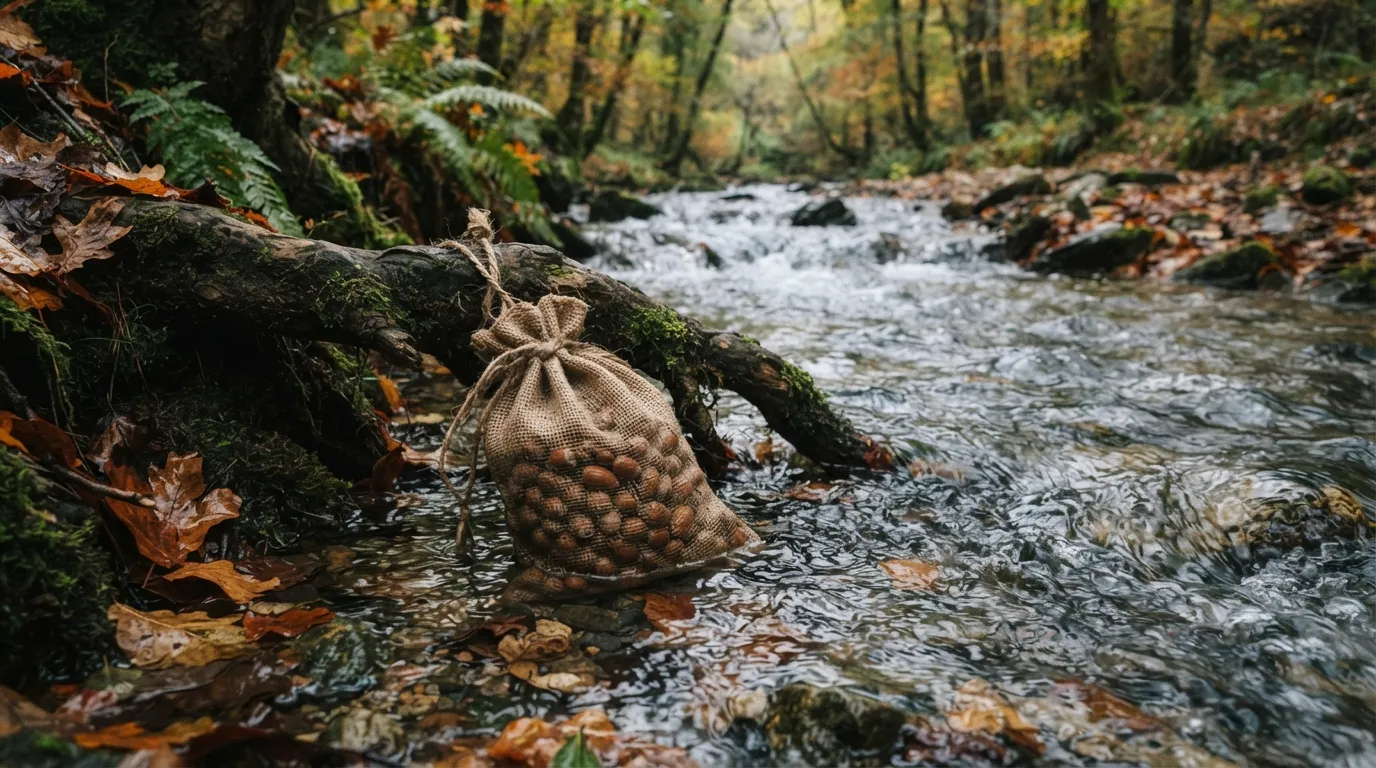
Acorns provide 387 kcal per 100 g, containing 41% carbohydrates and 24% fats. The main issue is tannins: bitter, astringent, and harsh on the kidneys in large amounts. Since tannins are water-soluble, the process focuses entirely on washing them out. White oak species (English oak, sessile oak, Quercus alba in North America) contain far fewer tannins than red oaks.
- Sort: throw away acorns with insect holes or those that float in water.
- Shell them and remove the thin brown inner skin.
- Grind into a coarse meal (using stones or a mortar): finer meal leaches faster.
- Cold water leaching (keeps starch intact for binding flour): place meal in a canvas bag or perforated container in a running stream. Washington tribes left bags submerged for three days; California tribes dug sand basins, lined them with leaves, and poured water through the meal repeatedly.
- Hot water leaching (if short on time): boil through three or four changes of water to leach them in under an hour—note that this cooks the starch, so the resulting meal won’t bind as dough.
- Taste test: place a tiny piece on your tongue and spit it out. Once all bitterness is gone, they are ready. Dry, grind, and bake into cakes.
Nuts, beechnuts, and pine
Hazelnuts (Corylus avellana) are gathered in September and October; evidence shows people were roasting them in pit ovens in Scotland 9,000 years ago. Beechnuts from beech trees (Fagus sylvatica), containing 40% fat, are edible when roasted in small amounts: raw beechnuts contain fagin and trimethylamine, which cause headaches and nausea if you eat more than a small handful. Pine trees (Pinus sylvestris and related species) offer three resources: pine needle tea (a reliable source of vitamin C when steeped at 90°C rather than boiled; claims of “five times the vitamin C of lemons” lack solid scientific proof), edible seeds inside pine cones (all species are non-toxic, though only around 29 produce seeds large enough to be worth harvesting—such as stone pine, Swiss pine, and American pinyon pines), and inner bark (cambium). The Sami dried, roasted, and ground this soft layer between bark and wood to replace a quarter to a third of the flour in their bread. This “bark bread” saved Finland during the severe famines of 1690 and 1860, and its vitamin C content prevented scurvy among inland Sami when coastal populations were suffering from it. Critical danger: yew (Taxus baccata), featuring flat, soft needles, scaly bark, and bright red arils—highly toxic, except for the red fleshy coat of the berry.
Berries, elderberry, and rose hips
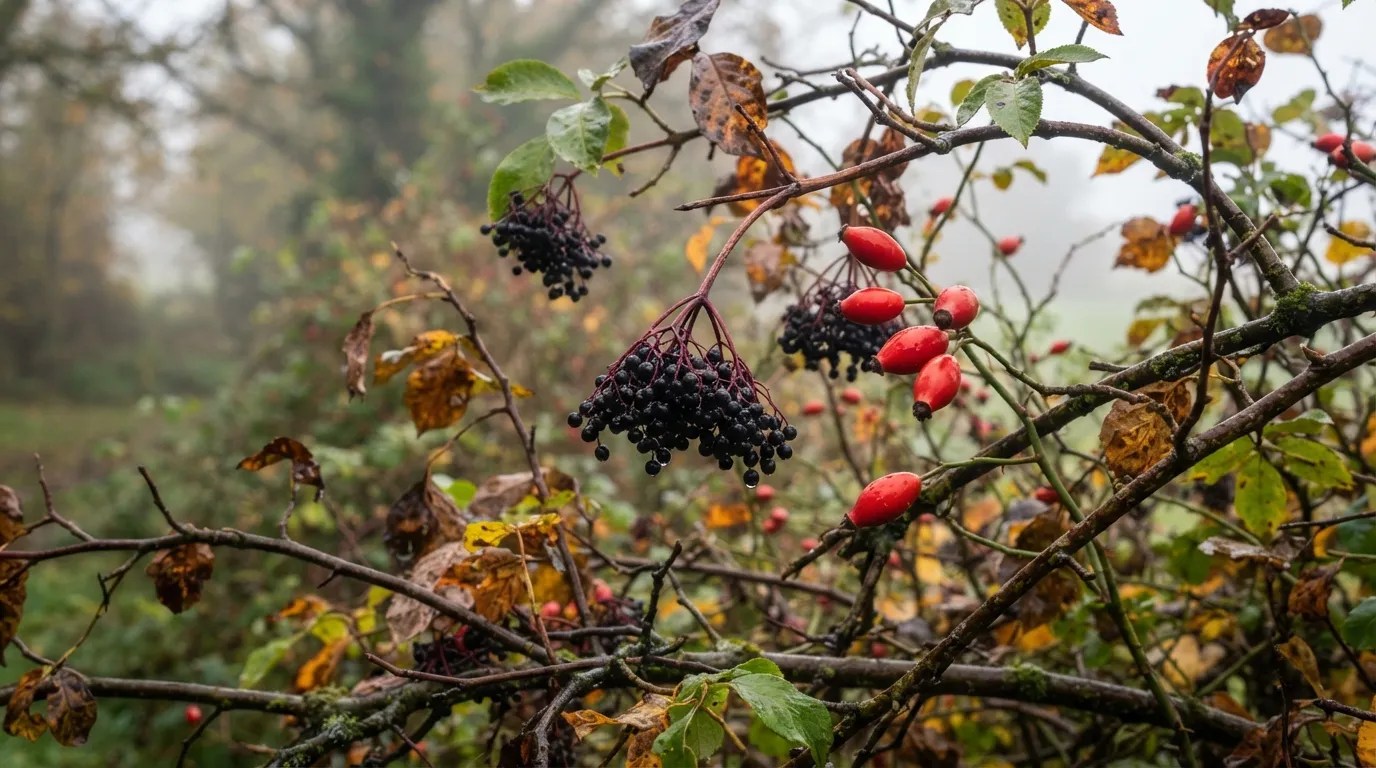
Blackberries (Rubus fruticosus) and wild raspberries have no poisonous look-alikes in Europe or North America. Black elderberry (Sambucus nigra): a woody shrub bearing drooping clusters of dark purple berries. Raw berries, leaves, and stems contain cyanogenic glycosides and lectins causing severe vomiting and diarrhea; cooked elderberries are completely safe. Don’t confuse it with dwarf elder (Sambucus ebulus), an herbaceous plant with no woody trunk whose berry clusters point upward, remaining toxic even when cooked. Rose hips (Rosa canina): packed with 426 mg of vitamin C per 100 g according to USDA data—twenty times more than oranges—they are best picked after the first frosts when soft and sweet. Be sure to scrape out the inner seeds and itchy hairs before eating.
Lichens and seaweeds: emergency famine foods
Rock tripe (Umbilicaria) appears as flat brown patches clinging to rocks. In 1821, the Franklin expedition survived on it during their retreat across the Barren Grounds—eleven out of twenty men died, and Franklin noted that the lichen “produced bowel complaints in several of the officers.” This was caused by gyrophoric acid: it requires soaking and boiling in multiple changes of water; the Cree cooked it in fish broth. Its primary carbohydrate, pustulan, is difficult to digest, making it more filling than nourishing. Iceland moss (Cetraria islandica), containing 70% lichenin, was boiled to remove bitterness and ground into Scandinavian bread flour. Almost all lichens become edible after proper leaching; a notable exception is wolf lichen (Letharia vulpina), which is bright yellow-green and toxic.
Along marine coastlines, virtually all seaweeds are non-toxic: dulse (Palmaria palmata), sea lettuce (Ulva), kelp, bladderwrack, and nori (Porphyra). Keep two exceptions in mind: Desmarestia, a brown seaweed that concentrates sulfuric acid (internal pH down to 0.6—you’ll notice the taste immediately), and the cyanobacterium Lyngbya majuscula found in warm waters, which can be fatal. In contrast, most freshwater algae are toxic. Also watch out for excessive iodine intake.
Ten deadly plants to know on sight
| Toxin | Edible look-alike | Identifying trait | |
|---|---|---|---|
| Yew (Taxus baccata) | taxine, heart | fir, pine needles | flat soft needles, red arils; only the red fleshy coat is safe |
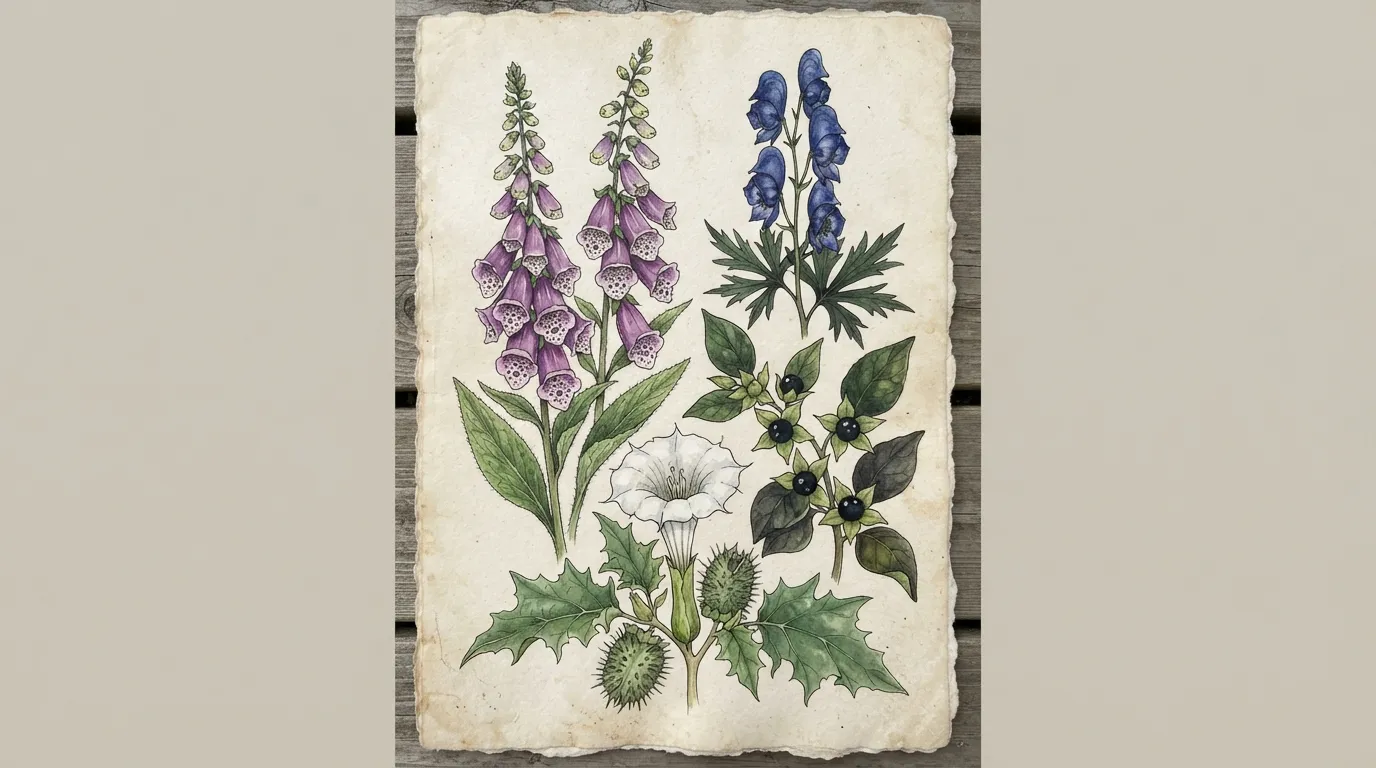
| Foxglove (Digitalis purpurea) | digitoxin, heart | comfrey, borage | soft velvety leaf rosette, spotted purple bell flowers |
| Monkshood (Aconitum napellus) | aconitine, nerves/heart | wild angelica/lovage | helmet-shaped blue flowers; can poison through bare skin |
| Poison hemlock (Conium maculatum) | coniine, paralysis | wild carrot, parsley | smooth stem with purple splotches, mouse-like odor |
| Deadly nightshade (Atropa belladonna) | atropine, delirium | blueberry, blackcurrant | solitary shiny black berries set on a star-shaped calyx |
| Jimsonweed (Datura stramonium) | scopolamine, delirium | spinach look-alikes | large trumpet white flower, spiky pod; 2 to 5 seeds kill a child |
| Autumn crocus (Colchicum autumnale) | colchicine, no antidote | wild garlic | leaves lack a petiole and smell, bitter taste |
| Lily of the valley (Convallaria majalis) | convallatoxin, heart | wild garlic | two sheathing leaves per stem, no garlic smell |
| White hellebore (Veratrum album) | alkaloids, heart | yellow gentian | strongly pleated alternate leaves (gentian has opposite leaves) |
| Oleander (Nerium oleander) | oleandrin, heart | bay laurel | 13% of plant mix-ups in Marseille; extremely bitter, rarely fatal |
Autumn crocus and jimsonweed each account for 15% of severe plant poisonings in France, with foxglove making up 12%. Two urban myths worth dispelling: roasting meat on oleander sticks wiping out an entire family (a urban legend recorded worldwide, never documented), and oleander honey (its flowers produce no nectar; “mad honey” comes from rhododendrons).
Frequently asked questions
How can you tell if a wild plant is edible?
You must identify it with complete certainty: be able to name it, list its verified identification traits, and know any dangerous look-alikes. No quick test can replace this knowledge, and a bitter taste or unusual smell should always prompt you to spit it out and stop immediately.
Does the US Army Universal Edibility Test actually work?
It is severely limited and dangerous if misunderstood: it fails to detect the most fatal toxins, such as coniine in poison hemlock or colchicine in autumn crocus, which produce no skin or lip reaction at test doses. It serves as an absolute last resort for an unknown starchy plant when facing starvation—never as a method for casual foraging, and never for mushrooms.
How do you distinguish wild garlic from autumn crocus when they grow together?
Wild garlic has leaves with a distinct petiole and smells strongly of garlic when crushed, whereas autumn crocus has thick, rigid leaves without petioles sprouting directly from the ground in clusters of three or four, with no garlic smell and a bitter taste. Confusing them is extremely dangerous: colchicine in autumn crocus has no antidote and leads to death within days.
Is a plant or mushroom safe to eat if animals are eating it?
No, this is a dangerous myth: birds eat toxic yew berries without harm, and deer or rabbits easily tolerate plant alkaloids that would kill a human or a horse. What an animal can digest tells you nothing about what the human liver can process.
How long can a human survive without food?
Generally around three weeks, and often much longer: the medical record for a supervised fast reached 382 days, and many hunger strikers have exceeded 40 days. That’s why food remains your lowest priority in a survival scenario, coming well after water, shelter, fire, and signaling.
Which dangerous plants should everyone learn to recognize and avoid?
The top ten to know on sight are yew, foxglove, monkshood, poison hemlock, deadly nightshade, jimsonweed, autumn crocus, lily of the valley, white hellebore, and oleander—together responsible for the vast majority of severe plant poisonings. Their common trait: they frequently grow alongside edible look-alikes, making it vital to learn both.
Key takeaways
- Food comes after water, shelter, fire, and signaling: you can last three weeks and often much longer without eating.
- The Universal Edibility Test does not detect deadly poisons (hemlocks, autumn crocus, foxglove): use it only as a last resort for starches, never for casual foraging.
- Avoid wild mushrooms, avoid umbellifers, don’t harvest in uninspected handfuls, avoid bitter plants, and don’t eat anything you can’t identify by name.
- Real survival calories come from cattail rhizomes, leached acorns, nuts, and inner bark—not from leafy greens.
- Wild garlic vs. autumn crocus/lily of the valley, wild carrot vs. hemlocks, sweet chestnut vs. horse chestnut, sorrel vs. cuckoopint: four primary pairs that cause most Poison Control emergency calls.
Going further
- François Couplan, Plantes sauvages comestibles (Larousse) — the classic French reference guide, highlighting toxic look-alikes.
- Samuel Thayer, Nature’s Garden and The Forager’s Harvest — the gold standard for North American foraging, grounded in hands-on field experience.
- Christopher Nyerges, Foraging Wild Edible Plants of North America — 150 recipes combined with a core philosophy: “know what you’re eating.”
- Anses, Vigil’Anses reports #8 and #26 — official statistics on plant poisonings, available online for free.
- Tela Botanica (tela-botanica.org) — a collaborative flora database for cross-checking plant identifications.
Sources for this module (19)
- FM 21-76 US Army Survival Manual (1992), ch. 9 « Survival use of plants »
- Paul Kirtley — Discussing problems presented by the Universal Edibility Test
- Libérez votre assiette — Analyse du test universel de comestibilité
- Anses, Vigil'Anses n°8 (juin 2019) — Confusion entre plantes comestibles et toxiques
- Anses, Vigil'Anses n°26 (juillet 2025) — Les plantes à l'origine d'intoxications fréquentes ou graves
- Centre antipoison de Marseille — 22 ans de confusions alimentaires (Toxics, 2024)
- Cueilleurs sauvages (CH) — Grande ciguë, petite ciguë, ciguë vireuse
- Tela Botanica — eFlore, flore de France
- François Couplan — Plantes sauvages comestibles (Larousse)
- Samuel Thayer — Nature's Garden
- Christopher Nyerges — A beginner's guide to finding wild edible plants (Popular Science)
- Wikipedia — Rock tripe (expédition Franklin)
- Wikipedia — Bark bread (pettuleipä)
- Wikipedia — Camassia quamash
- Rautio et al. (2016) — Historical Sami harvest of Angelica archangelica, J. Ethnobiology
- NatureOutside — How to make acorns into food
- Wikipedia — Rule of threes (survival)
- The Prepared — Rabbit starvation
- Gizmodo — The strange poison that killed Chris McCandless
Continue in "The fundamentals"
Mindset: the key to everything
Before fire, before water, before shelter: what happens in your head during the first ten minutes.
Water: Finding, collecting, and making it drinkable
Three days without water is the popular myth. The real question is where it's hiding and what's inside it.
Fire: light it anywhere, keep it always
In the rain, on the snow, without a lighter: the physics of fire, techniques that work, and those that only work in the movies.