At sea: shipwreck, life raft, and water everywhere but not a drop to drink
The boat has sunk, you are floating in water you can't drink: what you need to do in the next hour.
The deck has tilted, the water rose faster than you ever thought possible, and here you are in the sea, life jacket inflated, with the boat finishing its final sink twenty meters away. The water temperature is 14 degrees Celsius and you are hyperventilating as if you just finished a sprint. What you do in the next minute matters more than everything you know about sea survival: the cold won’t wait for you to figure out what’s going on.
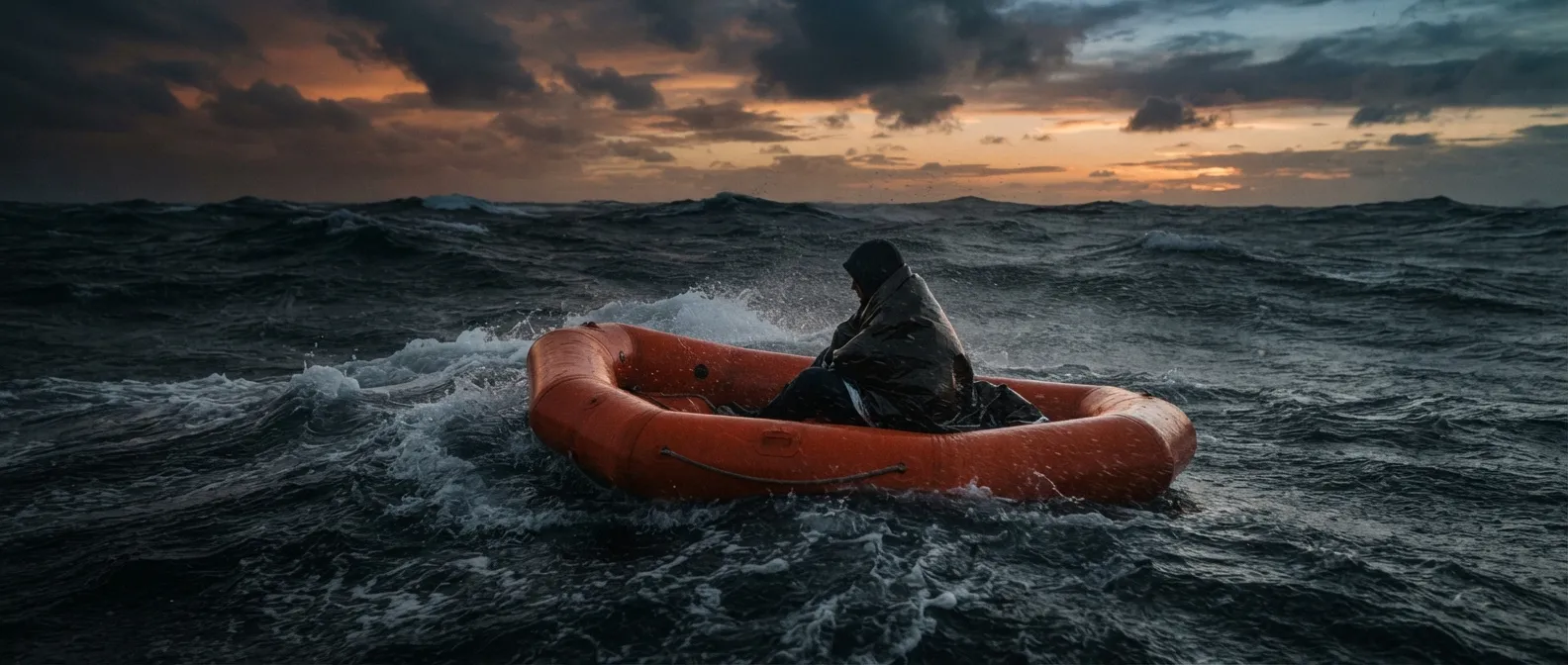
The first hundred seconds: the shock, not the cold
Most people who die falling into cold water don’t die of hypothermia. They drown in the first minute, long before the cold has had time to cool down much of anything. The culprit is the cold shock response: cold water triggers a reflex gasp followed by hyperventilation that can hit 600 to 1,000% of normal breathing. Your ability to hold your breath collapses, dropping from 60–90 seconds in air to just a few seconds in water under 15 degrees. A wave hits right at that moment, and in goes the water.
Canadian physiologist Gordon Giesbrecht popularized an easy rule to remember, the 1-10-1: one minute to get the shock and your breathing under control, ten minutes of useful movement before your hands and legs give out, one hour before hypothermia leads to loss of consciousness. It’s a great mental alarm, with one caveat raised by the National Center for Cold Water Safety: these numbers aren’t hard limits. Loss of motor function can happen in 2 minutes or drag out to 30, depending on your body, clothing, and exact temperature. The real point of 1-10-1 isn’t the timer; it’s the order of priorities: first breathe, then move while you still can, and only then worry about staying warm.
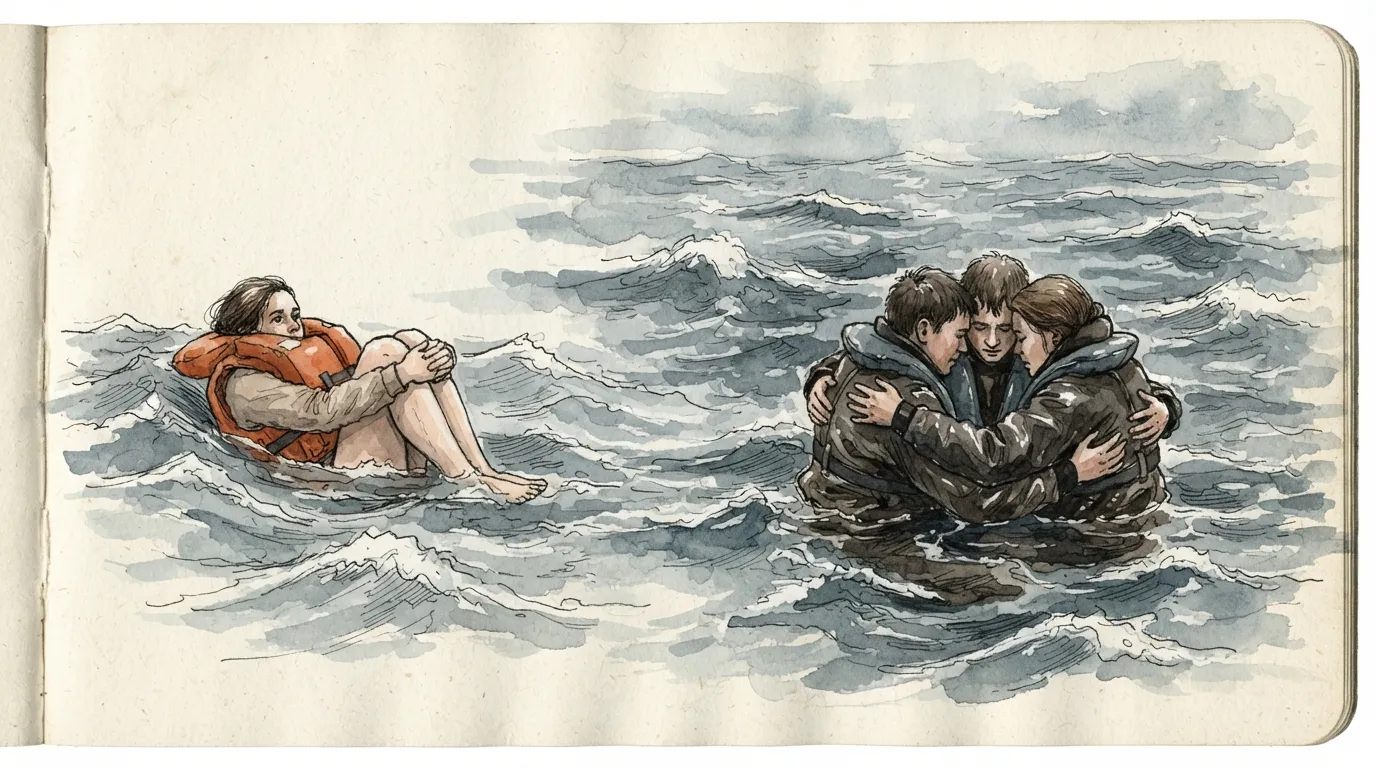
Once that first minute has passed and your breathing is under control, posture is everything. The HELP (Heat Escape Lessening Posture), described by researcher John Hayward in 1973, involves pulling your knees up to your chest, wrapping your arms around your legs, and keeping your torso upright with your head out of the water: it protects the three areas that lose the most heat—the groin, the head and neck, and the sides of the torso under the arms—and can increase survival time by nearly 50%. In a group, form a huddle: press your chests together, wrap your arms around each other’s backs, interlock legs, and place children in the middle. The survival gain can climb up to 40%, and a tight group is far easier to spot from a distance than a single head bobbing between wave crests.
Boarding and organizing the life raft
A SOLAS life raft must withstand thirty days at sea and remain functional even after being dropped into the water from eighteen meters high—those are the standards manufacturers must meet before a raft heads out to sea. But climbing inside is only the beginning: a poorly managed raft will fill with water, capsize, or leak away in an hour supplies meant to last a week.
US survival manuals break down the logic into seven steps, in this order: assess the situation, inventory your gear, shelter, signals, water, food, and—last but not least—keep your mind occupied. Traditional maritime manuals compress this into four words: protection, location, water, food. You can survive weeks without food, barely over a week without drinking, but hypothermia or heatstroke can kill in a matter of hours: protection against cold, wind, and sun comes before everything else, and a signal sent early is worth far more than water saved by delaying it.
- Cut the painter line tethering the raft to the sinking boat if the vessel threatens to drag you down with it.
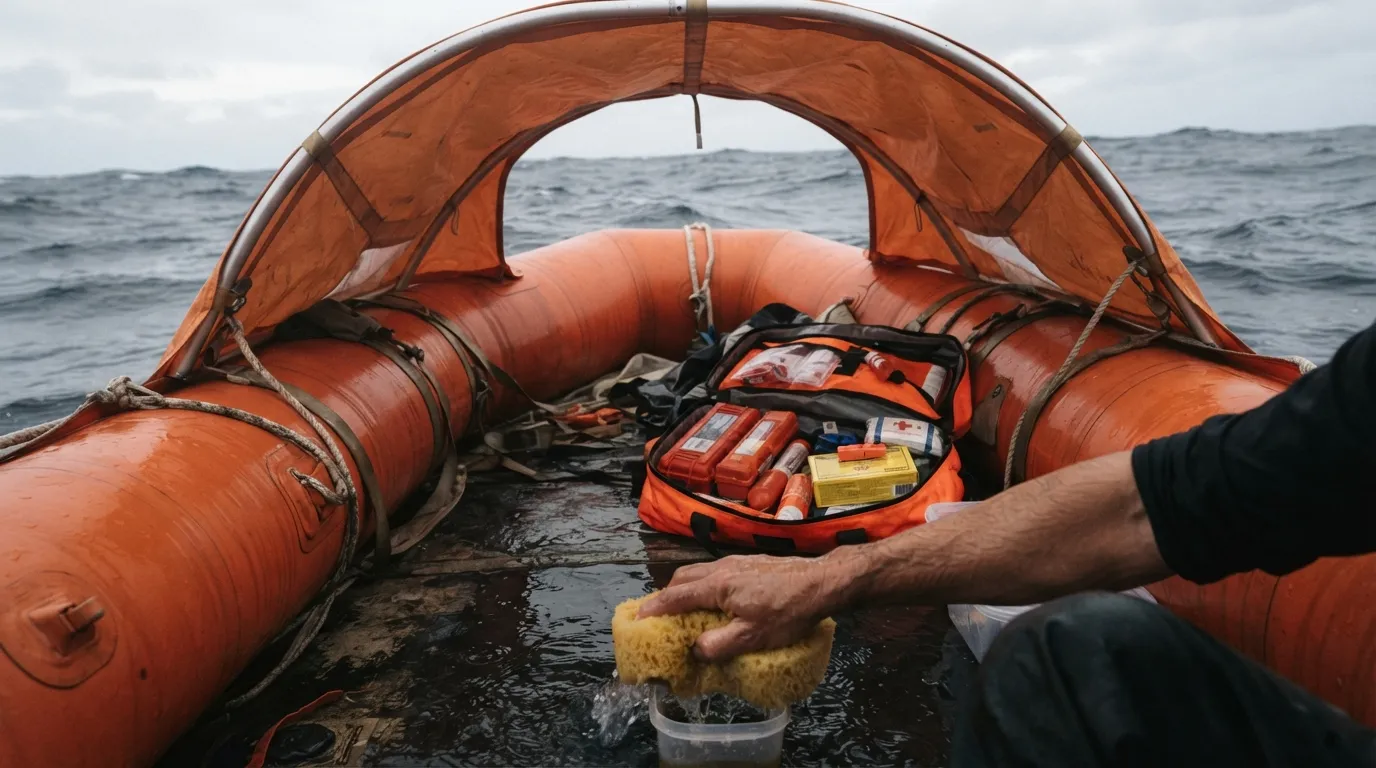
- Erect the canopy (the tent usually inflates automatically): this is your shelter against wind, rain, and sun, long before you even think about drinking.
- Bail out the water that entered during boarding, and inflate the insulating floor if your model has one: seawater beneath your body siphons away heat far faster than air.
- Take inventory of what’s inside the survival kit and whatever else you managed to grab, throwing nothing overboard until you are certain it’s useless.
- Take seasickness pills right away, even if you feel fine: survival manuals stress this, even for seasoned sailors, because vomiting wastes precious body water you don’t yet have a way to replace.
- Right the raft if it deployed upside down: climb onto the underside, use the wind and the capsizing strap near the CO2 cylinder to leverage it back over.
Water: surrounded by ocean, dying of thirst
The ultimate trap of a shipwreck is being surrounded by water you cannot drink.
Reliable water sources, in the order you’ll encounter them at sea:
- Rain. The raft canopy and SOLAS manuals emphasize this: it’s the first system you need to set up, using a tarp or the folds of the canopy to channel rainwater into a container. The first twenty minutes of rainfall wash away salt crust built up on the fabric; only drink this initial rinse as a absolute last resort, or let it run off before collecting the rest.
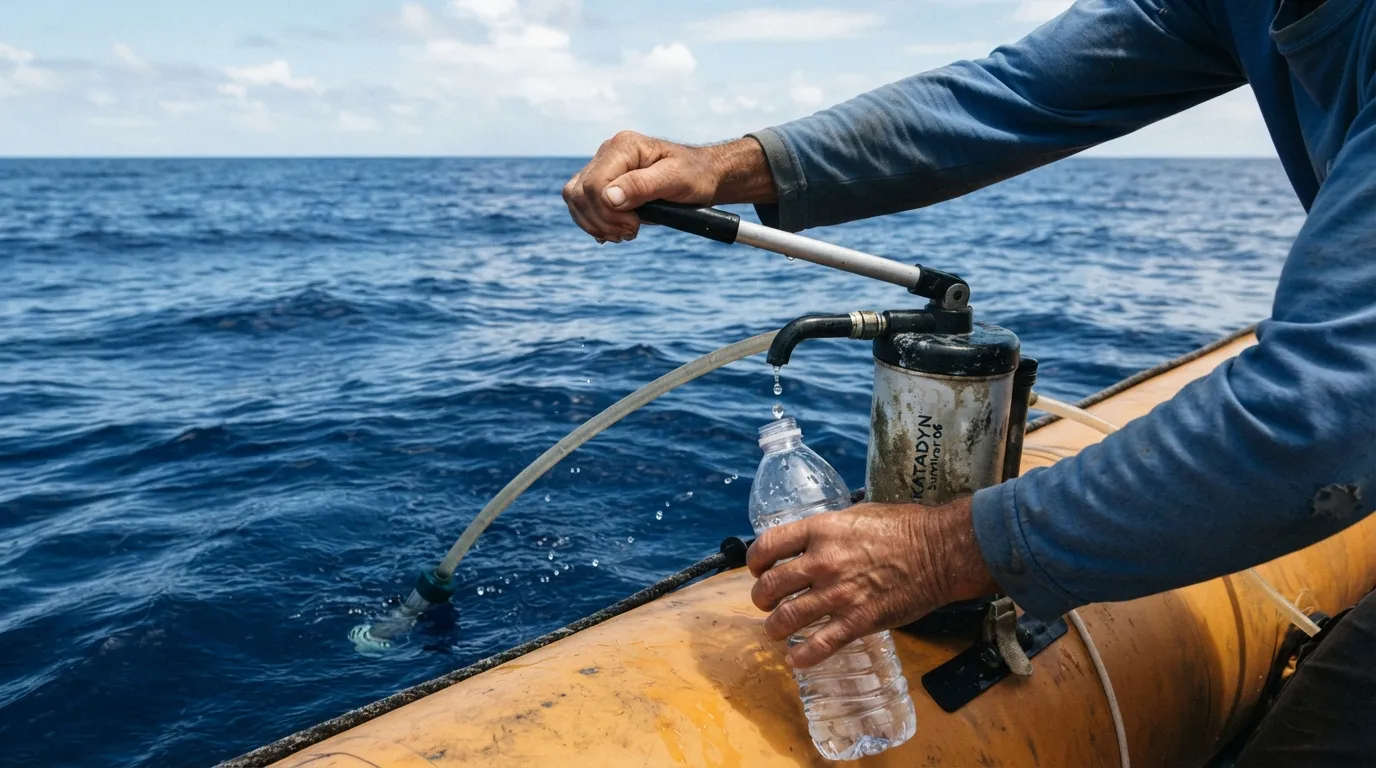
- Manual reverse osmosis desalinator. A hand pump forces seawater through a membrane at around 60 bar of pressure, overcoming the ocean’s natural osmotic pressure. A modern portable unit yields 4 to 6 liters per hour with about 98% salt rejection, requiring 30 to 40 pump strokes per minute—a real physical workout, but one that relies on neither batteries nor sunshine.
- Solar still. A clear, inflatable dome that distills seawater through evaporation and condensation powered by the sun, requiring zero physical effort: yields about 0.5 to 2 liters per day depending on sunlight. The exact opposite trade-off of the manual desalinator—no labor needed, but you need bright sun and patience.
- Dew. Yields are low in the open ocean (0.5 mm per night at best in favorable climates), but wiping down the condensation that beads on the canopy at dawn with a cloth costs nothing and adds to your stash.
- Fish fluids. Alain Bombard, crossing the Atlantic in 1952 on an inflatable boat without provisions, squeezed caught fish with a homemade press to extract their fluid. Thirty years later, Steven Callahan took it further: he drank the fluids pressed from fish spines and bones as an improvised broth, and systematically ate the fish eyes, which are liquid-rich and low in salt. According to a toxicologist quoted by Mental Floss, eyes, fish flesh, seabird meat, and turtle meat do indeed contain little enough salt to help keep you hydrated.
- Plankton. Bombard scooped it up with a net and ate it raw for vitamins. His crossing remains controversial: photos later revealed he received fresh provisions from the freighter Arakaka mid-journey, far beyond the simple “meal and shower” he described in his book. Yet even factoring in that resupply, spending fifty days living largely on fish juice and plankton was a serious proof of concept.
| Rainfall | Manual Desalinator | Solar Still | Fish Fluid | |
|---|---|---|---|---|
| Volume | variable, sometimes abundant | 4-6 L/h | 0.5-2 L/day | a few dozen mL per fish |
| Physical effort | none | high, continuous | none | moderate (pressing, bone crushing) |
| Sun-dependent | no | no | yes | no |
| Reliability | weather dependent | high | medium | high if you catch fish |
Food: catching fish, and watching what you eat
A life raft creates its own micro-ecosystem. Steven Callahan experienced this firsthand: mahi-mahi (dolphinfish), triggerfish, flying fish, and barnacles eventually formed a small habitat that followed him for nearly 3,300 kilometers. Mahi-mahi hunt flying fish by leaping out of the water, which explains why a terrified flying fish will sometimes land right on the raft floor—a free breakfast with zero effort. Aboard the Kon-Tiki, Thor Heyerdahl’s crew ate flying fish, mahi-mahi, tuna, bonito, and shark over 101 days and 6,980 kilometers.
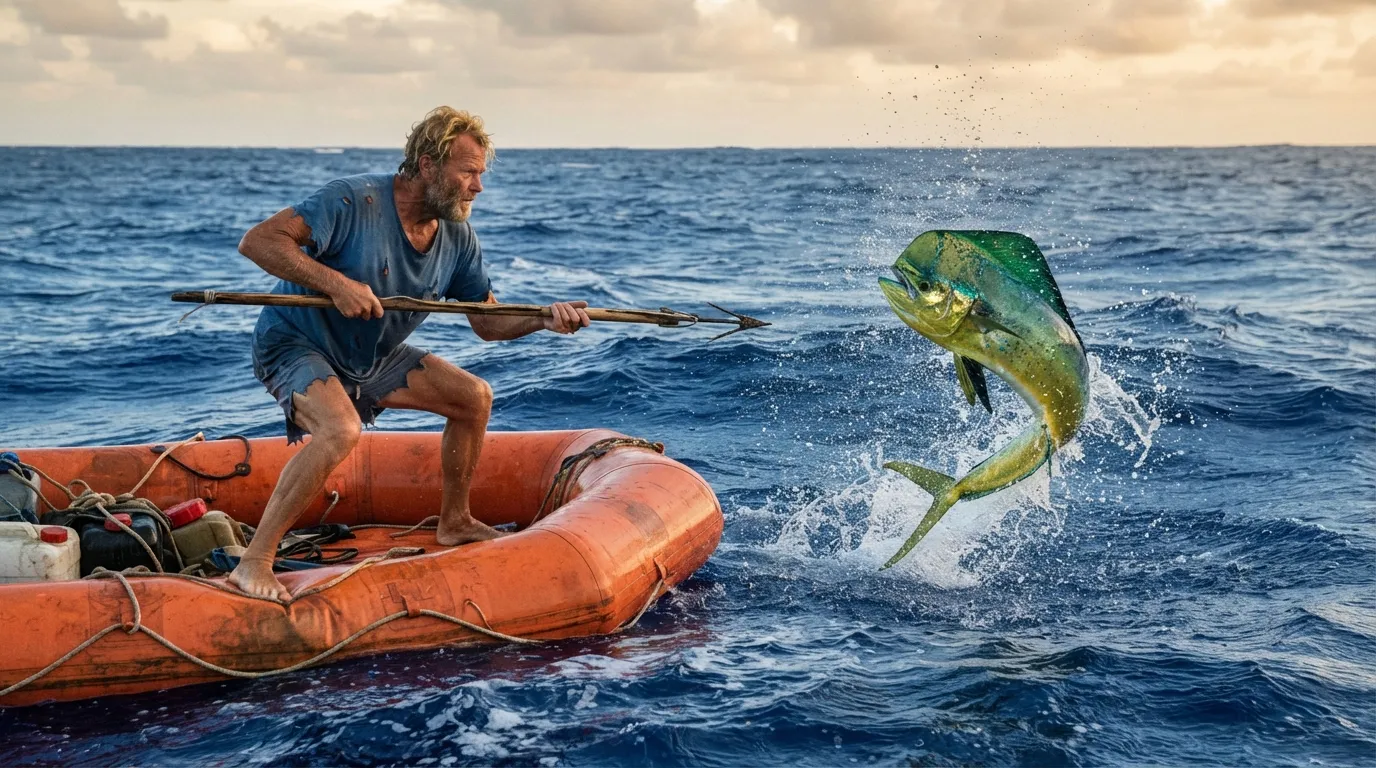
Not everything that bites is safe to eat, though. Ciguatera poisoning mainly affects reef fish (barracuda, grouper, moray eel, amberjack, jacks, parrotfish, surgeonfish, snapper), building up to high levels in their liver, intestines, and roe. Ciguatoxin is colorless, odorless, tasteless, and heat-resistant: cooking won’t neutralize it. Pelagic open-ocean fish (tuna, mahi-mahi) are traditionally considered safer, though health authorities warn this is no longer a 100% guarantee.
Sea turtles and exhausted seabirds landing on your raft offer extra nourishment: the Robertsons, the Baileys, and Alvarenga all relied on them, grabbing them with their bare hands when necessary. Just remember the golden rule: never eat solid protein unless you have enough water to digest it.
Making yourself seen in the expanse
An orange life raft with no active signals is extraordinarily hard to spot on a churning ocean—which is why survival kits come packed with signaling gear.
- Flares: Parachute flares launched high into the air can be seen up to 40 nautical miles (74 km) away at night. Handheld flares and orange smoke canisters used at water level carry only 3 to 5 miles (5.5 to 9 km)—save these for when a vessel or aircraft is already in sight.
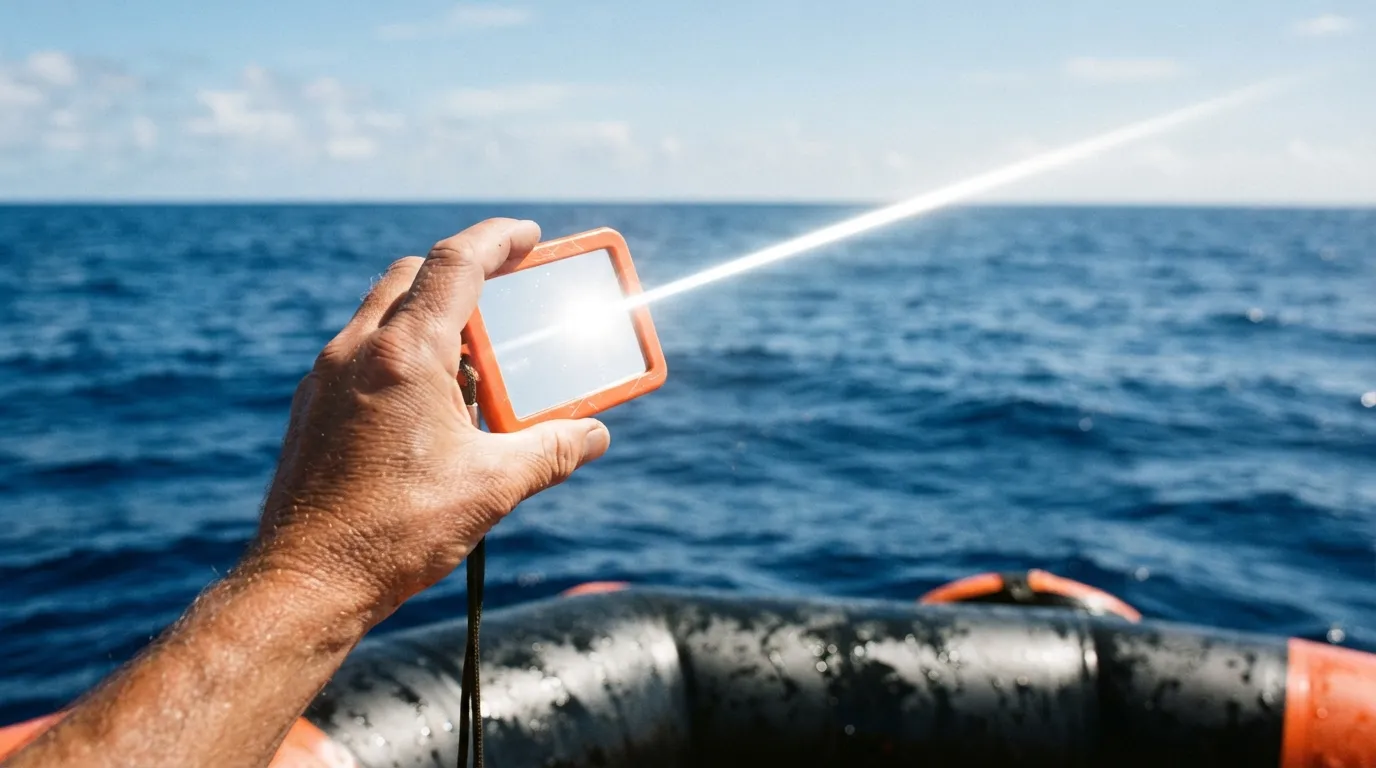
- Signal mirror: In clear weather, a mirror flash can be spotted up to 40 nautical miles away in broad daylight—the longest range of any tool in your kit, and it requires no batteries.
- VHF Radio: Line-of-sight, but highly effective when drifting near busy shipping lanes or coastal waters.
- EPIRB or PLB: Emergency beacons broadcast continuously on 406 MHz, picked up by the international COSPAS-SARSAT satellite network, providing a position accurate to within 100 meters if equipped with GPS. A PLB signals for 24 to 48 hours and its battery lasts ten years; registering it (for free) allows search and rescue to call your emergency contact to rule out false alarms before scrambling a helicopter.
- Sea dye marker: A pouch of fluorescent dye dropped in the water spreads into a neon slick easily spotted from aircraft long after the raft’s silhouette blends into the waves.
- Radar reflector: A simple arrangement of metal corner plates (usually an octahedron) bounces radar pulses straight back to their source. Without one, a small inflatable raft reflects virtually no radar energy—making you completely invisible on the radar screen of a cargo ship passing just a few hundred meters away.
Sharks, salt, sun, and night: physical toll
Shark attacks on shipwreck survivors are rare: most encounters consist of curious passes rather than outright aggression. But blood in the water changes everything. World War II accounts describe sharks acting cautiously around rafts at first, then growing increasingly aggressive as blood from wounded survivors spilled into the ocean—a behavioral shift military observers dubbed “hunger-lust.” Steven Callahan had to push off sharks scraping against the thin bottom of his raft, drawn by the blood of the fish he caught.
Salt works on you silently: clothes soaked in seawater rubbing against skin cause painful, open sores known as “salt boils.” The fix is straightforward on paper, difficult in practice: rinse with freshwater whenever you have spare, keep affected areas dry, and never wrap bandages so tightly that they restrict circulation.
The sun attacks from two angles: directly from above, and reflected off the water and salt crusting on your skin. Rigging the canopy shade comes ahead of finding water in survival manual priorities—if your raft lacks a roof, improvise one using spare clothes or a recovered sail rather than staying exposed for hours.
Night brings cold—air temperatures drop faster than water—and takes away your vision. Set up a strict watch rotation, one person at a time, rather than letting everyone sleep at once with nobody monitoring the horizon or checking for air leaks.
The mental edge: how survivors held on
The longest survival stories all share one lesson: routine beats despair. Steven Callahan (76 days, Atlantic, 1982) wrote that “giving up hope was giving up life.” He forced himself into daily routines—fishing, repairing equipment, navigating, keeping a logbook—so no day was left empty. José Salvador Alvarenga (438 days, Pacific, 2012–2014) nearly gave up: after his young crewmate died, he contemplated suicide for four days before pulling back, sustained by his faith. Poon Lim (133 days, Atlantic, 1942–1943) focused on concrete, achievable goals—a new hook, a line, a measure of rainwater—rather than dwelling on the total length of his ordeal.
The Robertson family (38 days, Pacific, 1972) lost their sailboat Lucette when it was rammed and sunk by killer whales. When their inflatable raft became unusable sixteen days later, all six crowded into a tiny three-meter dinghy. Maurice and Maralyn Bailey (117–118 days, Pacific, 1973), cast adrift after a whale struck their hull, fashioned safety pins into fishhooks when their gear wore out—Maurice later credited his wife with giving him the mental fortitude to keep going day after day. And the crew of the Kon-Tiki (101 days, Pacific, 1947), who set sail voluntarily to prove an ancient navigation theory, showed that choosing your journey changes everything—mental preparation alters how you handle drift.
The common thread: nobody passively “waited.” Every survivor kept their hands and minds busy, set manageable daily tasks, and refused to let counting remaining days consume their thoughts.
Getting back: currents, surf, man overboard, capsized kayak
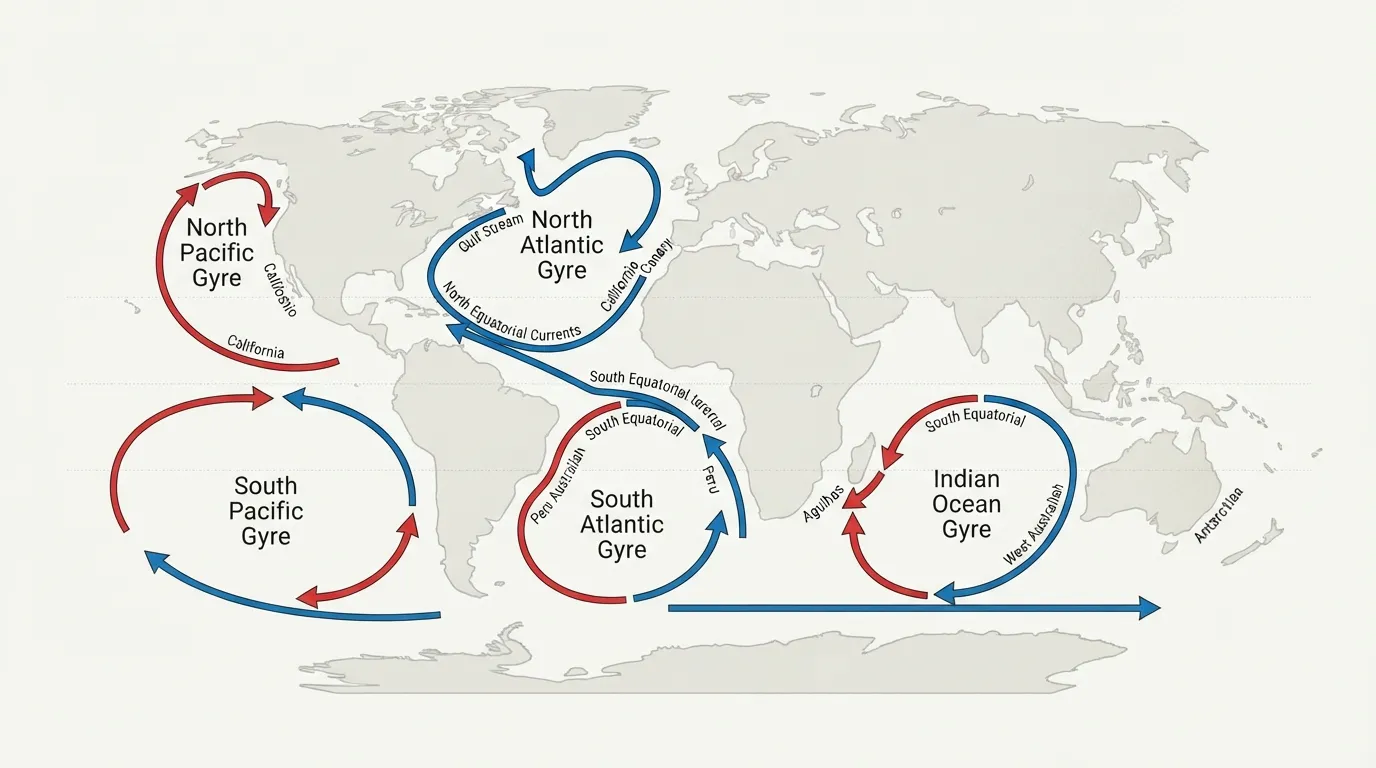
Castaways rarely pick their direction, but understanding where currents are taking you shapes your decisions on board. Great ocean currents form massive gyres—giant loops driven by prevailing winds and deflected by the Coriolis effect, rotating clockwise in the Northern Hemisphere and counterclockwise in the Southern. In the age of sail, mariners used these routes strategically: riding the Gulf Stream rather than fighting it made the difference between a swift passage and a dead end. A castaway who knows their general position and local gyre understands what coastline they are drifting toward, saving energy instead of paddling against a current faster than they can stroke.
The most dangerous phase of a drift is rarely the open ocean—it’s approaching land. Waves breaking near the shore hide rip currents: narrow channels of water rushing back out to sea faster than even strong swimmers can fight head-on. The life-saving maneuver is not swimming against the flow, but swimming parallel to the beach until you exit the rip, then heading obliquely back to sand. If you cannot swim, float: the current will naturally weaken once it clears the surf zone. Identify a rip current by looking for gaps in the breaking waves, churned foam or debris floating seaward, or discolored water.
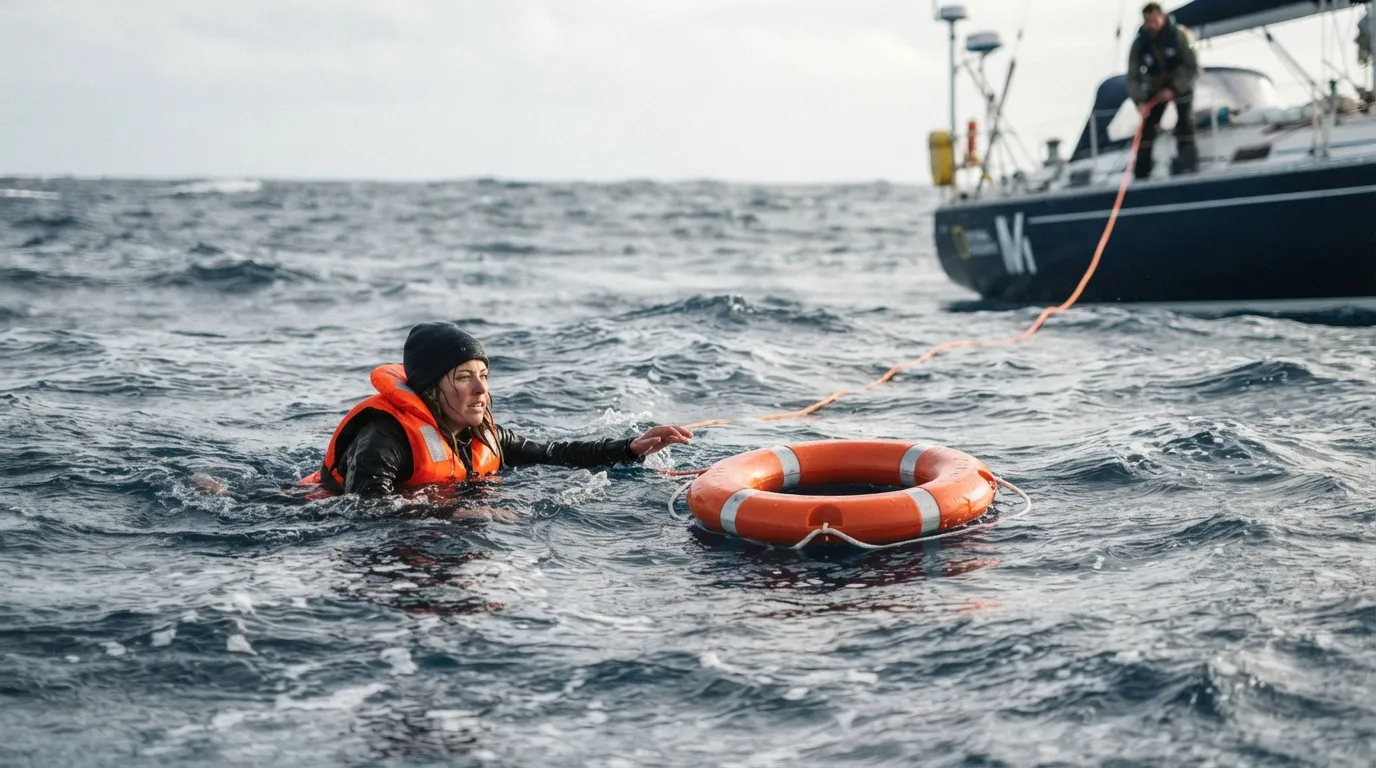
A man overboard incident demands a crisp, practiced response: yell immediately to alert the crew, designate one person to point directly at the victim without ever taking their eyes off them, throw all available flotation gear (horseshoe buoy, life jacket), mark the GPS location, and maneuver the vessel to return—sailors use techniques like the “quick stop” (tacking without touching the foresheet) or broader turnbacks. For the person in the water: a worn life jacket dramatically increases survival odds, a attached whistle carries far better than a human voice, and reflective SOLAS tape catches a searchlight beam long after dark.
A capsized kayak or paddleboard far from shore follows the same physics as falling off a ship: controlling cold shock and your breathing comes before anything else. Stay with your craft—it floats, it’s visible, and remounting it is almost always faster than swimming to shore. Self-rescue techniques (cowboy scramble, Eskimo roll, paddle-float re-entry) exist to minimize time spent in the water: in cold conditions, the ten-minute motor control window of the 1-10-1 rule applies to kayakers just as it does to open-sea castaways.
Frequently asked questions
Can you drink small amounts of seawater to survive?
No. Your kidneys cannot produce urine saltier than seawater itself, so every sip forces your body to draw from its freshwater reserves to flush out the extra salt. Even famous survivors who consumed seawater, like Alain Bombard, did so in tiny amounts alongside other fluid sources—never as a primary survival strategy.
How long can you survive in cold water?
It depends heavily on water temperature and your clothing, but the 1-10-1 rule offers a solid benchmark: about one minute to overcome cold shock, ten minutes of functional movement, and up to one hour before hypothermia causes loss of consciousness. These aren’t rigid limits, but a framework for prioritizing actions.
Should you swim for shore after a shipwreck?
Only if land is clearly close and safe to reach. In almost all other scenarios, staying with the raft or wreckage conserves energy, keeps your core protected from the cold, and makes you far easier for rescue teams to locate—a raft is much larger and more visible than a head bobbing in waves.
How can you tell if a caught ocean fish is safe to eat?
There are no visual cues to detect ciguatera: the toxin is colorless, odorless, tasteless, and unaffected by cooking. Play it safe by avoiding large reef predators (barracuda, grouper, moray eel) and never eat the liver, viscera, or roe, where toxins accumulate. If a fish inflates into a ball, do not eat it—it’s a pufferfish, which carries lethal doses of tetrodotoxin.
Do sharks frequently attack castaways?
It happens far less often than popular culture suggests: most shark encounters are curious passes rather than predatory strikes. However, risk escalates dramatically when blood enters the water—whether from gutting fish over the side or open wounds—which accounts for the aggressive feeding frenzies documented during WWII shipwrecks.
Is a life raft easily spotted by ships or aircraft?
No, and that is a major hazard: an unlit, passive raft easily disappears between swell crests. That’s why signaling equipment (mirrors, flares, radar reflectors, EPIRBs) is vital: a properly used signal mirror can be spotted up to 40 nautical miles away on a clear day—far beyond the visible range of the raft itself.
Key takeaways
- Manage your first minute in cold water by controlling your breathing, not by swimming hard: cold shock kills long before hypothermia sets in.
- Inside the raft, prioritize protection, signals, water, then food—never reverse this order, and never drink seawater, no matter how thirsty you are.
- Rain, manual desalinators, solar stills, and fish fluids are legitimate water sources; plankton and fish flesh add nourishment, but don’t replace freshwater needs.
- An unassisted life raft is virtually invisible: use your mirror, flares, radar reflector, and emergency beacon because the ocean swallows small shapes.
- Survivors who made it 76, 117, or 438 days relied on routine, focused on practical daily tasks, and refused to sit passively counting the days.
Further reading
- Alain Bombard, The Voyage of the Heretique (1953) — the foundational text, controversies included, on surviving off ocean resources.
- Steven Callahan, Adrift: Seventy-six Days Lost at Sea (1986) — the definitive, highly detailed account of day-to-day survival in an inflatable raft.
- Dougal Robertson, Survive the Savage Sea (1973) and Sea Survival: A Manual (1975) — the survival story followed by the practical manual it inspired.
- AMSEA, Life Raft Survival — a concise, practical breakdown of the seven steps for life raft survival.
Sources for this module (30)
- Wikipedia — Cold shock response
- Wikipedia — Heat escape lessening position
- National Center for Cold Water Safety — The 1-10-1 Myth
- AMSEA — Life Raft Survival
- Mariners Learning System — Survival at Sea: How to Survive Your First Day in a Life Raft
- NOAA Ocean Service — Can humans drink seawater?
- Mental Floss — What Would Actually Happen If You Drank Saltwater?
- Wikipedia — Alain Bombard
- Wikipedia — Steven Callahan
- Yankee Magazine — Lost at Sea (Steven Callahan)
- Wikipedia — Adrift: Seventy-six Days Lost at Sea
- Wikipedia — Dougal Robertson
- Wikipedia — José Salvador Alvarenga
- Wikipedia — Poon Lim
- Wikipedia — Maurice and Maralyn Bailey
- Wikipedia — Kon-Tiki expedition
- Wikipedia — Life raft
- Wikipedia — Emergency position-indicating radiobeacon station
- Wikipedia — Radar reflector
- Wikipedia — Man overboard
- Wikipedia — Rip current
- Wikipedia — Ocean current
- QuenchSea — Manual Seawater Desalination: Survival Hydration Guide
- CDC — Fish poisoning: ciguatera and scombroid
- StatPearls / NCBI — Tetrodotoxin Toxicity
- My Medic — Survival Situations: Ocean
- Wikipedia — Personal flotation device
- Wikipedia — Immersion suit
- Wikipedia — Seasickness
- Wikipedia — Dew
Continue in "By environment"

The temperate forest
The most generous environment in the world can also swallow you in ten minutes: here is how to read it instead of fearing it.

Mountains: Where the Weather Decides for You
The weather changes in thirty minutes, altitude works against you, the terrain is unforgiving: the signs to read before it's too late.
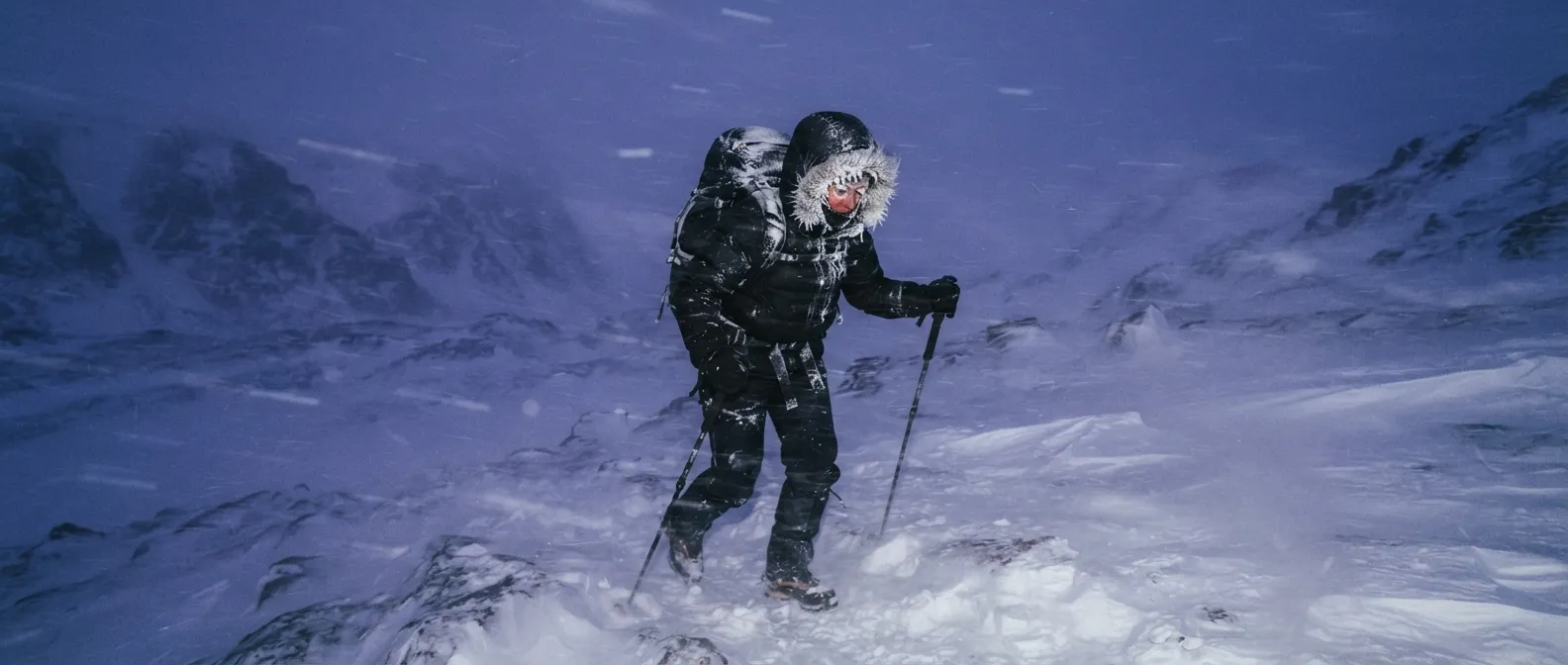
Snow, extreme cold, and the Far North: surviving at minus 30
Cold doesn't kill you: humidity, exhaustion, and panic do. What you need to know to stay alive below zero.