Rivers, lakes and whitewater
A river can guide you back to civilization or drown you in thirty seconds: it all depends on whether you know how to read it before stepping foot in it.
It’s 3:00 PM, you’ve been following the river for two hours because the trail disappeared under a rockslide, and ahead of you the water closes in between two canyon walls. You hear the roar of a rapid further down, and you don’t know if a hundred meters downstream it widens or gets even narrower. Following the river seemed like the easiest option an hour ago. That might be true. It’s also what drowned people who thought the exact same thing.
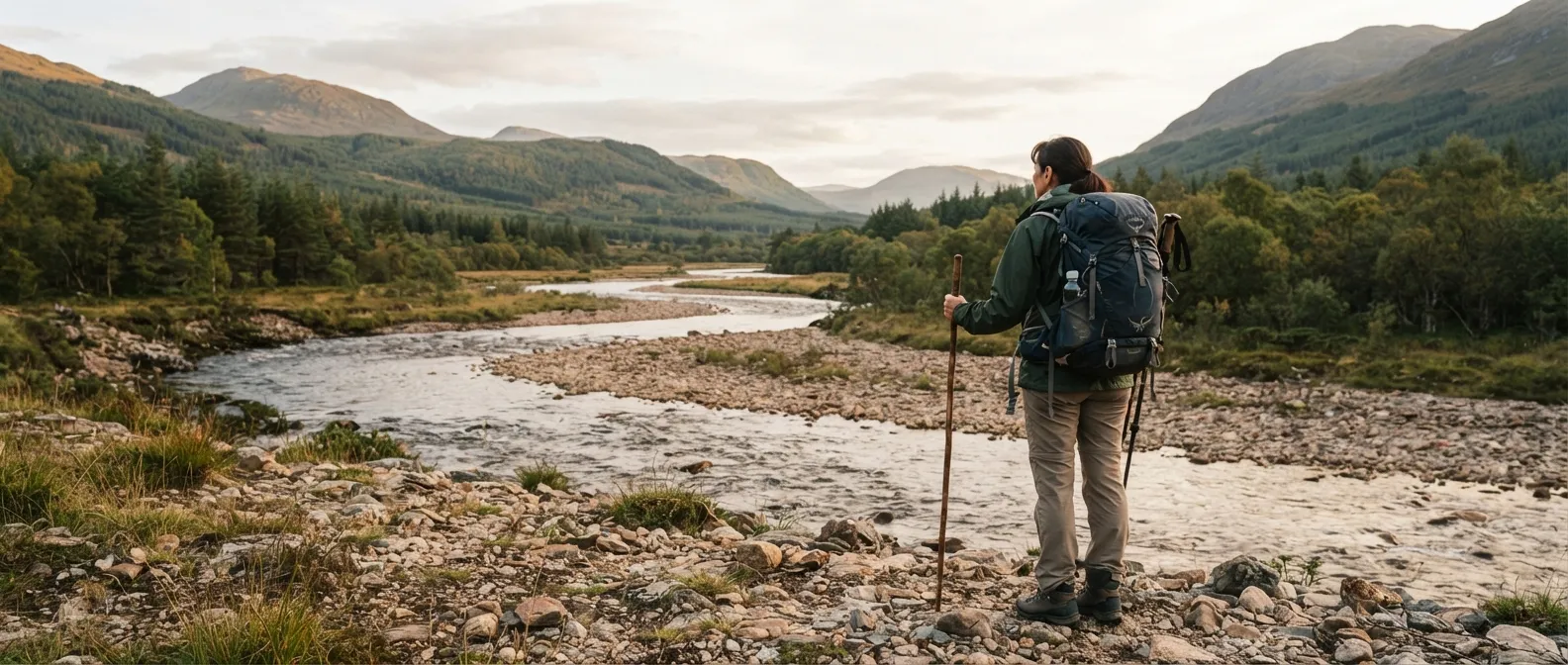
The river: the highway that can get you lost
When you’re lost, a river is the most tempting resource: it always flows downstream, it almost always leads to civilization, and it carves the landscape clearly enough that you won’t lose your way again. Following water down is the most quoted rule in survival—and nine times out of ten, it works.
The tenth time, it puts your life on the line. A descending river can lead you to a town just as easily as it can trap you in vertical gorges with no bank left to walk on, or in a swamp where every step sinks deeper. Before committing to follow a waterway long-term, check a map if you have one. If you don’t, listen closely: a continuously growing roar of rapids means a narrow canyon, not just another rapid. The right move, documented in military survival manuals, is to stay high on the bank as long as possible rather than walking in the riverbed, and to turn back as soon as the banks vanish on both sides.
Choosing and crossing a ford
Never pick a ford at the narrowest point. Pick it at the widest spot, because a widening riverbed almost always means the water flattens out and slows down at the same time—the same amount of water spread over more width flows slower and shallower. A rapid or waterfall just downstream from your crossing point changes everything: if you lose your balance, that’s where you’ll end up. Never cross right above a rapid.
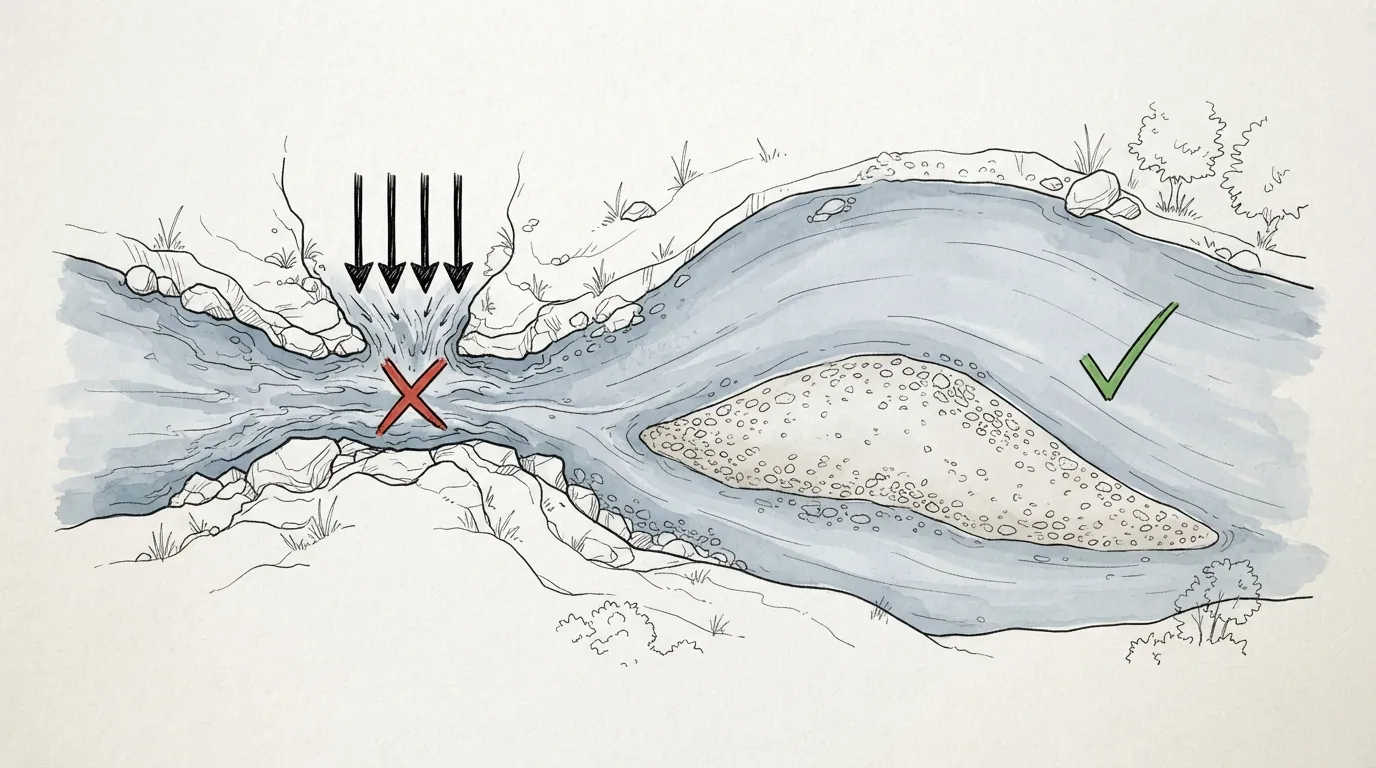
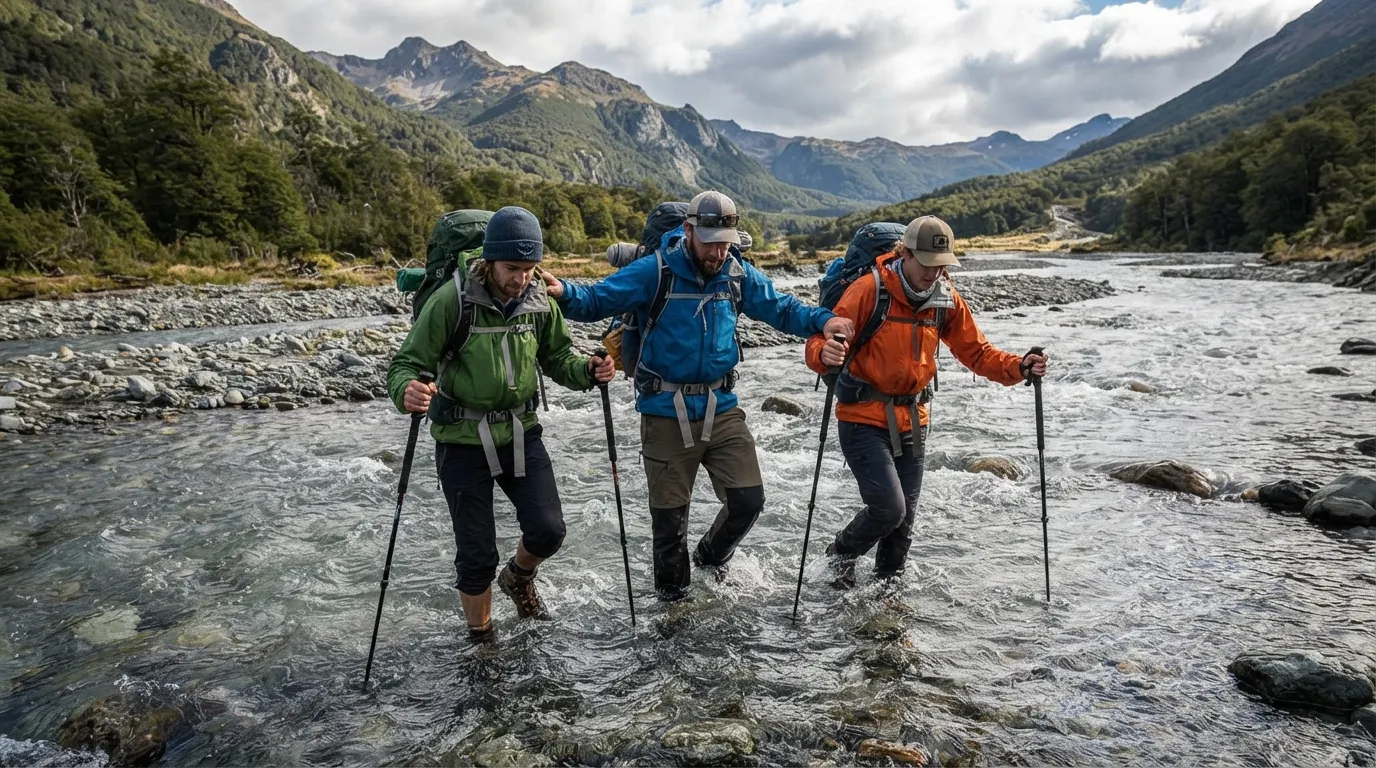
The US Forest Service, which manages most mountain trails in the United States, sums up the technique in a few precise steps, each with a clear purpose:
- Assess the area before stepping into the water. Avoid deep and/or fast water, and check where you’d wash up if you fell—a logjam or rapid downstream changes your whole plan.
- Unbuckle your backpack’s hip belt. A pack that pins you underwater if you fall is more dangerous than anything inside it; you must be able to ditch it in a second.
- Keep your shoes on. Barefoot, you can’t feel where you’re stepping and risk getting cut on sharp rocks or submerged glass.
- Plant a pole upstream, facing the current. The pole creates a stable third point of contact; always move while keeping two points planted, never moving all three at once.
- In a group, huddle in a triangle or line, shoulder to shoulder, with the sturdiest person upstream to break the current for the others.
- Never tie yourself with a rope around your waist. A taut rope across the current becomes a trap itself if you lose your balance: the Forest Service explicitly advises against it.
Falling into swiftwater: the life-saving position
If the current sweeps you away, the golden rule has a technical name and a physical reason: never try to stand up in strong current. Getting a foot trapped between two rocks under the force of the current folding you downstream is a deadly trap known as foot entrapment—your body is held underwater by the sheer water pressure, without any rock actually catching hold of you.
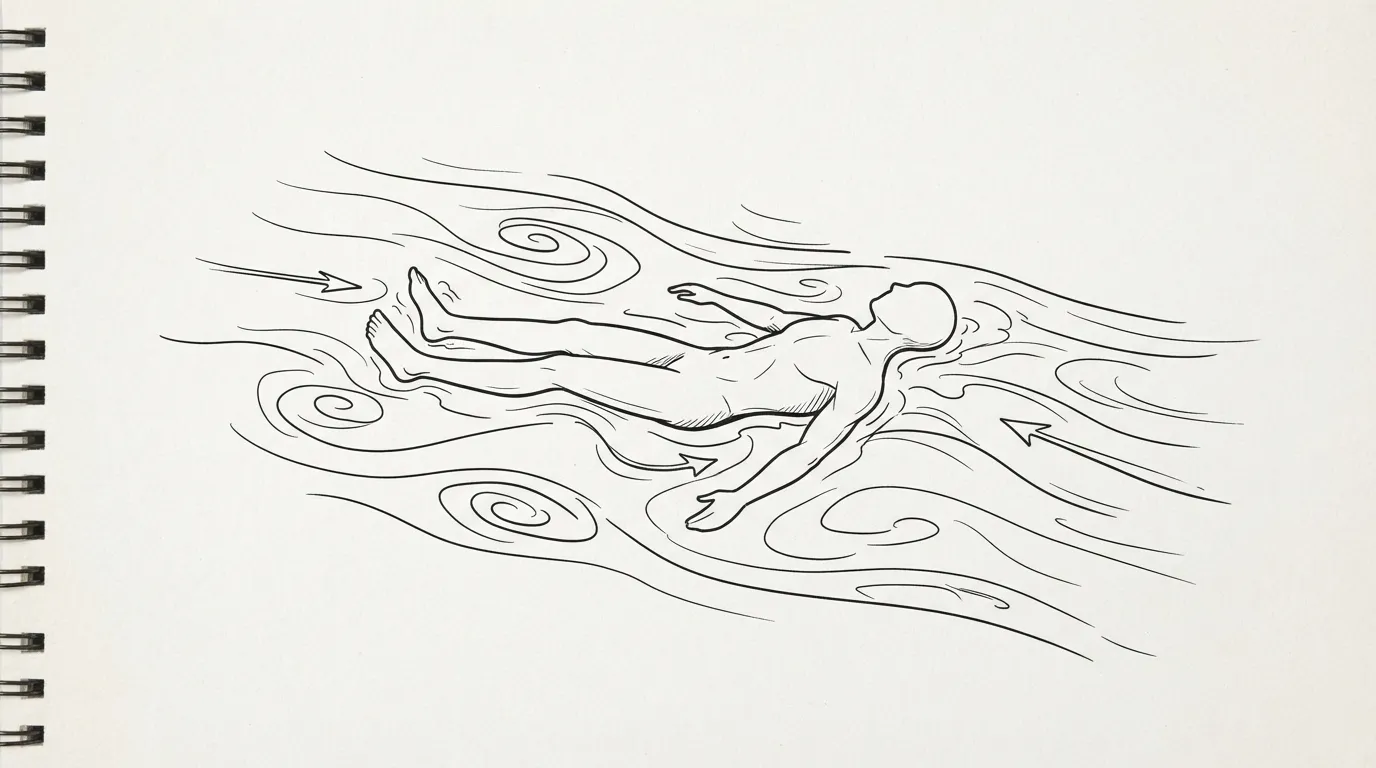
Once in this position, your only goal is swimming diagonally, never straight across: reach the bank by letting the current carry you downstream rather than fighting it head-on.
Two hazards make swiftwater truly fatal, and neither is always obvious from the shore:
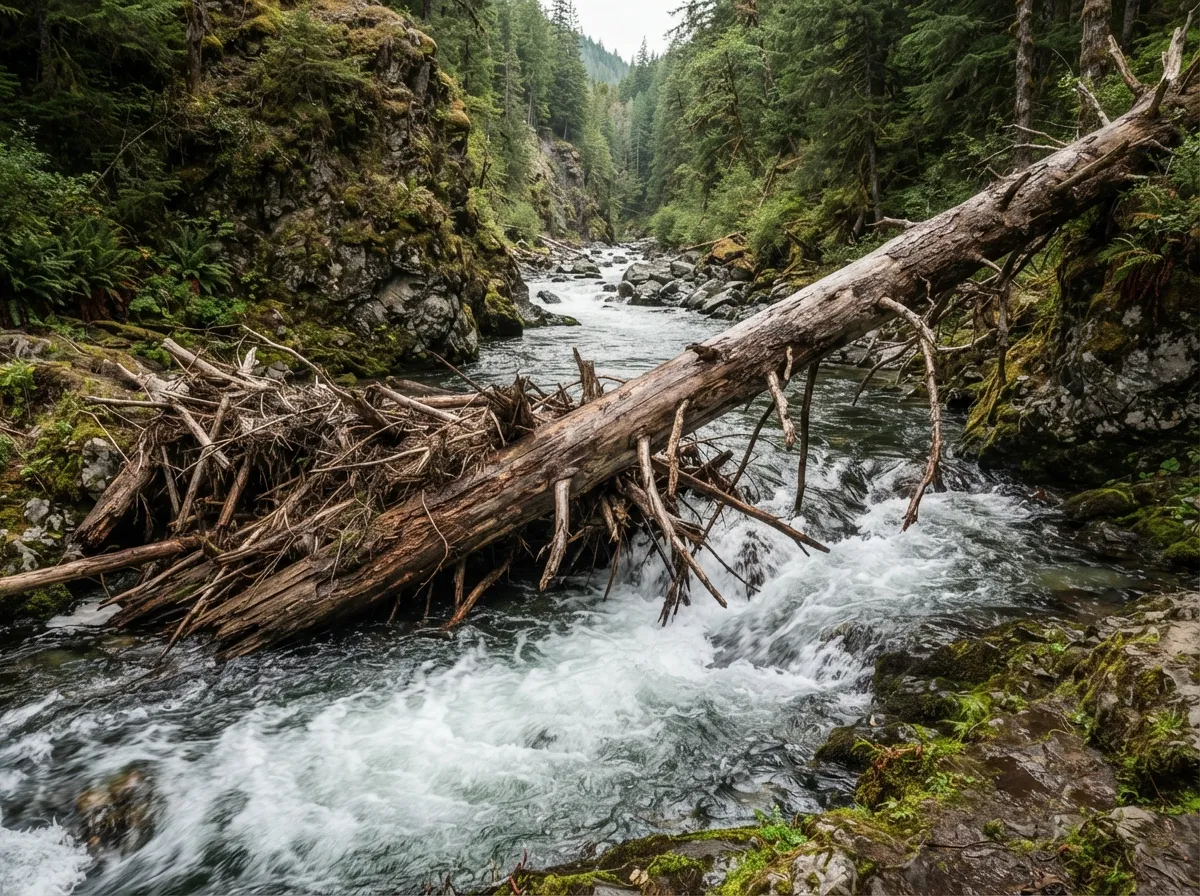
- Strainers and logjams. A fallen tree across the current lets water pass through but catches anything larger—including a person, who gets pinned against the branches by the pressure of the entire river. They are the silent killers of forested rivers: from the surface, they look no different than a harmless log until you’re right on them.
- Weirs and low-head dams. Seen from above, they look harmless—a small drop of water. Below them, the falling water creates a recirculating hydraulic feature that continuously rolls back on itself: anything that falls in stays trapped, pulled down to the bottom and brought back up without ever being released downstream. North American paddlers bluntly call them “drowning machines.”
Flash floods
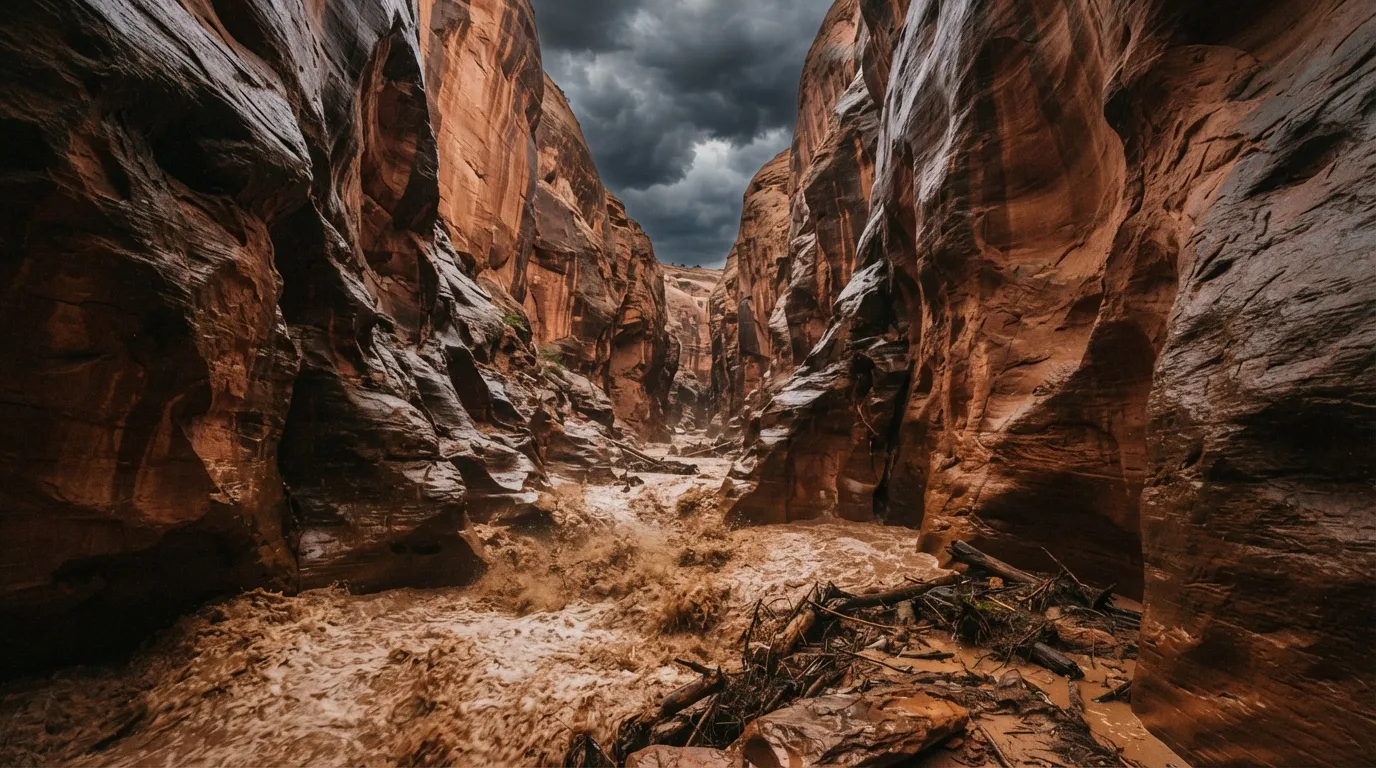
A flash flood doesn’t require rain right where you’re standing. A thunderstorm miles upstream, over a plateau you can’t even see, can send a wall of water surging into the canyon you’re walking through, raising water levels in minutes instead of hours. In 2015, a sudden storm claimed the lives of seven people in the canyons of Zion National Park, even while the sky directly above them remained clear.
Warning signs to watch for: water suddenly turning muddy, a deep growing rumble echoing down the canyon before the water even rises, debris or foam appearing in the flow, and of course visible storms or thunder upstream. The official slogan from US safety agencies, reinforced after every deadly season, comes down to four words: “Turn Around, Don’t Drown.” In narrow slot canyons, canyoning guides use an even stricter rule: never enter if storms are forecasted anywhere in the watershed, and always locate emergency escape routes before descending.
The story of Aron Ralston—trapped for five days with his arm pinned under a 800 lb (360 kg) boulder in a remote Utah canyon in 2003—wasn’t caused by a flash flood, but stems from the same isolation: nobody knew where he was. He ended up amputating his own forearm to survive. The lesson he shares in every talk since has become a core hiking safety rule: always tell someone where you’re going and when you expect to be back.
Drinking and fishing in rivers
Drinking water
River water that looks crystal clear isn’t automatically safe to drink: it just hasn’t shown you what’s in it yet. The main threat is Giardia, a parasite spread through fecal-oral transmission via water contaminated by upstream animal or human waste—including beavers, earning it the nickname “beaver fever.” Symptoms (sulfury diarrhea, bloating, fatigue) show up one to three weeks after ingestion, making it easy to miss the connection to the water you drank weeks ago. Boiling water for one minute is enough to kill the cysts; standard chlorine tablets don’t always cut it, unlike iodine or fine mechanical filters.
On a lake, the strategy shifts slightly: collect water from the surface, far from the shore and stagnant or scum-covered areas—the water there is better oxygenated and holds less decaying matter than shallow banks where animals wade. That doesn’t make it drinkable without treatment, just cleaner water to purify.
Fishing without a rod
A river can feed you without fishing tackle if you know where to look. The oldest techniques rely on waiting rather than active hunting: a trotline with multiple hooks left overnight, tied to a flexible branch that absorbs sudden tugs, is checked in the morning. A woven fish trap placed at a narrow gap or against a small stone weir built across a shallow channel catches fish moving up or down stream. In parts of the United States, an extreme but well-documented technique goes a step further: noodling, which involves sliding your hand into underwater bank holes where catfish hide, grabbing them bare-handed when they bite down on your arm instead of swimming away.
Rafts and lakes: standing water
Impromptu rafts: a dangerous illusion
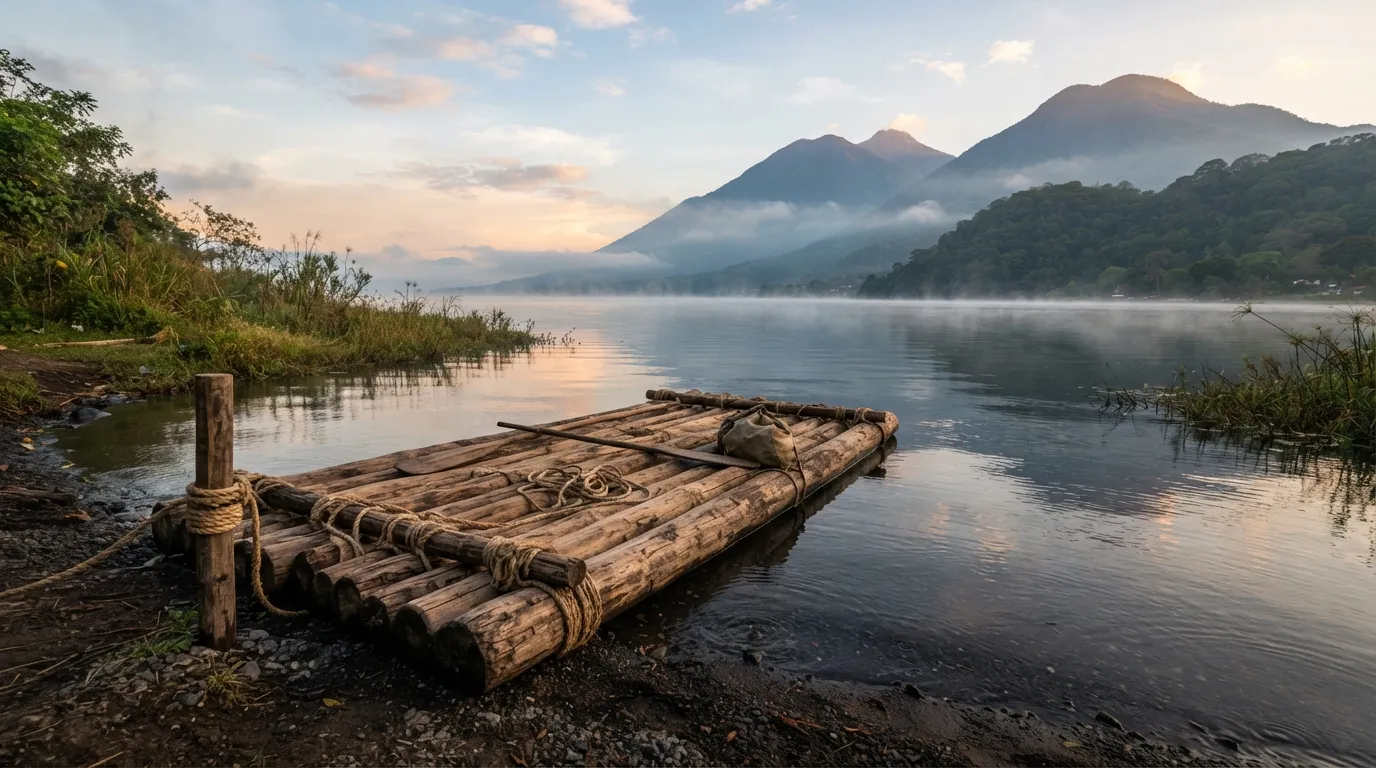
On paper, a raft seems like the obvious way to cross water you can’t ford: a few logs or sealed drums tied together offer plenty of buoyancy. Historically, that’s exactly what river log drivers did, riding floating timber down entire river systems well into the 20th century. The problem isn’t staying afloat—it’s steering. An improvised raft has no rudder and zero ability to dodge a logjam or a rapid. In moving water, it turns into an uncontrollable hazard, just as dangerous for the rider as for whatever it hits. On a completely calm lake or dead-water river stretch, however, it can be your best bet when the swimming distance is too far.
| On foot (ford) | Improvised raft | |
|---|---|---|
| Moving water, swift current | Proven, established technique | Uncontrollable — avoid |
| Calm lake or slow channel, too wide to swim | Impossible | The only time it's worth it |
| Prep time | None | 1 to 3 hours building and testing |
| If it fails | You get wet, you back off | You sink with all your gear |
Lakes: a cold trap
A lake doesn’t sweep you away like a river, but it kills in a different way: cold and wind. Lake water often stays significantly colder than the surrounding air, and sudden immersion triggers cold shock response—a reaction hitting within seconds, causing uncontrollable gasping and hyperventilation that sharply increases the risk of inhaling water before fatigue or hypothermia even set in. In French, this has been called “hydrocution” since the 1950s; modern medicine prefers the term cold water immersion shock, but the practical danger remains the same: plunging into cold water after physical exertion without acclimating first.
A capsized kayak far from shore on a large lake turns a minor mistake into a race against cold: you have to drain the craft, climb back in, or swim for shore before the cold steals the strength in your arms. The real question to ask yourself before crossing a lake isn’t just “can I swim this distance?” but “if I end up in the water halfway across, will I still be able to warm up and sleep tonight?”—that second question is usually the one that matters.
Beavers and river wildlife
Beavers: engineers and changemakers
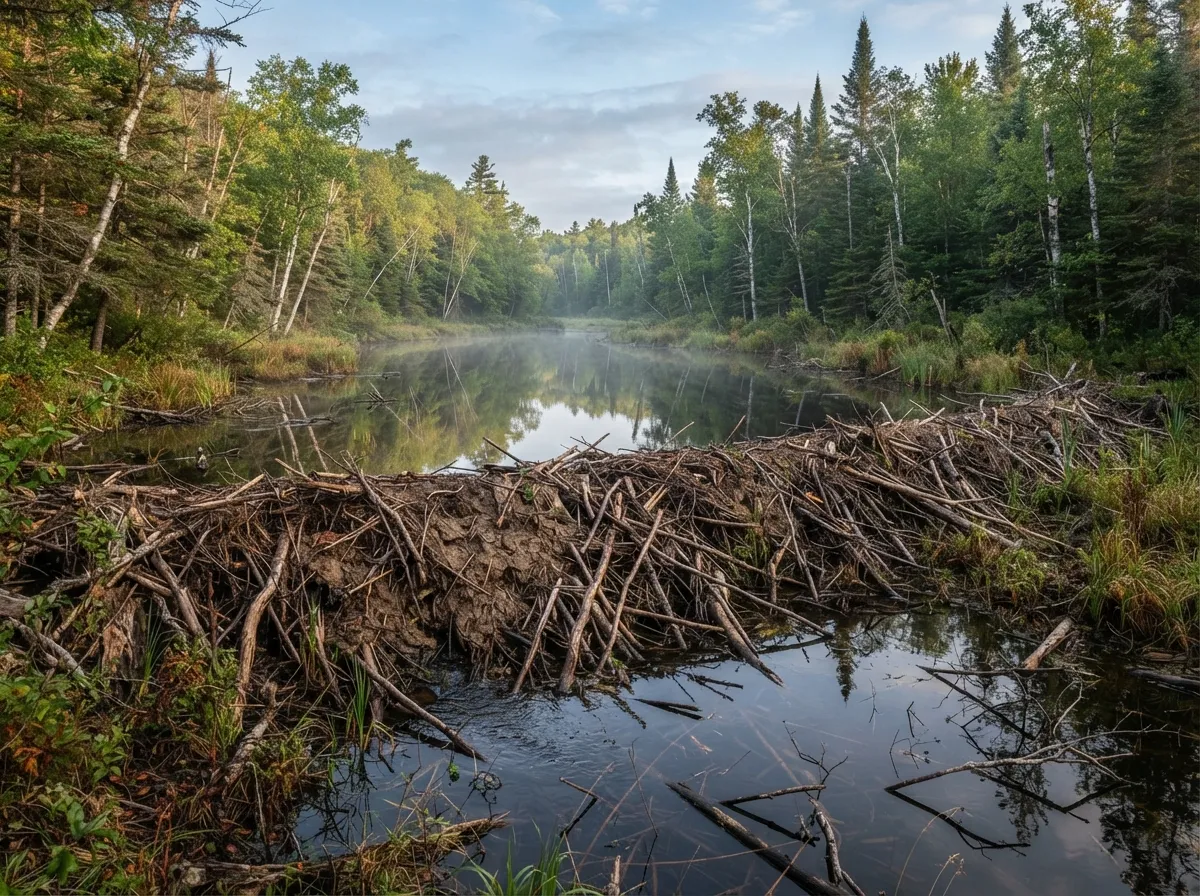
A beaver dam isn’t just a pile of sticks: the animal first diverts the current to reduce pressure, drives branches into the bed to build a foundation, then piles up wood, mud, and stones until it forms a structure built to last for years. Some dams stretch over a hundred meters; the largest ever recorded, in Canada, spans 775 meters. For a hiker, it’s a double-edged sword: the pond created upstream can submerge a path that was dry the week before, but that same pond filters water, slows down floods, and creates a refuge for wildlife you won’t find along an open river.
Leeches and mosquitoes
Freshwater leeches thrive in shallow, vegetated spots in ponds, lakes, and slow rivers—they avoid swift current. Once attached by its two suckers, a leech will drop off on its own when full; simply detach it with your fingers—don’t use salt or flames, which only stress the parasite and increase the risk of it regurgitating into the bite wound. The real danger isn’t the minor blood loss, but potential secondary bacterial infection.
Mosquitoes breed in stagnant water along shallow banks and nearby rain pools: in areas where malaria is present, bite risks spike dramatically at dusk and overnight—the exact time you’re set up near water at camp.
Hippos and crocodiles
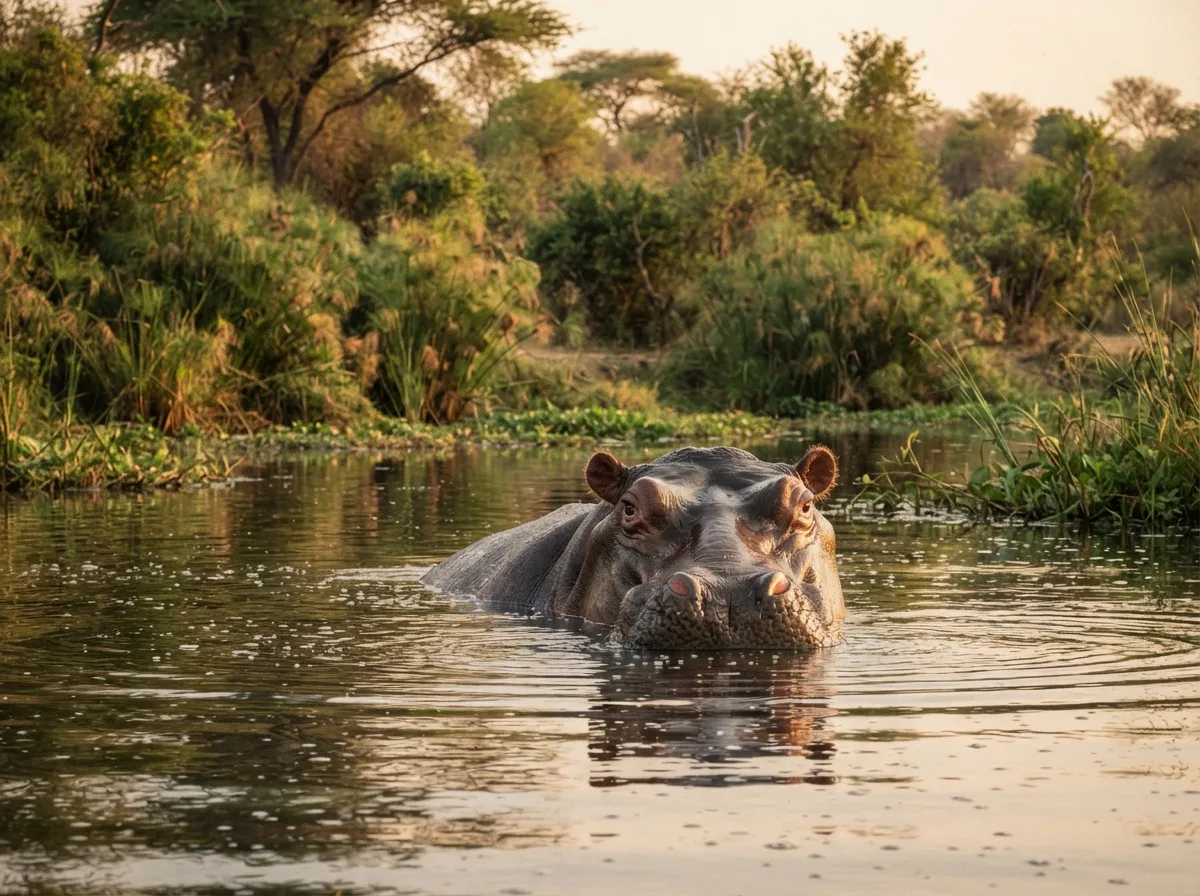
Hippos don’t attack for food: they defend aquatic territories with unrelenting aggression, and boats or swimmers getting close pay a heavy price. Nile crocodiles hunt by ambush near water sources where animals—and humans—come to drink or cross, striking up to 50 meters from the bank: caution starts before you even reach the water, not just when you’re in it.
Fishing bears
Along salmon rivers in Alaska or British Columbia, brown bears gather at the same prime fishing spots year after year, sometimes fighting each other for the best positions. A hiker walking along a river during a salmon run is traveling straight through an open-air buffet: hiking in groups of six or more significantly cuts down the risk of an encounter.
Hygiene and camping near water
Camp toilets should be dug at least 60 meters (200 feet) from any flowing or standing water—this is the standard distance recommended by major North American trail networks to prevent runoff from contaminating water sources people drink from downstream. The same logic applies to your campsite: never pitch camp in a flood zone, which a river can reclaim during sudden high water, and ideally stay about thirty meters back from the bank.
At night, valley floors trap cold air: it sinks down surrounding slopes and pools near the water because it’s denser than the warmer air above—the same phenomenon that generates morning river mist. A camp set up fifty meters higher up the slope, out of the riverbed, often sleeps several degrees warmer and drier than one pitched right at the water’s edge.
Frequently asked questions
Can you drink river water without treating it?
No, even if it looks crystal clear. The main threat is the parasite Giardia, spread by animal waste upstream, with symptoms showing up one to three weeks later. Boiling water for one minute or using a fine mechanical filter removes this risk.
What should you do if you fall into a swift river current?
Never try to stand up: flip onto your back, feet pointing downstream, toes at the surface, and swim diagonally toward the bank while letting the current carry you. Standing up puts you at risk of foot entrapment between rocks, which can hold you underwater against your power.
How do you spot a dangerous low-head dam (“drowning machine”)?
It’s usually a small weir or low dam with a uniform drop across its entire width. Below it, the falling water creates a recirculating hydraulic roll that traps whatever falls in. From upstream, it often looks completely harmless—which is precisely why it’s so deadly.
Is an improvised raft a good idea for crossing a river?
Only on calm water, like a lake or a wide, slow river bend. In swiftwater, an improvised raft cannot be steered or maneuvered around hazards: it becomes far more dangerous than swimming or fording on foot.
Are hippos really as dangerous as people say?
Yes: they are responsible for an estimated 300 deaths per year in Africa, making them one of the deadliest large mammals on the continent for humans. They defend their water territories with constant aggression, targeting boats and swimmers alike.
How far from water should you set up camp?
At least thirty meters away, and never in a low flood plain that the river could reoccupy during high water. Camp latrines must be dug at least 60 meters (200 feet) from any water source to prevent waste from leaching into the stream.
Key takeaways
- Following a river downstream is often a solid strategy to reach civilization, but it can also lead straight into impassable gorges or swamps: stay high on the bank and turn back if the walls close in on both sides.
- A good ford is wide and shallow, never right above a rapid; cross with your pack unbuckled, shoes on, using a pole planted upstream against the current while maintaining two solid points of contact at all times.
- If swept away by the current: stay on your back, feet downstream, never stand up—and swim diagonally, never straight against the flow.
- Logjams and low-head dams (“drowning machines”) are the two most treacherous swiftwater traps: they kill because they offer no obvious warning.
- Flash floods can hit without any rain where you are: at the first sign (muddy water, rising roar, distant storms), move out of the riverbed immediately.
Going further
- FM 21-76 / TC 3-21.76 (US Army Survival Manual), chapter on water crossings.
- Swiftwater Rescue Manual, Les Bechdel & Slim Ray — the core technical reference for swiftwater rescue.
- US Forest Service — Know Before You Go: Water Safety, fs.usda.gov — official guidelines for foot crossings.
- FFCK (French Canoe-Kayak Federation) and Rescue 3 International for swiftwater safety training courses.
Sources for this module (29)
- US Forest Service — Know Before You Go: Water Safety (franchissement de cours d'eau)
- Wikipedia — Weir (low-head dam, 'drowning machine')
- Wikipedia — Whitewater (strainers, hydraulics, foot entrapment)
- Wikipedia — Swiftwater rescue
- Wikipedia — Hydraulic jump
- Wikipedia — Flash flood
- Wikipédia FR — Crue éclair
- Wikipedia — The Narrows (Zion National Park)
- Wikipedia — Aron Ralston
- Wikipedia — Giardiasis
- Wikipédia FR — Giardiase
- Wikipédia FR — Gué (hydrographie)
- Wikipedia — Ford (crossing)
- Wikipédia FR — Noodling
- Wikipedia — Raft
- Wikipedia — Cold shock response
- Wikipédia FR — Hydrocution
- Wikipedia — Temperature inversion
- Wikipedia — Beaver dam
- Wikipedia — Leech
- Wikipédia FR — Sangsue
- Wikipedia — Malaria
- Wikipédia FR — Hippopotame
- Wikipedia — Nile crocodile
- Wikipedia — Grizzly bear
- Wikipedia — Leave No Trace (distance des points d'eau pour les déchets humains)
- Wikipedia — Coracle
- Wikipedia — Inca rope bridge
- Wikipedia — Rope bridge (ponts de racines vivantes)
Continue in "By environment"
The temperate forest
The most generous environment in the world can also swallow you in ten minutes: here is how to read it instead of fearing it.
Mountains: Where the Weather Decides for You
The weather changes in thirty minutes, altitude works against you, the terrain is unforgiving: the signs to read before it's too late.
Snow, extreme cold, and the Far North: surviving at minus 30
Cold doesn't kill you: humidity, exhaustion, and panic do. What you need to know to stay alive below zero.