Dressing for survival: the science of layering
Why soaked cotton kills you faster than an icy wind, and how three well-thought-out layers do more than an overpriced coat.
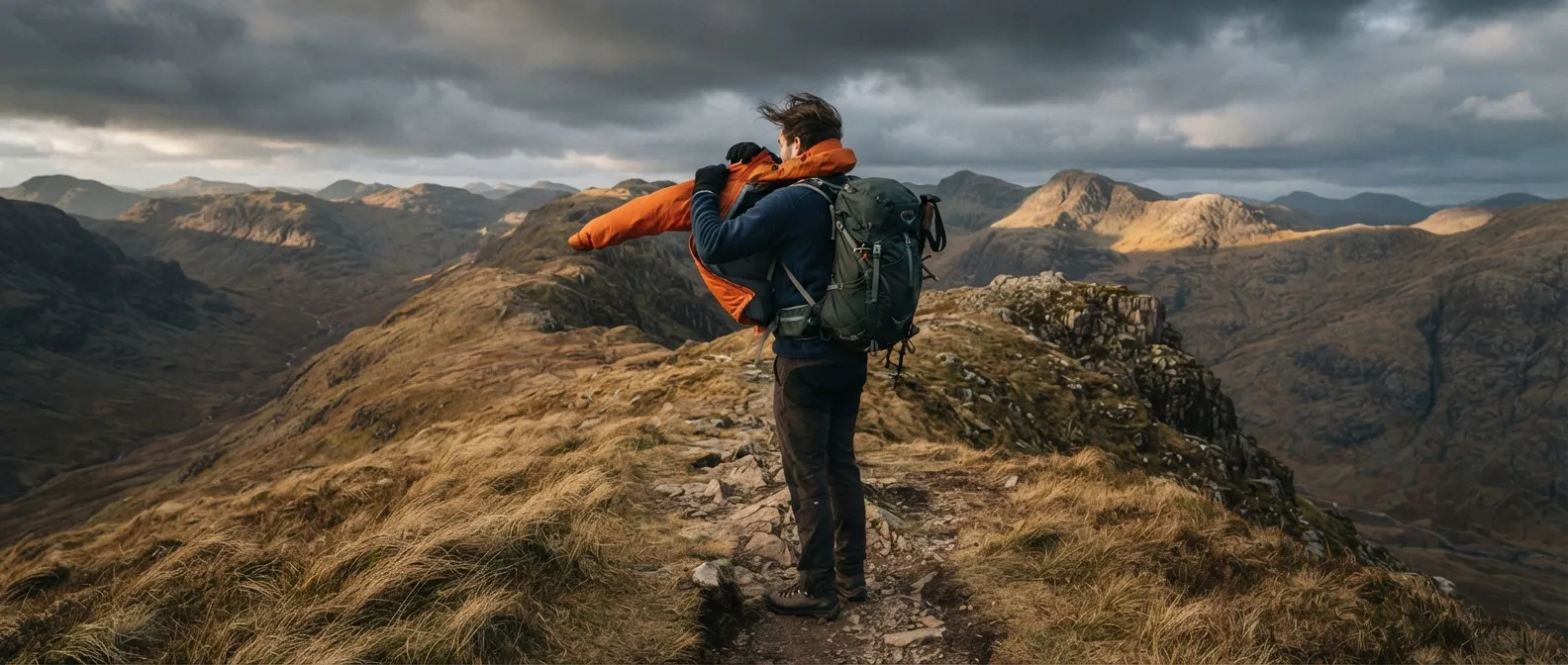
It’s 3 p.m., you’re drenched in sweat after a steep climb, and the wind has just swept across the ridge. Your cotton t-shirt, which kept you warm during the effort, now sticks to your skin like an ice pack. Ten minutes ago you were too hot. Now you’re shivering. The clothing hasn’t changed: it’s the water inside it that changed everything.
The body has only one temperature that counts
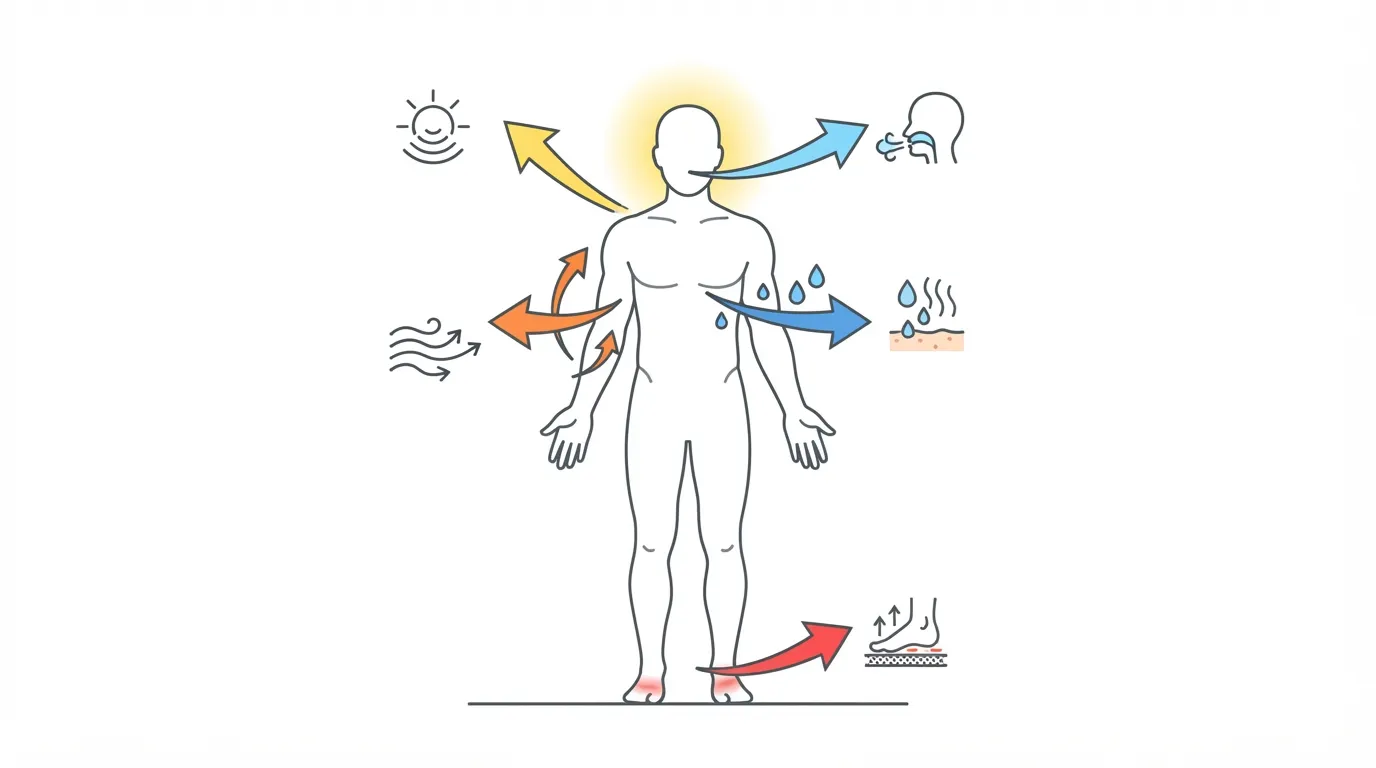
Your body works to keep its core—blood, liver, brain—at 37 °C, no matter what happens around it. It loses heat in five ways, and clothing only ever acts on these five:
- Conduction: direct contact with something colder (the ground, water, the steel of a tool). Water pulls heat away about 25 times faster than still air at the same temperature—that’s the number explaining why wet clothing betrays its wearer.
- Convection: air (or water) moving around and carrying heat away as it warms against the skin. Wind worsens this, and a windbreaker stops it.
- Radiation: the body radiates heat like a heater, without contact. It’s the only loss no fabric truly stops—only a reflective surface (survival blanket) bounces it back.
- Evaporation: every gram of sweat evaporating from skin draws heat to do so. Useful during hard exertion in hot weather, disastrous when stopped in the cold.
- Respiration: cold inhaled air is warmed and humidified by the lungs before being exhaled—a continuous loss, heavier at high altitude where air is dry and cold.
Why fingers freeze before your chest
When facing cold, the body triggers vasoconstriction: blood vessels in the skin constrict to reduce flow to the surface and keep warm blood around vital organs. This choice comes at a price, paid by the areas furthest from the heart and least essential to immediate survival—fingers, toes, nose, ears, cheeks. That’s why extremities freeze first: they are sacrificed first, by design.
The myth that “you lose 40% of your body heat through your head” comes from an old misunderstanding: in the tests that spawned it, test subjects were bundled up everywhere except their head, which naturally made the head responsible for most of the measured heat loss—not because it loses more per square centimeter, but because it was the only exposed surface. In reality, heat loss is proportional to exposed surface area: the head accounts for about 7% of body surface area and roughly 10% of heat loss at rest (slightly more, 13%, during exertion). A beanie helps, but no more than a glove on a bare hand or a sleeve on a bare arm—no more, no less.
The three-layer system, and why the order matters
An effective winter outfit is almost never a single thick coat: it’s a stack of three separate functions, each useless without the other two.
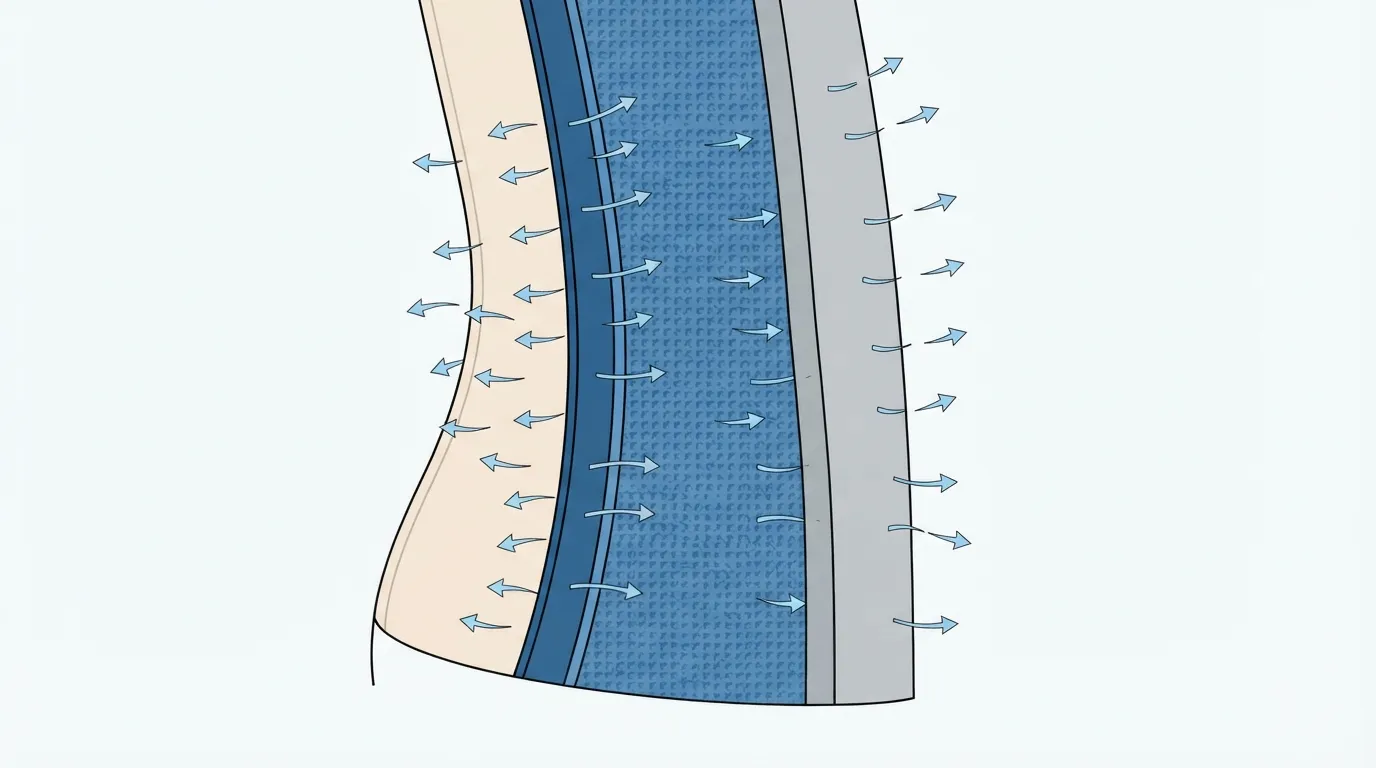
- The base layer: right against the skin, its sole job is to wick sweat outward before it cools your skin. It should be form-fitting (no trapped useless air) and never made of cotton.
- The middle layer: it traps the warm air produced by your body. The thicker and airier it is, the more it insulates—this is what provides most of the clo (the unit of clothing insulation, detailed below).
- The outer layer: it protects against the elements—wind, rain, snow—without blocking the moisture vapor produced by the inner two layers from escaping. It decides whether you stay dry from the inside.
Order matters because each layer does only one thing: a cotton base layer ruins everything, even under the best down jacket, because it holds water against the skin instead of wicking it away. A completely waterproof outer layer lacking breathability turns sweat into indoor rain. The entire system is only as strong as its weakest link.
Materials, one by one, backed by numbers
The reference unit is the clo: 1 clo corresponds to the insulation needed to stay comfortable while sitting in a 21 °C room with a slight draft. Values add up across layers, and crucial to know, they drop very differently once wet.
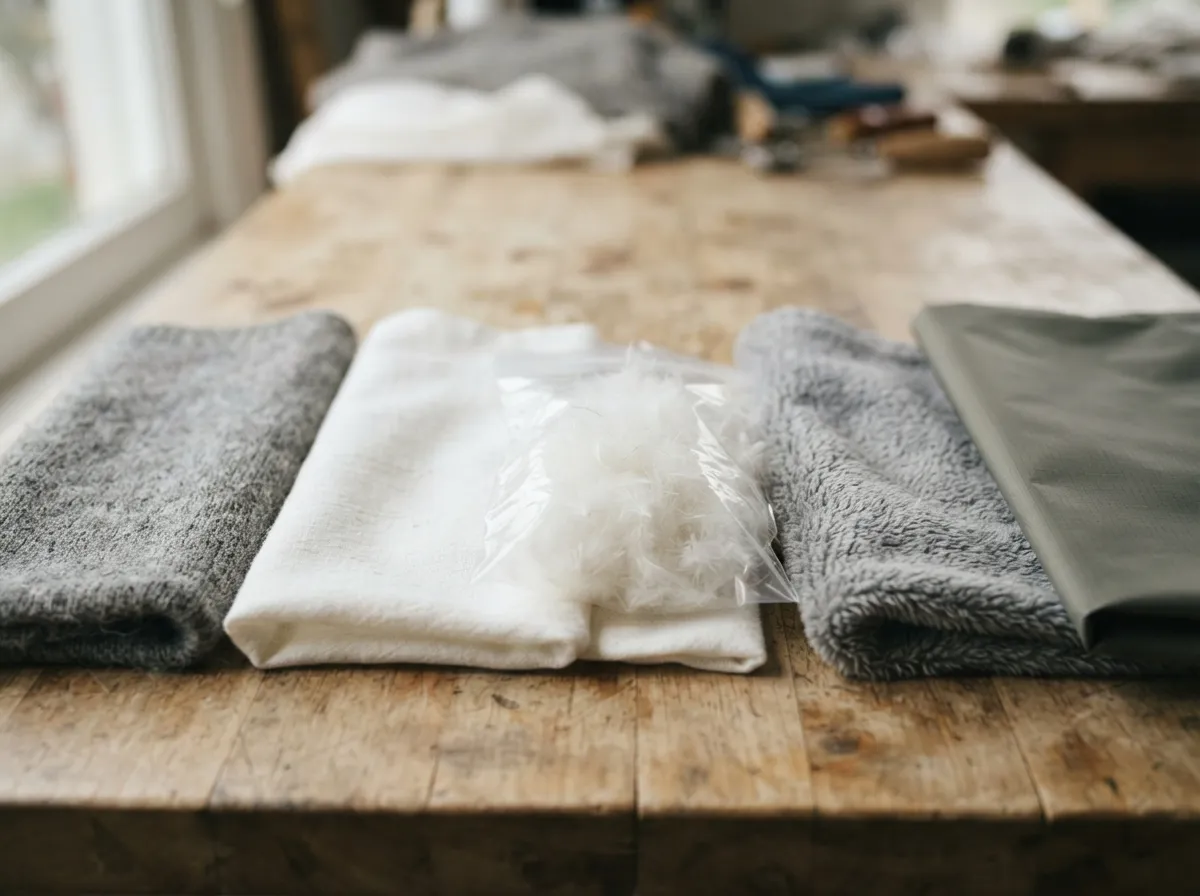
- Merino wool: stays warm even when wet (it retains about 80% of its insulation soaked, versus 10% for cotton), naturally antibacterial—wool, treated by its own lanolin, limits odor-causing bacteria, which explains why merino clothing can be worn for days without stinking. The downside: it absorbs up to a third of its weight in water before feeling wet, and dries slowly (around 5 hours for a light layer).
- Cotton: “cotton kills” isn’t a bushcrafter catchphrase; it’s a fact of measurement. Once soaked, it retains only about 10% of its dry insulation, and it dries slowly. Jeans are even worse to dry: about ten hours. Never as a base layer, never on an expedition—cheap and comfortable only when dry.
- Polyester and fleece: dry quickly (2 hours), retain about 75% of insulation when wet, but melt and burn instantly if touched by a spark or flame—keep away from the campfire—and hold onto odors strongly.
- Down: the best warmth-to-weight ratio available. Its insulating capacity is measured in fill power (the volume, in cubic inches, occupied by one ounce of down): 500 to 650 is enough for most uses, eiderdown climbs up to 1,200. But when wet, it collapses: retaining only about 15% of its insulation, clumping together, and taking more than a day to dry. Hydrophobic treatments (“DWR down”) lessen the damage without eliminating it.
- Synthetics (like PrimaLoft): born in 1983 from a US Army Research Laboratory contract seeking a down alternative that performed when wet—the patent for “synthetic down” was filed in 1985. Less effective than dry down, it insulates far better when wet and dries in a few hours. The first commercial garment launched in 1989.
- Waterproof-breathable membranes (Gore-Tex): an accidental discovery. In 1969, Robert Gore rapidly stretched heated PTFE instead of pulling it slowly, creating a microporous structure that was 70% air—about 9 billion pores per square inch, each far too small for a water droplet but large enough for vapor. On paper, both waterproof and breathable. In practice, breathability collapses during high exertion: the membrane vents vapor much slower than the body produces it during a steep ascent, and the external durable water repellent (DWR) protecting the membrane wears off with washing and use.
- Silk: very light, warm for its weight as a base layer, but delicate—it loses up to 20% of its strength when wet and can shrink by 8%. A useful luxury for ultralight travel, not a top choice for harsh field conditions.
- Leather: excellent windbreaker, abrasion-resistant, but heavy, slow to dry (about 30 hours), and retains only about 30% of its insulation when soaked. It requires regular care (oil or grease) to remain supple and avoid cracking.
| Merino wool | Cotton | 800 Down | Synthetics | Gore-Tex | |
|---|---|---|---|---|---|
| Dry insulation (clo) | 0.30 | 0.09 | 0.55 | 0.45 | 0.10 |
| Insulation retained wet | ~80% | ~10% | ~15% | ~75% | ~90% |
| Drying time | 5 h | 3 h | 24 h+ | 5 h | 2 h |
| Odor resistance | Low | Medium | Low | High | Low |
The full material comparator, featuring thirteen fabrics and detailed sources, lets you sort by weight, price, or flammability depending on your needs.
The habit that matters more than the gear
The best gear is useless if it stays in your pack. Active layer management matters more than layer quality.
- Be bold, start cold: if you feel cozy from your very first steps, you’ll be sweating within fifteen minutes. A mild initial chill that disappears as you warm up is normal.
- Remove a layer before you feel sweat, not after—as soon as you feel heat building up on a climb or during sustained exertion.
- Ventilate before stripping down completely: open your collar, push up sleeves, unzip pit zips if your jacket has them. Often that’s enough.
- When stopping, pull your down jacket or thick fleece out immediately, before you cool down—keeping heat is far easier than regenerating it.
- Change your base layer as soon as it’s wet when stopping for the night or taking a long break: sleeping in a sweat-soaked base layer completely undoes the work of your sleeping bag.
Extremities: where everything is won or lost
Fingers, toes, and head concentrate risk because they concentrate vasoconstriction. Protect them first, not your chest.
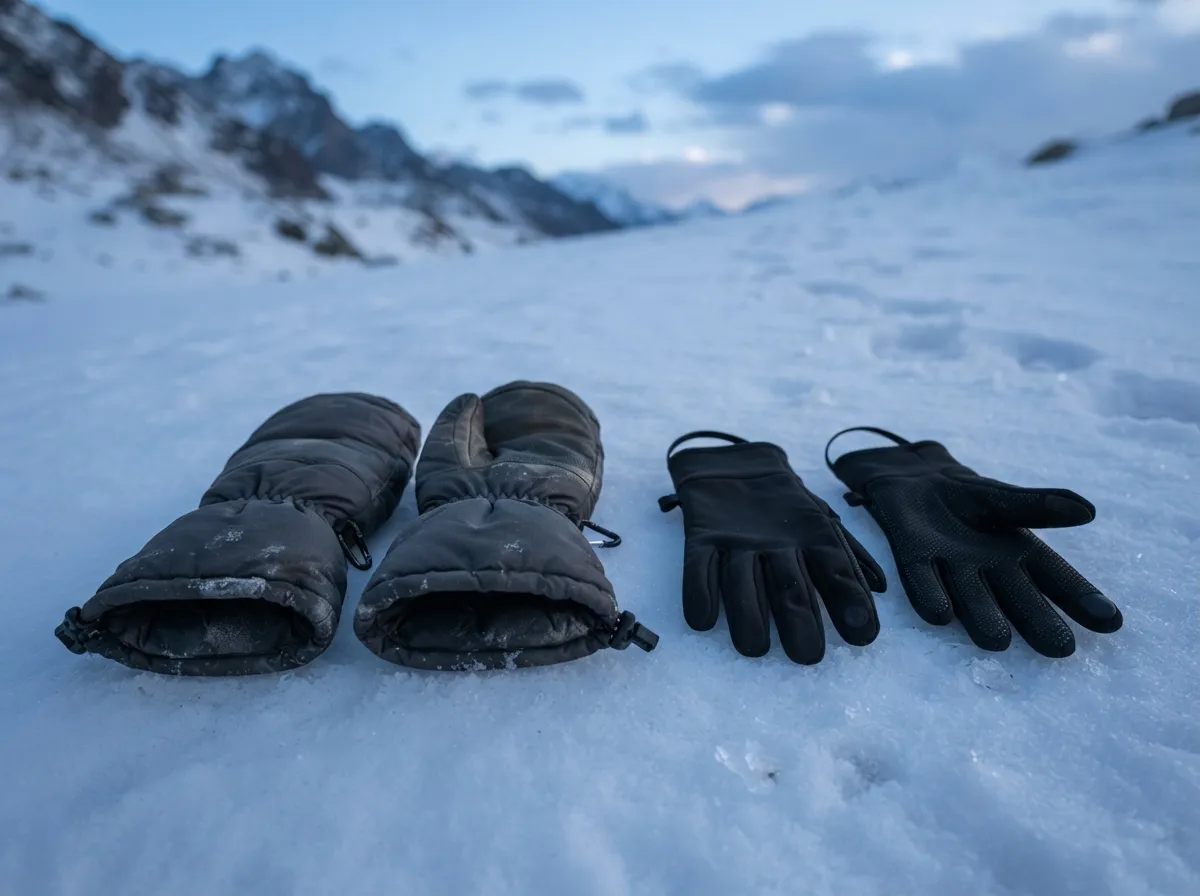
- Mittens vs gloves: for equal insulation, a mitten is warmer because it gathers fingers into a single pocket, reducing overall surface area exposed to the cold—fingers also warm each other. The trade-off is dexterity: it’s no surprise mittens dominate in skiing and extreme cold, while gloves take over when handling fine objects.
- Socks, myth and reality: wearing a thin liner sock under a thick sock genuinely reduces blisters by transferring friction between the two socks rather than against skin—this is a proven fact, not a myth. What’s overrated is the heat gain: beyond two pairs, feet get squeezed inside the boot, blood circulation drops, and the result is colder feet, not warmer—the exact same principle as overly tight clothing restricting circulation.
- Vapor Barrier Liner (VBL) system: a completely waterproof layer (silicone nylon, polyurethane, or a simple plastic bag) worn directly against the skin or over a thin base layer, before insulation. It prevents sweat from migrating into and freezing inside down or lining—the damp feeling against skin is immediate, which also forces you to regulate effort before sweating excessively. Best reserved for steady-intensity efforts (approaches, winter camps), not high-exertion activities where sweat volume becomes unmanageable.
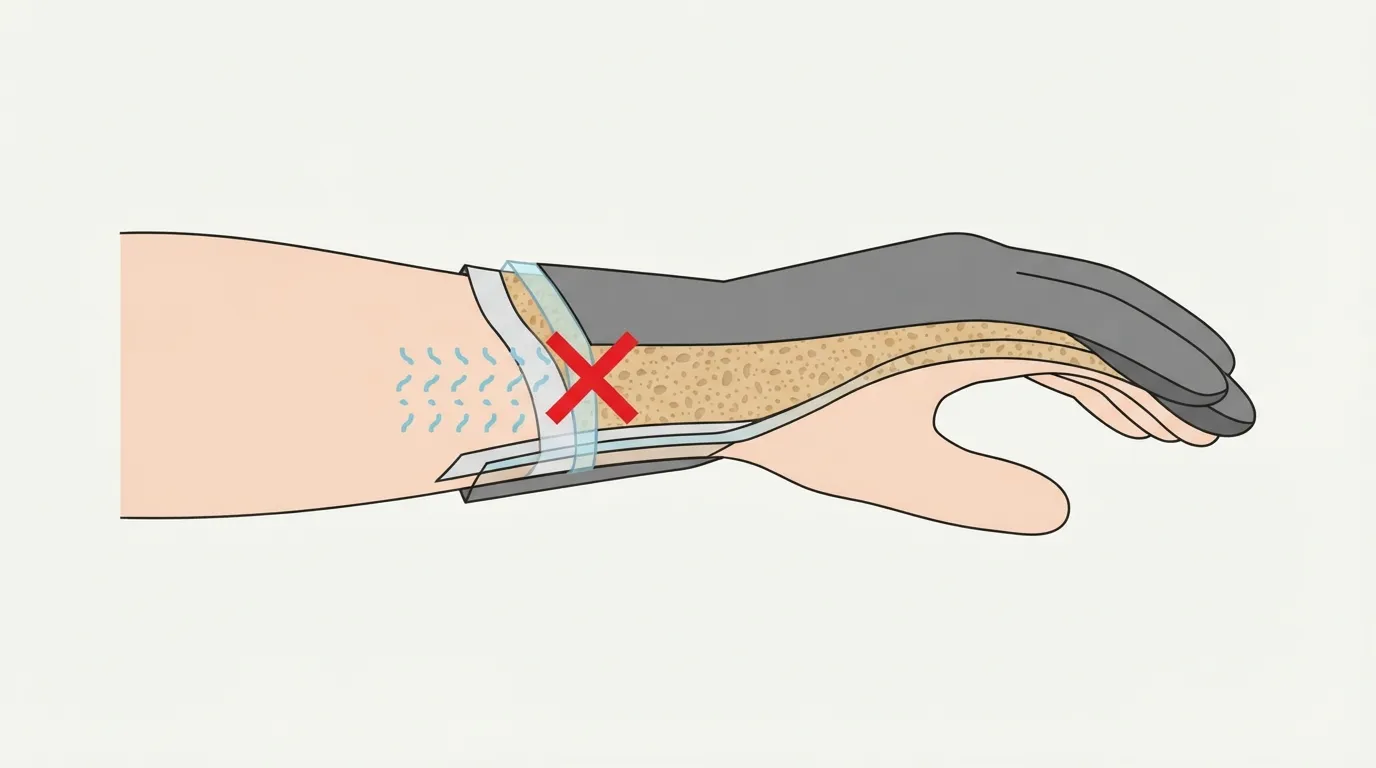
- Footwear, leather vs synthetics: full-grain leather is warm and resists abrasion, but absorbs water and dries very slowly once saturated. Modern synthetics dry fast but insulate less when wet. Gaiters (covers sealing the gap between pant legs and boots) stop snow, pebbles, and water from entering through the top—a small detail that can save a trip.
- Trench foot: this isn’t frostbite; it’s tissue damage caused by prolonged cold, wet conditions. It can occur at temperatures as mild as 16 °C in about 13 hours if feet stay wet and constricted in footwear. Named during World War I, where it affected roughly 75,000 British and 2,000 American soldiers—though Napoleon had already documented it among his troops during the 1812 retreat from Russia. Prevention comes down to one rule: dry and change socks daily, preferably every night, and take off boots as soon as walking stops.
- The head: a beanie or hood remains essential—not because the head loses 40% of body heat, but because it’s an easy surface to cover, frequently forgotten, and the face (nose, ears, cheeks) is particularly vulnerable to wind and frostbite.
The cold threshold table details, degree by degree and minute by minute, when wind chill or cold water immersion become dangerous.
Dressing for heat, not just for cold
Clothing protects against the sun too, and the reflex that “wearing less is better” is often wrong in hot deserts.
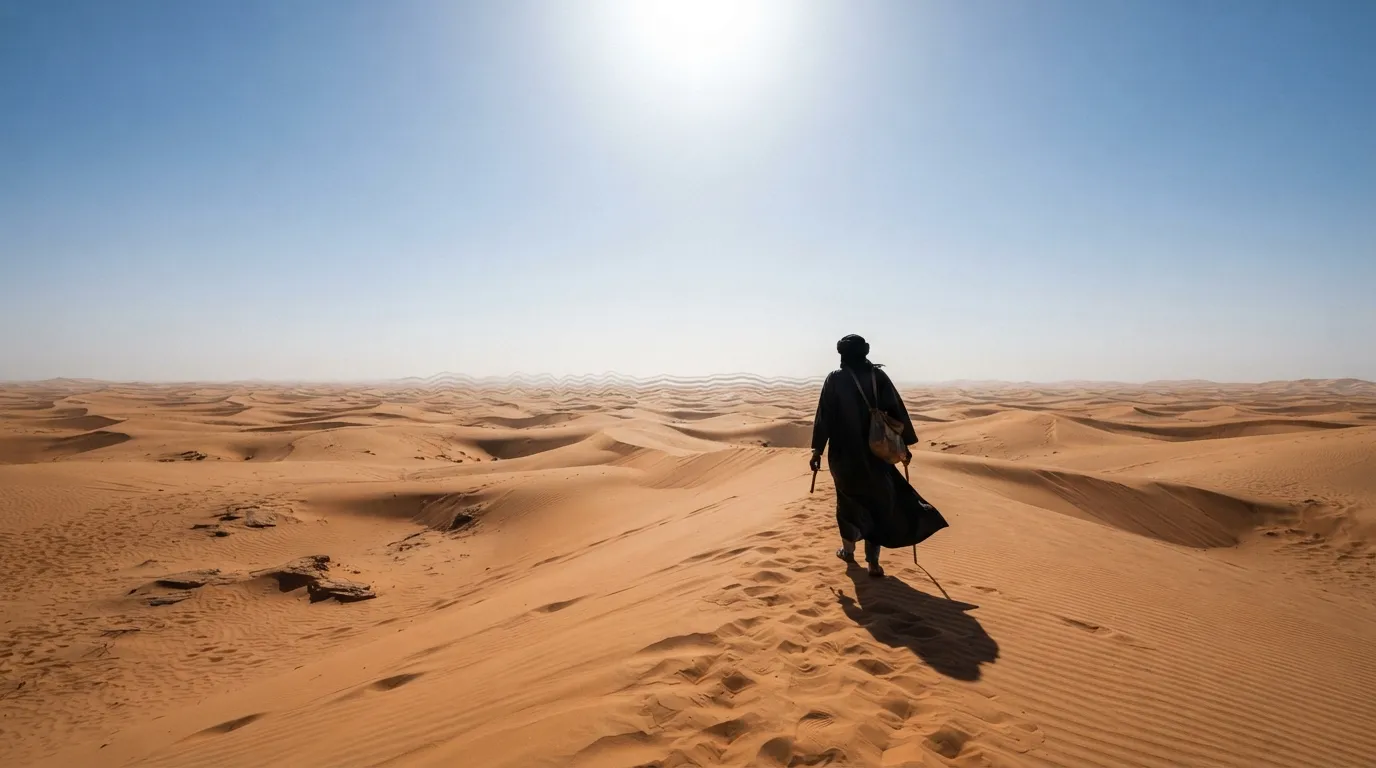
- Covered and loose beats undressed: lightweight, loose fabric creates an air buffer between skin and sun, slows down direct sweat evaporation (thus reducing dehydration), and blocks UV rays—going topless in desert sun brings sunburn and accelerated fluid loss, not cooling.
- The keffiyeh and shemagh: a simple square of fabric, historically cotton, protects against sun, dust, and windblown sand—wrapped, it covers the neck, pulls over the nose and mouth during sandstorms, and stays anchored with a cord (agal).
- The Tuareg tagelmust: a veil extending up to 10 meters of cotton cloth, dyed with dry-pounded indigo (rather than soaked, due to water scarcity)—which permanently transfers pigment onto the wearer’s skin, earning them the nickname “blue men”. It prevents inhaling windborne sand across the Sahara.
- Wide-brimmed hat and long sleeves: a wide brim shades the face and neck, two highly exposed zones; long sleeves in light, pale fabric protect forearms without trapping heat the way bare skin does, which heats up and sweats more under direct sunlight.
- UV at high altitude and on snow: UV radiation increases with altitude, and fresh snow reflects roughly 80% of incoming UV rays—creating a double exposure, from above and below. Category 4 sunglasses (3% to 8% light transmission, unsuitable for driving) are standard for high mountains and glaciers; traditional glacier glasses feature dark lenses and side leather shields to block peripheral light.
- Snow blindness (photokeratitis): a painful sunburn of the cornea caused by reflected UV light, leading to tearing and extreme light sensitivity—reversible within 24 to 72 hours once sheltered from light, but easily prevented with filtering sunglasses or, if unavailable, a blindfold with narrow slits cut into it, like traditional Inuit snow goggles.
In the rain
- Poncho vs rain jacket: a poncho covers more area (often including your backpack) and ventilates far better than a zipped jacket, at the cost of lower wind protection and catching easily on branches in dense woods.
- Trekking umbrella: far from being a gimmick, it prevents the inevitable internal condensation of a sealed jacket under warm rain, leaves arms free to move, and traps zero heat—a well-documented option in ultralight hiking communities, especially when wind is light and trails are open. It loses value when wind picks up or brush thickens.
Improvising when you have nothing
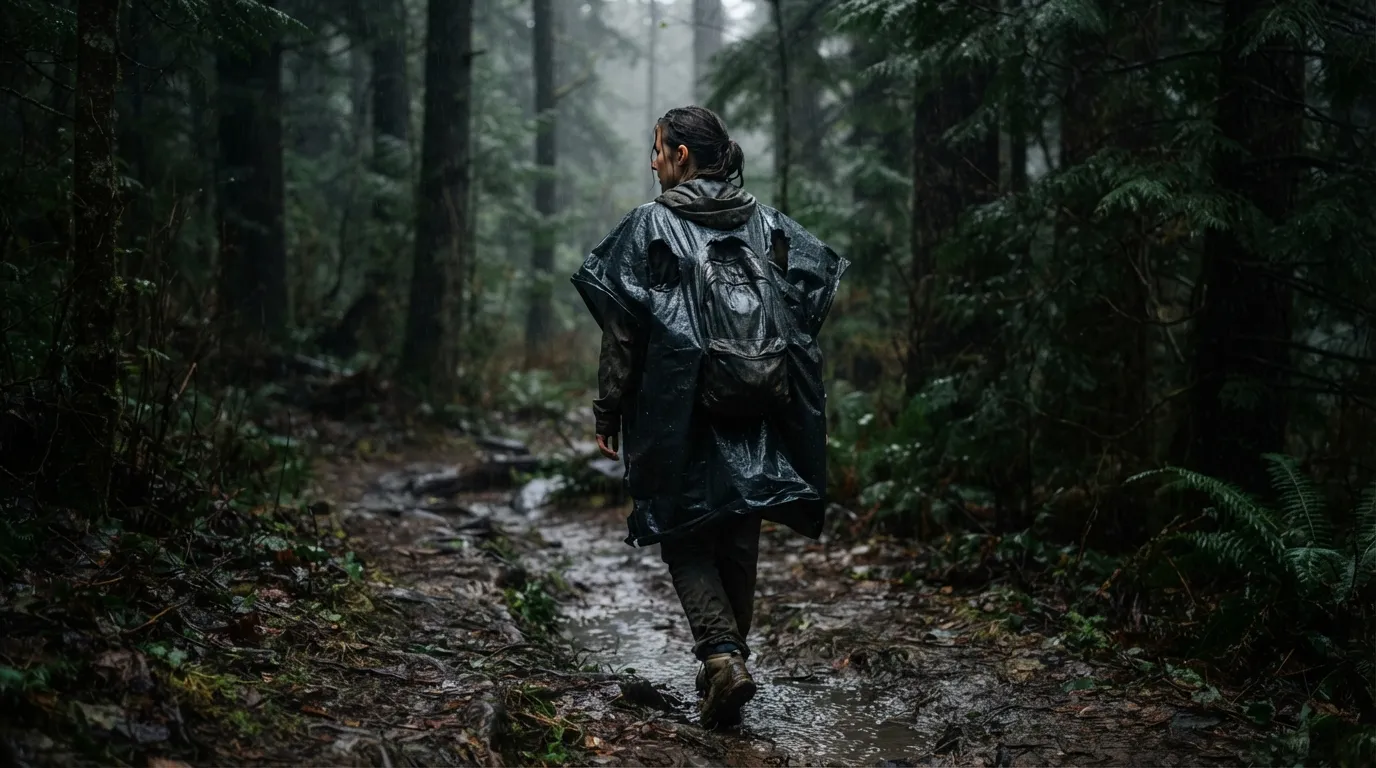
- Trash bag: cut three holes (head, arms) for an instant rain poncho; slip over a sock for a makeshift vapor barrier; wrap double layers around your torso for an emergency windbreaker.
- Newspaper: crumpled and stuffed between clothing layers, it traps dead air just like any fibrous insulation—an old trick still useful in a pinch, though never comfortable or durable once wet.
- Dry grass inside clothes: far older than emergency survival. The Sámi packed their reindeer skin boots (kommager) with dried, hand-softened grass—sennegrass, harvested from a sedge (Carex vesicaria)—as insulating liners that pulled moisture away from the foot. And the shoes of Ötzi the Iceman, who died around 5,300 years ago in the Alps, used the exact same principle: soft grass padding acting as a sock between his foot and an outer shell of deer and bear leather.
- Dry leaves and bark: stuffed between two layers of clothing or inside a improvised sack, dry leaves insulate through the same principle as down—still air trapped inside a fibrous network. Birch or linden bark, being stiffer, serves better to craft shelter from rain or wind rather than insulating against cold.
Sleeping dressed, drying over fire, making repairs
- Sleeping dressed vs naked, the myth: the claim that sleeping naked keeps you warmer inside a sleeping bag is unsupported by insulation physics—manufacturers rate comfort temperatures assuming a sleeper wearing long underwear, socks, and a beanie. What truly chills a bag is moisture (sweat or a damp base layer trapped inside) and crushed insulation under body weight, not wearing dry, clean clothing.
- Drying clothes over a fire without burning them: never directly above flames. Hang garments on an angled branch angled away from the fire, far enough that you feel only heat and no burning smell, turning them regularly—technical fabrics (fleece, membranes) melt before burning, often without visible flame.
- Field repairs: a needle and thread (or dental floss, strong and thin) closes tears; duct tape sticks even to dirty or damp fabric, temporarily fixing rips or peeling boot soles; safety pins secure torn garments without sewing in seconds.
Cold-climate indigenous peoples: Inuit and Sámi
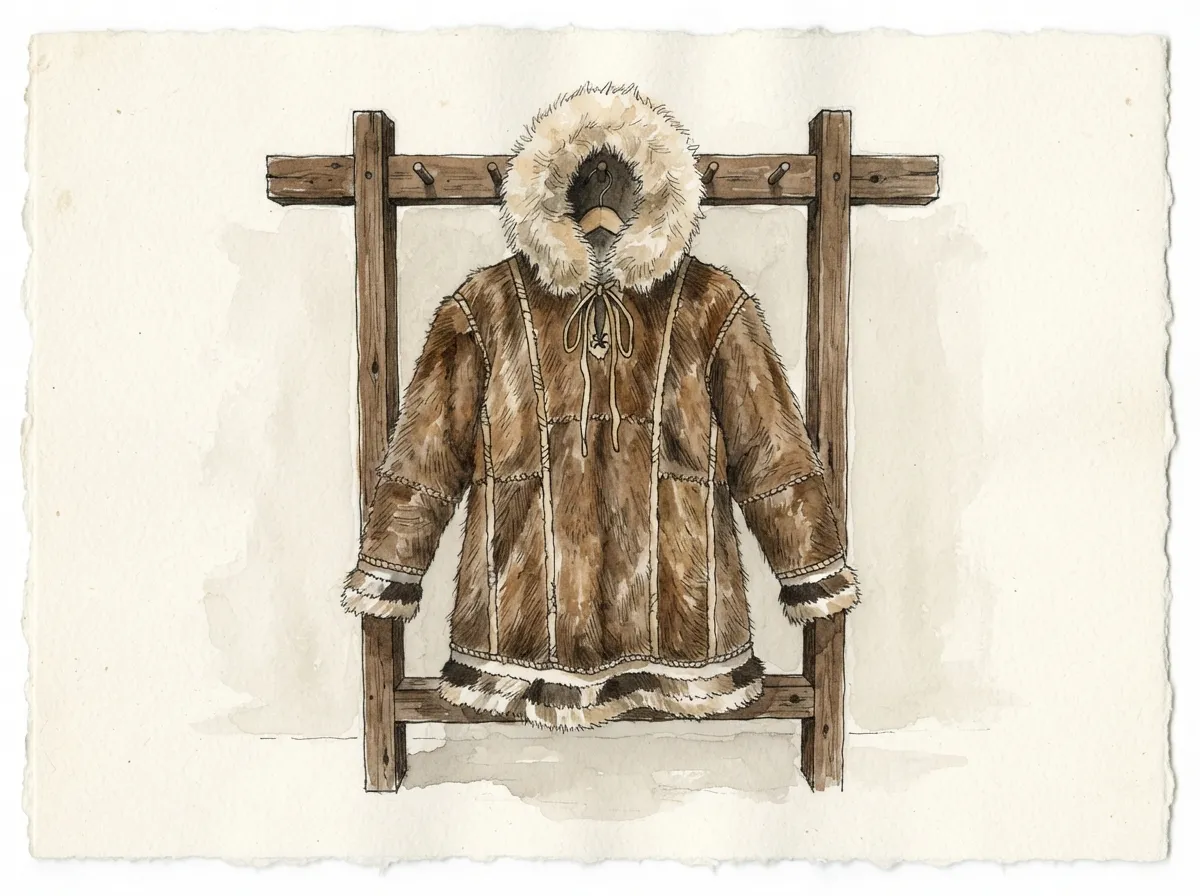
- The Inuit double-layer parka: two layered parkas, the inner atigi with fur facing the skin, the outer qulittuq with fur facing outward, overlapping to block cold air entry. Caribou fur grows in two layers trapping air, which is then warmed by body heat. A full set (parka, pants, mittens, socks, boots) weighs 3 to 4.5 kg, and crafting it required immense work: roughly 300 hours to prepare about twenty caribou hides, and 225 hours of sewing to dress a family of five for winter.
- Amundsen copied the Inuit, Scott kept wool: during his Northwest Passage transit (1903–1906), Roald Amundsen learned from the Netsilik Inuit to wear animal skins rather than the heavy wool parkas of prior polar expeditions, “which failed to hold heat once wet.” His 1911 South Pole expedition benefited directly from this shift.
- The Sámi gákti: historically made of reindeer skin, today often woven wool, cotton, or silk, featuring a distinct high collar. Colors and patterns reveal marital status and geographic origin—down to belt buttons, square for married individuals, round for singles.
Infants and children
A baby does not regulate temperature like an adult: their skin surface area is large relative to weight, they cannot shiver effectively, and they can neither remove a layer nor clearly communicate that they are overheating. This leads to two matching rules:
- Do not underdress: extremities (hands, feet, head) cool down fast, faster than in adults for equivalent surface area.
- Above all, do not overdress: this is the less intuitive risk, yet the best documented. A New Zealand study showed that excessive thermal insulation (from two “togs”—the unit used for infant bedding—above critical threshold) raised Sudden Infant Death Syndrome (SIDS) risk (odds ratio of 1.35). A 1984 study identified severe swaddling in two-thirds of examined SIDS cases.
Frequently asked questions
Why do people say “cotton kills” in hiking and mountaineering?
Because when wet—from rain or sweat—cotton retains only about 10% of its dry insulating capability, compared to about 80% for wool. Combined with the fact that water pulls heat away from the body roughly 25 times faster than air, wet cotton sticks to the skin and speeds up hypothermia instead of offering protection.
Do you really lose 40% of your body heat through your head?
No. Heat loss is proportional to exposed surface area, and your head represents only about 7% of body surface area, accounting for roughly 10% of heat loss at rest. The myth originated from early experiments where subjects were fully clothed except for their bare heads, making the head artificially responsible for almost all measured heat loss.
Are mittens or gloves better in extreme cold?
Mittens are warmer for the same level of insulation because they pool fingers into a single air space, reducing overall surface area exposed to cold and allowing fingers to share warmth. Gloves offer far better dexterity but less insulation; many technical designs offer trigger-finger mittens to blend both advantages.
Should you wear two pairs of socks to keep feet warm?
A thin liner sock worn under a thick wool sock genuinely prevents blisters by transferring friction between the two sock layers rather than against skin. However, piling too many sock layers into tight boots compresses your feet, restricts blood flow, and leaves them colder—excess socks can produce the exact opposite of the intended effect.
How do you dress to stay warm without sweating while hiking?
By using three adjustable layers: a base layer that wicks sweat, an insulating layer that traps warm air, and an outer shell that blocks wind and rain while venting moisture vapor. The practical rule is to start out feeling slightly cool and remove a layer before you begin sweating, rather than waiting until you are soaked to react.
Key takeaways
- The body loses heat through conduction, convection, radiation, evaporation, and respiration—clothing only ever acts on these five mechanisms, never a sixth.
- The 40% head heat loss myth is false: heat loss is proportional to exposed surface area, and the head represents only about 7% of your body.
- The three-layer system (wicking base, air-trapping mid, protective outer) works because each layer handles one job; a cotton base layer collapses the whole system.
- Extremities freeze first due to vasoconstriction: mittens, proper sock management, and head protection take priority over coat thickness.
- Dressing for heat follows the same principles as cold: loose and covered protects better than undressed, and garment fit matters more than fabric color.
Going further
- Clothing Materials Comparator—thirteen fabrics, eight benchmarked and sourced metrics.
- Cold Threshold Table—wind chill, cold water immersion times, stages of hypothermia.
- Andrew Skurka, Vapor Barrier Liners: Theory & Application—the practical reference on vapor barriers by a professional long-distance trekker.
- A. Shkolnik et al., Why do Bedouins wear black robes in hot deserts?, Nature 283 (1980)—the landmark study that reshaped our understanding of desert clothing.
Sources for this module (26)
- The Engineering ToolBox — Clo, Clothing and Thermal Insulation
- The Conversation — Monday's medical myth: you lose most heat through your head
- Wikipedia — Trench foot
- Wikipedia — Frostbite
- Wikipedia — Photokeratitis (cécité des neiges)
- Wikipedia — PrimaLoft
- Wikipedia — Gore-Tex
- Wikipedia — Down feather (fill power)
- Wikipedia — Inuit clothing
- Wikipedia — Gákti (costume traditionnel sami)
- Wikipedia — Sennegrass
- Wikipedia — Ötzi
- Wikipedia — Keffiyeh
- Wikipedia — Tagelmust
- Wikipedia — Hypothermia (vêtements et prévention)
- Wikipedia — Wool
- Wikipedia — Silk
- Wikipedia — Mitten
- Wikipedia — Sock (liner socks)
- Wikipedia — Infant clothing (togs et SIDS)
- Wikipedia — Roald Amundsen
- Wikipedia — Gambeson
- Wikipedia — Sleeping bag
- Wikipedia — Wind chill
- Andrew Skurka — Vapor Barrier Liners: Theory & Application
- Shkolnik, Taylor, Finch & Borut (1980), Why do Bedouins wear black robes in hot deserts?, Nature 283
Continue in "Cross-cutting skills"
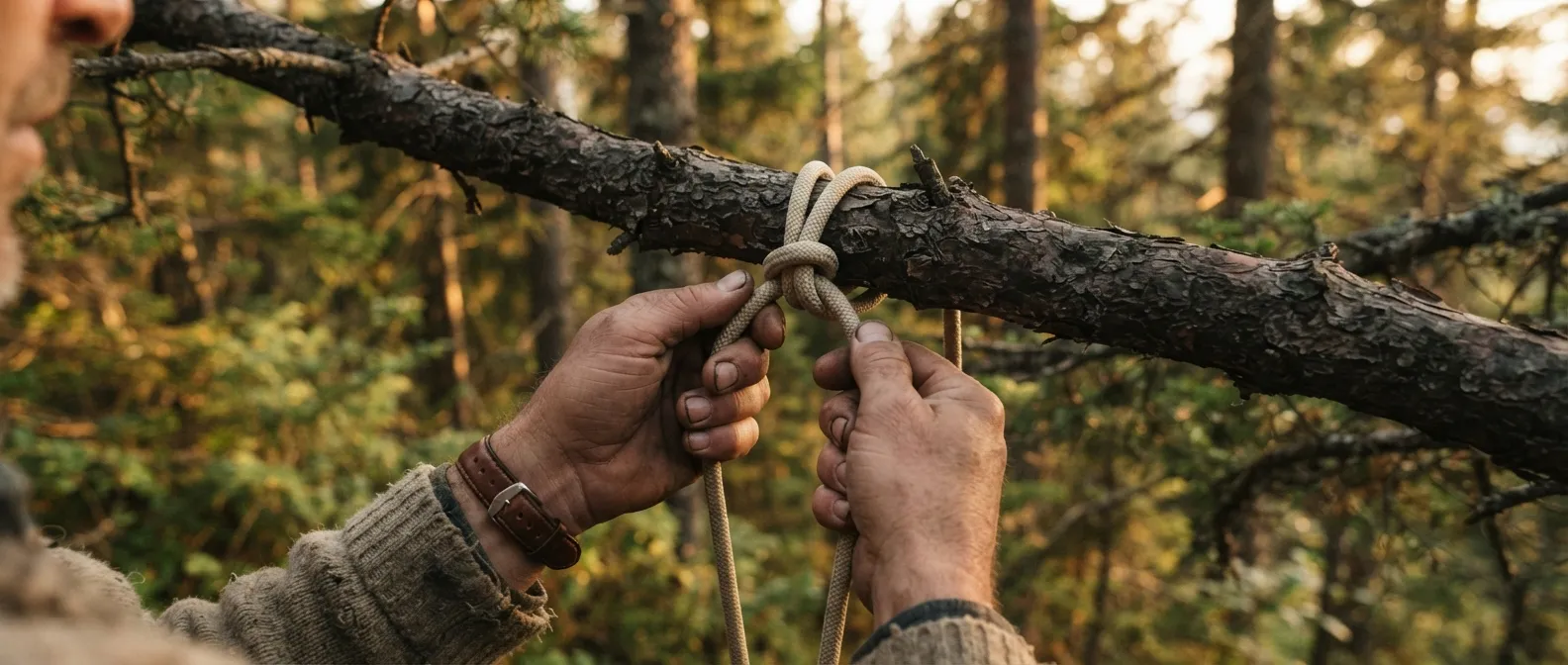
Knots and Cordage: The 10 That Actually Matter
3,857 knots listed in the reference book, and ten that are enough to pitch a shelter, scale a cliff, or save a life.
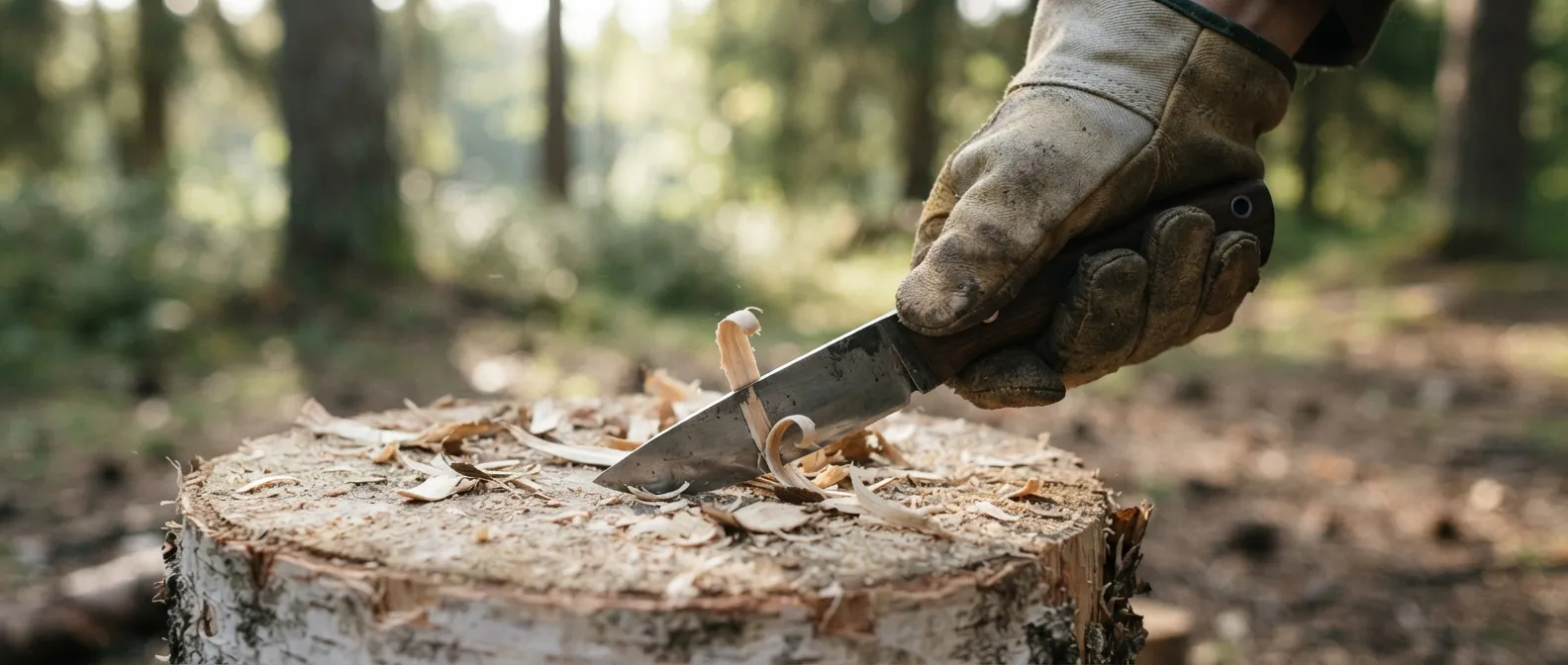
Knife, axe, saw: tools and the techniques that prevent injuries
The 'best knife' doesn't exist: only the one that fits your hand and your task—and the movements that keep you from getting hurt.
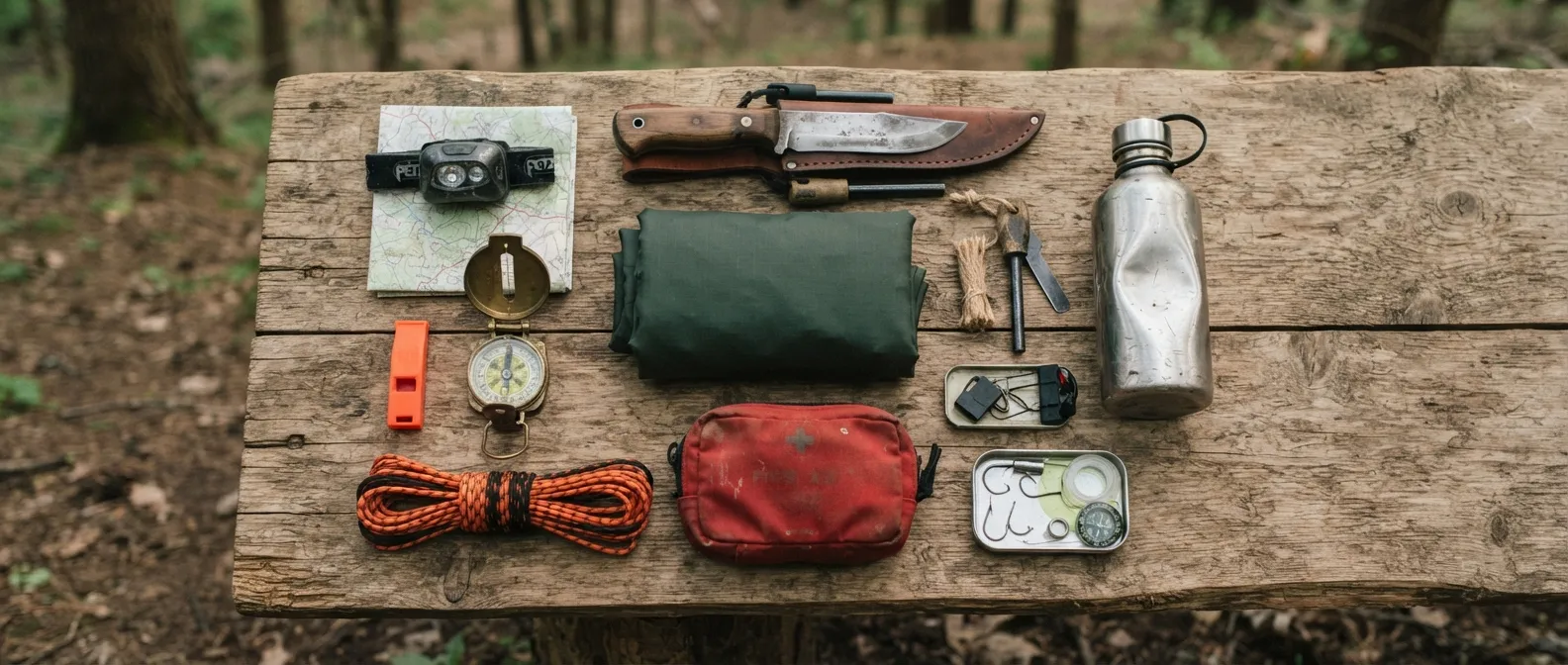
The Kit: What Should Be in Your Pockets, Backpack, and Car
What you carry on you saves you when you lose your pack: the kit hierarchy and essential checklists you shouldn't improvise.