Desert Island: Real-life Robinsons
Nobody ever had to suck a coconut husk to find water: real Robinsons dug, caught rainwater, and held out for years. Here is how.
The boat capsized last night, and this morning all that remains is a beach, coconut palms, and the sound of the surf. No signal, no road, no neighbor. The first question that pops into your head—what am I going to eat—is the wrong one. Castaways have held out for four years without ever starving to death. What killed those who died was almost always water, the sun, or an infected wound. A desert island is not a postcard backdrop to be tamed: it’s a plumbing and patience problem that dozens of people have already solved, in real life.
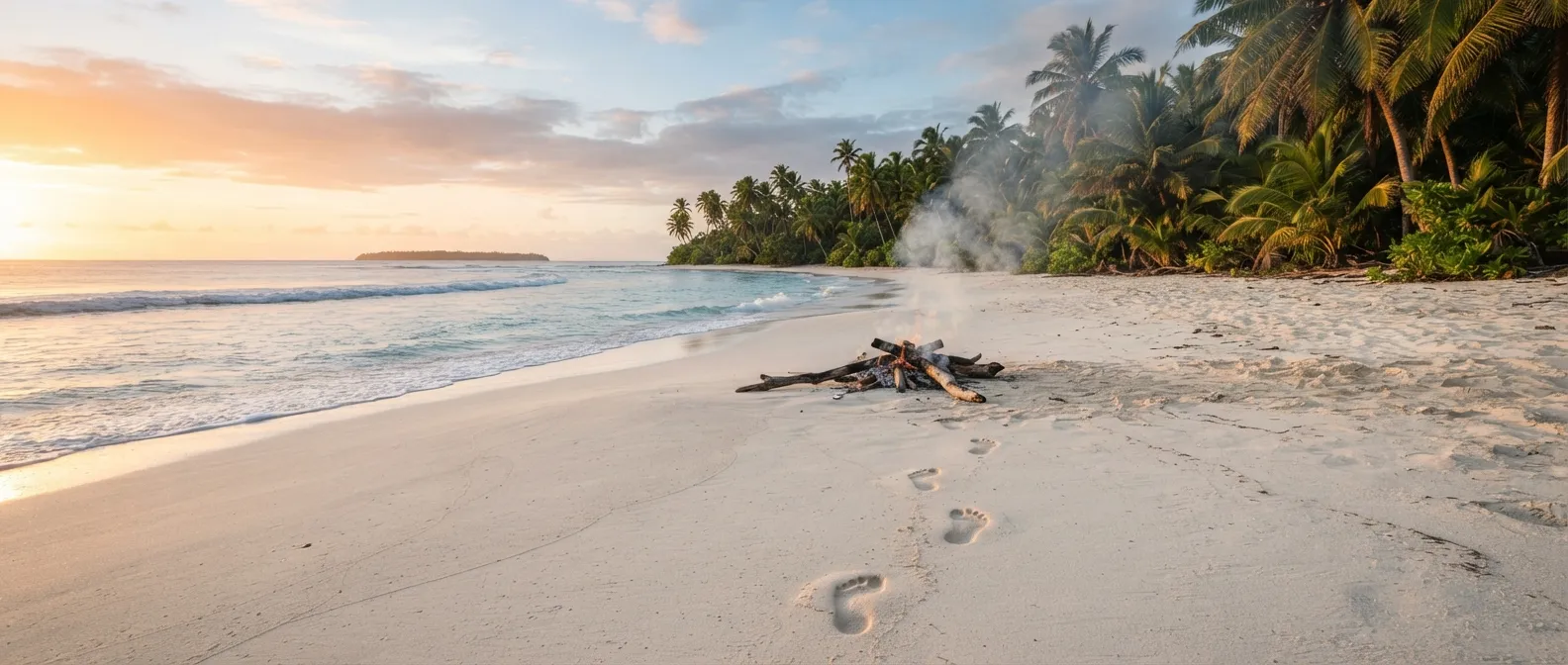
Real-life Robinsonades
Daniel Defoe didn’t invent a thing: he read the newspapers. Alexander Selkirk, a Scottish sailor, spent four years and four months (1704–1709) alone on the island of Más a Tierra, off the coast of Chile—now renamed “Robinson Crusoe Island”. Cast ashore with a musket, a knife, and a Bible, he ended up running fast enough to catch wild goats with his bare hands, sang psalms to keep sane, and was rescued in 1709 by a privateer ship piloted by William Dampier—“almost incoherent with joy,” according to eyewitnesses.
Harsh still: the castaways of Tromelin Island (the Utile shipwreck), in the Indian Ocean. On July 31, 1761, this slave ship ran aground with about 80 Malagasy slaves aboard. The crew left on a makeshift boat, promising to send help—and never came back. It would take fifteen years. When the rescue ship finally arrived on November 29, 1776, only eight survivors remained: seven women and an eight-month-old baby. Archaeological digs led by INRAP between 2006 and 2013 revealed what they did to survive: a well, buildings constructed from coral blocks, and a fire that never once went out.
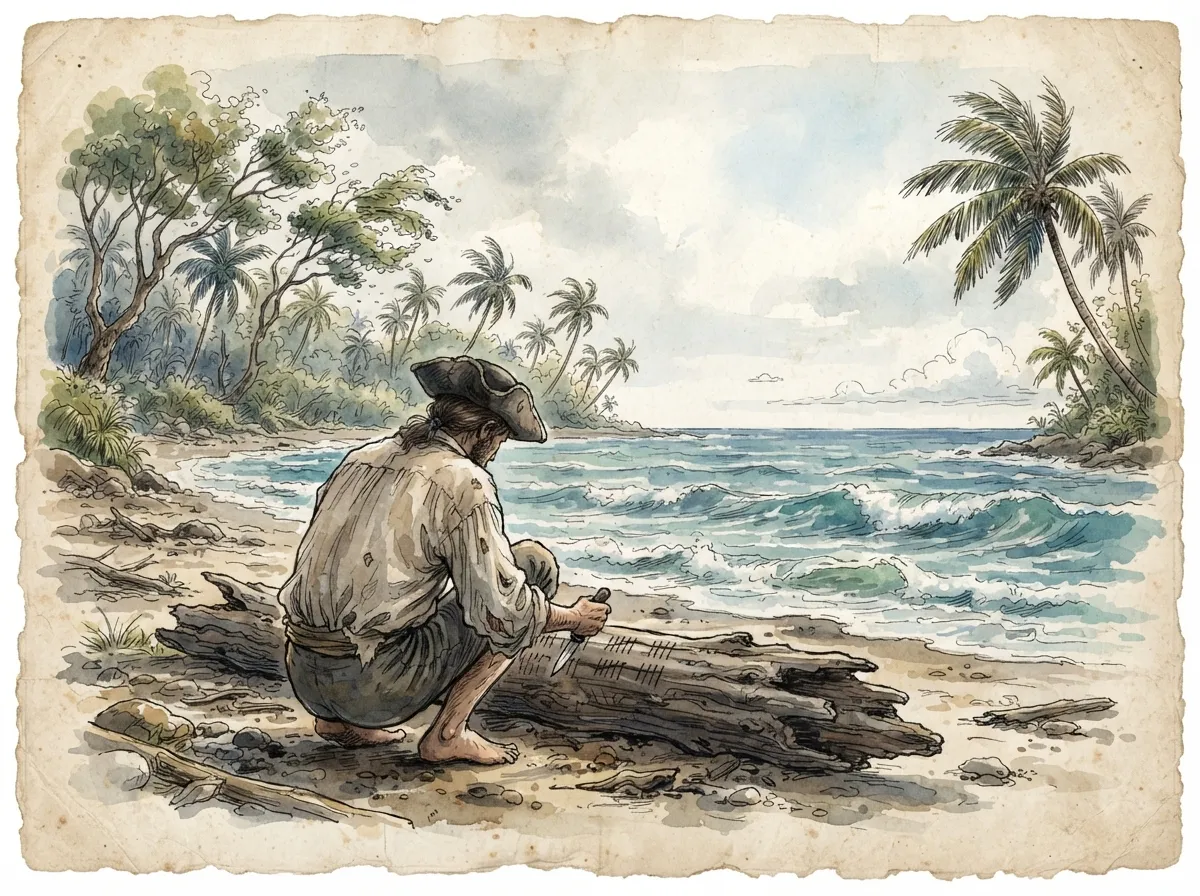
Other stories prove that this isn’t a curse reserved strictly for accidents. New Zealander Tom Neale chose to live alone on the uninhabited atoll of Suwarrow in the Cook Islands—three stays totaling sixteen years between 1952 and 1977, living on fish, lobsters, chickens, eggs, papayas, coconuts, and breadfruit. He wrote a book about it, An Island to Oneself, the royalties of which funded his supplies for his final stay. And in June 1965, six Tongan teenagers stole a boat to flee their boarding school, got caught in a storm, and ran aground on the deserted islet of ʻAta. They survived there for fifteen months, eating seabirds, feral chickens, taro, and bananas found in the ruins of a former village, until a lobster fisherman, Peter Warner, spotted them by chance in September 1966.
Conversely, the island of Anuta in the Solomons shows that you can live on a mere speck of land—0.37 km², featuring one of the highest population densities in the world—without ever experiencing famine: the 300 inhabitants practice aropa, a strict principle of sharing, and collectively forbid themselves from overharvesting certain species during specific seasons. And isolation isn’t limited to the tropics: the story of Ada Blackjack, alone for two years on Arctic Wrangel Island, displays the exact same survival mechanisms—routine, improvisation, sheer obstinacy—under a radically different climate.
Water, the ultimate priority
On an island, food is almost always abundant—fish, shellfish, coconuts. Fresh water, on the other hand, hides. Saving its search for later is the single mistake that kills you first.
The freshwater lens, under the beach sand
On many sandy or coral islands, infiltrating rainwater doesn’t mix with seawater right away: it floats on top of it, lighter, forming a convex layer known as a freshwater lens (the Ghyben-Herzberg principle). It recharges with every rainfall and shrinks during droughts—in the Marshall Islands, during the 1997–1998 drought, the lens thickness measured in certain wells dropped from 45 to 18 feet, even as pumping supplied up to 90% of the population’s drinking water. This is exactly what the castaways on Tromelin tapped into: a few dozen meters back from the wave-pounded sand, where denser vegetation grows, they dug a five-meter-deep well—in just three days, a massive effort using whatever tools they had on hand.
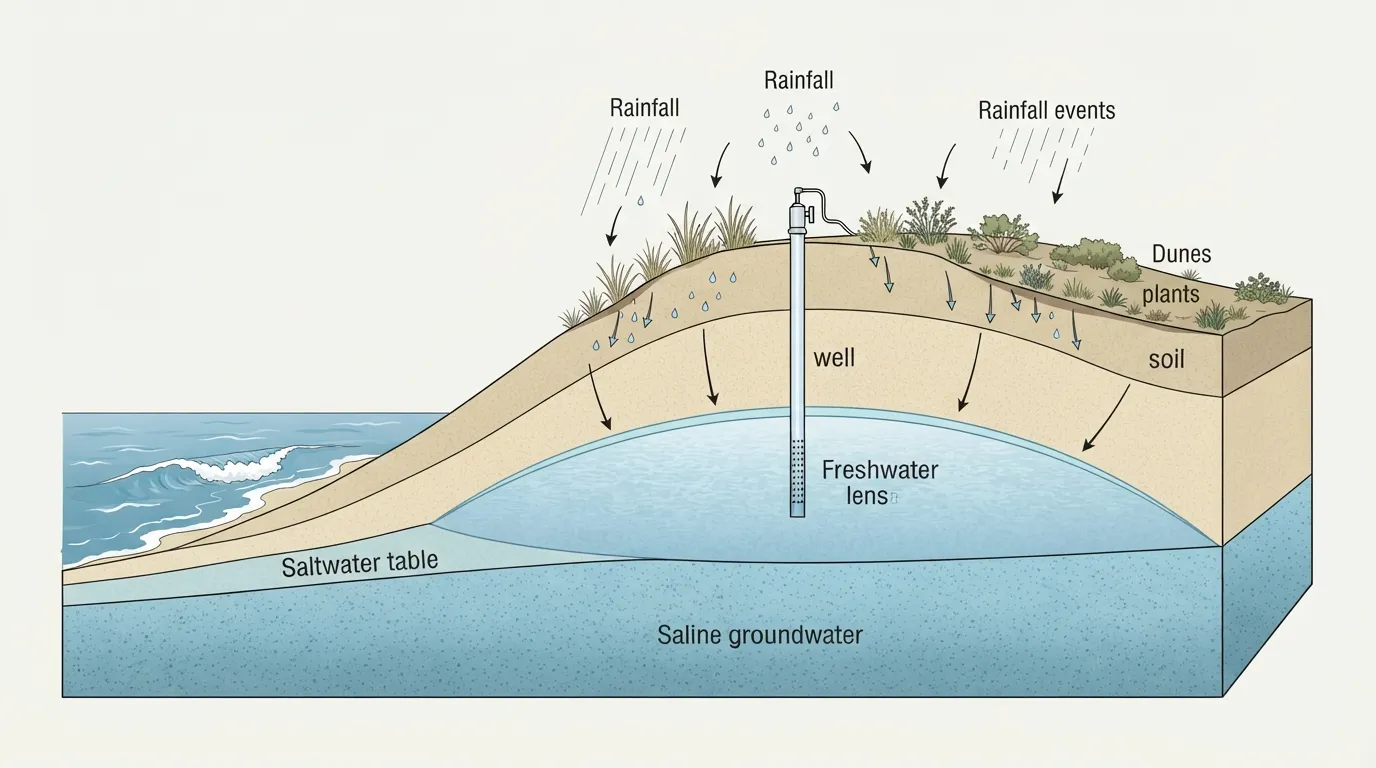
- Spot the densest vegetation set back from the bare sand—it grows where moisture is accessible underground, never on the sand directly washed by the tide.
- Dig a few dozen meters away from the shoreline, never right above the high-water mark: the closer you dig to salt water, the faster you contaminate the lens.
- Stop as soon as water appears: it floats right on top of the salt water, so digging deeper only punctures the lens and mixes the two.
- Taste cautiously before drinking in quantity: a well too close to the sea or over-pumped becomes brackish, worsening dehydration instead of relieving it.
- Let it settle between draws: an over-pumped lens turns salty, exactly as demonstrated by the Marshall Islands case.
Rain, coconut water, and the disappointing solar still
Rain remains the most reliable source, provided you collect it using anything with a wide surface area: banana or coconut palm leaves folded into gutters, coconut shells, tarps, or stretched cloth squeezed out into a container. Coconut water works in a pinch, but it isn’t pure water: 100 ml of coconut water provides about 250 mg of potassium compared to only 105 mg of sodium—the exact opposite of what your body loses through sweat, which primarily expels sodium. Drunk in excessive quantities, it doesn’t properly replace lost electrolytes and can trigger diarrhea, which worsens dehydration.
The beach solar still (a hole lined with plastic, a container in the middle, a transparent sheet weighted over the top) looks great on paper—evaporation-condensation is a sound physical principle—but real-world yields are consistently disappointing: around 100 to 150 ml per day for a small setup, far below the 3.8 liters an adult burns through under harsh conditions. Digging the hole costs more water in sweat than the still will yield in its first few days. Keep it as an extra supplement, never as your primary plan.
| Sand lens | Collected rain | Coconut water | Solar still | |
|---|---|---|---|---|
| Reliability | high, once located | high during frequent showers | medium (laxative effect) | low |
| Yield | several liters/day | depends on rainfall | ~0.3–0.5 L per nut | 0.1–0.15 L/day |
| Effort | dig once | near zero with good containers | climb or gather | high effort for minimal return |
| Risk | brackish if over-pumped | none | diarrhea if drunk in excess | dehydration from digging sweat |
Feeding yourself on the reef and beach
Unlike water, food is almost never scarce on a tropical island—the real danger lies in choosing the wrong things to eat.
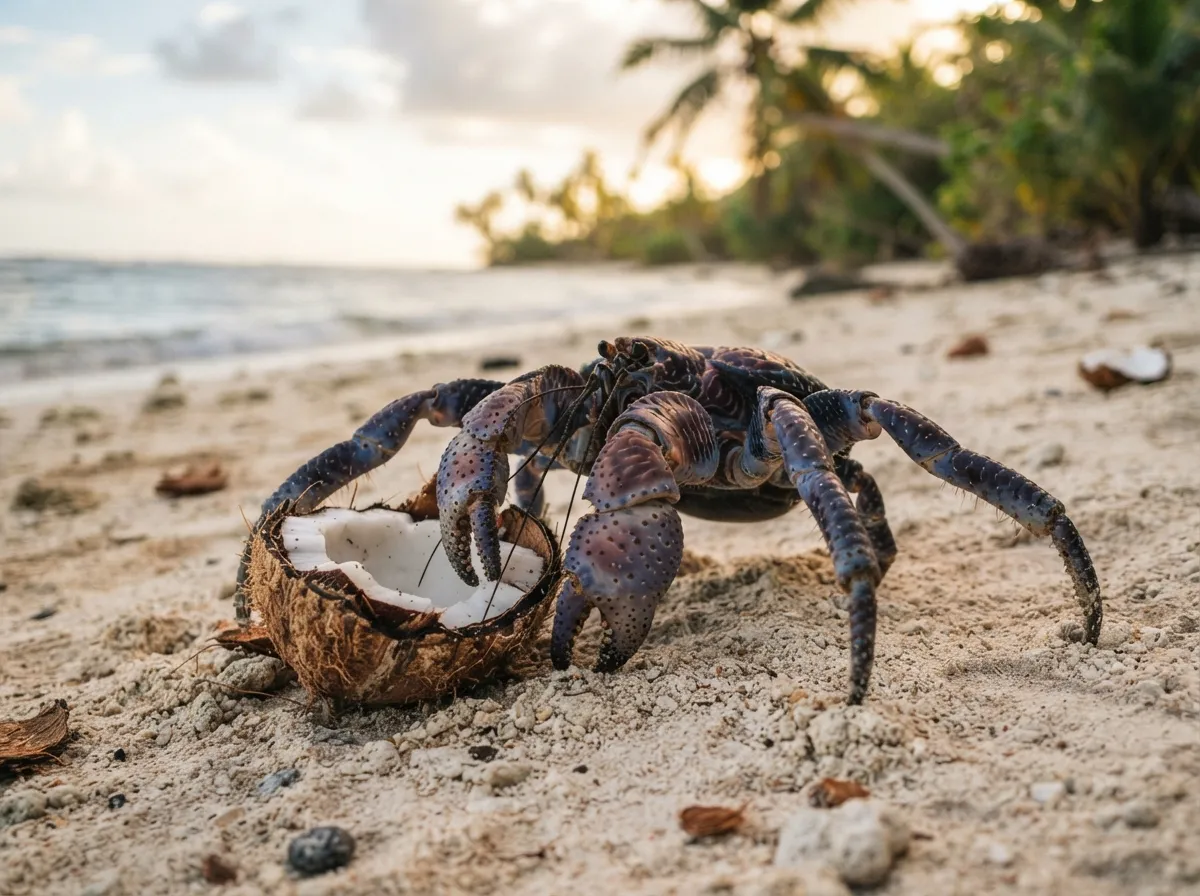
The reef provides fish, shellfish, sea urchins, and crabs in abundance at low tide. Coconut crabs (Birgus latro), the largest terrestrial arthropod in the world—weighing up to 4.1 kg with a leg span exceeding 90 cm—are easily spotted at night near coconut palms, which they know how to crack open; in the Philippines, the species is listed as threatened and harvesting is regulated, something to keep in mind depending on the archipelago. Sea turtles are protected almost everywhere (CITES Appendix I, ban on trade): while castaways on Tromelin or 19th-century Caymanians lived off them extensively, today legal and ethical constraints must take priority unless your survival is genuinely on the line. Seabirds and their eggs, nesting in colonies on rocky bluffs, remain a straightforward and abundant resource almost everywhere.
Two other reef hazards demand constant vigilance. The stonefish (Synanceia), the most venomous fish known, blends perfectly with rocks on the seabed; its sting causes excruciating pain and can kill—the primary first-aid treatment is immersing the wound in water as hot as tolerable (at least 45 °C / 113 °F) to denature the venom. And ciguatoxin, present in over 400 species of reef fish (barracuda, grouper, moray eel, and amberjack leading the list), cannot be seen, smelled, or cooked out.
The fire you never let die
Driftwood, sun-dried and impregnated with salt, burns well once dry—and coconut husk, fibrous and oily, makes formidable tinder once frayed. Without a lighter, a bow drill works here just like anywhere else (see the Fire module for the full technique), provided you find soft, dry wood—often harder to come by along the shore than inland.
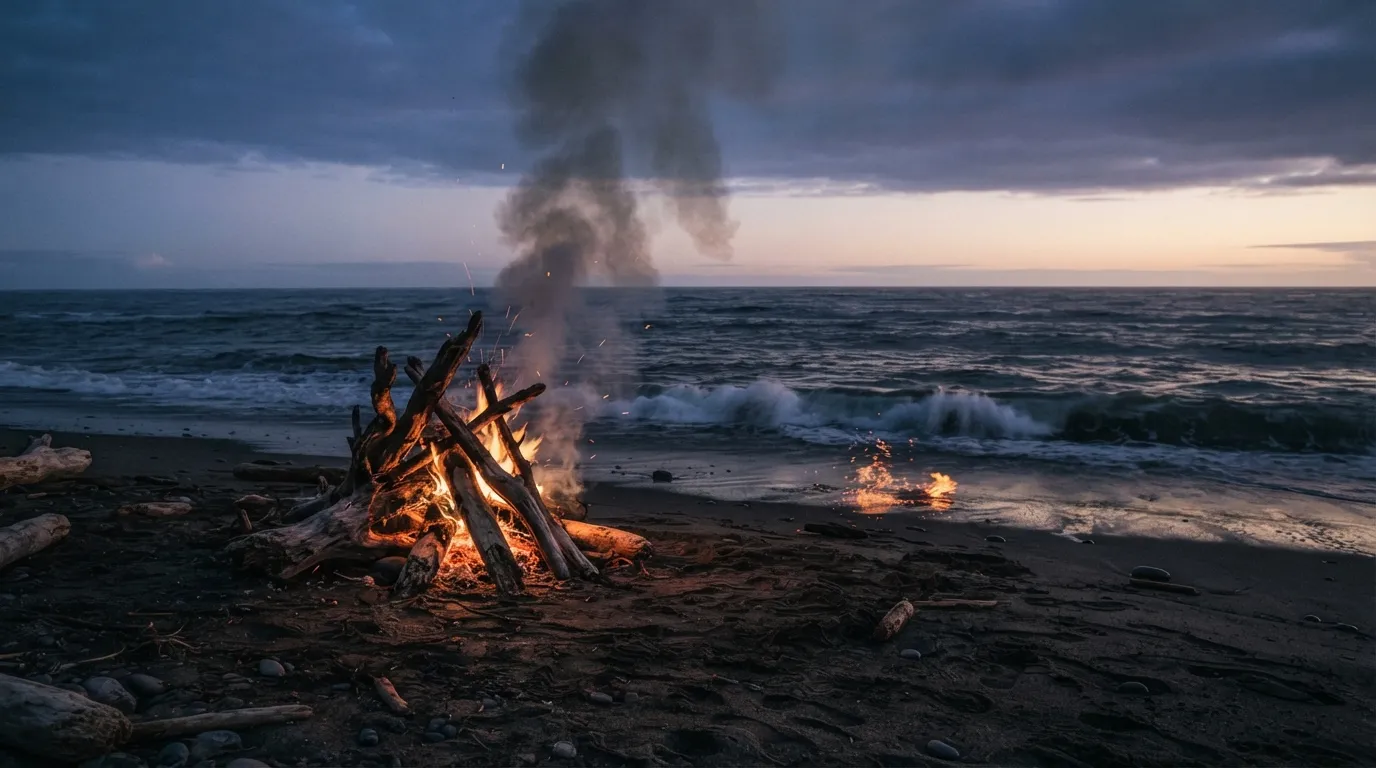
The real challenge isn’t lighting a fire, but keeping it burning constantly: it provides heat, cooks, reassures, and acts as a signal at all hours. The castaways on Tromelin kept theirs lit for fifteen years using wood from the shipwreck—2010 excavations even uncovered fire-steels and flints that allowed them to reignite it if it accidentally went out. Cover coals with sand or ash overnight to retrieve glowing embers in the morning, just as you would with any long-term fire (see the Fire module).
Shade, wind, and the legend of falling coconuts
In the tropics, shade isn’t a comfort: it’s what prevents heatstroke. A basic shelter—woven palm fronds, a tarp stretched between two trunks—must block the midday sun while letting air circulate, or it will turn into an oven. Look for slightly elevated ground, sheltered from the prevailing wind but not in a low hollow where humidity settles.
Making yourself seen: SOS, fire, mirror
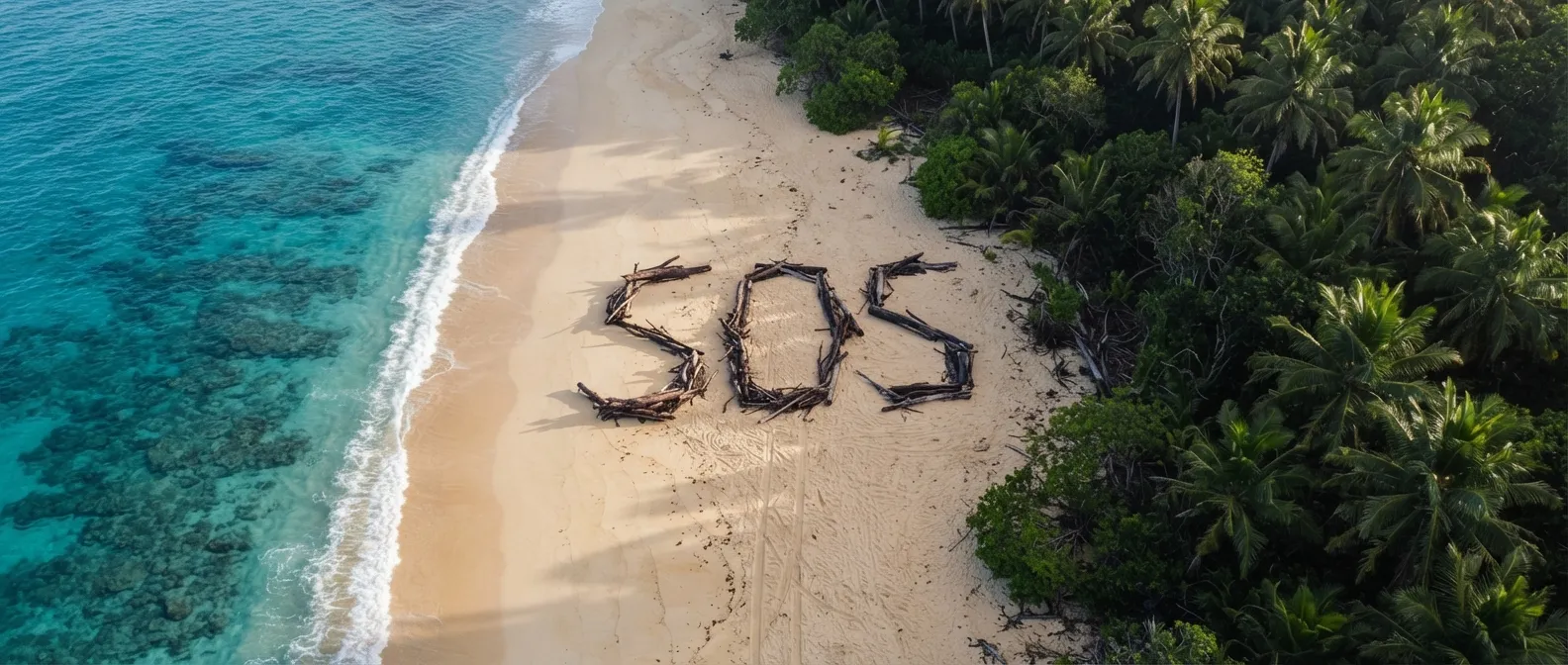
A fire maintained around the clock also serves as a beacon. The international standard for distress signals relies on a simple rule applicable across all mediums: three of anything (three fires, three whistle blasts, three flashes of a mirror) signals distress, whereas a single signal blends in with chance. On the sand, lay out an SOS with letters at least three meters long so they are visible from an aircraft—contrast matters far more than neatness: dark wood on light sand, or the reverse using green palm fronds.
A signal mirror remains the most powerful daytime tool: its range depends on its diameter, delivering roughly 16 km of visibility for every 2.5 cm of mirror size. But all these techniques only work if someone passes by: cargo ships and commercial flights follow strict maritime and air corridors, often dozens of kilometers away from isolated islands. If possible, gauge your proximity to shipping lanes before spending all your energy on visual signalling rather than on a permanent, long-range fire.
Sun, salt, and the long haul
Tropical sun burns fast and deep, especially when reflected off sand and water—a factor that is frequently underestimated. Salt-soaked clothing eventually chafes and infects skin folds (groin, armpits): rinsing with fresh water whenever possible, even in tiny amounts, keeps these sores at bay. Mosquitoes, active mainly at dusk and dawn, carry dengue fever in over a hundred tropical countries; without insect repellent, a smoky fire and long clothing during peak hours remain your best available protection.
Over time, the true nutritional threat is scurvy: it sets in after about a month without vitamin C, starting with fatigue and joint pain, followed by bleeding gums and non-healing wounds. A ridiculously tiny amount prevents it—around 10 mg per day of raw food rich in vitamin C—and on a tropical island, native fruits (coconuts, wild fruits), certain seaweeds, and raw fish flesh supply plenty to keep it away.
Why you shouldn’t leave on a raft
Instinct urges you to build a raft and row for the horizon. This is almost always a bad idea. An island, no matter how small, is a fixed, visible point where search-and-rescue teams know to look first—the exact same logic that dictates you should never abandon a stranded vehicle to strike out on foot without certainty. Out on the open ocean, without charts or instruments, your drift depends on currents and wind, not your determination: stories of castaways who drifted for months, like Steve Callahan, show just how much more hostile the high seas are compared to an island that already offers water, food, and shelter. Only set sail if you know with absolute certainty that inhabited land is close and reachable—never on a directional hunch.
Staying sane for the long run
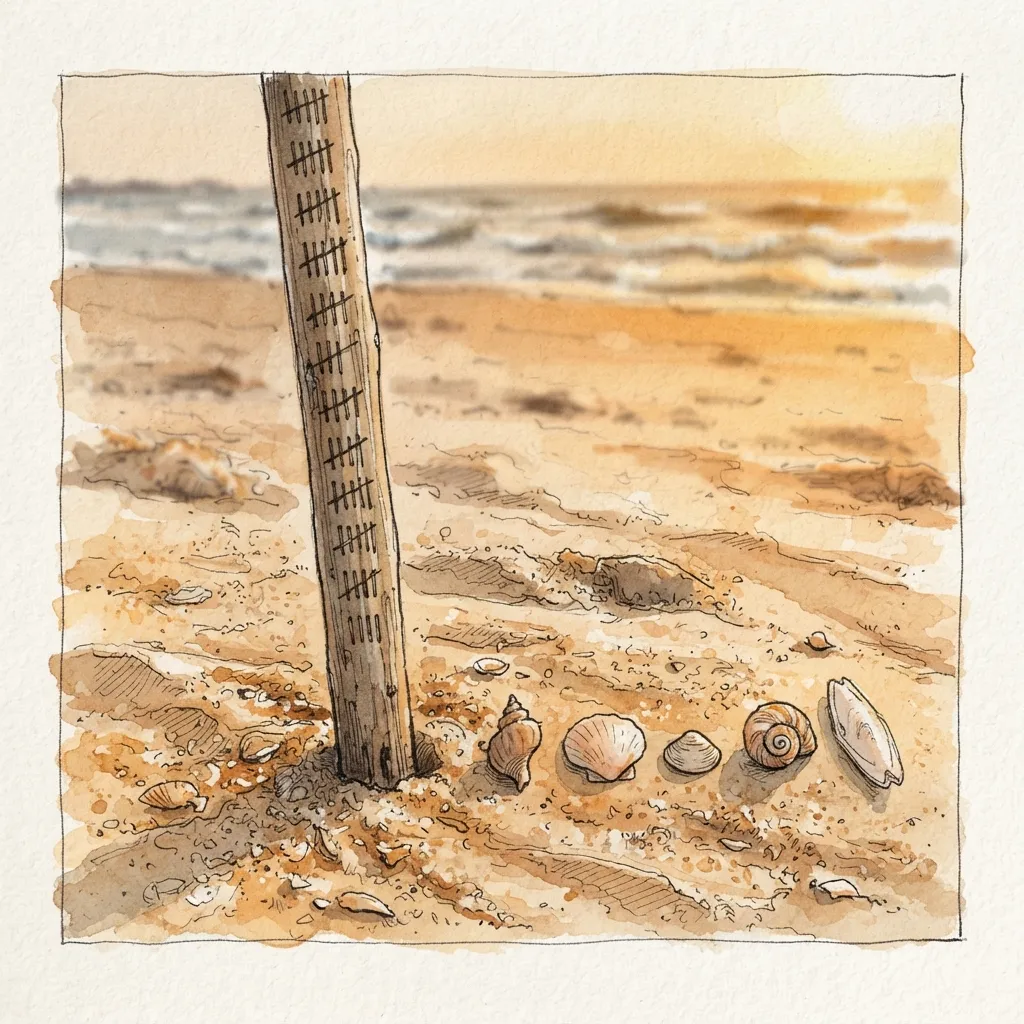
The movie Cast Away shows a survivor spiraling into acute mental distress—that’s partly true, partly Hollywood: the reality for Tom Neale, the Tongan boys, or the Tromelin castaways resembles an established routine far more than a permanent nervous breakdown. Setting daily tasks (tending the fire, gathering water, marking the passage of time), maintaining small rituals, and—like the six Tongan boys who, according to accounts gathered after their rescue, set up guard rotations and resolved disputes using shared rules—organizing as a group rather than letting everyone fend for themselves are the key levers found in nearly every long-term survival story. The mindset guide breaks down these mental mechanisms in detail; for now, remember that routine isn’t a luxury—it’s what keeps you alive.
Island law and where to test yourself
Not all deserted islands are unclaimed—most belong to someone. A private island remains subject to the national jurisdiction of its host country: its owner cannot make up their own laws, and in several nations (like the UK or Brazil), the beach itself remains public land despite private ownership inland. Tromelin has belonged to the French Southern and Antarctic Lands since 2007; like the other “Scattered Islands”, it is an uninhabited territory requiring special permits to land—and is, moreover, claimed by Mauritius. Before setting foot on an island that looks uninhabited, check first: nature reserves, military zones, or disputed territories don’t look any different from offshore.
If you want to experience island survival voluntarily, several archipelagos cater to it: Tonga, with 171 islands of which only 45 are inhabited, offers the largest legal wilderness playground in the Pacific; the Philippines, around Palawan, features hundreds of rarely visited coral islets. Specialized outfits (such as Desert Island Survival) run structured 10-to-12-day courses combining technical training and off-grid survival challenges across the Philippines, Maldives, Tonga, or Panama—our site map lists several accessible locations and courses around the world for anyone wanting to test their skills under proper supervision, rather than actually getting lost.
Frequently asked questions
How long can someone survive on a deserted island?
Months or even years, provided fresh water is located quickly: Tom Neale spent a cumulative sixteen years on his atoll, and the castaways of Tromelin held out for fifteen years. Survival limits are almost always imposed by water, sun, or infection—rarely by hunger, as long as a reef or coconut palms are available.
Can you drink coconut water instead of fresh water?
No, not indefinitely. Coconut water hydrates, but it contains high levels of potassium and very little sodium—the exact opposite of what your body loses through sweat. Drunk in excess, it can trigger severe diarrhea, which speeds up dehydration. Use it as a supplement, never as your sole water source.
How do you find fresh water on an island with no rivers?
Look for a freshwater lens: a pool of infiltrated rainwater that floats on top of denser salt water beneath the sand behind the beach. Digging a shallow well a few meters down where vegetation grows thickest is often enough to reach it—this exact technique allowed the castaways on Tromelin to survive for fifteen years.
Is it safe to eat any reef fish you catch?
No: over 400 species of reef fish, especially large apex predators like barracuda or grouper, can carry ciguatoxin—a toxin that cannot be seen, tasted, or cooked away. Sticking to small pelagic fish rather than large reef carnivores significantly reduces your risk, though it never eliminates it entirely.
Should you stay on the island or try to leave on a raft?
Stay put, in the vast majority of cases. An island is a fixed location that rescuers know how to search, stocked with accessible water, food, and shelter. A raft in open ocean is at the mercy of currents, not willpower, turning a manageable situation into a deadly gamble. Only take to the sea if an inhabited landmass is confirmed close and reachable.
Are falling coconuts actually dangerous?
The risk is real, but the widely quoted figure of “150 deaths per year worldwide” is a myth born from a misreading of a 1984 study that recorded zero actual deaths. While setting up camp away from heavy coconut clusters is basic common sense, it shouldn’t consume all your attention.
Key takeaways
- Water dictates everything before food: find a freshwater lens set back from the beach, or collect rainwater using broad surfaces.
- The reef provides plenty of food, but ciguatera, cone snails, and stonefish strike without warning: avoid large reef predators and never handle live shellfish.
- A permanent fire keeps you warm, cooks food, and signals your position all at once—keeping it burning matters far more than lighting it once.
- Stay on the island almost every time: a fixed location with food and water beats a drifting raft.
- Daily routine and group structure have kept castaways alive for years—rely on steady discipline over single-day heroics.
Further reading
- Irène Frain, The Shipwrecked of Tromelin (2009)—the definitive historical account of the abandoned Malagasy castaways.
- INRAP, archaeological campaign reports on Tromelin (2006–2013)—scientific breakdowns of the well, fire pits, and stone shelters discovered on the island.
- Tom Neale, An Island to Oneself (1966)—a firsthand account of choosing to live isolated on an atoll over sixteen cumulative years.
- Desert Island Survival—for those wanting to experience off-grid survival under expert instruction on a real tropical island.
Sources for this module (23)
- Wikipedia EN — Alexander Selkirk
- Wikipédia FR — Île Tromelin
- Wikipedia EN — ʻAta (les six garçons tongiens)
- Wikipedia EN — Tom Neale
- Wikipedia EN — Anuta
- Wikipédia FR — Ada Blackjack (récit complet sur ce site)
- Wikipedia EN — Ciguatera fish poisoning
- Wikipedia EN — Solar still
- Wikipedia EN — Scurvy
- Wikipedia EN — Stonefish
- Wikipedia EN — Cone snail
- Wikipedia EN — Coconut crab
- Wikipedia EN — Death by coconut
- Wikipedia EN — Freshwater lens
- Wikipedia EN — Heliograph
- Wikipedia EN — Green sea turtle
- Wikipedia EN — Dengue fever
- Wikipedia EN — Coconut water
- Wikipedia EN — Rainwater harvesting
- Wikipédia FR — Terres australes et antarctiques françaises (statut de Tromelin)
- Wikipedia EN — Private island
- Wikipedia EN — Tonga
- Desert Island Survival — stages réels sur îles tropicales
Continue in "By environment"
The temperate forest
The most generous environment in the world can also swallow you in ten minutes: here is how to read it instead of fearing it.
Mountains: Where the Weather Decides for You
The weather changes in thirty minutes, altitude works against you, the terrain is unforgiving: the signs to read before it's too late.
Snow, extreme cold, and the Far North: surviving at minus 30
Cold doesn't kill you: humidity, exhaustion, and panic do. What you need to know to stay alive below zero.