The Kit: What Should Be in Your Pockets, Backpack, and Car
What you carry on you saves you when you lose your pack: the kit hierarchy and essential checklists you shouldn't improvise.
It’s 2:00 PM. You head out for an “easy” three-hour walk, the kind where you don’t pack much. An ankle twists on a root, the sky turns, and night falls before you make it back to the car. What you have on you at that exact moment—not what stayed in the pack you left at the campsite, not what’s in the trunk—is all you can rely on. A kit isn’t a checklist you tick off once before heading out: it’s a hierarchy you build once and for all.
The Hierarchy: What You Wear Is Worth More Than What You Carry
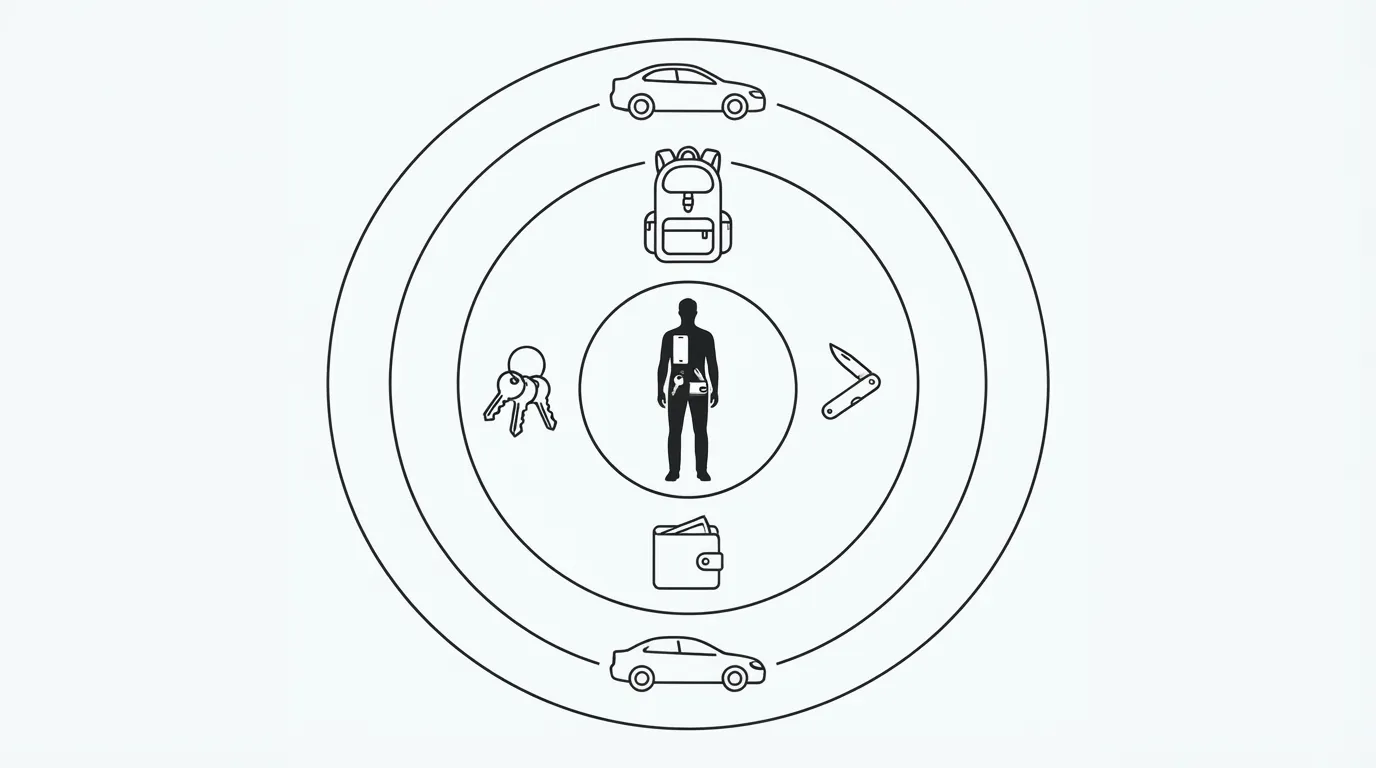
Almost everyone makes the first mistake: thinking of a kit as a single object, a bag you pack once. In reality, survival gear works in four concentric circles, from closest to your body to furthest away. Each circle is insurance against losing the previous one.
- On you: what you carry in your pockets or around your neck, even when you change clothes. This is what you have left if your pack floats down a river, gets caught on a branch during a fall, or if you set it down for “two minutes” to take a photo and can’t find it again.
- EDC (everyday carry): the slightly broader set of gear you keep on you daily, even off the trail—wallet, knife, flashlight, lighter. Wikipedia sums it up well: EDC solves small daily problems as well as emergencies, even before heading into the wild.
- The pack: what fits in your daypack, adapted to the length of your trip—a few hours, a full day, or several days.
- The vehicle: what stays in your car, accessible even if you didn’t plan for it that day—useful if you’re stranded by snow, a breakdown, or forced into an unplanned overnight stay on the road.
The Wikipedia article on everyday carry uses the same three-tiered logic: light and practical daily carry, supplemented by “a more substantial survival kit” for serious situations, and finally the bag reserved for evacuation. It’s no coincidence that practitioners have repeated this exact rule in different ways for a century: an item left in a bag at the bottom of your trunk is useless the day you leave without it.
The Pocket Kit: The Time-Tested Altoids Tin
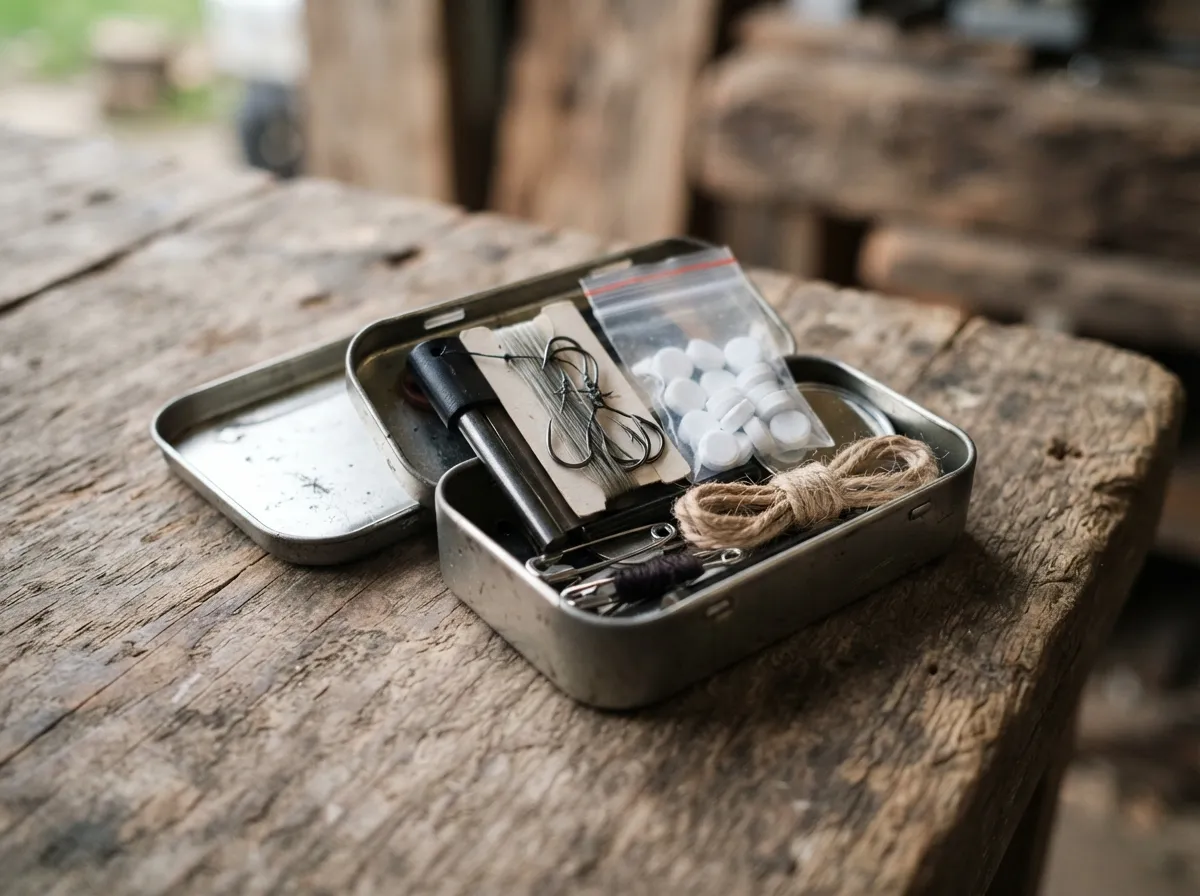
The legend of the miniature survival kit comes from an unlikely container: a flat, rainproof mint tin small enough to fit in a jacket pocket. We don’t recommend this brand for its mints, but for its format—roughly 9 x 6 x 2 cm, weighing around a hundred grams when full. It has been a standard among hikers and military personnel since the 2000s because it ticks every box: rigid, flat, and waterproof if you seal the lid with a wrap of tape.
Everything inside must answer a single question: what would I miss the most if I lost my pack right now? No duplicates with your main pack, no gimmicks—space is measured down to the cubic centimeter.
The Daypack: The Modern Ten Essentials
The most cited gear list in the world for a day hike comes from American mountaineering clubs—The Mountaineers and The Mazamas—and is nearly a century old. It first appeared in its current form in the third edition of Mountaineering: The Freedom of the Hills in 1974. It was later updated in the ninth edition (2017) to focus on functional systems rather than individual items: ten core categories, each filled with whatever gear you have on hand.
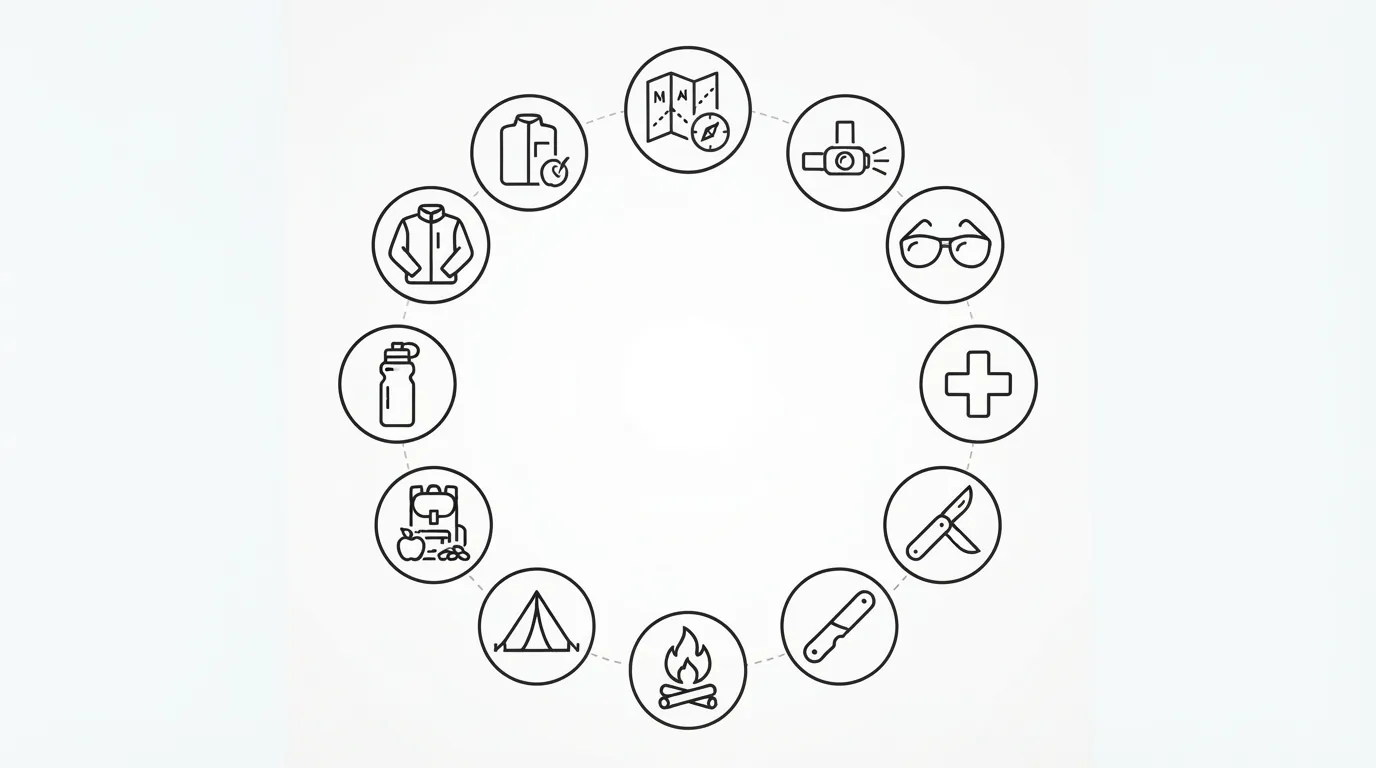
- Navigation: map, compass, optionally an altimeter, GPS, or beacon—never just your phone.
- Headlamp with extra batteries.
- Sun protection: sunglasses, sunscreen, protective clothing.
- First aid kit, in a waterproof bag.
- Knife or multi-tool, plus repair supplies (cordage, tape).
- Fire starters: lighter, matches, or ferro rod, plus tinder.
- Emergency shelter: heavy-duty trash bag, light tarp, or bivy sack.
- Extra food: at least one extra day’s worth of no-cook food.
- Extra water, plus a way to treat more.
- Extra clothes: enough to survive an unexpected night outdoors.
The logic behind the list matters: the first five prevent or manage an incident; the last five allow you to spend a night outside safely if your “day hike” takes longer than planned. Regional clubs adapt the list to their terrain—the Wasatch Mountain Club in Utah prioritizes water over food for desert trips; the Spokane Mountaineers expand it to thirteen items by adding an emergency blanket and hygiene supplies; the Central Arizona Mountain Rescue pushes it to twelve, placing heavy emphasis on signaling. The list isn’t set in stone: it’s a framework—ten functional categories—that you tailor to your environment.
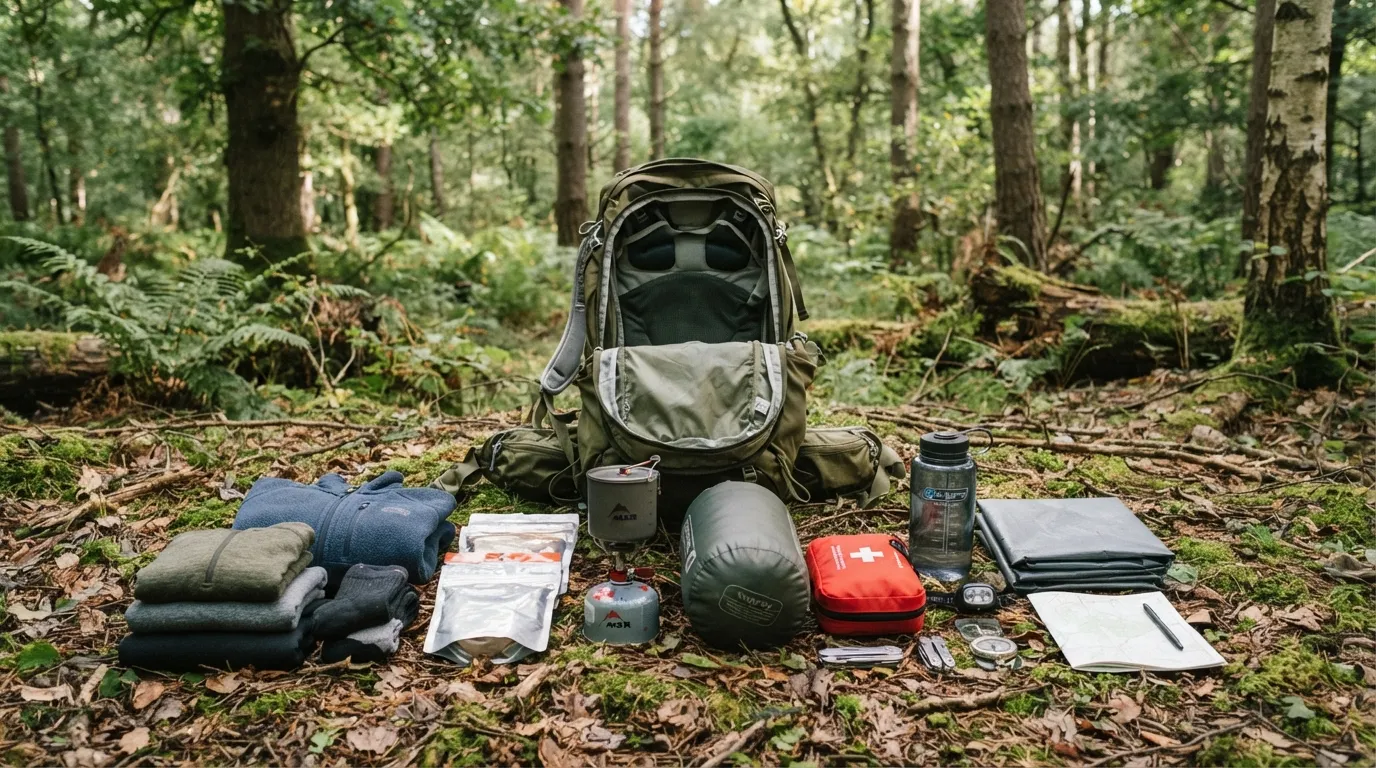
The 72-Hour Pack: Not for the End of the World, Just to Get Home
The term comes from the Korean War, where the US military ordered units to “bug out”—retreat urgently—carrying only what they could pack. The 72-hour figure comes from disaster relief organizations: it’s the standard timeframe they estimate to reach an affected area. In a wilderness context, forget apocalyptic scenarios: a 72-hour pack is for when a multi-day trek goes wrong, when a trail is blocked and you have to wait or walk longer than planned, or when an evacuation forces you to head back to civilization on foot.
The Car Kit: Winter and Desert
Your vehicle is the fourth circle, often forgotten because we don’t associate it with the “outdoors”—until a mountain road closes under heavy snow, or a desert track strands your car far from cell service. US official guidance (Ready.gov, the Federal Emergency Management Agency) recommends basic, practical gear: jumper cables, flares or a reflective triangle, ice scraper, phone charger, blanket, paper road map—and one unexpected item: cat litter or sand, sprinkled under tires to gain traction on ice.
In the desert, the logic flips: less cold, more focus on water and time. A vehicle stuck in sand or broken down far from help becomes your primary shelter (the shade it casts is better than your own) and a far more visible landmark for rescue teams than a single human outline. The classic rule remains: stay with the vehicle rather than walking off under the sun, unless you are 100% certain of the distance to help.
Canterbury’s 10 Cs: What No List Should Omit
American survival instructor Dave Canterbury, a former military veteran turned bushcraft instructor (author of the bestseller Bushcraft 101, 2014), popularized a shorter, more memorable list than the Ten Essentials: the 5 Cs, later expanded to the 10 Cs. Each item starts with the same letter so you can recall it easily from memory.
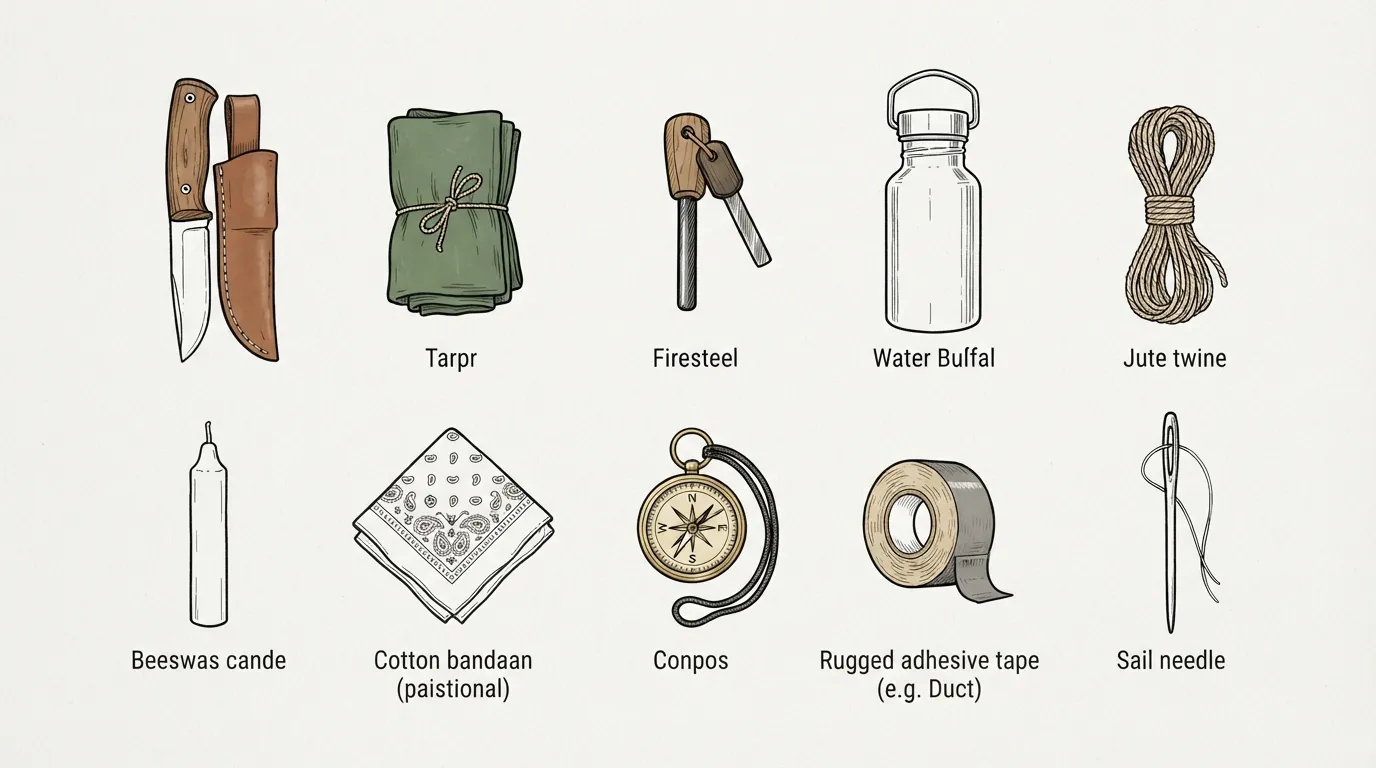
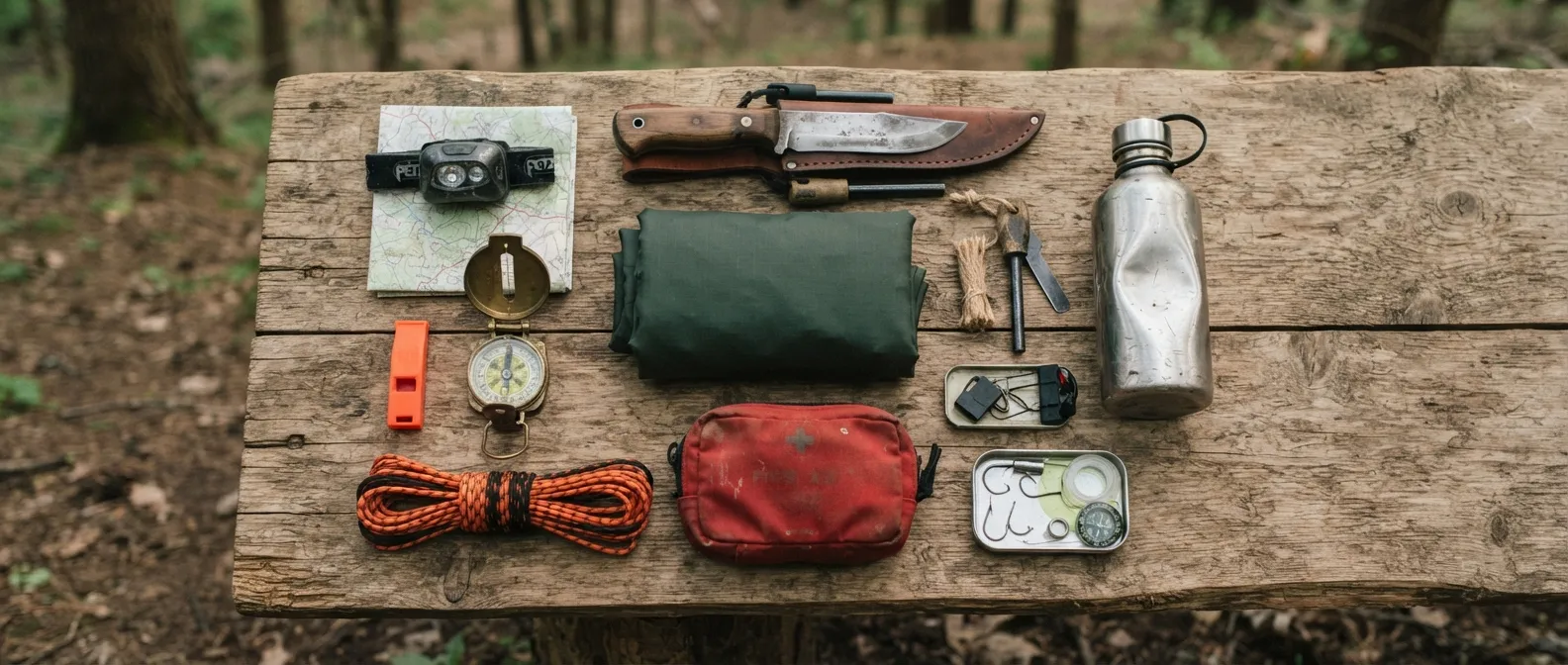
- Cutting tool: a reliable fixed-blade knife, the foundation for everything else.
- Cover: a tarp or poncho—one of the heaviest items in your pack, but one of the most vital.
- Combustion: a ferro rod rather than just a lighter, because it won’t run out or fail when wet.
- Container: a metal bottle that can also boil water—see below why this detail changes everything.
- Cordage: paracord, whose inner strands can be unraveled for sewing thread or fine fishing line.
- Cotton: a 100% cotton bandana—tinder, rough filter, bandage, sun protection.
- Compass: works without batteries, never runs out of power.
- Cargo tape (duct tape): repairs, first aid, tinder.
- Candling device (candle/flashlight): a light and heat source independent of main batteries.
- Canvas needle: for repairing fabric, packs, and boots—the C everyone forgets.
This site uses this classification in its gear comparison tool: out of 40 items tracked in our kit and weight dataset, exactly 10 match the “10 Cs”—the list isn’t just decorative, it represents a core set of survival tools.
Water, Fire, Shelter: The Non-Negotiable Three
These are the three needs that will kill you fastest if unmet, and the three areas where your kit requires redundancy—never rely on a single item.
Water: The Bottle That Doubles as a Pot
The CDC (U.S. health agency) gives precise boiling guidelines: bringing water to a rolling boil for one minute kills pathogens at sea level. Above ~2,000 meters (~6,500 feet) in altitude, extend that time to three minutes, because water boils at a lower temperature. This is the main advantage of a single-wall metal bottle: it acts as an emergency pot without taking up extra space.
Fire: Three Methods, Never Just One
Redundancy isn’t a luxury: lighters freeze, ferro rods get dropped, matches get soaked. The basic rule across survival manuals is simple: carry at least three independent fire starters, stored in different places, not all crammed into one pocket. We cover fire-starting techniques—ferro rod, flint, magnifying glass, friction—in detail in the Fire module. For your kit, just remember that fire starter redundancy is an equipment choice, not just a skill.
Shelter: Tarps, Bivy Bags, and the Limits of Mylar Blankets
A 3 x 3 meter silnylon tarp packs down to the size of your hand and provides enough coverage for a lean-to or a low-pitched shelter. A heavy-duty orange survival bag (often called a bivy or survival bag) costs a few dollars, weighs about a hundred grams, and does something a thin space blanket can’t: it fully encloses your body, resists tears, and its bright color works as a signal.
Standard emergency blankets are made of metallized polyester film (often called Mylar) that reflects up to 97-99% of radiated heat and infrared. NASA originally developed this technology in 1964 for spacecraft thermal insulation. It’s an impressive stat, but it hides two major flaws: it provides almost no protection against conduction or convection (wind blows right through unless sealed completely), and the thin film tears easily—making it essentially single-use. A bivy sack made of woven aluminized fabric, like the SOL Escape Bivy, costs more than a disposable blanket, but it can be washed, refolded, and reused repeatedly.
| Single-Wall | Double-Wall Insulated | |
|---|---|---|
| Can boil water over fire | ✅ | ❌ (risk of rupture) |
| Keeps drinks hot/cold for hours | ❌ | ✅ |
| Typical weight (750 ml-1 L) | ~150-200 g | ~350-450 g |
| Role in the 10 Cs kit | Container | Comfort item, outside 10 Cs |
Light, Navigation, Signaling
Light: Never Rely on a Single Battery
Modern LED headlamps draw very little power and cast bright light compared to incandescent flashlights from a century ago—1910s miner lamps produced barely 2 to 5 lumens after twelve hours, while modern headlamps easily reach hundreds. For your kit, sheer brightness matters less than never relying on a single battery. Keeping a spare battery set packed separately, or using a headlamp that takes both rechargeable packs and standard disposable batteries, keeps you from being left in the dark.
Navigation: Paper Never Runs Out of Battery
A topographic map and compass remain at the top of every Ten Essentials list worldwide—ahead of GPS units and smartphones. A phone in airplane mode with offline maps downloaded in advance is a great secondary tool, but never a primary one: batteries die, screens crack, devices get lost or water-damaged. Full details on navigating with map, compass, and stars are covered in the Navigation module.
Signaling: Voice, Whistle, Mirror, Satellite
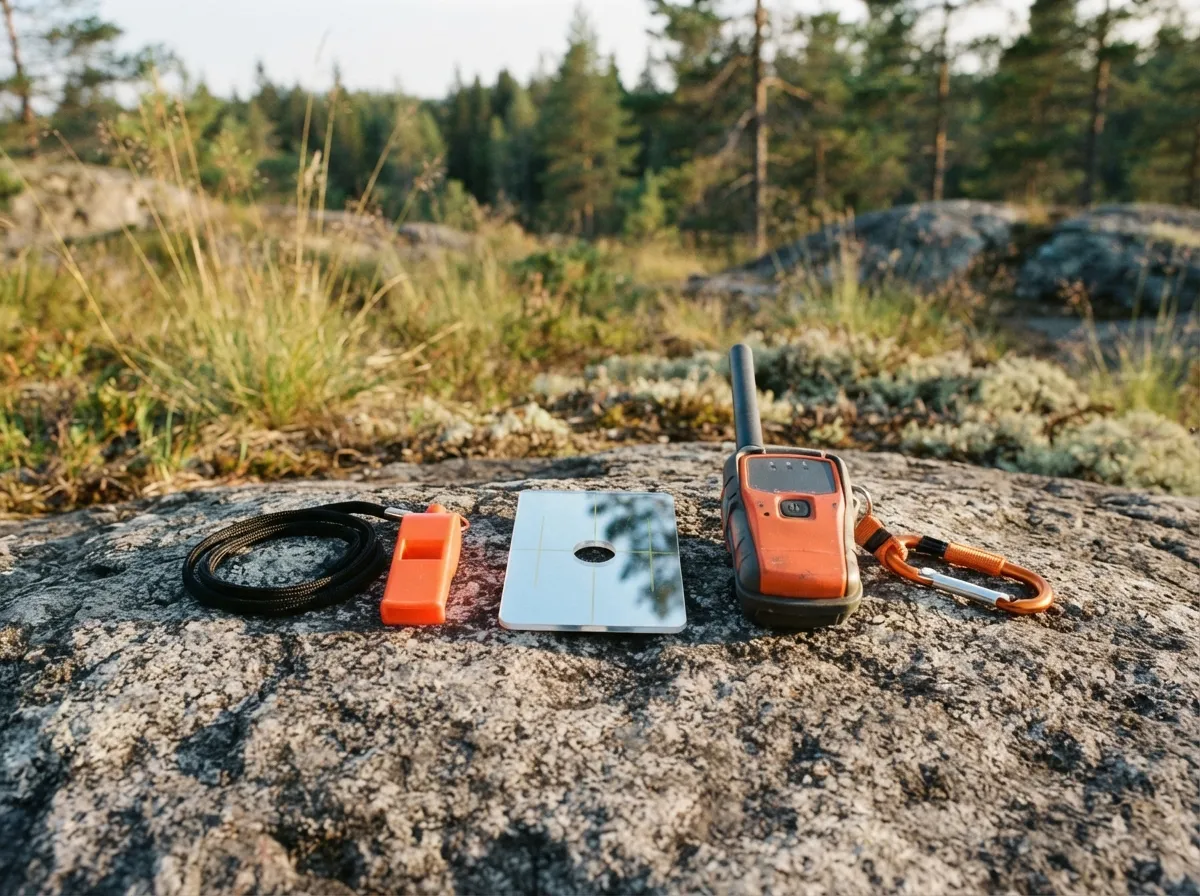
A whistle carries eight to sixteen times farther than a human shout and won’t exhaust your vocal cords. This has been documented since Joseph Hudson invented the pea whistle in 1883 for the London police, creating a tool that could carry sound over a mile away. A dedicated signal mirror, meanwhile, can flash light up to 100 miles (160 km) in optimal conditions—far beyond the reach of a hand flare.
When sound and mirrors can’t reach anyone, two types of satellite emergency devices come into play. A PLB beacon (406 MHz, Cospas-Sarsat network) costs a few hundred dollars to buy with zero subscription fees. PLBs have contributed to over 50,000 rescues since 1982, broadcasting continuously for 24 to 48 hours once activated, with GPS-enabled accuracy down to about 100 meters. A two-way satellite messenger (like a Garmin inReach) costs roughly the same upfront but requires a monthly subscription. In return, it lets you send and receive text messages, rather than just firing off a one-way distress signal.
| Whistle + Mirror | PLB Beacon | Satellite Messenger (inReach) | |
|---|---|---|---|
| Range | A few hundred meters to ~160 km (mirror, full sun) | Global (satellite) | Global (satellite) |
| Subscription | None | None | Required monthly |
| Two-way messaging | ❌ | ❌ (location only) | ✅ |
| Weight | ~45 g combined | ~180 g | ~113 g |
| Battery failure risk | ❌ Never | ✅ (Rare, long shelf life) | ✅ |
For full specs—price, weight, and signal range for each option—check out our signaling comparison page.
First Aid: Low Weight, High Utility
A wilderness first aid kit doesn’t need to look like a hospital pharmacy: it needs to treat real outdoor injuries—blisters, cuts, sprains, allergic reactions, and pain—at a weight that won’t convince you to leave it behind. Specific treatments and recommended supplies are covered in the First Aid module. For your kit, follow this simple principle: a basic kit you always bring and know how to use beats a complete medical kit sitting at home in a closet.
Weight: The 20% Rule and Ultralight Backpacking
An overly heavy pack isn’t safe—it’s dangerous. Excess weight leads to fatigue, joint strain, falls, and poor decision-making as your body wears down. The standard guideline among trekking guides and outdoor organizations is to never exceed 20% of your body weight for a healthy adult on a multi-day trip (less for children, up to one-third for trained haulers on short trips).
On the other end of the spectrum, the ultralight movement popularized a concept that benefits every hiker, regardless of gear preferences: base weight. This is the weight of your packed bag excluding food, water, and fuel—the consumables that change daily. Ray Jardine, who pioneered ultralight hiking with his 1992 book PCT Hiker’s Handbook, cut his base weight from 5.7 kg on his first Pacific Crest Trail thru-hike down to under 4.5 kg on his third. Modern conventions classify a base weight under 4.5 kg (10 lbs) as ultralight, under 6.8 kg (15 lbs) as lightweight, and 6.8 to 13.6 kg as “traditional.” Andrew Skurka, who has hiked tens of thousands of miles refining this approach, maintains a base weight of 3 to 3.6 kg (excluding food, water, and fuel) while covering 35 to 45 miles per day.
For a full breakdown of 40 standard items—their weights, costs, and multi-use ratings—explore our kit and weight comparison tool. Complete advice on selecting and packing your backpack lives in the Backpack module.
Kits by Environment
Your core kit—water, fire, shelter, light, navigation, first aid—stays the same. What shifts is the emphasis you place on specific items.
- Snow/Winter: double your fire starters (cold drains batteries and butane fuel quickly), pack chemical hand warmers, a folding shovel, glacier glasses to prevent snow blindness, and prioritize extra insulation over raw shelter size.
- Desert: water management trumps everything else—bring several liters per person per day, a dedicated shade shelter (reflective tarp, not just clothing), lip and nasal balm against dry air, and shift your hiking schedule to move during cooler hours.
- Ocean/Coastal: focus on buoyancy and long-range signaling (mirrors, flares). Fresh water becomes your primary bottleneck since seawater isn’t drinkable, and store all electronics inside dry bags, not just “water-resistant” pouches.
- Jungle/Tropical: persistent dampness changes everything—pack a machete over a hatchet, a head net, and insect-repellent treated clothing. Use individual dry bags inside your pack for every single item (nothing stays dry otherwise), and pay special attention to foot care, as fungal infections spread fast in hot, humid climates.
Kits by Duration
A two-hour day walk and a ten-day expedition share the same core Ten Essentials foundation. As trip duration increases, your repair kit needs to grow (sewing gear, stove repair parts, extra duct tape), and gear redundancy becomes far more critical. On a short day hike, losing your only lighter is an inconvenience; on a ten-day solo trek, it can turn into a serious emergency. The basic rule: one night out requires a 72-hour pack setup; multi-day trips take a 72-hour pack plus additional food and repair supplies. Extra duration mostly means carrying more food and backup options, rarely completely new types of gear.
What Everyone Always Forgets
A few small items show up on almost every list of “things I regretted leaving behind,” usually because they seem insignificant when packing at home:
- A spare pair of prescription glasses, if you wear them: breaking your main pair in the backcountry instantly impairs you, and a spare frame weighs almost nothing.
- Personal medications, packed with extra days to spare—a delay on the trail should never turn a routine prescription into a medical crisis.
- ID cards and cash, kept in a waterproof pouch for return travel, emergency identification, or unexpected expenses.
- A heavy-duty trash bag, which serves as a makeshift shelter, rain poncho, ground cloth, or pack liner to separate wet gear.
- Duct tape, wrapped around a card or trekking pole rather than carrying a full roll—it repairs almost anything, including a boot sole coming unglued.
Kids’ Kits and Dog Kits
Kids’ Kits
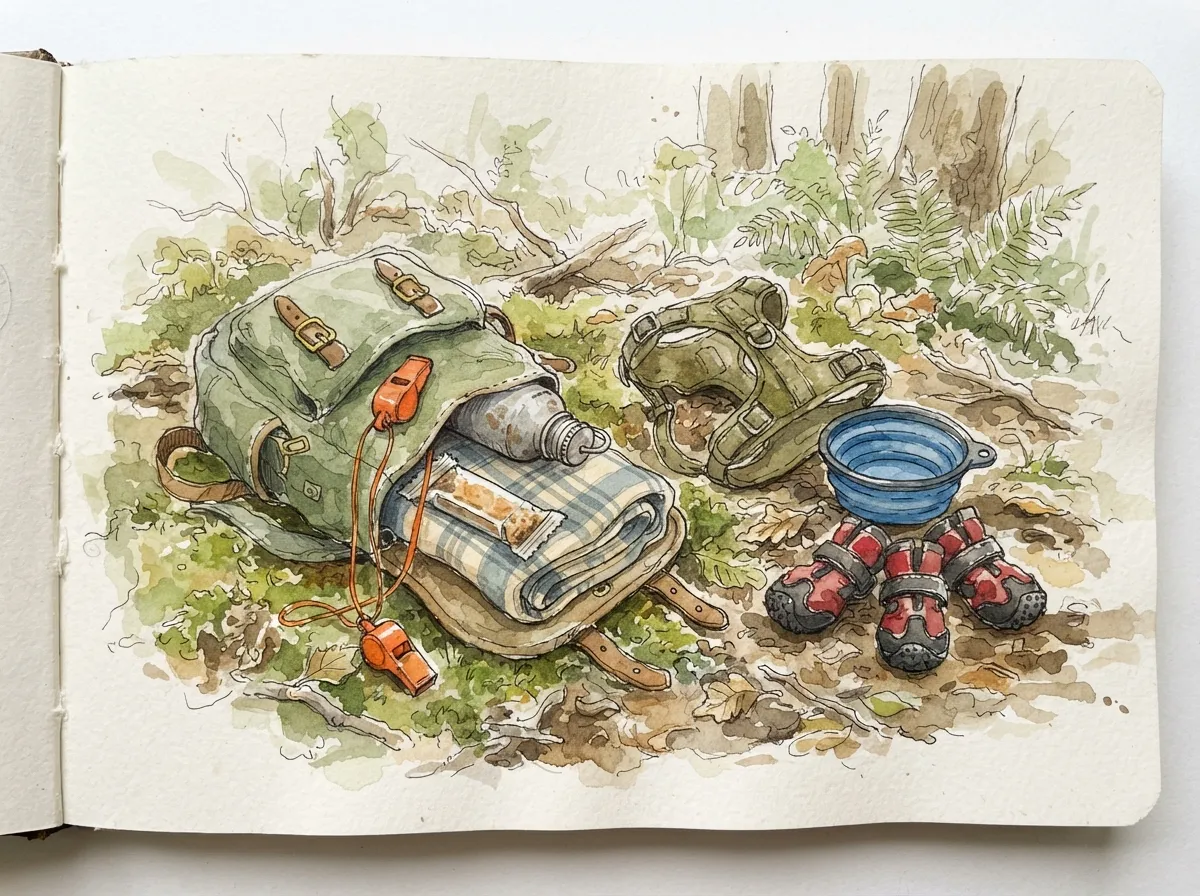
A child on a trail should carry a pack scaled to their size, not an adult pack stuffed with less gear. A whistle, worn around the neck and never packed away, is their most important safety item. The full protocol for teaching kids how to signal for help and stay put is covered in the Lost Child module. The checklist below builds on that foundation, designed to fit in a small backpack.
Dog Kits
A dog joining you on a trek has its own requirements: extra water (they can’t carry enough on their own unless wearing dog panniers), a lightweight collapsible bowl, and foot pad care—the primary site of injury on rocky or scorching terrain. Protective boots have a long history in sled dog racing: the Yukon Quest, a 1,000-mile endurance race across Alaska and the Yukon, mandates that mushers carry at least eight booties per dog, with teams replacing 2,000 to 3,000 boots over the course of a single race.
How to Test Your Kit: An Overnight in the Garden
The absolute best test for a survival kit isn’t re-reading a checklist—it’s spending a night outdoors where failure carries no consequence. Pick your backyard or a familiar spot five minutes from your front door, ideally when the weather isn’t perfectly warm, so it acts as a true test. Pitch your shelter using only the gear in your pack, start a fire using your packed fire starters, and sleep in the bag rated for the temperature outside. The next morning, write down what you lacked, what was useless, and what added weight for no real benefit.
- Pick slightly uncomfortable weather: avoid dangerous storms, but skip warm, clear summer nights—slight cold or rain reveals gear flaws fast.
- Use strictly what is inside your pack: bring nothing extra out from the house “just in case.”
- Set up shelter and start your fire using the exact gear and techniques you’d rely on in the wild.
- Sleep through the full night, or until cold and discomfort wake you up—treat waking up uncomfortable as valuable test data, not a failure.
- Review objectively the next morning: note what you missed, what went unused, and what was dead weight. Adjust your pack, then test it again next month.
Common Beginner Mistakes
- Carrying too much weight: packing for every hypothetical “what if” without stripping away excess pushes your pack weight far beyond the 20% limit—turning the weight of the bag itself into your biggest safety hazard.
- Never testing gear before leaving: brand-new, unopened gear leads to bad surprises—an empty lighter, a dead pre-installed battery, or instructions you can’t read in the dark under heavy rain.
- Consolidating everything in one bag: keeping zero gear in your pockets or vehicle means losing or soaking your primary pack wipes out your entire setup in one go.
- Relying on multi-gimmick gadgets: a 16-in-1 tool where 12 functions barely work, or a cheap compass-lighter-whistle combo device, performs every job poorly. A simple, sturdy, single-purpose tool beats a fragile gadget every time.
Frequently asked questions
What should I always carry on me while hiking?
At a minimum: a whistle, a small fire starter, a reliable knife, and basic emergency shelter (a heavy-duty trash bag works). These form your inner circle—the gear that stays on your person even if you get separated from your pack.
How much should a hiking pack weigh?
The standard guideline limits your packed bag to 20% of your body weight for multi-day trips (less for children). Carrying more causes fatigue and joint strain that outpaces any comfort provided by the extra gear.
What is the difference between a PLB beacon and a satellite messenger like the inReach?
A PLB (Personal Locator Beacon) does one job without subscription fees: it sends a localized satellite distress alert directly to search and rescue. A satellite messenger like the Garmin inReach requires a monthly subscription, but provides two-way text messaging in addition to emergency SOS features.
Should I choose a multi-tool or a dedicated fixed-blade knife?
A sturdy fixed-blade knife handles real wilderness survival tasks (cutting wood, carving, processing fire materials) far better than a multi-tool packed with fragile, rarely used features. Both have their place, but a fixed-blade knife remains a core priority among Canterbury’s 10 Cs.
Can I boil water in any type of water bottle?
No. Only single-wall metal bottles (like stainless steel or titanium) can be safely placed over open flames. Double-wall insulated bottles are designed to block heat transfer and can rupture or deform under direct heat.
How can I tell if my gear kit is complete?
By field-testing it in a safe environment—such as spending a night in your backyard relying exclusively on what’s inside your pack. It’s the only way to uncover missing or non-functional gear before you actually need it.
Key Takeaways
- Think of your kit in concentric circles—on your body, EDC, daypack, vehicle—rather than a single bag. Each layer acts as backup for the next.
- The Ten Essentials and Canterbury’s 10 Cs focus on the same core priorities: cutting, fire-making, shelter, water containment, signaling, navigation, and first aid.
- A single-wall stainless bottle acts as an emergency pot; carrying three independent fire sources beats relying on a single lighter.
- Keep your total pack weight under 20% of your body weight; an ultralight base weight stays under 4.5 kg (10 lbs) excluding consumables.
- Gear is only as good as your testing: one overnight trial in your yard teaches you more than reading a checklist a hundred times.
Going Further
- Dave Canterbury, Bushcraft 101: A Field Guide to the Art of Wilderness Survival (2014)—the definitive guide to the 5 and 10 Cs of survivability.
- Mountaineering: The Freedom of the Hills, 9th Edition (The Mountaineers, 2017)—the modern standard for the Ten Essentials framework.
- Ray Jardine, Beyond Backpacking—the foundational book behind the ultralight movement and base weight concept.
- Our Gear & Weight Comparison Tool—40 standard survival and hiking items compared by weight, cost, and utility.
Sources for this module (18)
- Wikipedia — Ten Essentials
- Wikipédia — Everyday carry
- Wikipedia — Bug-out bag
- Wikipedia — Personal locator beacon
- Wikipedia — Emergency blanket
- CDC — Making Water Safe in an Emergency
- Wikipedia — Ultralight backpacking
- Wikipedia — Andrew Skurka
- Wikipédia — Peloton de gendarmerie de haute montagne
- Ready.gov — Prepare Your Car
- Wikipedia — Garmin inReach
- Wikipedia — Paracord
- Wikipedia — Duct tape
- Wikipedia — Dave Canterbury
- Wikipedia — Dog booties
- Wikipedia — Water bottle
- Wikipedia — Mylar
- Wikipedia — Swiss Army knife
Continue in "Cross-cutting skills"
Knots and Cordage: The 10 That Actually Matter
3,857 knots listed in the reference book, and ten that are enough to pitch a shelter, scale a cliff, or save a life.
Knife, axe, saw: tools and the techniques that prevent injuries
The 'best knife' doesn't exist: only the one that fits your hand and your task—and the movements that keep you from getting hurt.
Reading the sky: predicting the weather without a phone
Cirrus clouds, halos, shifting breezes, an altimeter watch that 'climbs' while you stand still: your phone has no service, but the sky is still broadcasting.