Shackleton: 22 months in the ice, and not a single death
The boat sinks, the goal fails, yet twenty-eight men all make it back alive: the art of changing objectives in time.
October 27, 1915, Weddell Sea. The noise comes first from the wood: a dull creak, then a sharp crack, like a timber frame giving way under too much weight. The Endurance has been trapped in the ice pack for ten months, and tonight the ice squeezes for good — the pack floes lift against the hull, distorting it, splitting it open. The men will later describe a hull that groans, almost alive, before snapping. On deck, Ernest Shackleton gives the order no captain ever wants to give: abandon ship. Twenty-eight men, sled dogs, and nothing ahead of them but a frozen ocean, more than 1,000 kilometers from any inhabited land. The journey intended to be the first land crossing of the Antarctic continent has just ended before truly starting. What begins in its place doesn’t really have a name in exploration textbooks: twenty-two months of drifting, ice, and sea, to bring back alive all twenty-eight men who had set out.
What happened
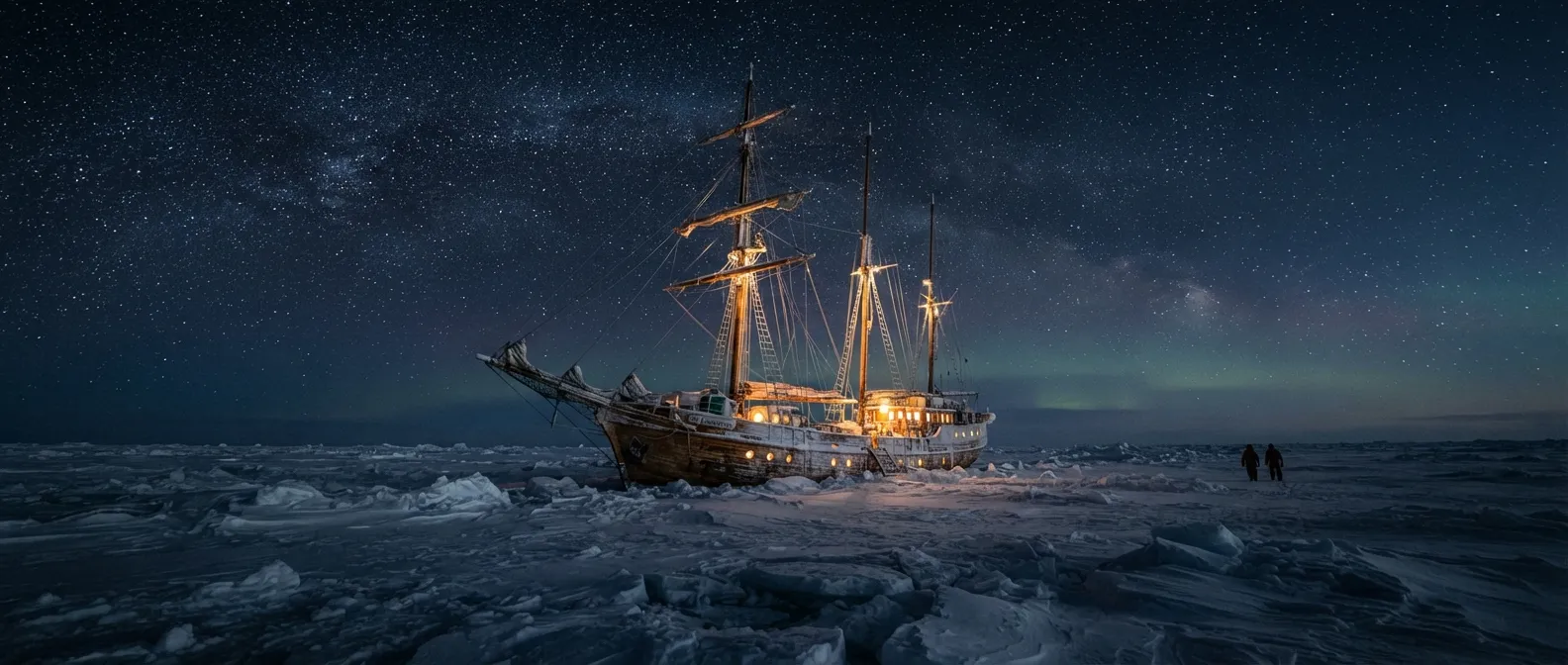
The Imperial Trans-Antarctic Expedition sets sail from Plymouth on August 8, 1914, with an unprecedented goal: cross Antarctica on foot, from ocean to ocean, passing through the South Pole. Ernest Shackleton commands the Endurance, a three-masted vessel built for the ice. On December 5, 1914, after a final stopover in South Georgia, the ship heads for the Weddell Sea. As early as December 7, it encounters its first pack ice. On January 18, 1915, at 76°34’ South, trapped in an ice pack that has grown too dense, the Endurance grinds to a halt. It will never sail again.
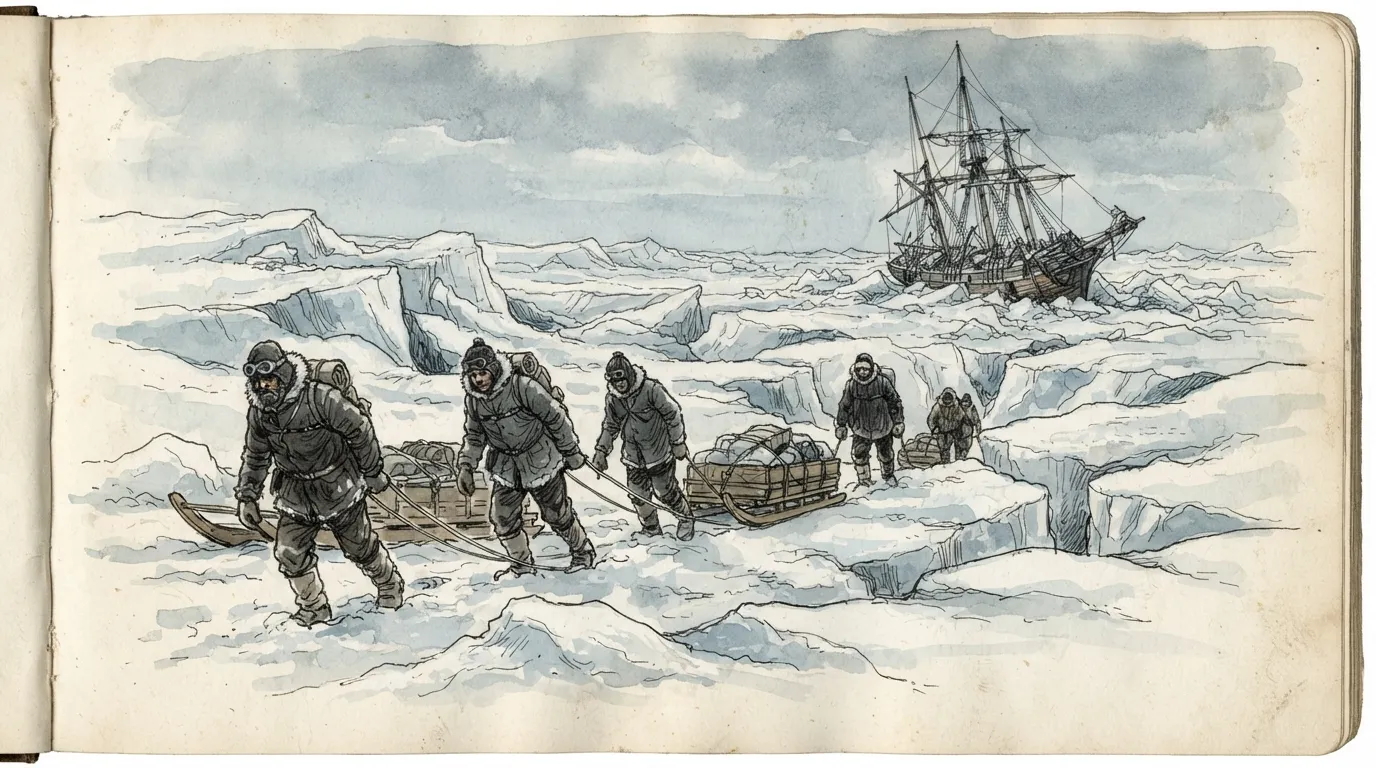
The ship drifts with the ice pack for nearly a year, hostage to the current, reaching a far southern point of 76°58’ South in late February 1915. The austral winter passes this way, completely immobilized. Starting in October, the pressure of the ice floes begins crushing the hull: water leaks in on October 24, and on October 27, 1915, in temperatures below -26 °C, Shackleton orders the evacuation. The men first camp on the ice a few meters from the boat — this is Ocean Camp, set up on November 1 after a failed attempt to march toward Paulet Island, deemed too exhausting over broken ice. The crushed Endurance takes another three weeks to disappear: she sinks beneath the ice pack on November 21, 1915.
Then begins an open-air drift lasting several months. On December 29, 1915, the crew sets up Patience Camp on a new ice floe and stays there for over three months, eating seal and penguin, waiting for the ice to finally break up close enough to land. On April 9, 1916, the floe under their feet finally cracks open: all 28 men board the three lifeboats salvaged from the ship — the James Caird, the Dudley Docker, and the Stancomb Wills — and row through ice and swells to Elephant Island, reaching it on April 15, 1916. For the first time in 497 days, they set foot on solid ground. But Elephant Island is on no shipping route: no one will ever come rescue them there by chance.
On April 24, 1916, Shackleton sets out for help with five men aboard the James Caird — Frank Worsley, Tom Crean, Harry McNish, Timothy McCarthy, and John Vincent — leaving Frank Wild in command of the other 22. Destination: South Georgia, 1,300 km away, the only inhabited land reachable before winter. The boat touches shore there on May 10, on the wrong side of the island: between them and the Stromness whaling station lies an uncrossed mountain range. Shackleton, Worsley, and Crean set off across it on foot on May 19 and reach Stromness the next morning, after 36 hours without sleep.
It remained to return for the 22 men on Elephant Island. Three ships fail against the pack ice between May and July. It is only on August 30, 1916, that the Yelcho, a Chilean tugboat commanded by Luis Pardo, finally cuts through the ice and retrieves the 22 survivors, starving but alive, after four and a half months of waiting under two capsized lifeboats. All 28 men who had left in 1914 made it back home.
What Shackleton did
The most critical decision Shackleton makes happens in an instant, when the hull snaps for good: abandon the expedition’s goal. Crossing Antarctica will not happen; the new goal, the only one that matters now, fits in one phrase he repeats to his men: bring everyone back alive. This immediate pivot, without prolonged grieving over the original plan, is what polar historians highlight as his hardest and wisest decision: clinging to a dead plan costs lives, changing it in time saves them.
On the ice, he refuses to exhaust his men for nothing. The first attempt to march toward Paulet Island in November 1915 covers only a few hundred meters a day across shattered ice pack, men and dogs hauling overburdened boats: Shackleton stops it after a few days rather than stubbornly pushing on, choosing instead to pitch camp and wait for the drift to do the work. A decision that goes against instinct — marching feels like taking action — but one that saves calories they cannot afford to waste.
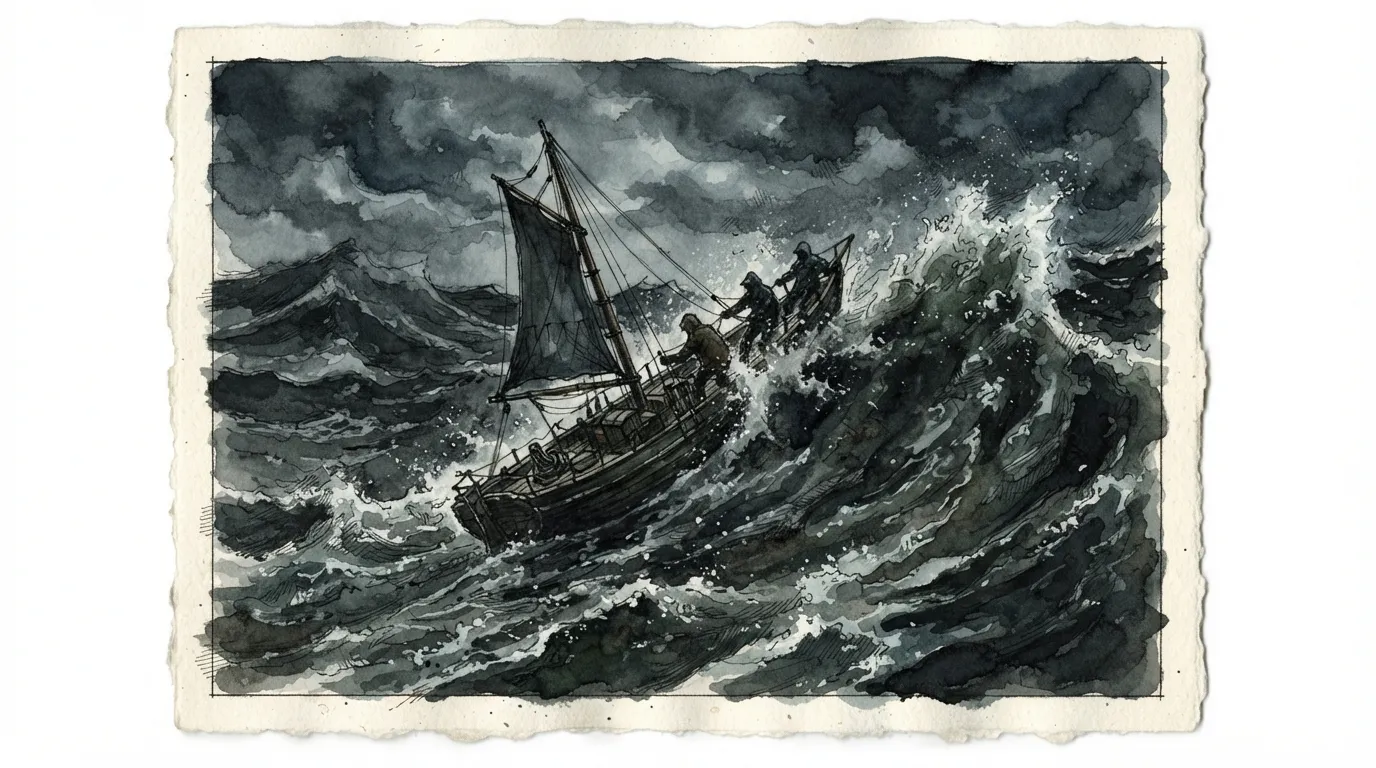
Once on Elephant Island, he takes a second gamble: setting off himself with five men on a 6.90-meter open boat, rather than awaiting hypothetical rescue on an island off all shipping lanes. Carpenter Harry McNish raises the sides of the James Caird, crafts a makeshift deck of wood and canvas sealed with paint, lamp wick, and seal blood, and lines the bottom of the hull with nearly a ton of stones as ballast to keep it from capsizing in heavy seas. Frank Worsley navigates by dead reckoning for most of the trip, as the storm allows him only three sextant sightings in seventeen days — after the third, he himself calls the rest of the navigation a pure gamble.
Arriving in South Georgia, Shackleton makes another radical call: cross an uncharted mountain range on foot rather than launching the battered boat back into the water to round a treacherous coastline. He takes only the two strongest men, Worsley and Crean, leaving the three weakest — McNish, Vincent, McCarthy — at the camp on the beach. A cold sorting, but a logical one: the trek allows no room for a man who breaks down along the way.
The heaviest burden fell to Frank Wild: keeping 22 men alive on a barren island, without knowing if Shackleton had even survived his ocean crossing. Wild enforces rotating shifts for hunting and cooking, refuses to let his storekeeper Orde-Lees hoard rations for a whole winter — a move he deems “defeatist” — and organizes a modest Saturday night celebration every week to break up the time that would otherwise crush them. On June 15, 1916, surgeons Macklin and McIlroy amputate young Perce Blackborow’s gangrenous toes without proper warmth, using what little chloroform remains: a 55-minute operation Wild had to supervise without knowing if it would ultimately save someone who might never be rescued anyway.
What saved them
Seamanship pushed to its absolute limit. Without Frank Worsley’s dead reckoning and Harry McNish’s modifications to the James Caird, neither alone would have sufficed: they had to hit a tiny dot in the middle of the South Atlantic while keeping the vessel afloat in mountain-high waves. Everything regarding reading sea conditions and handling small craft in gale-force weather is covered in the sea guide.
Cold management that left zero room for improvisation. Layered wool clothing, seal blubber used as fuel and light, keeping the body moving rather than remaining static: every action helped slow heat loss in an environment where immobility kills faster than starvation. The winter guide details these mechanisms.
Rationed food shared with strict equality. Seal, penguin, and hoosh — a thick stew of meat, fat, and sledging biscuits — replaced ship rations for over a year. Officers and seamen ate the exact same food in the exact same amounts: no dining hierarchy to fracture the group when things got worst. The food guide explains how to calculate and allocate survival rations.
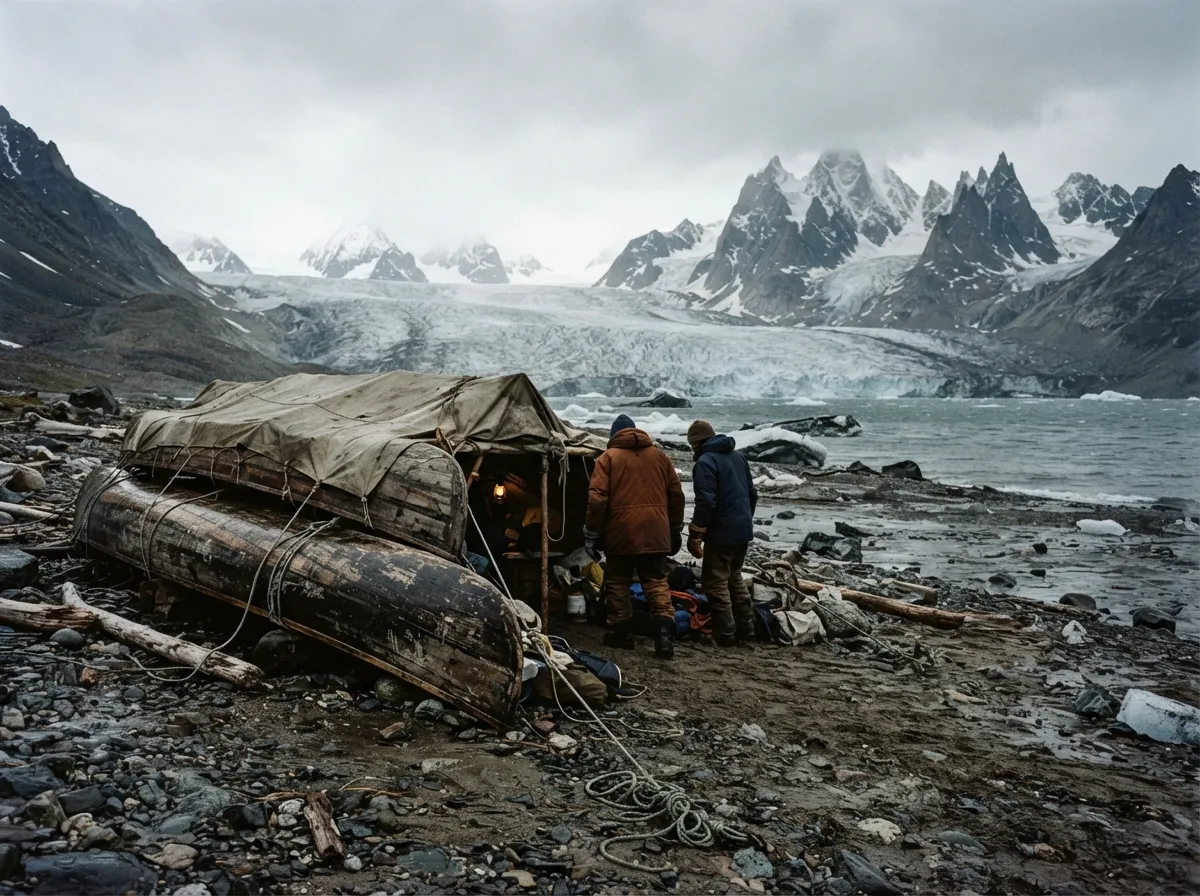
A routine that replaced vague hope with concrete structure. Rotating chores, organized hunting parties, lookout watches, small Saturday celebrations: Frank Wild structured days that would otherwise have lost all meaning. The mental guide explores what prolonged waiting does to a group and what makes it bearable.
Calculated resolve during the South Georgia crossing. Three men, lacking a reliable map, chose a route across peaks no human had ever crossed, betting on one absolute truth: staying still at night, at that altitude and in that state of exhaustion, meant death far more surely than continuing to push forward. The mountain guide explains why movement in cold mountain terrain is sometimes the safest option.
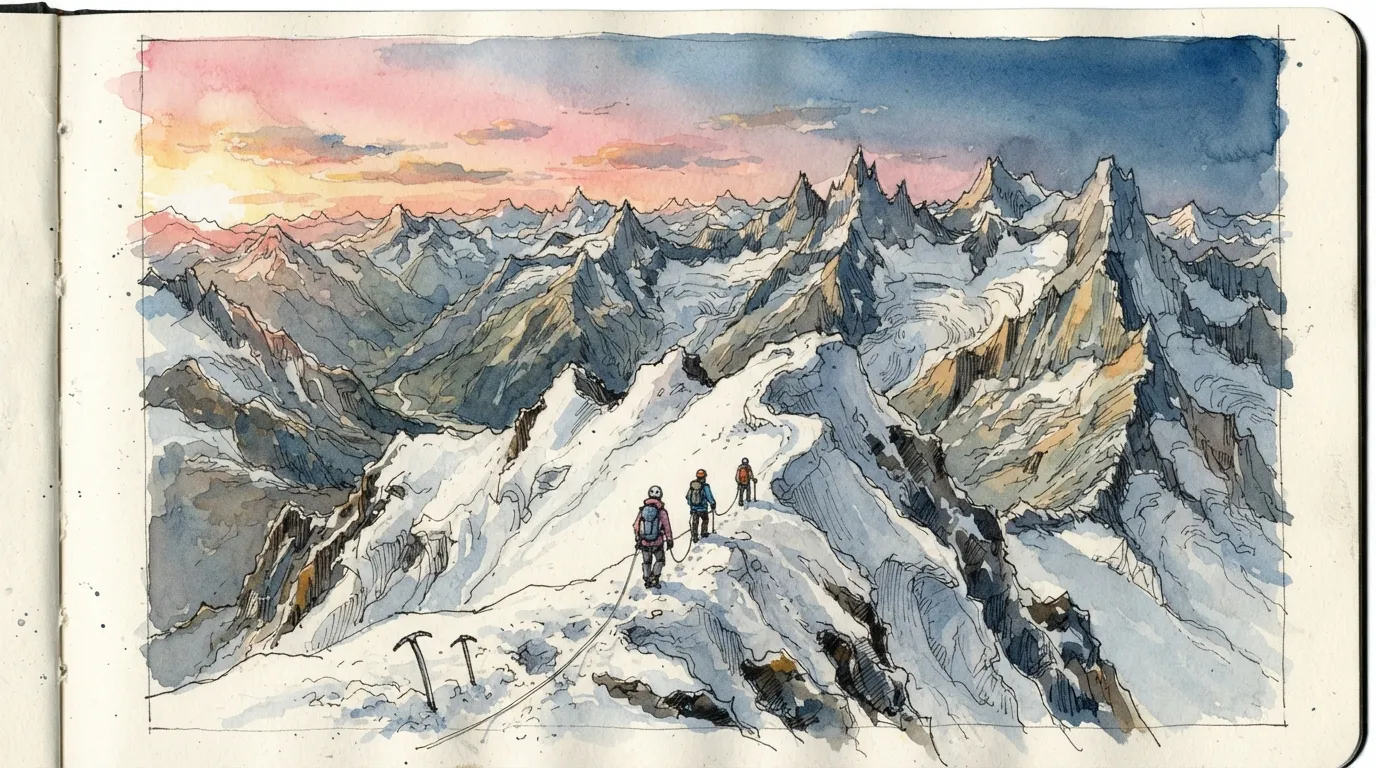
What we learn from it
1. Redefine your goal as soon as it becomes dangerous to pursue, not after. On a trail, this translates very practical: reaching the summit isn’t the goal, coming back safely is. Shackleton never tried to save the expedition once the hull was crushed; he pivoted the mission within the hour. A hiker seeing weather turn or night fall too fast gains everything by doing the same: giving up a plan isn’t failure when the new plan is staying alive.
2. Structure your days of waiting, no matter how small. Scheduled meals, a specific chore, a ritual — even a minor one — shatter the feeling of crushing time that drains morale faster than cold or hunger. If you are stranded somewhere waiting for rescue, build yourself a routine instead of staring blankly at the horizon.
3. Share resources equally within a group, especially under pressure. This isn’t a sentimental gesture: it is what keeps a group from fracturing right when unity matters most. A trip leader holding responsibility over a small group shares the same duty Shackleton had with his 28 men: nobody eats better just because they hold a different title.
Frequently asked questions
How did all 28 men of the Endurance expedition survive?
By changing their primary objective as soon as the ship was lost: Shackleton abandoned the Antarctic crossing to focus exclusively on bringing every single man home alive. Months drifting on pack ice, a 1,300 km open boat journey, and a mountain trek across South Georgia eventually allowed them to raise the alarm, though it took four attempts for rescue ships to break through to Elephant Island.
What happened to the ship Endurance?
Trapped in the Weddell Sea pack ice in January 1915, the Endurance drifted for ten months before being crushed by ice pressure. The crew abandoned her on October 27, 1915, and the ship finally sank beneath the ice on November 21. Her wreck was discovered at a depth of nearly 3,000 meters in 2022, more than a century later.
Who was Frank Wild?
Shackleton’s second-in-command, left in charge of the 22 men on Elephant Island during the four and a half months it took to secure rescue. He managed hunting, daily chores, and crew morale beneath a shelter built from two capsized lifeboats, never knowing if Shackleton had survived his boat voyage.
Is the voyage of the James Caird really one of the greatest small-boat journeys ever completed?
Yes: 1,300 km in seventeen days aboard a hastily modified 6.90-meter lifeboat, through some of the roughest seas in the Southern Ocean, without support or communication tools. It remains a legendary case study in maritime navigation schools for its demonstration of dead-reckoning accuracy under extreme stress.
Did Shackleton really post an ad stating “Men wanted for hazardous journey”?
There is no proof he did. No copy of this famous classified ad, supposedly warning applicants of low pay, bitter cold, and doubtful safe return, has ever been found in contemporary newspapers despite extensive research. Polar historians currently regard it as a post-factum myth.
Going further
- Alfred Lansing, Endurance: Shackleton’s Incredible Voyage (1959) — the definitive account, written after interviewing several expedition survivors.
- Caroline Alexander, The Endurance: Shackleton’s Legendary Antarctic Expedition (1998) — built around Frank Hurley’s original expedition photographs.
- South (1919), the original documentary film shot on location by Frank Hurley, showing footage of the Endurance trapped in the ice.
- Shackleton (2002), feature film starring Kenneth Branagh, featuring a highly accurate historical recreation of the James Caird crossing.
Key takeaways
- When an objective becomes impossible without risking lives, changing it isn’t failure: it’s the decision that saves you.
- A strict routine — daily chores, hunting shifts, minor rituals — holds a group together far better than vague hope.
- Sharing resources equally, from leader to lowest deckhand, stops a team from breaking apart under extreme pressure.
- Dead reckoning navigation without reliable instruments remains possible with practice — but leaves a margin of error you must account for.
- An adventurer’s legend isn’t always verifiable: Shackleton’s famous recruitment ad has never actually been found.
Sources for this module (8)
- Wikipedia (EN) — Imperial Trans-Antarctic Expedition
- Wikipédia (FR) — Ernest Shackleton
- Wikipedia (EN) — Ernest Shackleton
- Wikipedia (EN) — James Caird (ship)
- Wikipedia (EN) — Frank Wild
- Wikipedia (EN) — Elephant Island
- Alfred Lansing, Endurance: Shackleton's Incredible Voyage (1959)
- Caroline Alexander, The Endurance: Shackleton's Legendary Antarctic Expedition (1998)
Continue in "Survivor stories"
Aron Ralston: 127 hours trapped in a canyon
An arm trapped under a boulder, five days without rescue, and a decision no manual teaches: cutting oneself to live.
Juliane Koepcke: 11 Days Alone in the Jungle After the Crash
Seventeen years old, alone after falling three kilometers into the Amazon jungle, she followed a single rule: walk toward water.
Steven Callahan: 76 days adrift on a raft
A crash in the night, a sailboat sinking in a matter of minutes, and 76 days on a tiny raft reinventing survival.