Blizzard and whiteout: when you can no longer see your feet
White swallows the horizon, ground merges with sky, and you no longer know if you're walking straight: what you need to know before it happens to you.
It’s 2:00 PM, the ridge was still visible ten minutes ago. Now the sky and the snow have merged into a single white mass, you can’t even see your own skis, and a wave of vertigo hits your stomach while you stand perfectly still. It’s not the snow that puts you in danger. It’s what the complete lack of visual landmarks does to your brain, while the wind keeps stealing your body heat.
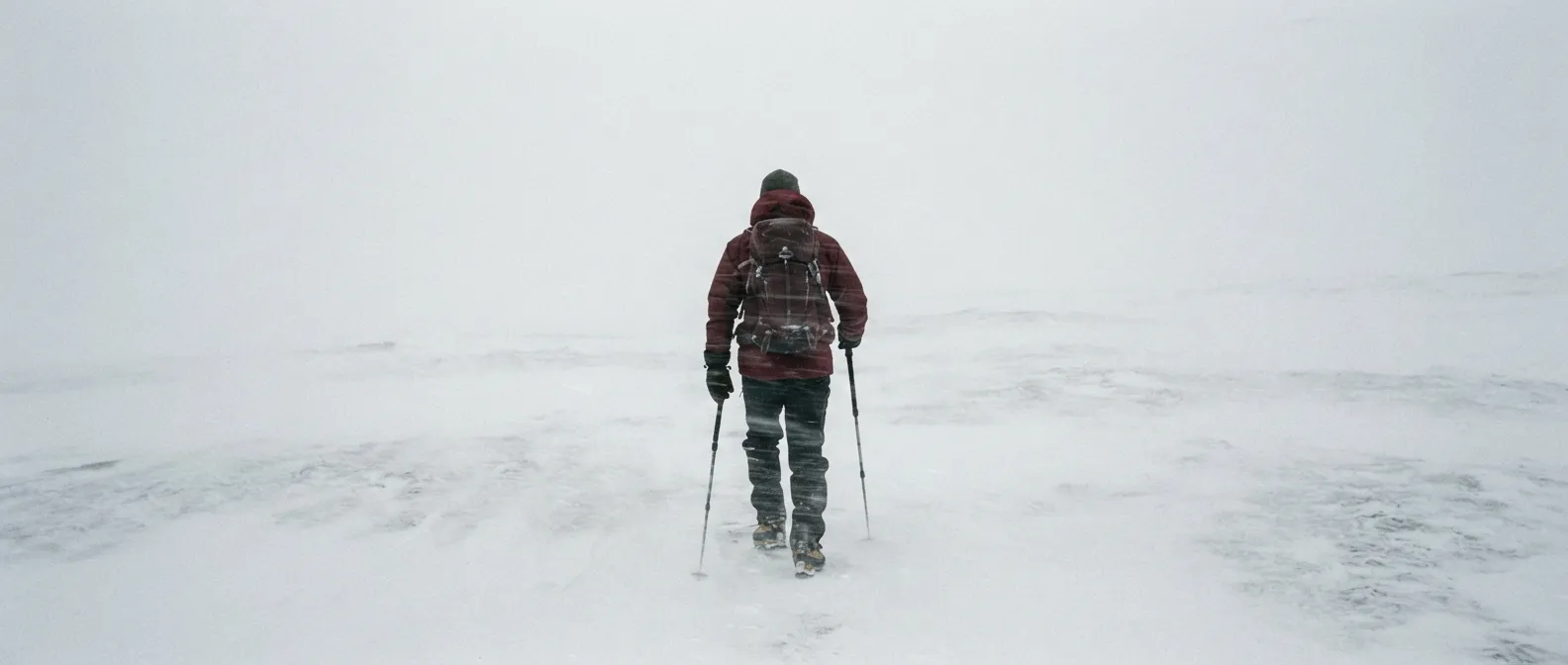
Whiteout: what it actually does to your head
Technically, a blizzard is snow blowing hard enough and long enough to collapse visibility: the US National Weather Service defines it as winds of at least 60 km/h with visibility below 500 meters for over three hours; Environment Canada uses a wind chill equivalent of −20 °C, visibility below 400 meters, for four hours. The snow doesn’t even need to be falling: a ground blizzard (blowing snow), which happens when strong winds pick up snow already on the ground under a sometimes clear sky, creates the exact same effect. It catches people off guard even more because the morning weather forecast didn’t mention it.
A whiteout is what a blizzard does to your perception: light scatters in all directions at once, casting no shadows and leaving zero contrast between the snow on the ground and the overcast sky. Your vestibular system, which manages balance, constantly relies on visual cues to figure out which way is up. Without them, it improvise—causing vertigo, nausea, and the very real feeling that you can no longer tell if the ground under your feet slopes up or down. Pilots have crashed in this exact state: the crash of Air New Zealand Flight 901 into Mount Erebus in Antarctica was partly caused by a whiteout that erased the relief the crew thought they were seeing.
The site’s Navigation module explains why humans walk in circles without visual cues—the same disorientation mechanics apply here, but worse, because a whiteout strips away the entire scene instantly rather than just a single landmark.
Stop or keep moving: the rule that decides for you
The killer question in a blizzard isn’t “where is the shelter?” but “should I keep looking for it?”. Two red lines, established before setting out, must decide for you—because in the middle of a storm, your judgment is already deteriorating:
- Before nightfall. Searching for a trail in a whiteout at night stacks one sensory deficit on top of another: you lose both your sight and the last faint contrast nuances that daytime, even a grey one, still offered.
- Before exhaustion. A tired body shivers less efficiently, thinks slower, and makes worse decisions—the spiral that killed Scott eighteen kilometers from his supply depot (see below) started right there.
- Stop as soon as visibility drops below thirty meters or so and check your watch: this is your decision deadline, not the summit time.
- Assess the distance you have left to travel with certainty—not by guess—to a known shelter.
- Compare it to your remaining daylight, energy, and the condition of your group members.
- If any of the three is lacking, take shelter right where you are. A botched bivouac is always better than an unseen cliff fall.
Shelter fast: dig rather than search
An improvised shelter built in fifteen to thirty minutes always beats twenty more minutes searching for a shelter that never shows up. In order of speed:
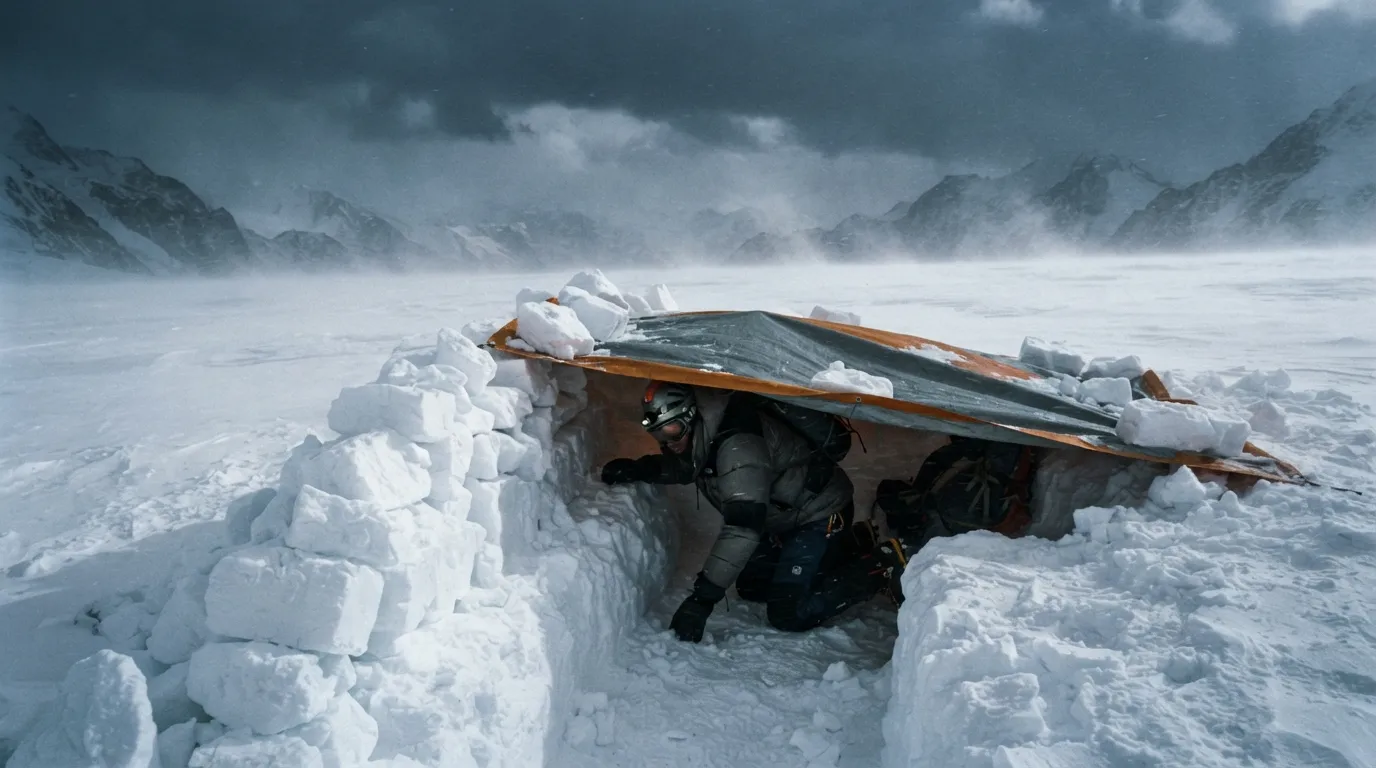
- The snow trench: the fastest option. Dig a ditch as deep as your shoulders and as long as your body, perpendicular to the prevailing wind. Cover it with skis, poles, and a tarp or bivy sack weighed down with snow along the edges. It blocks the worst of the wind after just a few minutes of shoveling.
- The snow wall: when the ground is too hard or too shallow to dig, stack blocks of compacted snow in an arc facing the wind. Less effective than a trench, but built in ten minutes with a folding shovel.
- Behind a boulder, bank, or treeline: the fastest retreat of all when the terrain offers one. Huddle on the leeward side, as low as possible—wind slows down near the ground.
- Your car: if you have one, it’s the safest shelter available (details below).
Cold and wind: what kills you fastest
A blizzard combines two compounding dangers: air temperature, and wind that speeds up your heat loss by stripping away the thin layer of warm air trapping next to your skin. This is wind chill, an index developed before World War II by Paul Siple and Charles Passel, who timed how fast water bottles froze when exposed to Antarctic winds. It doesn’t measure actual air temperature—a pipe won’t freeze faster just because it’s windy—but skin sensation, providing a reliable way to predict how quickly frostbite sets in.
The full table, broken down by degree and wind speed with frostbite onset times for each level, can be found in the site’s Cold comparator—it’s the reference to review before any winter trip, not something to memorize.
Roping up together
In a whiteout, group members who drift apart by just a few meters can lose sight of each other permanently—the winter equivalent of what happens in caving or diving when you lose physical contact. Roping up isn’t just for crevasse-ridden glaciers: tying together—or using a strap, spare rope, or even a tight cord stretched between everyone—ensures no one wanders off unnoticed. Put a child or the most exhausted team member in the middle, never at the front or rear.
Navigating blind: bearings and pacing
When no landmarks stick out of the white, your compass becomes the only tool that won’t lie to you—the Navigation module covers the complete technique for walking on a bearing; here is the essential version for blizzards:
- Take a bearing on your map before setting out, or at the last second a landmark was still visible: get a precise heading in degrees toward your goal.
- Sight a point a few meters ahead of you along the compass line—your own trekking pole stuck in the snow works if nothing else is visible in the white.
- Walk to that point, then repeat. In a pair, one person navigates with the compass while the other walks ahead as a mobile landmark, adjusting direction as called out.
- Count your steps at the same time: once calibrated on flat ground, about a hundred double-steps equal roughly one hundred meters for an adult. This is your only way to estimate distance traveled when nothing else can tell you.
GPS and phones in extreme cold
Cold weather doesn’t erase your phone or GPS data—it drains its battery. Lithium-ion batteries handle discharge poorly below 0 °C, and charging a cold device causes metallic lithium to plate onto the negative electrode—damaging the battery permanently and, in extreme cases, compromising its safety. The practical reality: a device showing 40% charge indoors can shut off in ten minutes outside, then boot back up with a more accurate percentage once warmed against your body.
| Against skin | Outer pocket | Backpack | Left on continuously | |
|---|---|---|---|---|
| Battery life | Best | Moderate | Poor | Plummets fast |
| Quick access | ✅ | ✅ | ❌ | ✅ |
| Breakage risk (fall) | Low | Medium | Low | Low |
| Recommended in a blizzard | ✅ | As backup | ❌ | ❌ (airplane mode + periodic checks) |
Real cases: what blizzards have done to experienced people
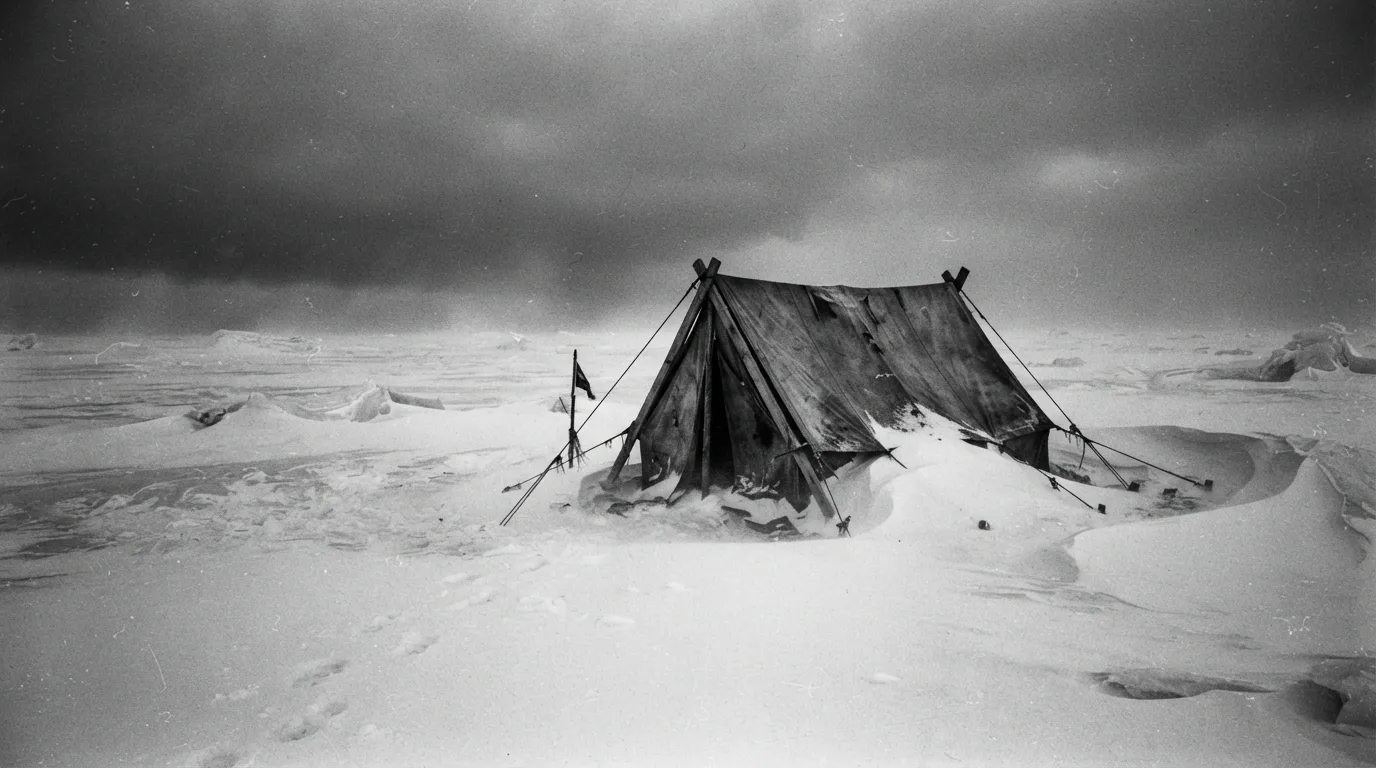
Robert Falcon Scott, Antarctica, 1912. Returning from the South Pole, Scott and his final two companions were trapped by an unusually violent blizzard just eighteen kilometers from their supply depot, One Ton Depot. “We have been held up here since the 20th by a continuous gale; no progress possible,” he wrote in his diary. They never made it out of the tent. Eighteen kilometers—a short morning’s walk in good weather—was enough to end their lives.
Mount Everest, May 10–11, 1996. A storm caught several expeditions descending from the summit. Winds exceeded 20 m/s, temperatures dropped near −30 °C, and the wind chill reached roughly −51 °C—cold enough to freeze exposed skin in two to five minutes—while “blowing snow reduced visibility to a few meters and severely impaired hearing and communication.” Eight people died that night. Beck Weathers, left for dead in the snow, regained consciousness hours later and stumbled back to camp on his own—losing his nose and right hand, but surviving.
Vincendon and Henry, Mont Blanc, December 1956. Two young climbers were caught in a severe storm near the summit, with temperatures plummeting to −35 °C and a whiteout that Italian climber Walter Bonatti, who was on the mountain, described as a “labyrinth” of featureless seracs. Miscoordinated rescue efforts deployed an unsuitable helicopter that crashed during the attempt; both men perished, and their bodies were not recovered until the following March. This tragedy led directly to the creation of the High Mountain Gendarmerie Platoon in 1958—the French PGHM, which now carries out over 40,000 rescues a year.
The Great Plains and the Rockies. Ground blizzards—loose snow picked up by high winds, sometimes under blue skies—primarily strike flat, open terrain: the North American Great Plains, Canadian Prairies, and the Rocky Mountain foothills. They catch people off guard far more than classic storms: no new snowfall is needed, just wind moving what’s already on the ground. A clear morning sky guarantees nothing.
Blizzards in a car
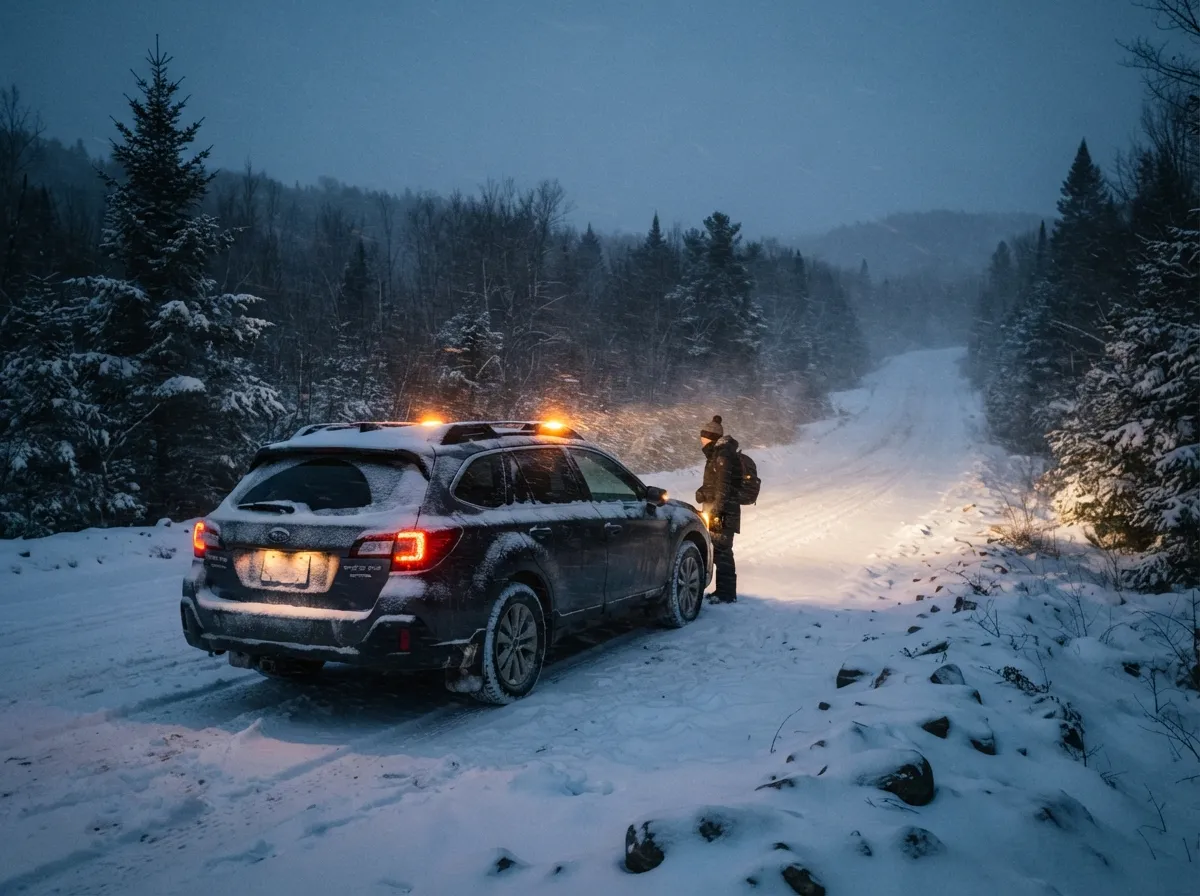
Statistically, a car is one of the safest places to be during a blizzard—it’s visible, insulated, and provides shelter. Stick to three simple rules:
- Stay with the vehicle. A snowed-in car is a fixed target rescuers can spot; a pedestrian walking out into a whiteout becomes a needle in a blinding white haystack.
- Clear the tailpipe before running the engine, and crack a window open on the leeward side. Odorless carbon monoxide builds up quickly inside an enclosed cabin if snow blocks the exhaust or seals off gaps—the same silent hazard that killed tent campers in the US during the 1990s claims stranded drivers too.
- Run the engine intermittently, for a few minutes every hour rather than non-stop: this conserves fuel for the hours or days you might be waiting, and reduces the risk of gas accumulation.
Sled dogs: the best compass in a blizzard
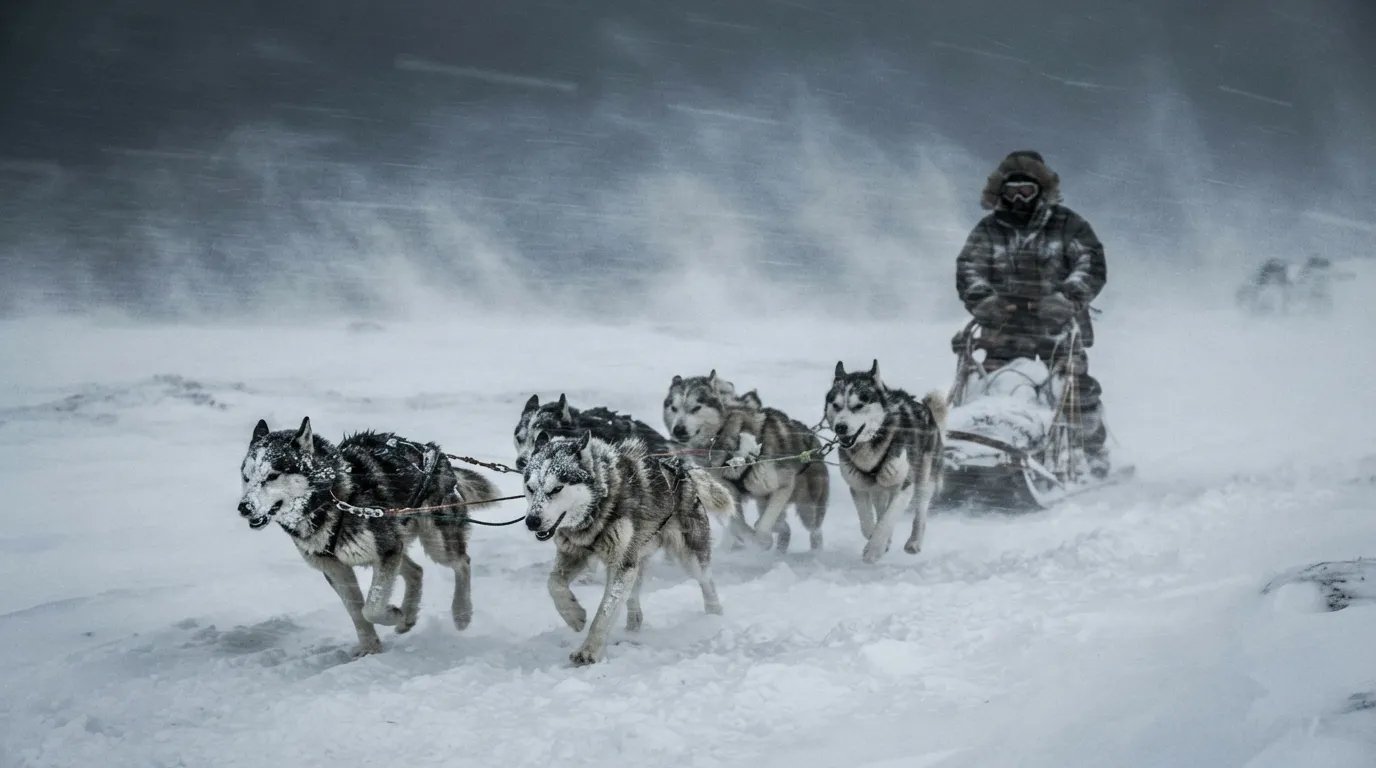
When a resting sled dog gets caught in a storm, it curls into a tight ball and tucks its nose beneath its bushy tail—a natural reflex protecting the areas most vulnerable to frostbite, reinforced by a dense double coat and specialized leg circulation that prevents tissue freezing. But on the trail, a lead dog becomes irreplaceable: during the 1925 Nome serum run in Alaska, several mushing teams pushed through a blizzard where the wind chill hit −65 °C and drivers couldn’t even see the dogs closest to the sled. Togo, Leonhard Seppala’s lead dog, “guided the team in a straight line through total darkness” across the treacherous ice of Norton Sound; Balto led Gunnar Kaasen’s team through deep drifts along a trail completely invisible to human eyes. The relay covered 674 miles in record time, successfully delivering the diphtheria antitoxin.
Reading the snow like Inuits and Sami
When a whiteout erases everything at eye level, indigenous peoples of the Far North look down at the ground. Wind blowing consistently from a dominant direction sculpts the snow into hard, asymmetrical ridges called sastrugi: one side features a smooth, windward slope, while the other drops off sharply, like a tiny pointing anvil. This pattern forms through a two-step process—wind first deposits snow in dune-like drifts, then carves them back out after the snow hardens through sublimation.
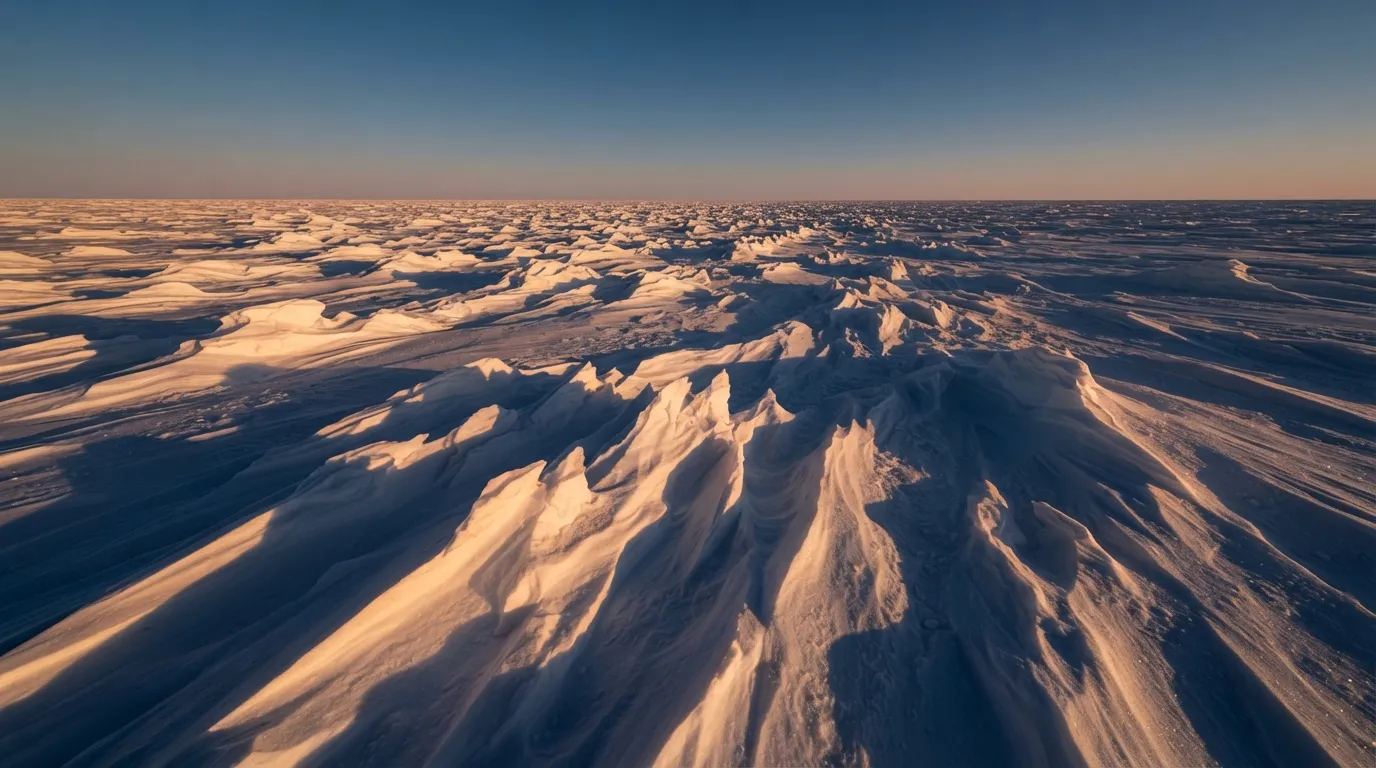
Canadian Inuits use distinct terms for different stages of wind-sculpted snow—kalutoqaniq for freshly redeposited snow, kaioqlaq for large, hardened formations, and tumarinyiq for small surface ripples—a taxonomy that doesn’t exist in European languages because no other culture depended on it so critically for survival. Once you know the prevailing wind direction of an area, aligned sastrugi serve as a natural compass that requires no batteries and works even in partial whiteouts right at ground level, where you can still see a few feet ahead even if the horizon has vanished.
Frequently asked questions
What should you do if caught in a whiteout in the mountains?
Stop moving immediately rather than pressing on blindly: vertigo and loss of balance come from the missing horizon, not an immediate external threat. Probe the ground ahead with a pole before taking steps if cornices or crevasses are a risk, and build a shelter (snow trench, snow wall) instead of searching for a refuge you can no longer see.
Why do people walk in circles when they can’t see?
Without external visual reference points to adjust your path, tiny natural biomechanical variations in your stride accumulate instead of canceling out. A study by the Max Planck Institute showed blindfolded volunteers walking in loops under twenty meters wide within minutes, all while convinced they were traveling in a straight line. Only a compass, tracked continuously, prevents this drift.
Should you stay inside your car during a blizzard?
Yes: a vehicle provides insulated shelter, is easy for rescue teams to spot, and serves as a fixed landmark that is far easier to locate than a lost pedestrian. However, check regularly that the tailpipe remains clear of snow before running the engine to prevent carbon monoxide poisoning.
How do you navigate without GPS during a blizzard?
A magnetic compass remains reliable when vision fails: take a bearing before losing all landmarks, sight a close intermediate target (a planted pole or a teammate stepping ahead), and count your paces to estimate distance traveled. Cold weather quickly drains phone and GPS batteries, making a paper record of your bearing essential.
How long can you survive in an improvised snow trench?
Built and covered correctly, a snow trench blocks most of the wind and can keep you safe for hours while waiting out a storm or awaiting rescue—more than enough to prevent the hypothermia that sets in quickly in exposed, high-wind conditions. It isn’t comfortable, but it works as a short-term survival solution.
Can sastrugi really be used for navigation?
Yes, in open areas where the wind blows consistently from a prevailing direction: hardened snow ridges align predictably, offering a clear ground-level reference when the horizon disappears. Always cross-check them with a compass rather than relying on them exclusively, as local terrain features can alter wind flow and mess up the pattern.
Summary
- A whiteout isn’t a problem of visual distance: it’s a balance issue—without a horizon, your body loses track of which way is up.
- Two clear rules make the call for you: stop before nightfall, stop before exhaustion—never after.
- A snow trench or wind wall built in twenty minutes beats a blind search for a shelter you might never find.
- A compass, bearing, and pace count stay reliable when sight and electronics fail; write your headings down on paper.
- Eighteen kilometers was enough to kill Scott’s team. Distance won’t protect you from a blizzard determined to hold its ground.
Going further
- Robert Falcon Scott, Scott’s Last Expedition—the original public domain journal containing the historical quotes featured in this module.
- Jon Krakauer, Into Thin Air (1997)—a detailed eyewitness account of the May 1996 Mount Everest storm.
- Walter Bonatti, The Mountains of My Life—an account of the Vincendon and Henry tragedy by one of the four climbers present on the mountain.
- Cold Water Boot Camp and the site’s Navigation module for a deep dive into sensory disorientation mechanics.
Sources for this module (14)
- Wikipédia (FR) — Blizzard (météorologie)
- Wikipedia (EN) — Whiteout (weather)
- Wikipedia (EN) — Ground blizzard
- Wikipédia (FR) — Expédition Terra Nova (Robert Falcon Scott)
- Wikipedia (EN) — 1996 Mount Everest disaster
- Wikipédia (FR) — Affaire Vincendon et Henry (Mont Blanc, 1956-1957)
- Wikipédia (FR) — Peloton de gendarmerie de haute montagne
- Wikipedia (EN) — Sastrugi
- Wikipedia (EN) — Wind chill
- Wikipedia (EN) — Dead reckoning
- Wikipedia (EN) — Lithium-ion battery (comportement à froid)
- Wikipedia (EN) — Sled dog
- Wikipedia (EN) — 1925 serum run to Nome
- CDC MMWR — Carbon Monoxide Poisoning Deaths Associated with Camping, Georgia 1999
Continue in "Critical situations"
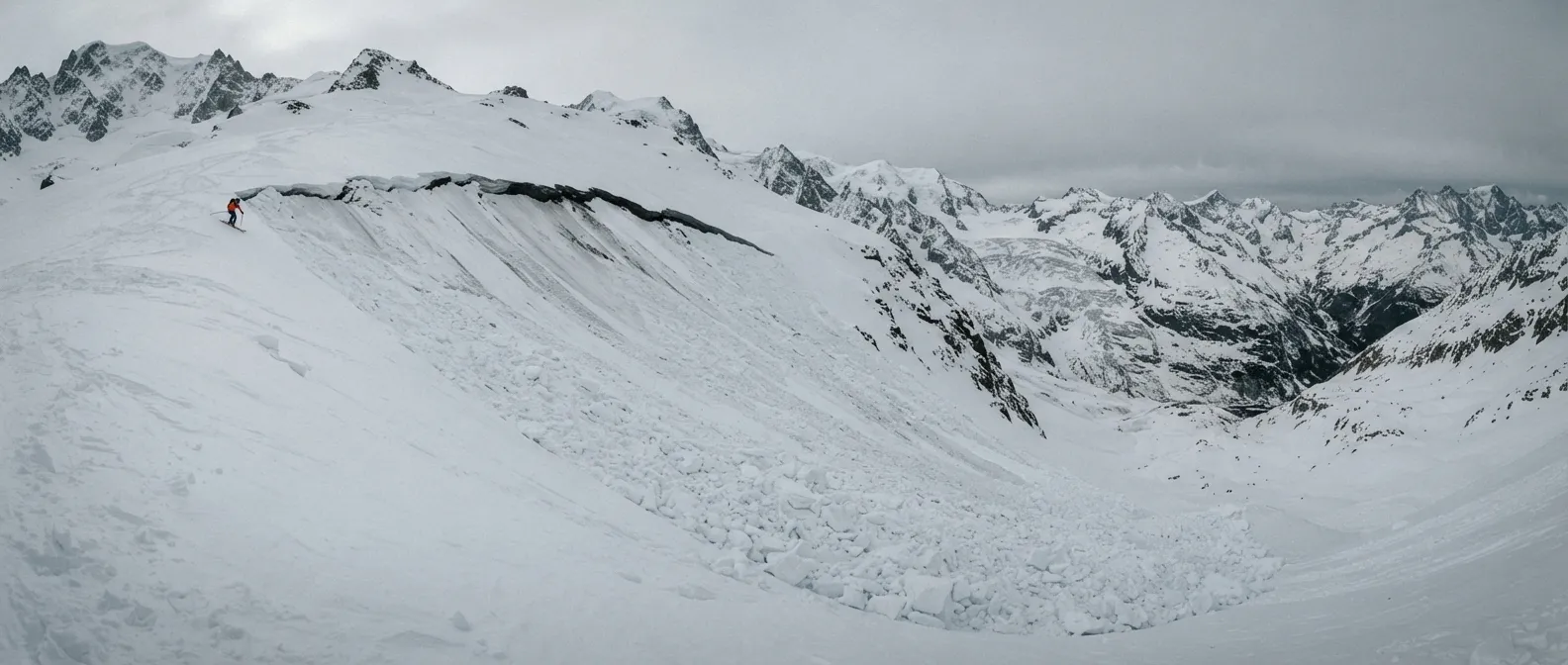
Avalanche: the 15 minutes that decide
A slab breaks loose under your skis, you have fifteen minutes before the stats turn against you: what you need to know instinctively, the night before heading out.
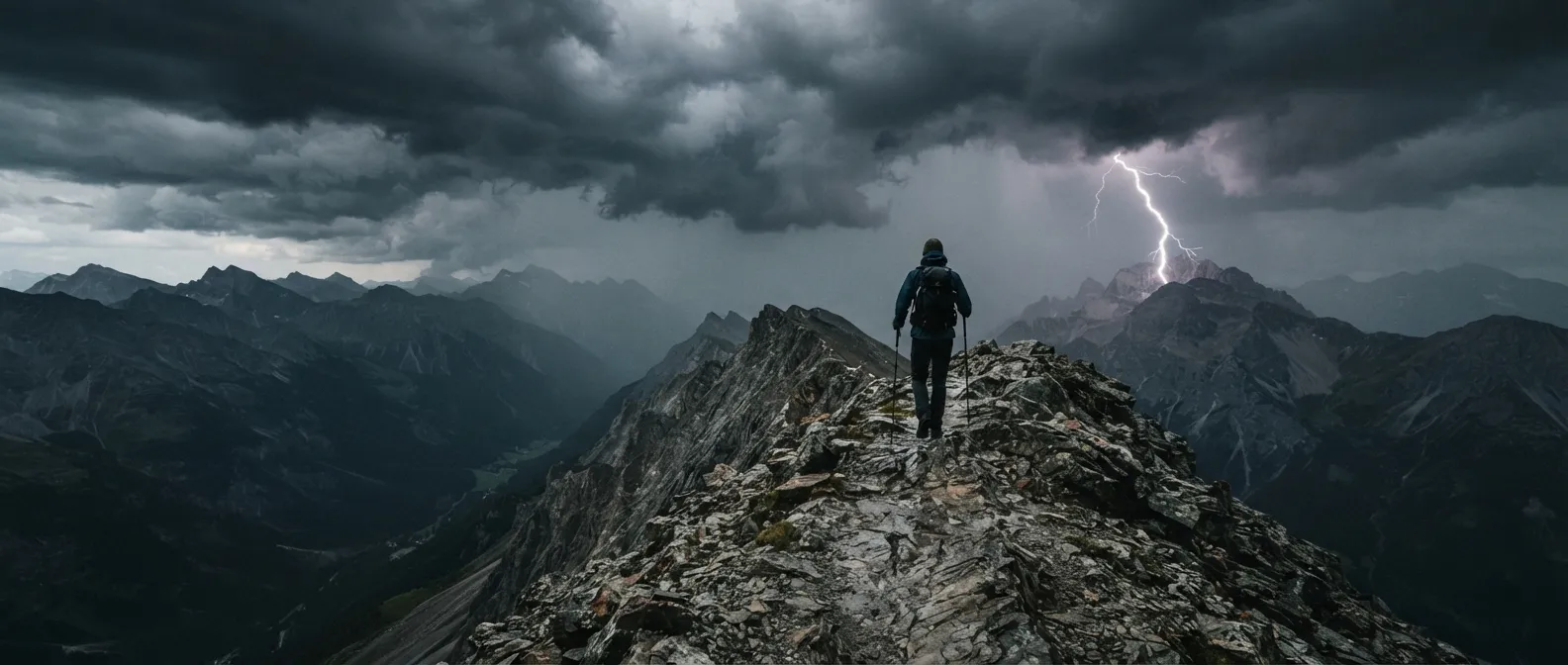
Lightning: When the Sky Targets You
In 3 seconds, a lightning bolt heats the air to 30,000 kelvins and kills 10% of those it strikes: here is what is at stake before you count to thirty.
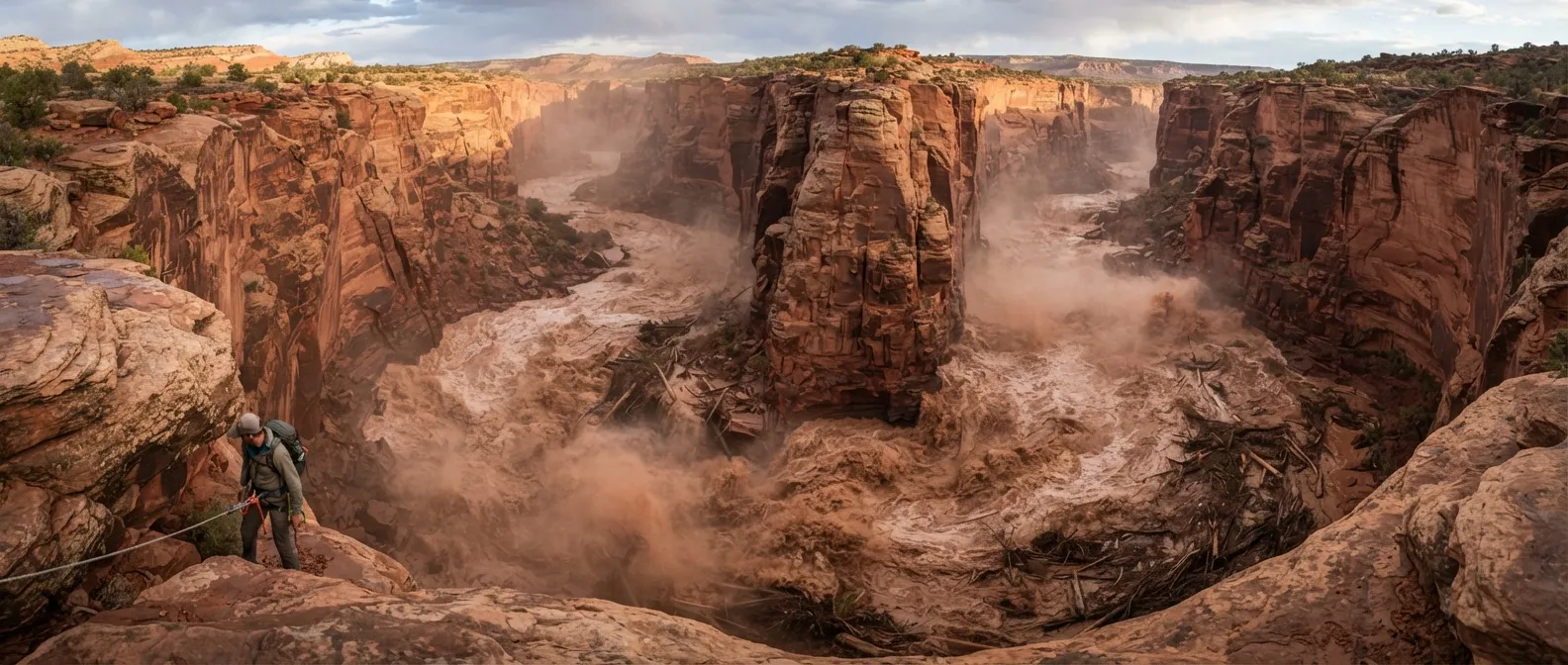
Flash Flood: Water Arriving Faster Than You
It isn't raining where you are, the creek has been dry all morning, yet you have less time than you think before a wall of water rushes down the valley.